
Use 304 stainless for indoor fixtures, kitchen equipment, and general hardware where moisture is occasional and chlorides are rare. Switch to 316 anywhere salt air, pool chemicals, or de-icing salts touch the metal, because its added molybdenum pushes pitting resistance from roughly 18–22 up to 23–30 on the PRE scale. Expect to pay 20-40% more for 316. If the part sits in seawater full-time, neither grade is enough. That job belongs to duplex or super duplex alloys.
TL;DR:
- 316 stainless steel costs about 20-40% more than 304 and is necessary only in environments with constant salt exposure, such as seawater or aggressive chemicals.
- Both grades have similar strength and machinability, but 316 offers superior corrosion resistance due to its 2-3% molybdenum content, especially in chloride-rich environments.
- For indoor, dry, and low-chloride conditions, 304 performs indefinitely and remains the most cost-effective choice.
- Welding 316 or 304 requires specifying their low-carbon versions to prevent sensitization and corrosion at heat-affected zones.
- When in doubt, professional testing methods like PMI or XRF analysis provide the most accurate identification of stainless steel grade.
Table of Contents
- 304 vs 316 Stainless: A Quick Spec Comparison
- Chemical Composition and Why Molybdenum Matters
- Where Does 304 Fail and 316 Hold Up?
- Mechanical Properties and Machinability
- Welding Guidance and When to Specify 'L' Grades
- Cost, Availability, and Long-Term Value
- How To Choose Between 304 and 316 for Your Project
- How Can You Tell If a Part Is 304 or 316?
- Maintenance and Real-World Use Cases
- What Years of Fastener Replacements Taught Us About Grade Selection
- Restoring a Pool Cage? Skip the Guesswork on Fasteners
- Sources
- FAQ
304 vs 316 Stainless: A Quick Spec Comparison
Before the metallurgy, here's the shorthand version buyers actually need at the hardware counter or the CAD screen.
304 stainless runs 18-20% chromium, 8-10.5% nickel, and no intentional molybdenum. Its PRE lands around 18-22.
316 stainless carries a similar 16-18% chromium and 10-14% nickel, but adds 2-3% molybdenum, lifting PRE to roughly 23-30, according to Makerstage's corrosion comparison.
That gap explains the "best for" split you'll see repeated across every spec sheet and supplier catalog:
- Kitchen equipment, appliance trim, indoor railings: 304 handles it without issue.
- Architectural facades in dry or moderate climates: 304 usually holds up for decades.
- Marine hardware, coastal railings, boat fittings: 316 is the baseline, not the upgrade.
- Medical instruments and implants: 316L (the low-carbon version) is the industry default.
- Pool enclosures, screen fasteners, deck hardware near chlorinated water: 316 resists the pitting that eats through 304 in a handful of seasons.
Budget-wise, expect the 316 version of a given part to run 20-40% higher in raw material cost, before any machining or fabrication markup.
Chemical Composition and Why Molybdenum Matters
The difference between these two alloys comes down to one element: molybdenum. 304 has none.
Here's how the full recipe compares:
| Element | 304 stainless | 316 stainless |
|---|---|---|
| Chromium | 18-20% | 16-18% |
| Nickel | 8-10.5% | 10-14% |
| Molybdenum | None | 2-3% |
| Carbon (standard) | ≤0.03% | ≤0.03% |
| Carbon ('L' grade) | ≤0.03% | ≤0.03% |
Engineers quantify chloride resistance with the Pitting Resistance Equivalent, a formula that weights chromium, molybdenum, and nitrogen: PRE = %Cr + 3.3(%Mo) + 16(%N). Run the numbers on a typical 304 sample and you land near 19. Run the same formula on 316 and the molybdenum term alone adds 6 to 10 points, pushing the total into the low-to-mid 20s or higher.
Molybdenum works by stabilizing the passive chromium oxide film that gives stainless its corrosion resistance in the first place. When chloride ions attack that film and create a microscopic pit, molybdenum helps the surface re-passivate faster, according to thyssenkrupp Materials. Without it, 304's film heals more slowly under sustained chloride exposure, and pitting compounds over time.
Where Does 304 Fail and 316 Hold Up?
Environment decides this comparison more than any other factor. Here's how the two grades map to real conditions:
- Indoor, dry, low-humidity settings: 304 performs indefinitely.
- Fresh water, occasional rain exposure: 304 is typically fine.
- Coastal air or salt spray: 316 is the safer default; 304 pits within a few years in direct spray zones.
- Chlorine-based cleaners or CIP (clean-in-place) food processing lines: 316 resists the repeated chemical exposure that degrades 304's surface.
- Bodily fluids and sterilization cycles: 316L is standard in surgical and medical-grade equipment.
- Continuous seawater immersion: neither grade is adequate.
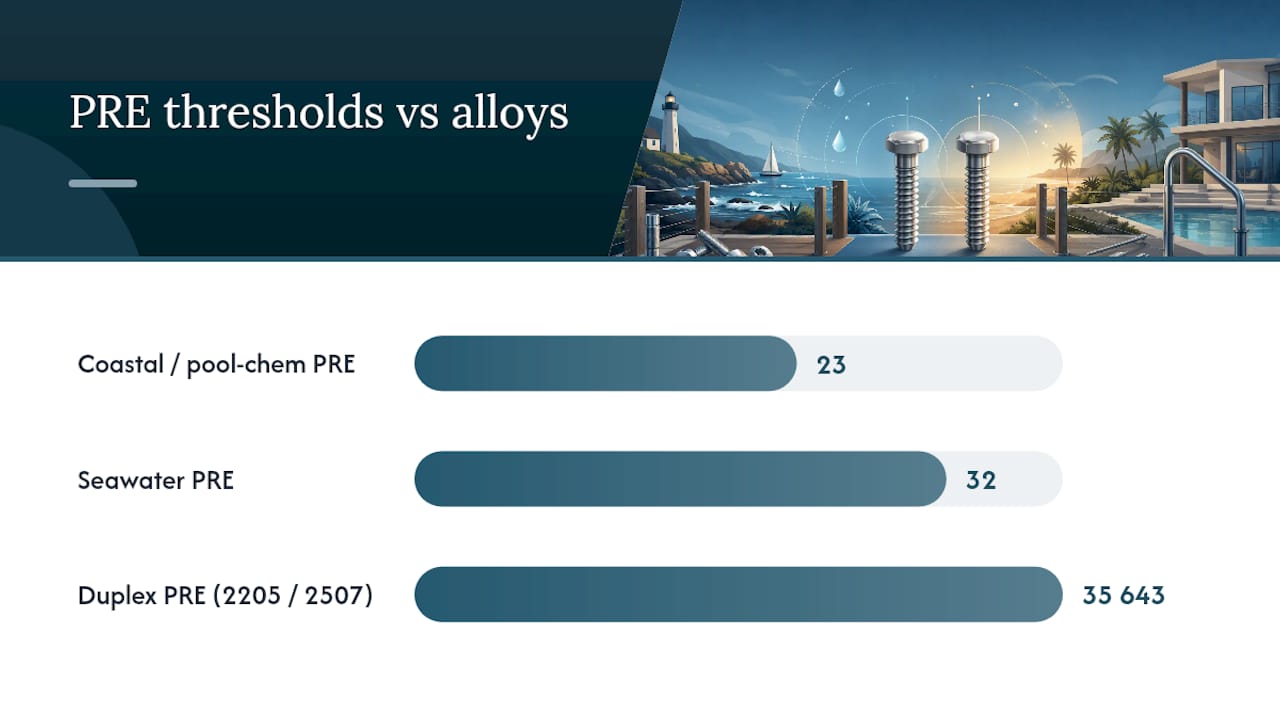
PRE math tells the real story here. Coastal and pool-chemical environments generally call for a PRE above 23, which puts 316 in range but leaves 304 short. Continuous seawater submersion, though, typically demands a PRE above 32. That's beyond what 316 offers, which is why duplex 2205 or super duplex 2507, with PRE values around 35-43, are the correct call for permanently submerged marine hardware.
Three failure modes explain why the wrong grade fails early:
Pitting corrosion starts as microscopic holes where chloride ions break down the passive film faster than it can heal, eventually punching through the metal.
Crevice corrosion happens in tight gaps, under washers, bolt heads, or gasket seams, where stagnant chloride solution concentrates and attacks the metal even in an otherwise mild environment.
Stress corrosion cracking (SCC) occurs when tensile stress and a corrosive environment combine, producing cracks that can propagate with little visible warning.
Mechanical Properties and Machinability
Strength is almost never the deciding factor between these two grades, and that surprises a lot of buyers who assume 316 is the "tougher" metal. At room temperature, 304 and 316 both run roughly 515 MPa ultimate tensile strength, 205 MPa yield strength, and about 40% elongation, according to EPCLand's material selection guide. If your project needs higher strength than either grade offers, the answer isn't switching between 304 and 316. It's stepping up to a duplex alloy or a hardened stainless variant entirely.
Machinability is similarly close between the two. Both work-harden under sustained cutting pressure and run at roughly 45-50% the speed of free-machining carbon steel, per Makerstage's shop-floor comparison. Practical tips that apply to both grades:
- Use sharp, rigid tooling and avoid letting the tool dwell in the cut, which accelerates work hardening.
- Keep consistent surface footage (SFM) rather than slowing down mid-cut.
- Budget machining time similarly for both grades. The real cost gap is the raw material, not the shop hours.
Welding Guidance and When to Specify 'L' Grades
Welding standard 304 or 316 creates a hidden risk called sensitization. Heat in the 800-1500°F range during welding causes chromium to bond with carbon and precipitate out along grain boundaries, leaving the surrounding metal chromium-depleted and vulnerable to corrosion right at the heat-affected zone.
The fix is specifying the low-carbon 'L' grades. 304L and 316L cap carbon at 0.03%, starving the sensitization reaction of the carbon it needs, based on ASM's welding metallurgy guidance.
Practical rules for anyone specifying welded stainless:
- Default to 316L for any welded assembly that will see moisture or chlorides.
- Match filler metal to base metal. Use ER316L filler when joining 316 components.
- Don't assume a mill certificate guarantees 'L' grade. Confirm carbon content on the spec sheet.
Pro Tip: After welding, passivate the weld and surrounding area, then verify the result against ASTM A967. Passivation restores the passive chromium oxide film that welding heat disrupts, and skipping this step is one of the most common reasons welded stainless rusts at the seam within a year.
Cost, Availability, and Long-Term Value
316's price premium over 304 typically runs 20-40%, driven mostly by the added nickel and molybdenum content rather than processing costs, according to thyssenkrupp's material comparison. That range isn't fixed, though. Nickel and molybdenum both trade as global commodities, and price swings in either metal ripple straight into 316's cost at the mill.
Where this matters most is lifecycle math, not sticker price:
- A 316 fastener costing a few cents more than 304 avoids a callback and full replacement two years later.
- Marine and pool hardware replaced under warranty or emergency repair almost always costs more than specifying the right alloy up front.
- 304 remains the smarter buy for indoor or low-chloride parts. Paying the 316 premium there is money spent solving a problem that doesn't exist.
- For outdoor hardware exposed to weather but not direct salt exposure, zinc-plated fasteners sometimes compete on cost, but stainless generally outlasts zinc coatings because its corrosion resistance is built into the metal itself, not a surface layer that can wear through.
How To Choose Between 304 and 316 for Your Project
Run through this sequence before you order material:
- Identify the environment. Indoor, dry, and low-humidity settings point straight to 304.
- Check for chlorides. Pool chemicals, coastal air, road salt, or CIP cleaning chemicals push the decision toward 316.
- Estimate expected lifetime. A part meant to last 20+ years outdoors justifies the 316 premium; a short-term or easily replaceable part may not.
- Confirm welding requirements. If the part will be welded, specify 316L (or 304L) rather than the standard carbon version.
- Check regulatory or industry standards. Food processing, medical, and pharmaceutical applications often mandate 316L by name.
- Escalate if chloride exposure is constant and severe. Continuous seawater immersion, marine ballast tanks, or offshore hardware need duplex 2205 or super duplex 2507, not 316. At that point, bring in a materials engineer rather than guessing.
How Can You Tell If a Part Is 304 or 316?
Markings on the part or its mill certificate are the most reliable clue, but not every fastener or bracket comes stamped. A few practical checks help narrow it down without lab equipment:
- Look for stamped grade markings on bolt heads, sheet edges, or tags. Not all manufacturers include them.
- Magnetism is not a reliable test. Both grades are largely non-magnetic in their annealed state, but cold working (bending, stamping, machining) can make either grade slightly magnetic, which trips up a lot of DIY testing.
- Visual clues are weak evidence at best. 316 sometimes looks marginally duller, but this isn't consistent enough to rely on.
For anything that actually matters, like a structural or safety-critical part, professional identification methods settle the question. PMI (positive material identification) and XRF analysis read the elemental composition directly and take seconds per test. Lab chemical analysis offers even more precision for critical applications.
Skip consumer chemical drop-test kits sold online. They're inconsistent, and misreading a false negative on a safety-related part is a worse outcome than just paying a supplier to verify the grade.
Maintenance and Real-World Use Cases
Both grades need periodic cleaning to perform as advertised. Mild soap and water on a regular schedule prevents the surface grime and mineral deposits that create the exact microenvironments where pitting starts. For 316 hardware in coastal or pool settings, an occasional passivation treatment resets the passive film and extends service life meaningfully, as explained in detail by One Day Doors & Closets.
A few use-case patterns show where the line actually falls:
- Kitchen fabrication and appliance trim: 304 is the standard, and upgrading rarely makes economic sense.
- Marine hardware and boat fittings: 316 is the floor, not the ceiling.
- Food processing equipment: 316 resists the chlorine-based sanitizers used in daily CIP cycles.
- Pool enclosures and screen fasteners: 316 is the right call anywhere splash, chlorine, or coastal humidity reaches the hardware. Pool screen frame corrosion often starts at exactly these fastener points.
Pro Tip: If a part sees occasional moisture but not direct chloride exposure, a quality coating or sacrificial zinc treatment sometimes solves the corrosion problem for less money than upgrading the whole part to 316. Save the alloy upgrade for parts that see chlorides directly and often.
What Years of Fastener Replacements Taught Us About Grade Selection
Replacing rusted screws on pool cages across Central Florida taught us something the spec sheets don't emphasize enough: fastener grade matters more than frame material in a screen enclosure's failure timeline. We've documented fixing rusted pool cage screws with 316 fasteners in under 20 minutes per fix, and the pattern repeats across nearly every job. Homeowners who replaced 304 or zinc-plated screws with 316 saw the corrosion stop returning. Screen frame material matters, but the fasteners fail first, and that's where grade selection earns its keep in a pool enclosure.
— Michel
Restoring a Pool Cage? Skip the Guesswork on Fasteners
Pool Screen Restoration service replaces rusted fasteners with stainless steel hardware and repaints frames with industrial-grade, water-based acrylic coatings, backed by a three-year warranty on completed work. Homeowners weighing a full cage rebuild against restoration may save on cost by going the restoration route.
If you're interviewing any contractor for this kind of work, ask three things: what fastener grade they're installing, whether they mask and protect surrounding surfaces during coating work, and what warranty backs the labor. Those three answers separate a lasting repair from one you'll be redoing in three years. Homeowners dealing with stained or worn pool decks alongside a tired screen enclosure can also look at Pool Deck Staining to handle both projects at once. Browse the project gallery to see completed restorations, or reach out through Mrpoolscreen to get a quote for your enclosure.
Sources
For readers who want to go past this guide and into the primary references, a few documents are worth bookmarking. ASTM A240 governs the chemical and mechanical requirements for both UNS S30400 (304) and UNS S31600 (316) sheet, plate, and strip. ASM International's welding metallurgy documentation covers sensitization mechanisms and filler metal selection in more depth than any consumer guide can. For a deeper technical breakdown of PRE calculations and corrosion testing, Makerstage's stainless steel guide and EPCLand's engineering comparison both hold up well against industry references.
- 304 vs 316 Stainless: Corrosion & CNC Guide (2026)
- 304 vs 316 Stainless Steel: Engineering Guide to Material Selection - EPCLand
- Difference Between stainless steel 316 and 304 - thyssenkrupp Materials
- Marine grade stainless - Wikipedia
FAQ
Which Is Better, 304 or 316 Stainless Steel?
Neither is universally better. It depends on the environment. 304 is the more cost-effective choice for indoor and low-chloride applications, while 316's added molybdenum makes it the better pick anywhere salt, chlorine, or aggressive chemicals are present.
What Are the Disadvantages of 316 Stainless Steel?
The main drawback is cost. 316 typically runs 20-40% more expensive than 304 for the same part, and that premium isn't justified for indoor or dry-climate applications where 304 already performs well. It offers no meaningful advantage in strength or machinability over 304.
What Is the Strongest Grade of Stainless Steel?
304 and 316 are essentially tied on strength, both running around 515 MPa tensile strength and 205 MPa yield strength at room temperature, according to EPCLand's material data. If a project genuinely needs higher strength than either offers, duplex stainless alloys or hardened stainless variants are the better path, not a choice between these two grades.
How Can I Tell if My Stainless Steel Is 304 or 316?
Check for a stamped grade marking on the part or its mill certificate first. Magnetism and visual appearance aren't reliable tests since cold-worked 304 can behave similarly to 316. For anything critical, a professional PMI (positive material identification) or XRF test gives a definitive answer in seconds.
Should I Use 316 for a Pool Enclosure or Deck Hardware?
Yes, for fasteners and hardware exposed to pool chemicals, splash, or coastal humidity. 316's resistance to chloride pitting holds up far longer than 304 or zinc-plated hardware in these conditions, which is why services like Pool Screen Restoration specify it as standard replacement hardware.