
A sunroom addition is defined as a glass-enclosed living space attached to a home, and the cost sunroom projects carry in 2026 ranges from $15,000 for a basic three-season room to well over $100,000 for a fully insulated, climate-controlled four-season build. The primary drivers are season rating, square footage, foundation type, and whether the space needs HVAC. Three-season sunrooms average $200–$350 per square foot, while four-season versions run $400–$600 per square foot. Custom glass solariums can push past $1,000 per square foot. Knowing these benchmarks before you talk to a contractor puts you in a far stronger position.
What are the main factors that drive sunroom cost?
The total price of a sunroom addition is not a single line item. It is the sum of several distinct cost categories, each with its own variables.
Glass and window packages represent 20–28% of the total construction budget. That makes glazing the single largest material cost in most sunroom projects. Choosing double-pane Low-E glass over standard single-pane can add thousands to the window budget, but it pays back in lower energy bills and better comfort year-round.
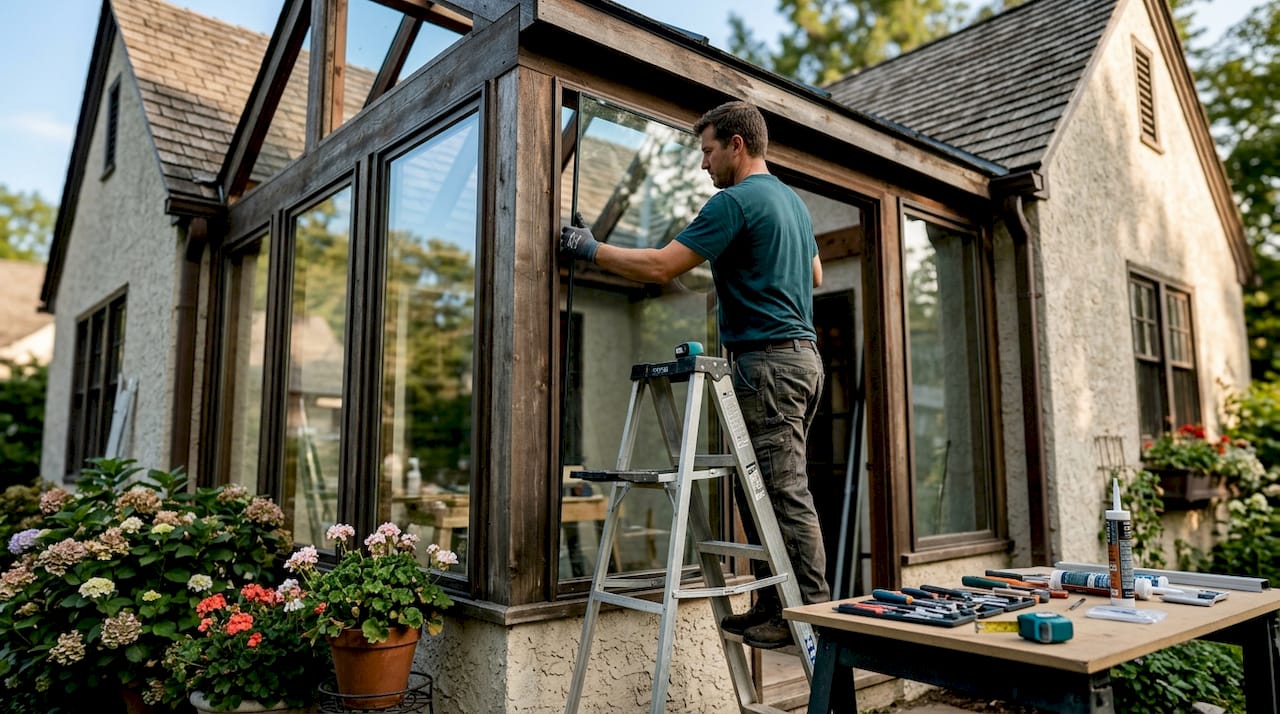
The foundation is the second biggest variable. A simple concrete slab works for mild climates, but colder regions require deeper footings and frost protection, which adds excavation, rebar, and extra concrete to the bill. Contractor overhead and markup account for 10–18% of the total, while roofing adds another 8–12%. HVAC rough-in and installation represent 6–10%, and permits plus engineering fees add 1–4%.
Here is a quick breakdown of how a typical sunroom budget splits across categories:
| Cost category | Share of total budget |
|---|---|
| Glass and windows | 20–28% |
| Contractor overhead | 10–18% |
| Roofing | 8–12% |
| HVAC system | 6–10% |
| Permits and engineering | 1–4% |
| Foundation and framing | Remainder |
Key cost factors that homeowners frequently underestimate include:
- Electrical upgrades. Outlets, lighting circuits, and ceiling fan wiring are rarely included in base quotes.
- Permit fees. Most municipalities require a building permit for any permanent addition, and fees vary widely by county.
- Structural engineering. Attaching a sunroom to an existing home often triggers a structural review, especially for two-story homes.
- Site preparation. Grading, drainage, and demolition of existing decks or patios add to the pre-construction budget.
Pro Tip: Ask your contractor to provide a line-item quote, not a single lump sum. That one request will reveal hidden costs before you sign anything.
How do three-season and four-season sunrooms differ in cost?
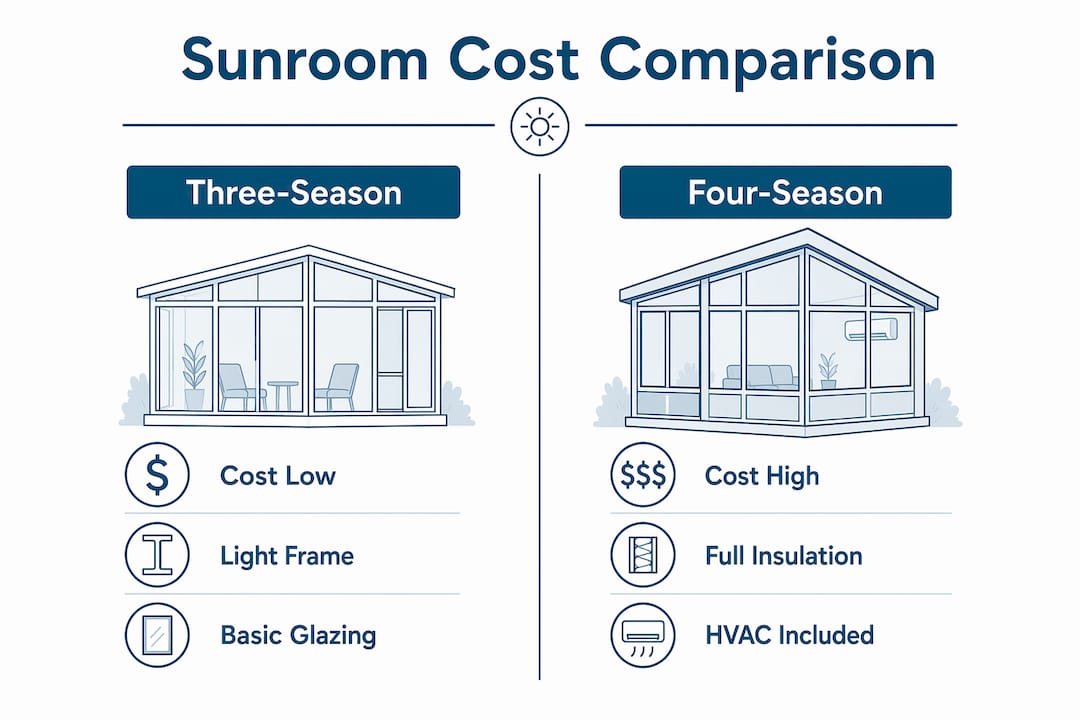
The core difference between sunroom types is climate performance. Three-season rooms use lighter framing and simpler glazing for spring-through-fall use. Four-season rooms must meet full building code for year-round occupancy, which means insulated walls, frost-protected foundations, and a dedicated HVAC system.
Three-season sunrooms
Three-season sunrooms typically cost between $15,000 and $45,000 installed. They work well in climates where winters are mild enough that you simply close the space off for a few months. The framing is lighter, the glazing is simpler, and no HVAC connection is required. That combination keeps costs manageable.
Four-season sunrooms
Four-season sunrooms with HVAC range from $45,000 to over $100,000. Four-season rooms require full insulation, frost-protected foundations, and HVAC capable of winter heating. Small four-season builds starting at 10x12 feet begin around $80,000, and large custom builds can reach $125,000–$160,000 or more.
| Feature | Three-season | Four-season |
|---|---|---|
| Typical installed cost | $15,000–$45,000 | $45,000–$100,000+ |
| Cost per square foot | $200–$350 | $400–$600 |
| Insulation required | No | Yes |
| HVAC required | No | Yes |
| Frost-protected foundation | Rarely | Almost always |
| Year-round usability | No | Yes |
One hidden cost that catches homeowners off guard is conversion. Converting a three-season to a four-season sunroom costs $25,000 to $55,000 because the entire thermal envelope must be rebuilt. Insulation, window thermal ratings, foundation depth, and HVAC all need upgrading. If you think you might want year-round use eventually, building four-season from the start is almost always cheaper than converting later.
Pro Tip: If you live in Florida or another warm-weather state, a three-season room with a ceiling fan and good cross-ventilation can function comfortably for ten or eleven months of the year at a fraction of the four-season price.
What size sunroom gives you the best value for money?
Size affects cost in two distinct ways: raw material volume and fixed cost efficiency. Raw material costs scale roughly with square footage. Fixed costs, like permits, foundation setup, and HVAC rough-in, do not scale at all. That math creates a clear pattern.
Very small sunrooms under 100 square feet have poor cost-per-square-foot value because fixed costs dominate the total. A 10x10 room might cost $30,000, which works out to $300 per square foot, but a 14x20 room at $55,000 works out to roughly $196 per square foot. The larger room delivers more usable space for less money per foot.
The optimal sunroom size for cost-effectiveness is about 200 square feet. At that size, fixed costs are spread across enough square footage to bring the per-foot rate down, while the room is large enough to function as a real living space rather than a glorified hallway.
Here is how popular sizes compare on installed cost for a three-season build:
| Sunroom size | Approximate sq ft | Estimated installed cost |
|---|---|---|
| 10x10 | 100 sq ft | $20,000–$35,000 |
| 12x16 | 192 sq ft | $38,000–$55,000 |
| 14x20 | 280 sq ft | $55,000–$80,000 |
| 16x20 | 320 sq ft | $65,000–$95,000 |
Climate also shapes the size decision. In Central Florida, a larger screened or glass enclosure makes sense because the space gets used most of the year. In the Midwest, a smaller four-season room may deliver more practical value than a large three-season space that sits empty from november through march.
- Go bigger if you plan to use the space as a dining room, home office, or family room.
- Go smaller if the sunroom is purely for plants, reading, or occasional relaxation.
- Match size to your home's footprint. A 300-square-foot addition on a 1,200-square-foot home can look and feel out of proportion.
What hidden costs do homeowners most often overlook?
Budget surprises in sunroom projects almost always come from the same handful of categories. Knowing them in advance is the difference between a smooth project and a stressful one.
High-performance glazing. Low-E glazing and electrical upgrades are frequently underestimated but are critical for comfort and energy efficiency. Triple-pane windows cost significantly more than double-pane, but in climates with extreme heat or cold, they reduce HVAC load enough to justify the premium.
Electrical work. Electrical upgrades for sunrooms typically include outlets, lighting, and ceiling fans. These are frequently absent from initial contractor estimates. A dedicated circuit for a mini-split HVAC unit adds further cost. Budget at least $1,500–$3,000 for electrical work as a baseline.
Frost-protected foundations. Foundations needing 42-inch footings in the Midwest add thousands to project budgets. Deeper excavation, more concrete, and additional rebar all compound the foundation cost in colder climates. Florida homeowners rarely face this issue, but anyone north of the Mason-Dixon line should plan for it.
Custom versus prefab builds. Prefab sunrooms offer faster timelines and predictable costs, while custom builds provide better long-term integration with the existing home. Prefab kits can save $10,000–$20,000 upfront, but they may not match the roofline, siding, or architectural style of your home as cleanly as a custom build.
Pro Tip: Add a 15% contingency buffer to your total sunroom budget before you start. Unexpected soil conditions, code changes, or material delays are common, and a buffer prevents them from stopping the project mid-build.
Key Takeaways
The sunroom addition cost is determined primarily by season rating, size, foundation requirements, and glazing quality, with four-season builds costing roughly twice as much as three-season rooms at every size.
| Point | Details |
|---|---|
| Season rating drives cost most | Four-season sunrooms cost $400–$600 per sq ft versus $200–$350 for three-season builds. |
| 200 sq ft is the value sweet spot | Fixed costs spread more efficiently at this size, lowering the per-foot rate significantly. |
| Glazing is the largest material cost | Glass and window packages represent 20–28% of the total sunroom construction budget. |
| Conversion costs more than building right | Upgrading a three-season room to four-season costs $25,000–$55,000 in retrofits. |
| Hidden costs add up fast | Electrical, permits, and frost foundations are frequently absent from initial contractor quotes. |
What I've learned from watching homeowners budget for sunrooms
Most homeowners I talk to anchor on the wrong number first. They find a prefab kit online for $12,000 and assume that is the project cost. The kit is just the shell. By the time you add foundation, electrical, permits, and labor, that $12,000 kit becomes a $40,000 project. The sticker price of the structure is rarely more than a third of the total.
The second mistake I see is treating a sunroom as a purely cosmetic upgrade. A well-built four-season sunroom adds real square footage to your home and shows up in appraisals. A poorly built three-season room that leaks or fogs up within five years does the opposite. The choice between prefab and custom is not just about upfront cost. It is about what the space looks like and performs like in year ten.
My honest recommendation is to decide on season rating before you decide on anything else. That single decision determines your foundation depth, your window spec, your HVAC requirement, and ultimately your budget range. Everything else flows from it. If you are in a warm climate like Central Florida, a well-screened or glass-enclosed space with good airflow can give you year-round use at three-season prices. That is a real opportunity that homeowners in colder states simply do not have.
You can browse completed enclosure projects to get a realistic sense of what finished spaces look like before committing to a design direction.
— Michel
Mrpoolscreen can help you plan your outdoor enclosure project
Homeowners in Central Florida planning a sunroom or screened enclosure have a practical advantage: the climate allows for year-round outdoor living at a fraction of the cost of a fully insulated four-season build. Mrpoolscreen specializes in restoring and building screen enclosures and pool structures using industrial-grade materials, including water-based acrylic coatings and stainless steel fasteners that hold up against Florida's heat and humidity.

Mrpoolscreen's pool screen restoration service can save homeowners up to 60% compared to a full rebuild, which makes it a strong alternative when your existing enclosure needs work rather than replacement. Whether you are starting fresh or restoring what you have, get online pricing to build an accurate budget before your first contractor call. A free estimate is also available for homeowners who want a professional assessment of their specific project.
FAQ
How much does a sunroom cost on average in 2026?
Three-season sunrooms average $15,000–$45,000 installed, while four-season sunrooms with HVAC range from $45,000 to over $100,000 depending on size and finishes.
What is the sunroom cost per square foot?
Three-season sunrooms average $200–$350 per square foot. Four-season sunrooms run $400–$600 per square foot, and custom glass solariums can exceed $1,000 per square foot.
Is it cheaper to build a sunroom or convert an existing porch?
Converting an existing covered porch is generally cheaper than building from scratch, but the savings depend heavily on the porch's existing foundation and framing condition.
What size sunroom is most cost-effective?
Around 200 square feet is the sweet spot. At that size, fixed costs like permits and foundation work are spread across enough square footage to bring the per-foot rate down meaningfully.
Do I need a permit to build a sunroom?
Most municipalities require a building permit for any permanent sunroom addition. Permit fees and engineering reviews add 1–4% to the total project cost and vary by county.