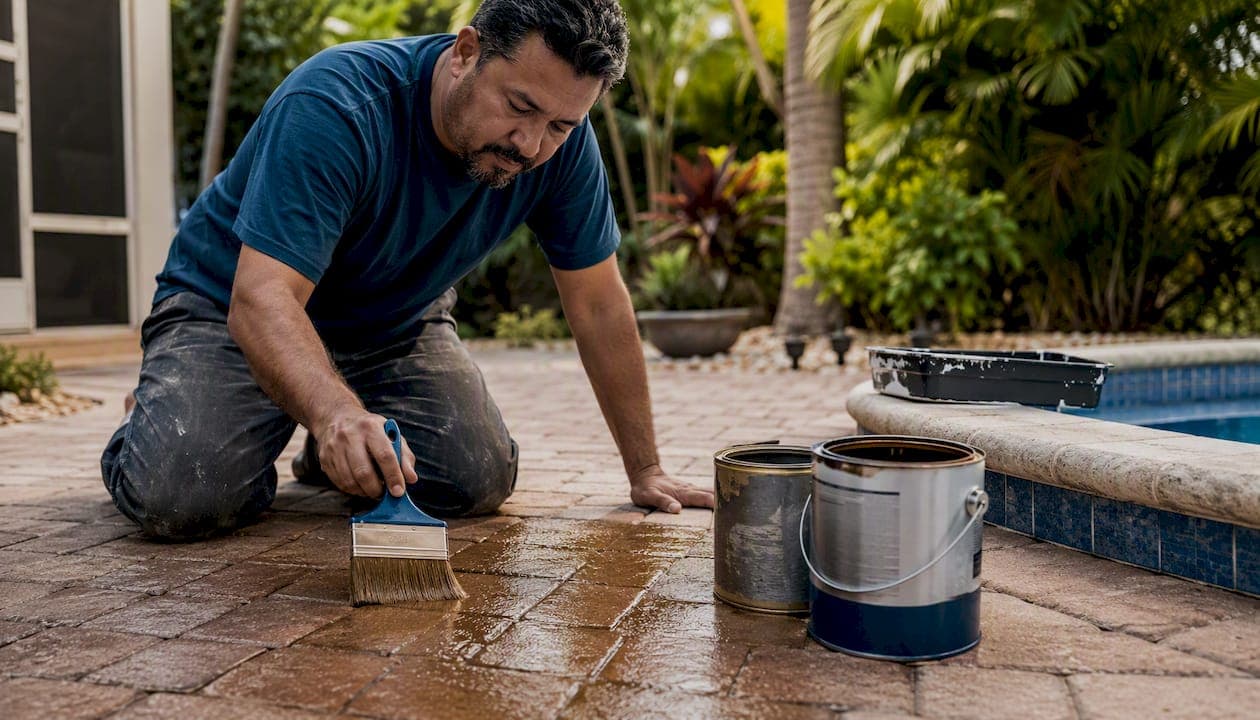
For most Central Florida pool decks, stain is the better default. Semi-transparent stain and quality solid stains breathe, fade gracefully, and refresh without stripping. Paint forms a film that traps moisture underneath, and in Florida's heat and humidity, that film peels. Mrpoolscreen's restoration crews see this pattern constantly on aging concrete and wood decks across the Orlando area.
Two situations where paint makes sense:
- Badly weathered or mismatched surfaces where grain damage, staining, or patchwork repairs need full concealment
- Specialized traffic-bearing decorative coating systems specified by a contractor for concrete, such as industrial-grade water-based acrylic coatings that are formulated for pool environments
If you want a low-maintenance, breathable finish, go with semi-transparent or quality solid stain. If you need full-coverage concealment, discuss paint options with a contractor and budget for more frequent maintenance cycles.
Table of Contents
- How do deck paint and stain actually compare?
- What does a professional job actually cost?
- How do you choose a finish and hire the right contractor?
- What does professional prep and application actually involve?
- How do stain and paint age in Central Florida?
- Key Takeaways
- What the work actually looks like from a contractor's perspective
- Mrpoolscreen handles pool deck restoration across Central Florida
- Useful sources and further reading
How do deck paint and stain actually compare?
The table below covers every dimension that matters for a pool deck in a humid, sunny climate.
| Dimension | Semi-Transparent Stain | Solid Stain | Penetrating (Oil-Based) Stain | Water-Based Acrylic Coating | Paint |
|---|---|---|---|---|---|
| Expected lifespan | lasts a few years | lasts several years | lasts a few years | lasts several years | lasts several years |
| Failure mode | Fades, wears | Fades, minor peeling | Fades, dries out | Peels if prep fails | Chips and peels |
| Maintenance labor | Low — clean and recoat | Moderate | Low to moderate | Moderate | High — scraping required |
| Breathability | High | Moderate | High | Moderate | Low |
| Appearance | Shows wood grain | Opaque-ish, some texture | Natural, enhances grain | Solid color, smooth | Fully opaque |
| Best substrate | Sound wood | Wood or concrete | Sound wood | Concrete | Damaged wood or concrete |
| Repairability | Easy spot-refresh | Moderate | Easy | Moderate | Difficult — full strip often needed |
| Slip resistance | Add texture additive | Add texture additive | Add texture additive | Specify slip-rated formula | Add texture additive |
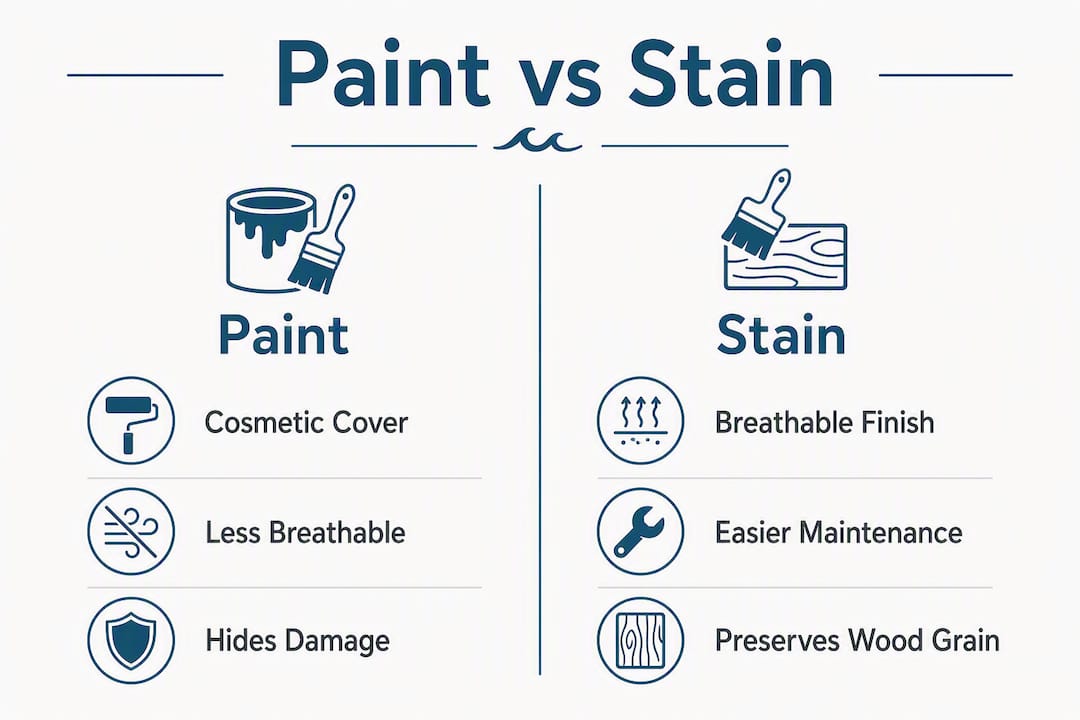
Where stain clearly wins: breathability on wood decks, easier refresh cycles, and lower long-term labor. Semi-transparent stain is the sweet spot for sound wood — it protects from UV, lets grain show, and is far easier to refresh than paint.
Where paint is useful: hiding severe cosmetic damage on concrete or wood where appearance matters more than breathability.
The middle-ground choice: solid stain. It covers like paint but still allows some moisture movement and refreshes without stripping.
For concrete pool decks specifically, water-based stains and water-based acrylic coatings penetrate or bond to the slab rather than sitting on top. Concrete stains resist peeling in ways that paint simply cannot match in humid conditions. Paint on a concrete slab bubbles when moisture migrates up from below, which is almost guaranteed in Florida.
One underappreciated point: once you paint a deck, going back to a natural or stained look means professional-grade sanding or chemical stripping. Many homeowners don't price that reversal into the original decision.
What does a professional job actually cost?
Up-front, stain materials run roughly half the per-gallon cost of exterior-grade deck paint. Paint projects also require primer and multiple topcoats, which adds both material and labor hours. On a professional job, that difference compounds quickly.
| Finish Type | Expected Lifespan | Typical Recoat Interval | Labor Intensity at Recoat |
|---|---|---|---|
| Semi-transparent stain | lasts a few years | Requires periodic refresh every few years | Low — clean and recoat |
| Solid stain | lasts several years | Requires refresh every few years | Moderate |
| Water-based acrylic coating | lasts several years | Requires refresh every few years | Moderate |
| Paint | lasts several years | Requires refresh every few years | High — scraping/stripping |
| Clear sealer | lasts a short time | Requires annual reapplication | Low |
For a typical Central Florida pool deck, professional staining generally costs a moderate price per square foot for labor and materials combined, varying with prep needs and substrate condition. Painted projects with primer and multiple topcoats typically cost more per square foot. Actual quotes depend on the deck's condition, repair needs, and the specific coating system.
Timing matters in Florida. The best window for deck work is October through April, when humidity drops and afternoon rain is less predictable. Summer applications are possible but require careful drying windows between coats. A professional should never apply a second coat over a surface that hasn't fully cured, and in July, that can mean a full 24-hour wait between coats.
How do you choose a finish and hire the right contractor?
Start with the deck's condition. Sound wood with intact grain? Semi-transparent stain. Weathered, patchy, or mismatched surfaces? Solid stain or paint. Concrete slab? Water-based stain or a water-based acrylic coating.
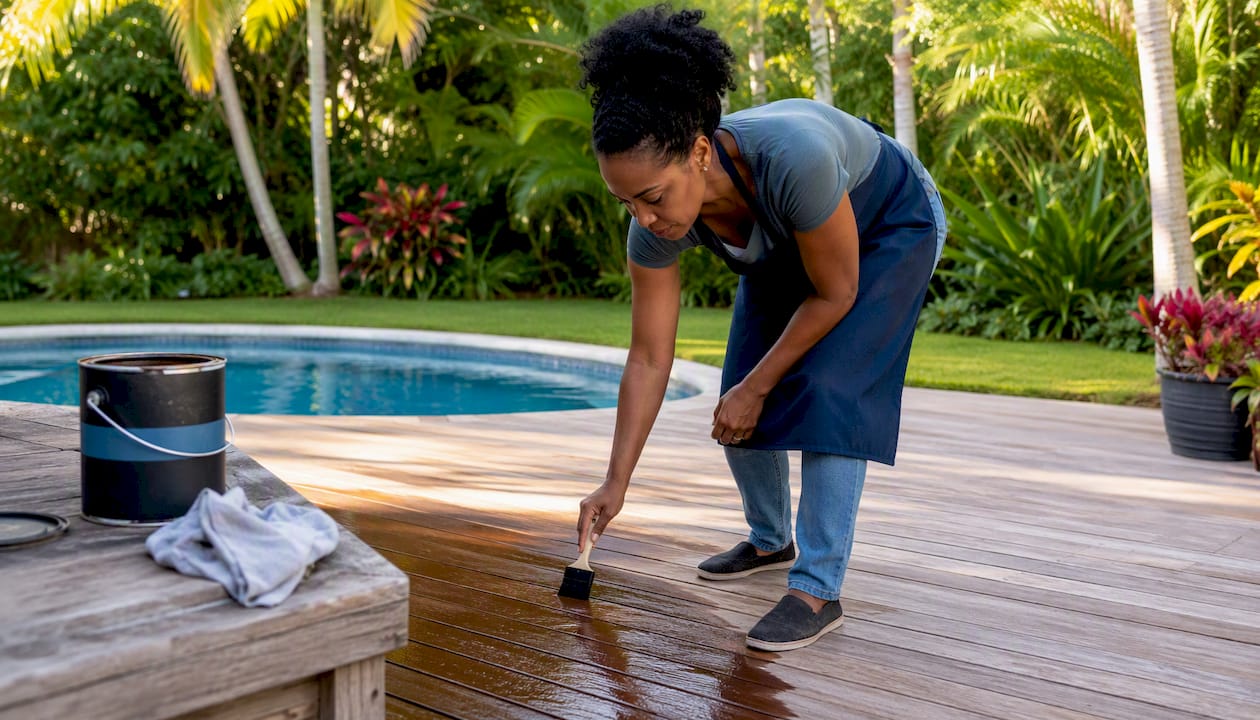
Then factor in your maintenance tolerance. If you want to minimize future labor, prioritize finishes that allow low-effort refreshes rather than full strip-and-repaint cycles.
Contractor hiring checklist:
- Licensed and insured in Florida
- Specific experience with pool decks (not just interior painting)
- Can name the exact products they'll use — ask for water-based acrylic coatings for concrete
- Provides a written estimate with prep steps spelled out line by line
- Offers a test patch before full application on acid-stained concrete
- Can show local references or a project gallery
- Warranty terms in writing
Questions to ask on the first call:
- What prep process do you use for this substrate?
- Which specific coating or stain product are you recommending, and why?
- How do you handle anti-slip texture around the pool edge?
- What does your warranty cover, and for how long?
- Can I see a recent local project similar to mine?
Red flags: rush pricing that skips prep, vague material specs ("a good deck paint"), or pushing thick resurfacing products as a quick fix. Thick, highly filled resurfacing coatings crack and bubble under Florida heat and are not what experienced contractors use.
Pro Tip: Insist on a small, inconspicuous test patch for any acid-based concrete stain. Final color depends on the slab's mineral content and age — what looks great on a sample card can look completely different on your specific concrete.
What does professional prep and application actually involve?
Surface prep determines roughly 80% of the final result — more than the finish itself. Here's what a reputable contractor should do for each substrate.
For wood decks:
- Pressure wash to remove dirt, mildew, and loose material (proper deck pressure washing is a full process, not a quick rinse)
- Apply a brightener or mildew-kill treatment
- Allow full drying — minimum 48 hours in Florida humidity
- Spot-sand rough areas and repair damaged boards
- Apply penetrating stain or primer coat as specified
- Apply finish coat(s) with anti-slip additive at pool edges
For concrete decks:
- Pressure wash and degrease
- Acid etch or diamond grind for proper adhesion
- Moisture and pH check before any coating
- Apply water-based stain or water-based acrylic coating in thin, even coats
- Add slip-rated texture to the final coat near pool entry points
For composite and masonry: composite decks generally bond poorly with oil-based penetrating stains. Water-based formulas or paint are usually the right call. Masonry surfaces follow the concrete protocol.
Pro Tip: Skip the "deck resurfacer" products sold at big-box stores. These thick, paint-like formulas are prone to cracking under intense heat and often fail within a single Florida summer. A proper thin-coat stain or acrylic system will outlast them significantly.
How do stain and paint age in Central Florida?
Paint chips and peels. Stain fades. Those aren't equivalent problems.
Peeling paint requires scraping, sometimes chemical stripping, and full recoating. Faded stain usually needs a cleaning and a fresh coat. In Central Florida's UV intensity and humidity, that difference shows up faster than it would in a northern climate.
Maintenance schedule for Central Florida pool decks:
- Annual: Visual inspection for bubbling, adhesion failure, or mildew. Clean with a deck-safe cleaner.
- Every 1–2 years: Clear sealer reapplication if used as a standalone finish.
- Every 2–4 years: Semi-transparent stain refresh — clean, light sand if needed, recoat.
- Every 3–7 years: Solid stain or water-based acrylic coating refresh.
- Every 3–7 years (paint): Full assessment; likely scraping and repainting.
Repair checklist by finish type:
- Stain (fading or worn patches): Clean the area, feather the edges, spot-recoat. Usually a DIY-friendly repair.
- Paint (peeling or bubbling): Scrape loose material, prime, recoat. Widespread failure means professional stripping.
- Slip resistance: Reapply texture additive at recoat time — it wears down with foot traffic.
Call a pro when you see rot under a wood deck, widespread bubbling on concrete, or adhesion failure across more than 20–30% of the surface. Those are signs the prep failed or the wrong product was used, and spot-patching won't hold.
Key Takeaways
For Central Florida pool decks, stain outperforms paint on breathability, maintenance labor, and long-term cost — with water-based acrylic coatings as the right call for concrete when full coverage is needed.
| Point | Details |
|---|---|
| Default finish choice | Semi-transparent or solid stain for most pool decks; paint only when concealment is required. |
| Lifespan ranges | Semi-transparent stain lasts 2–4 years; solid stain, water-based acrylic coating, and paint all reach 3–7 years, but paint fails harder. |
| Cost difference | Stain materials cost roughly half per gallon; painted projects add primer and extra coats, raising total cost. |
| Prep is the deciding factor | Surface prep accounts for roughly 80% of the result — always get prep steps in writing before signing. |
| Mrpoolscreen for local jobs | Mrpoolscreen handles pool deck staining, painting, and enclosure restoration across Central Florida with free estimates. |
What the work actually looks like from a contractor's perspective
The conversation about deck paint vs stain looks different when you're standing on a Florida pool deck in August. Moisture doesn't just come from rain here — it comes up through the slab, through the wood, from the pool itself. A finish that doesn't breathe traps that moisture, and trapped moisture is how you get rot on wood and bubbling paint on concrete.
The preference for breathable stains and water-based acrylic coatings on concrete isn't a marketing position. It's what holds up. On wood pool decks, a quality semi-transparent stain allows moisture to move through the finish rather than building pressure underneath it. On concrete, a properly applied water-based acrylic coating bonds to the slab without sealing it like a drum.
— Mrpoolscreen has completed pool deck and enclosure restoration projects across the Orlando area where switching from a painted finish to a stain-based system, or specifying the right water-based acrylic for a concrete slab, extended the finish life significantly compared to what the homeowner had experienced before.
Industrial-grade materials matter here. Stainless steel fasteners on enclosures, water-based acrylic coatings rated for pool environments, and proper slip-rated texture at pool edges aren't upsells. They're what separates a finish that lasts from one that needs redoing in two years.
Free estimates are available, and the project gallery shows real local work.
Mrpoolscreen handles pool deck restoration across Central Florida
Choosing between stain and paint is one decision. Getting the prep right, specifying the correct coating for your substrate, and applying it in Florida's climate is another. That's where Mrpoolscreen comes in.
Mrpoolscreen provides pool deck staining and painting for concrete, wood, masonry, and stone surfaces across Central Florida, alongside full pool enclosure restoration using industrial-grade water-based acrylic coatings and stainless steel fasteners. The process runs from inspection through prep, test patch, and application — with the finish and materials specified in writing before work begins.
The cost savings compared to full rebuilds can be significant, and every job comes with a free estimate. View completed local projects in the restoration gallery, or get online pricing to start comparing your options now.
Useful sources and further reading
The claims in this guide draw on the following published sources. Lifespan ranges, cost estimates, and prep guidance are industry ranges — your results will depend on substrate condition, prep quality, and the specific products used. For a site-specific recommendation, request a free estimate.
- Deck Stain vs Sealer vs Paint — DeckMath: lifespan ranges for semi-transparent stain (2–4 years), solid stain and paint (3–7 years), and clear sealers (1–2 years)
- Should I Paint or Stain My Pool Deck — Cypaint: paint lifecycle tradeoffs and failure modes on horizontal pool decks
- Pool Deck Paint vs Stain — SUNDEK of Pennsylvania: concrete-specific guidance on stain penetration vs paint film behavior
- Deck Stain vs Sealer vs Paint — Jaspector: semi-transparent stain as the sweet spot for wood; anti-slip and color guidance
- Paint or Stain a Deck — Brad The Painter: prep quality as the primary determinant of finish longevity
- Painting vs Staining a Deck — Bob Vila: side-by-side comparison of appearance, durability, and cost
- Deck Staining vs Painting — Enviro Painting: contractor perspective on moisture trapping and paint failure on wood decks
- Paint or Stain a Deck — Peek Painting: practical decision factors including substrate condition and maintenance tolerance
Contractor insights on resurfacing product failures, the one-way nature of painting, and acid-stain test patches are publisher-sourced observations from Mrpoolscreen's restoration practice and are not attributed to external citations.