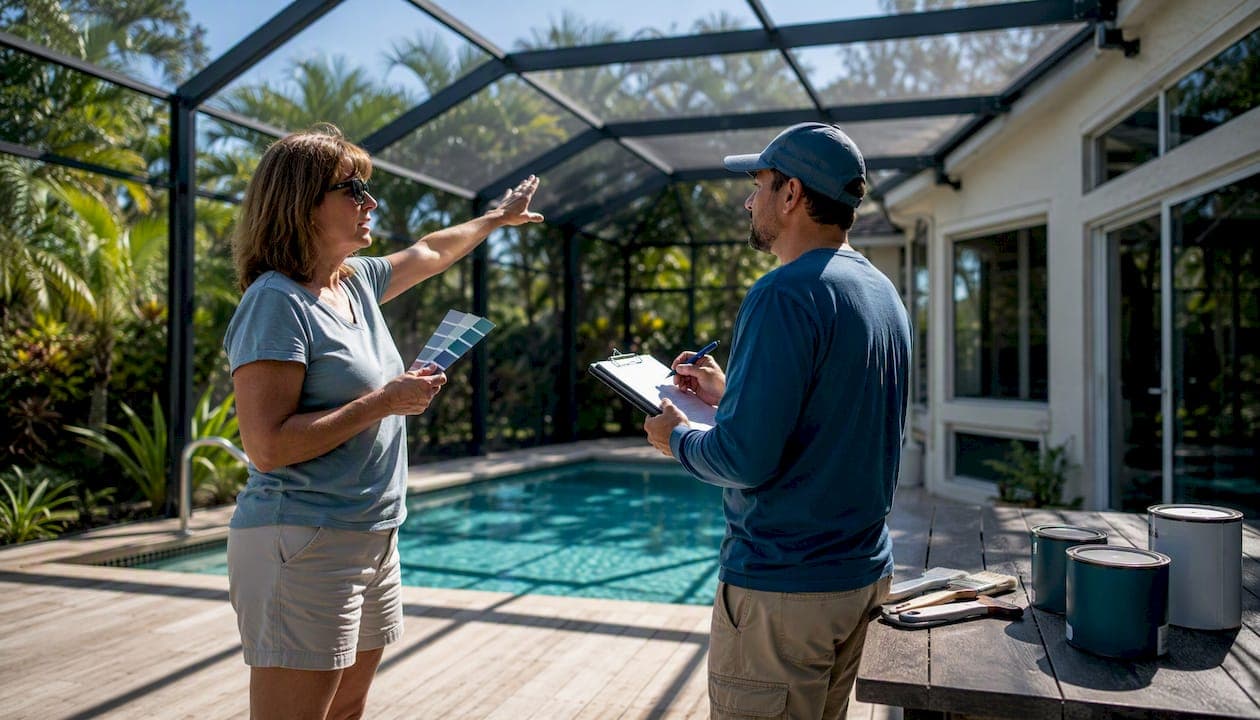
Most homeowners pay a few thousand dollars for a professional pool cage repaint, and a full restoration typically runs far less than the high cost of tearing down and rebuilding the structure. Here is where common job types land:
-
Minor touch-ups (spot rust, small sections): $300–$750
-
Standard professional repaint (single-story, average size): $2,500–$6,500
-
Full restorative repaint (rust treatment, fastener replacement, re-screening): $4,000–$9,000
-
Large or two-story enclosures: $13,000–$25,000
If your cage has surface oxidation and no major structural damage, professional restoration is almost always the smarter call over a rebuild. Touch-ups make sense only for isolated spots caught early; anything involving widespread rust or faded coating needs a full professional treatment to hold up.
Table of Contents
-
How professional restoration saves money — and what Mrpoolscreen does differently
-
DIY vs hiring a pro: what the cost and risk trade-off actually looks like
-
How often pool cages need refinishing and how to extend the interval
-
Mrpoolscreen restores your pool cage without the rebuild price tag
How much does pool cage painting cost by job type?
Not every cage needs the same level of work, and the price difference between a basic repaint and a full restoration can be several thousand dollars. Mapping your enclosure to the right job type is the fastest way to set a realistic budget.
Minor touch-up covers spot-treating isolated rust patches, touching up chipped paint on a few frame sections, and sealing small problem areas. This is a DIY-friendly scope when caught early, and a contractor will typically charge $300–$750 for a service call covering a handful of spots.
Standard repaint is the most common job: pressure washing, light sanding, priming, and applying two finish coats to the full aluminum frame of a single-story enclosure. Per-square-foot labor runs about $1.50–$2.50, and paint materials add roughly $0.20 per square foot on top of that. For a typical residential cage, total project costs usually fall within a few thousand dollars depending on size and prep needs.
Full restorative repaint adds rust removal, rust-inhibiting primer, fastener replacement with stainless steel or Nylotech hardware, and often re-screening. This is the right choice when oxidation has spread across multiple sections or the existing coating is peeling. Expect several thousand dollars for a standard single-story cage, more for larger footprints.
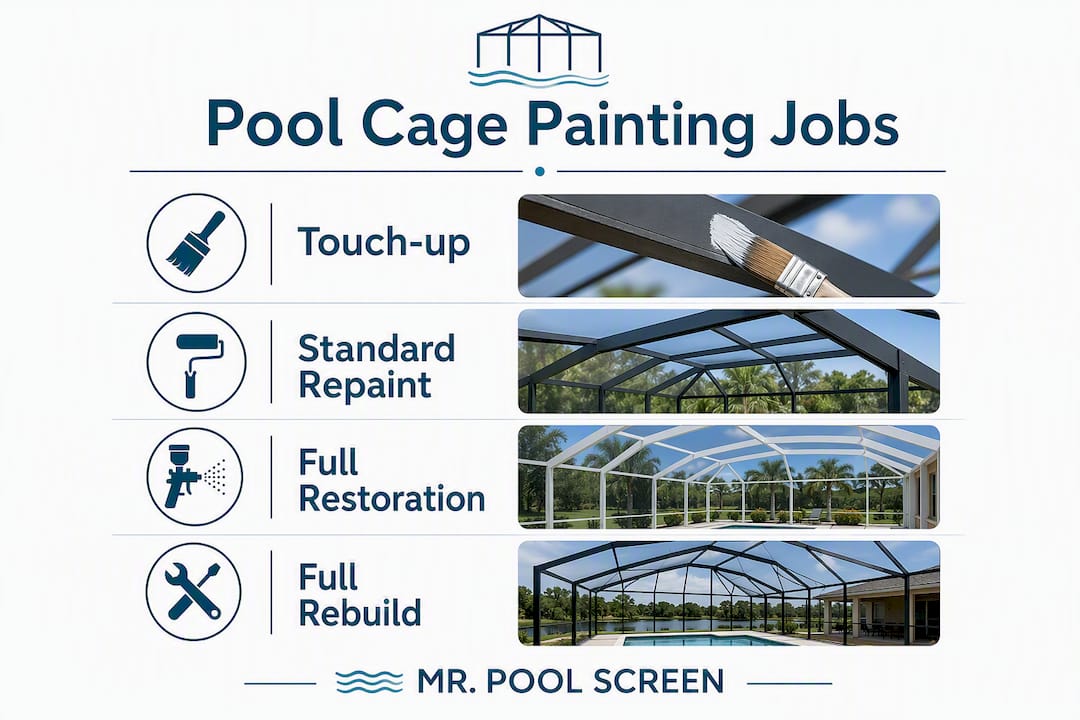
Full rebuild (tear-down and replacement) is only warranted when the aluminum structure itself is compromised. Costs typically start in the high thousands for large or two-story enclosures and can be higher in coastal markets.
| Job Type | Typical Price Range | What’s Included | Right Choice When |
|---|---|---|---|
| Touch-up | $300–$750 | Spot rust treatment, touch-up paint | Isolated damage, caught early |
| Standard repaint | $2,500–$6,500 | Wash, sand, prime, 2 finish coats | Faded or chalky coating, no major rust |
| Full restoration | $4,000–$9,000 | Rust removal, fastener replacement, re-screen | Widespread oxidation, peeling paint |
| Large/two-story | $13,000–$25,000 | Full scope above plus lift/scaffold | Large footprint, height access needed |
| Full rebuild | $15,000–$30,000+ | Complete tear-down and replacement | Structural failure, irreparable damage |
Regional labor rates shift these numbers. Coastal Florida markets like Fort Myers and Naples tend to run at the higher end of standard ranges due to demand and salt-air prep requirements. Get at least three local quotes before committing to any budget figure.
What drives pool cage paint pricing the most?
Size is the starting point, but it rarely explains the full estimate. These are the factors that actually move the number.
Enclosure size and surface area set the floor. A small lanai cage with 400–600 square feet of aluminum frame costs far less to coat than a sprawling two-story structure with 1,500+ square feet of surface. Contractors price by the job, but they are mentally calculating square footage the whole time.
Condition and extent of rust is often the single biggest variable. Light surface oxidation adds a primer coat and some sanding time. Heavy rust requires wire brushing, chemical rust converters, multiple primer coats, and extended drying windows between coats. A cage with heavy rust on a standard footprint can cost as much as a clean large cage.
Height and access add real money fast. Single-story cages with open ground access are the simplest to work. Two-story cages or properties with limited access typically require lifts or scaffolding, and scaffolding or access fees often run $200–$800 extra on top of the base job cost. Multi-roof lines and complex geometry push that number higher.
Prep and repairs are where estimates diverge most. A contractor who skips rust treatment will quote less upfront and deliver a job that fails in two years. Proper prep, including sanding, priming, and treating every corroded connection point, takes time and materials that show up in the price.
Coating type matters for both cost and longevity. Premium rust-inhibiting primers and UV-resistant topcoats raise upfront materials costs but extend the time before the next refinish cycle. Water-based acrylic coatings formulated for aluminum are the professional standard in Florida’s climate.
Re-screening and hardware replacement are common add-ons. Replacing rusted fasteners with stainless steel hardware and installing new mesh adds labor and materials, but it is often bundled with a restoration job at a better rate than scheduling it separately.
Local labor rates vary by market. Urban and coastal Florida markets run higher than inland areas, and peak season (fall through spring in Florida) can tighten contractor availability and push prices up slightly.
What a professional pool cage restoration actually involves
A professional job is not just paint on aluminum. The sequence matters, and skipping any step creates a failure point that shows up within a year or two.
-
Initial inspection — The contractor assesses rust extent, structural integrity, screen condition, and access requirements. This determines scope and drives the final quote.
-
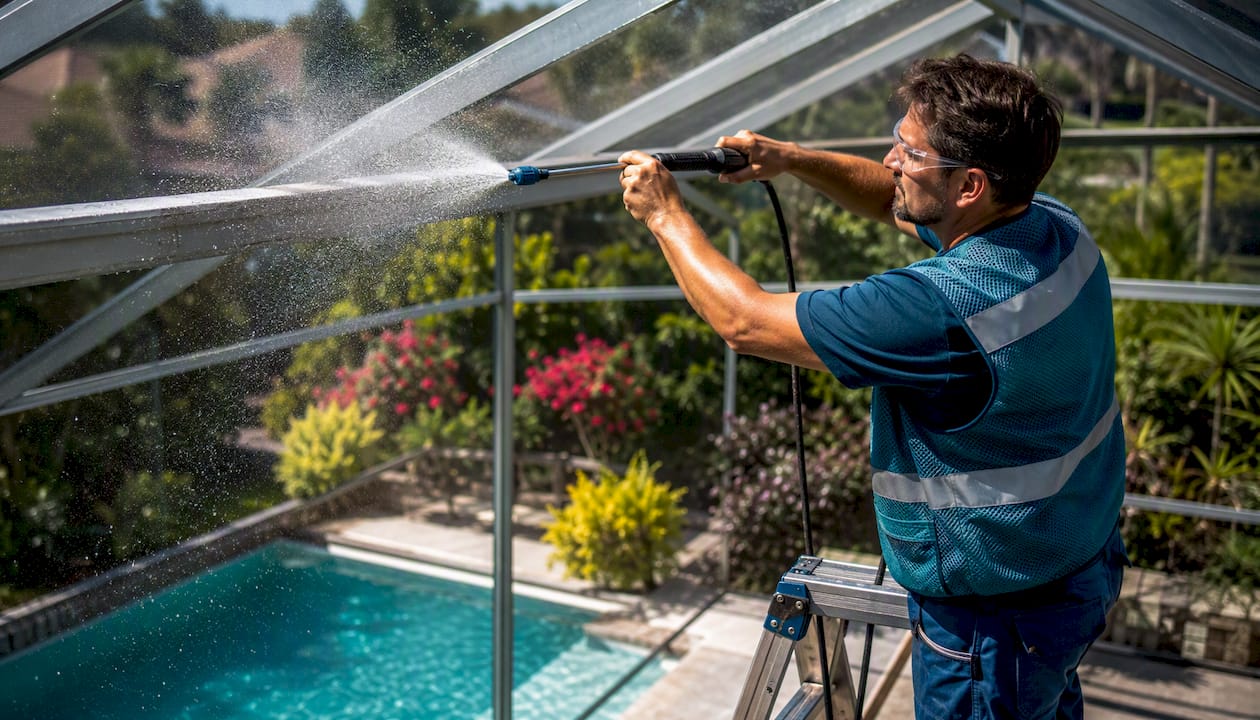
Power washing — High-pressure washing removes dirt, mildew, chalky oxidation, and loose paint. The frame needs to be completely clean before any prep work begins.
-
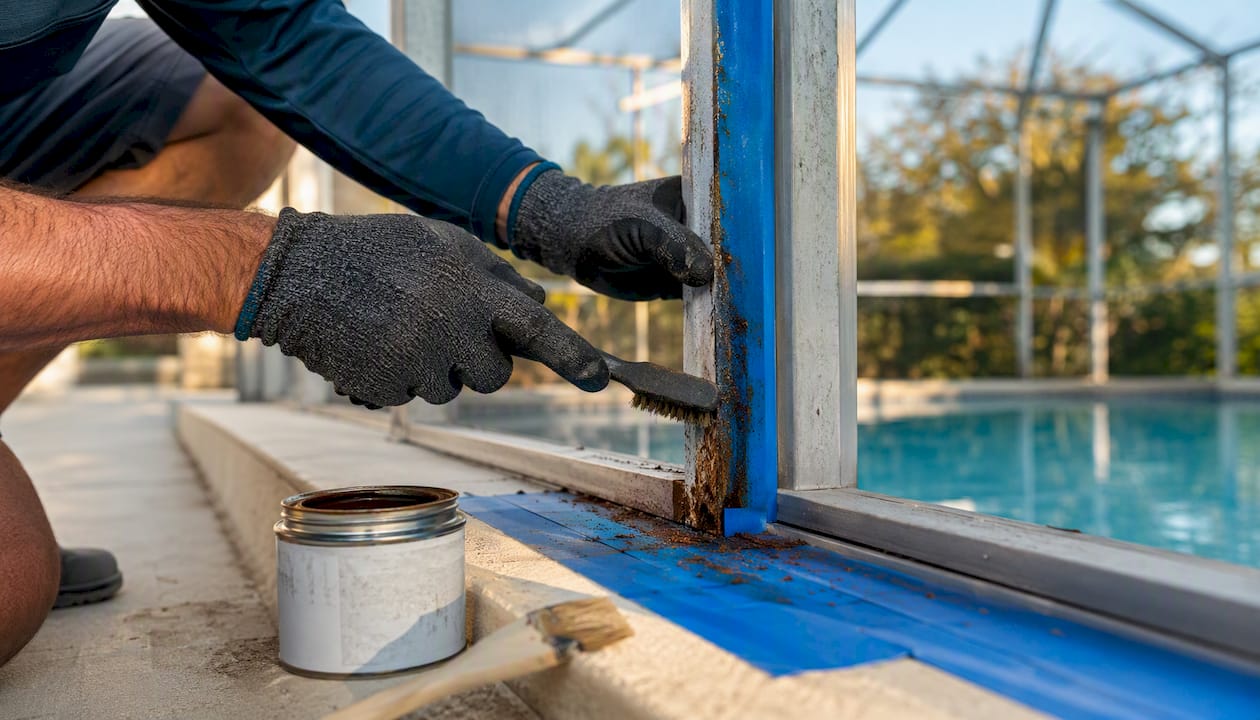
Rust treatment and fastener replacement — Corroded areas are wire-brushed or chemically treated with a rust converter. Rusted screws and fasteners are replaced with stainless steel or Nylotech hardware, which resists corrosion far longer than standard zinc-coated hardware.
-
Sanding and priming — Bare aluminum and treated areas are sanded smooth, then coated with a rust-inhibiting primer. On heavily corroded frames, this step may require two primer coats with drying time between them.
-
Screen removal or masking — Screened enclosures often require mesh removal and reinstallation to coat connection points fully; leaving screens in place risks incomplete coverage at frame joints, which is exactly where corrosion starts. Glass enclosures require careful masking instead.
-
Finish coat application — Water-based acrylic coatings are applied, typically in two coats, using spray equipment on larger surfaces. Spray application reduces visible brush marks and speeds large jobs, but it requires containment and masking that add prep time.
-
Cleanup and final inspection — Screens are reinstalled, the area is cleared, and the contractor walks the job with the homeowner to confirm coverage and address any touch-up spots.
Pro Tip: Ask every contractor directly: “Will you remove the screens before painting, and are the fasteners being replaced with stainless steel hardware?” A contractor who says screens stay in and fasteners are fine is cutting corners that will cost you money in two to three years.
How professional restoration saves money — and what Mrpoolscreen does differently
Restoration often costs a fraction of a full rebuild, and when the aluminum structure is still sound, there is no reason to replace it. Mrpoolscreen’s approach in Central Florida is built around this premise: treat the existing structure properly, use materials that hold up to Florida’s humidity and UV exposure, and deliver a result that lasts.
Mrpoolscreen’s standard restoration process covers:
-
Full inspection and rust assessment before any work begins
-
Water-based acrylic coatings formulated for aluminum in high-humidity, high-UV environments
-
Replacement of rusted fasteners with stainless steel or Nylotech hardware
-
Re-screening options across multiple mesh types to match the homeowner’s needs
-
Pool deck staining and painting for concrete, wood, masonry, and stone surfaces as an add-on
The project gallery shows before-and-after results across a range of enclosure sizes and conditions, from light oxidation touch-ups to full restorations on heavily rusted frames. Trust signals worth confirming with any contractor: a written workmanship guarantee, proof of licensing and insurance, and a clear description of the coatings and hardware being used. Mrpoolscreen provides all three.
A clear itemized warranty and a stated hardware standard like stainless or Nylotech are reliable signals that a contractor is planning for longevity rather than a quick fix.
How long does a pool cage repaint or restoration take?
Timeline depends on job scope, crew size, and weather. Here is what to expect at each stage:
-
Touch-up (1–2 spots): 1 day, including prep and touch-up coats
-
Standard repaint (single-story, light prep): 3–5 days with a two-person crew
-
Full restoration (rust treatment, fastener replacement, re-screen): 7–10 days or more for heavy-prep jobs
-
Cure time before normal pool area use: typically 24–48 hours after the final coat, though full cure for water-based acrylics runs 7–14 days
-
Lead time to schedule: 1–3 weeks in off-peak season; 3–6 weeks during Florida’s busy fall-spring window
Weather is the main wildcard. Rain during or immediately after application ruins a coat, and high humidity slows drying between coats. Most professional contractors will not apply finish coats if rain is forecast within 24 hours. Factor in potential weather delays of 1–3 days on any job scheduled during Florida’s rainy season (June through September).
HOA approval or permit requirements can add 1–4 weeks of lead time before work begins. Check with your HOA before scheduling, especially if the color is changing from the original.
DIY vs hiring a pro: what the cost and risk trade-off actually looks like
Small touch-ups on isolated rust spots are genuinely DIY-friendly. A wire brush, a can of rust-inhibiting primer, and a matching aluminum paint from a hardware store can handle a few problem areas for under $75. Anything beyond that, and the math and the risk both shift.
A full DIY repaint requires pressure washing equipment, spray or brush application gear, rust converter, primer, topcoat, masking materials, and safe ladder or scaffold access to upper frame sections. Materials alone for a standard cage run $300–$600. Add equipment rental and the time investment, and the savings over a professional quote narrow quickly.
| Criteria | DIY | Professional |
|---|---|---|
| Cost (materials only) | $300–$600 | $2,500–$9,000+ (full job) |
| Time | 5–10+ days (solo) | 3–10 days (crew) |
| Equipment needed | Pressure washer, sprayer, scaffold | Included in quote |
| Rust treatment quality | Variable (DIY products) | Industrial-grade converters and primers |
| Coating longevity | 2–4 years typical | 5–10 years with premium coatings |
| Warranty | None | Written workmanship guarantee |
| Safety | High ladder/fall risk | Trained crew with proper equipment |
The longevity gap is the real argument for hiring a pro. Premium rust-inhibiting primers and UV-resistant topcoats applied professionally extend maintenance windows significantly compared to hardware-store products applied by hand. A DIY job that fails in two years and requires a professional fix ends up costing more than the original professional quote.
Safety is the other issue. Working at height on an aluminum frame with a sprayer or brush is a genuine fall risk. For a two-story cage or any enclosure requiring scaffold access, DIY is not a reasonable option.
How to get accurate quotes and avoid surprise add-ons
Per-square-foot figures are useful for rough budgeting, but the real variation comes from prep and repairs — which is exactly why you need itemized, written estimates, not ballpark numbers over the phone.
Request quotes from at least three contractors and ask each one to break down:
-
Prep work: power washing, rust treatment, sanding, number of primer coats
-
Coatings: brand and type of primer and topcoat, number of finish coats
-
Hardware: whether rusted fasteners are replaced and what they are replaced with (stainless steel vs standard)
-
Screen handling: whether screens are removed and reinstalled or masked in place
-
Access fees: any charges for scaffolding, lifts, or equipment rental
-
Warranty: written workmanship guarantee, duration, and what it covers
-
Insurance and license: proof of both before signing anything
-
Timeline: start date, estimated completion, and weather contingency plan
When comparing bids, normalize them. A $3,200 quote that includes fastener replacement and screen removal is a better value than a $2,800 quote that skips both. Ask each contractor to confirm the number of coats and whether containment for spray application is included in the price.
Pro Tip: Ask for references from jobs completed in the past 12 months on enclosures similar in size and condition to yours. A contractor confident in their work will provide them without hesitation.
How often pool cages need refinishing and how to extend the interval
Most residential coatings under moderate conditions hold up for roughly 5–7 years before refinishing becomes necessary. Coastal properties, cages near salt water, and enclosures in high-humidity environments with limited shade tend to need attention sooner. Premium UV-resistant topcoats and proper prep at the time of painting push that interval toward the longer end.
A simple maintenance routine makes a real difference:
-
Monthly: Rinse aluminum frames with fresh water to remove salt, pollen, and mildew buildup
-
Quarterly: Check screen tension and look for small tears or loose fasteners
-
Annually: Inspect the full frame for early oxidation (chalky white residue), rust spots at connection points, and any areas where the coating is thinning or peeling
-
As needed: Apply touch-up paint to isolated spots before they spread; address loose or rusted fasteners immediately
The decision between a touch-up and a full restoration comes down to spread. If oxidation is limited to a few connection points and the coating is otherwise sound, a touch-up buys you another year or two. If chalking or rust covers more than 20–25% of the frame, a full restorative repaint is the more cost-effective path. Patching a frame that needs full treatment just delays the inevitable and often makes the eventual job harder.
For a practical checklist you can follow between professional refinishes, the pool screen maintenance guide from Mrpoolscreen covers monthly and annual tasks in detail.
Practical ways to reduce your pool enclosure painting bill
Cost reduction is possible without cutting corners on prep or materials. The strategies below work because they reduce labor time or take advantage of scheduling economics, not because they skip anything that matters.
-
Bundle with other exterior work. If you are also having the deck stained, the lanai painted, or gutters cleaned, scheduling everything with one contractor in the same week reduces mobilization costs and often earns a package discount.
-
Accept a standard color. Custom color matching or specialty finishes add materials cost and sometimes a mixing fee. Standard white or bronze aluminum colors are stocked and ready; custom tints are not.
-
Pre-clear the area. Remove furniture, potted plants, and any items stored around the cage perimeter before the crew arrives. Contractors charge for time, and setup time is billable.
-
Schedule in the off-season. In Florida, late summer (July–August) is slower for exterior contractors. You may find better availability and more competitive pricing than in the October–April peak window.
-
Bundle re-screening with painting. Scheduling screen replacement at the same time as painting is almost always cheaper than two separate mobilizations. The screens come out for painting anyway; reinstalling new mesh at that point adds minimal labor.
Pro Tip: Choosing a water-based acrylic coating with a UV-inhibitor additive costs slightly more upfront but typically extends the refinish interval by one to two years in Florida’s climate. Over a 10-year window, that one extra year between jobs more than pays for the premium.
One warning: skipping rust treatment to save $200–$400 on a quote is the most common false economy in this category. Rust left under a topcoat continues to spread, and the coating fails within 12–18 months. You end up paying for the full job again, plus the rust treatment that should have been done the first time.
Key Takeaways
Professional pool cage restoration typically costs $2,500–$9,000 for a standard single-story enclosure, and choosing restoration over a full rebuild can save homeowners up to 60% when the aluminum structure is still sound.
| Point | Details |
|---|---|
| Typical cost range | Standard repaints: $2,500–$6,500; full restorations (with rust treatment): $4,000–$9,000. |
| Biggest cost drivers | Rust extent, enclosure size, and access requirements move the price more than any other factors. |
| Refinishing interval | Most coatings last 5–7 years; monthly rinsing and annual inspections extend that window. |
| Getting accurate quotes | Request itemized written estimates covering prep, coatings, hardware, screen handling, and warranty. |
| Mrpoolscreen restoration | Mrpoolscreen offers full restoration in Central Florida using water-based acrylics and stainless hardware, saving up to 60% vs. rebuild. |
Why restoration is almost always the right call first
Most homeowners I talk to assume their aging cage needs to be replaced. The frame looks rough, the paint is chalking off, and a few screws are visibly rusted. That looks like a tear-down problem. It almost never is.
The real question is whether the aluminum extrusions themselves are structurally compromised, not whether the surface looks bad. Surface oxidation, peeling paint, and even moderate rust at connection points are all restoration problems. They respond to proper prep, rust treatment, and a quality coating. The structure underneath is usually fine.
What I see go wrong most often is not the cage itself but the sequence of decisions around it. A homeowner gets a low quote, the contractor skips rust treatment to hit that number, the coating fails in 18 months, and now the homeowner is paying twice. The second job costs more than the first professional quote would have, and the rust has had another year and a half to spread.
The contractors worth hiring are the ones who slow down on the inspection, point out every corroded fastener, and explain exactly what primer they are using and why. That conversation takes 20 minutes. It is the clearest signal you will get about whether the job will hold up.
Mrpoolscreen’s approach, using water-based acrylic coatings, stainless steel or Nylotech fasteners, and full screen removal before painting, reflects what a proper restoration actually requires. The before-and-after results in the project gallery show what that looks like in practice on Central Florida enclosures. A written workmanship guarantee backs the work after the crew leaves.
Mrpoolscreen restores your pool cage without the rebuild price tag
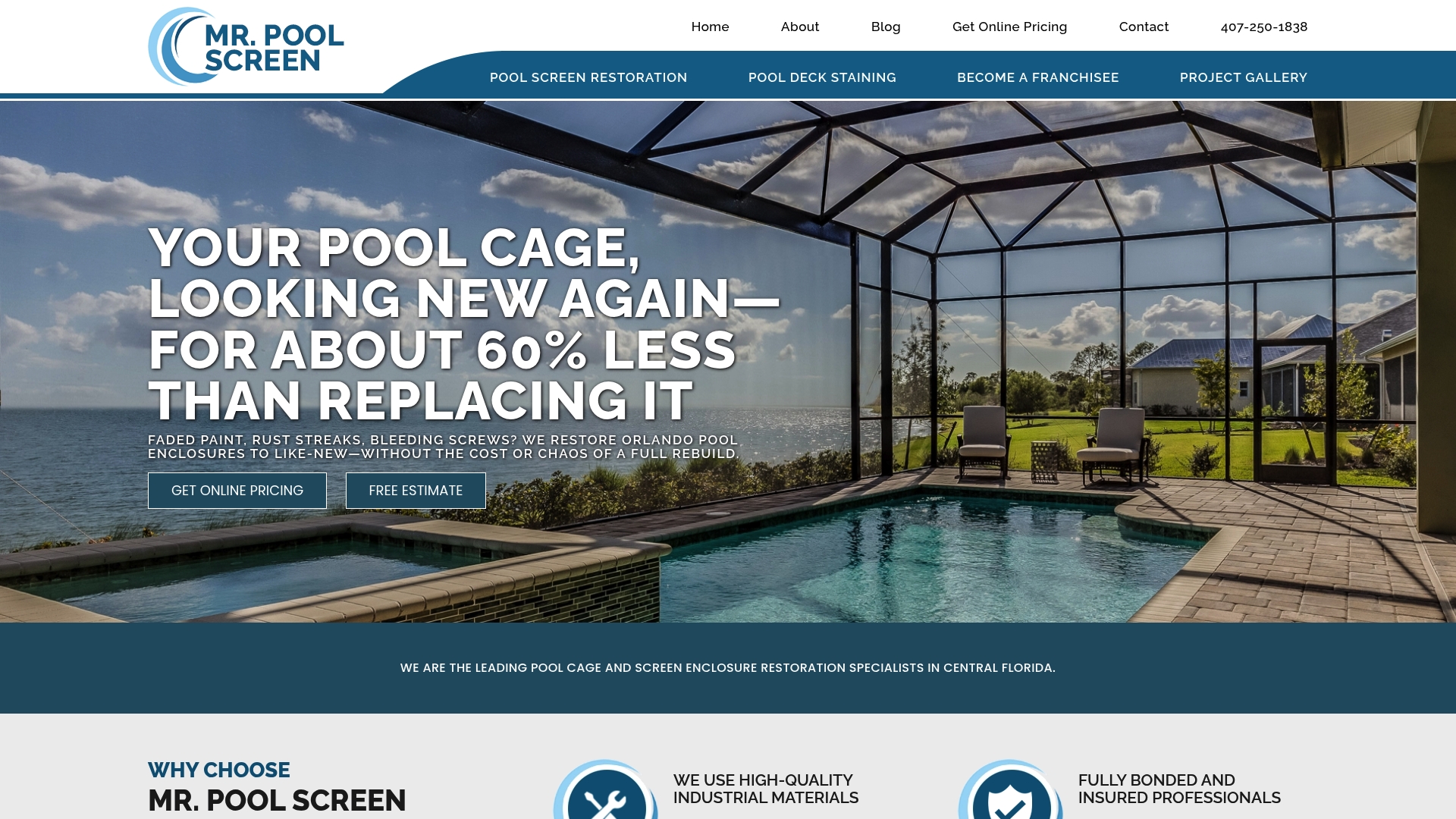
Replacing a pool cage costs $15,000–$30,000 or more. Mrpoolscreen’s pool screen restoration service delivers a professionally refinished enclosure for a fraction of that, with no structural compromise when the aluminum frame is sound.
Here is what the service covers:
-
Full enclosure restoration with water-based acrylic coatings built for Florida’s UV and humidity
-
Replacement of rusted fasteners with stainless steel or Nylotech hardware
-
Re-screening with multiple mesh options to match your needs
-
Pool deck staining and painting for concrete, wood, masonry, and stone
-
Written workmanship guarantee, licensed and insured
Savings of up to 60% compared to a full rebuild are typical when the structure is intact. The project gallery shows before-and-after results across a range of enclosure sizes and conditions. Ready to see what your job would cost? Get online pricing from Mrpoolscreen and receive a no-surprises estimate for your Central Florida enclosure.
Sources and further reading
The cost ranges and process details in this article draw from a combination of industry cost guides, regional contractor pricing data, and Mrpoolscreen’s own restoration documentation. Per-square-foot labor and materials figures are sourced from national cost guides; regional ranges reflect Florida market data. Process and timeline guidance reflects professional restoration standards for aluminum pool enclosures.
-
How Much Does It Cost to Rescreen or Repair a Pool Enclosure? — HomeAdvisor — per-square-foot labor and materials benchmarks
-
Pool Screen Restoration — Mrpoolscreen — restoration method, materials, and savings vs. rebuild