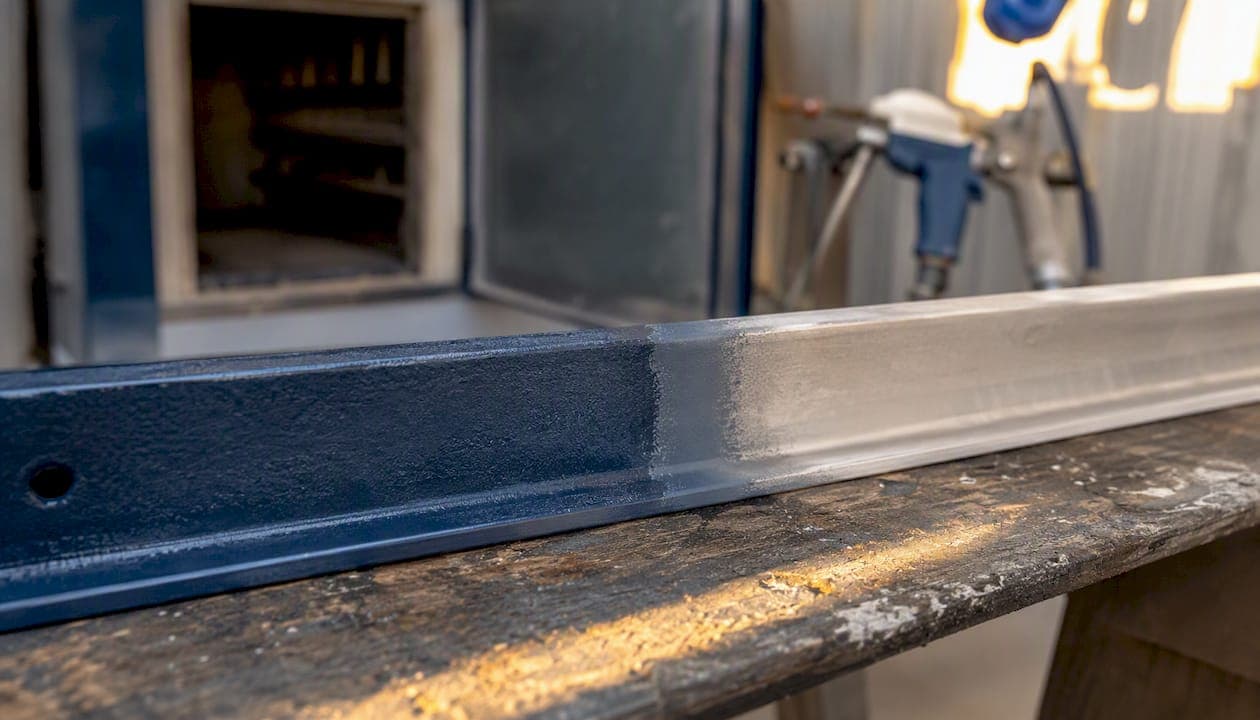
Powder coating wins for shop-applied metal parts that need to last outdoors. Liquid paint wins for field work, heat-sensitive materials, and any job where color matching or spot repairs matter. That's the short version. Shop comparisons show powder typically delivers 15–20 years of outdoor life on properly pretreated metal, while wet paint on the same exposure often needs maintenance every 3–5 years.
Quick use-case map:
- Fences, gates, outdoor furniture, wheels: Powder coating. Shop-applied, single-coat film build, long service life.
- Pool cage frames (on-site restoration): Water-based acrylic liquid paint. Oven cure isn't possible in the field; a quality acrylic applied on-site outperforms a rushed powder job on a fixed structure.
- Wood, plastic, or heat-sensitive assemblies: Liquid paint only. Powder cure temperatures rule it out entirely.
- One-off repairs or color-matched touch-ups: Liquid paint. Powder can't be matched in the field.
Key Takeaways
Powder coating outlasts liquid paint on removable metal parts by a wide margin, but liquid paint is the only practical system for on-site restoration of fixed structures like pool enclosures.
| Point | Details |
|---|---|
| Durability gap is real | Powder coating typically lasts 15–20 years outdoors; liquid paint needs maintenance every 3–5 years on comparable metal. |
| Shop vs. field is the deciding factor | Powder requires oven cure at 350–400°F, making it impossible for on-site or fixed-structure work. |
| Lifecycle cost favors powder at scale | Fewer recoats and 95–98% material efficiency make powder cheaper over time for removable parts. |
| Water-based acrylics are the right field system | For pool enclosures and on-site restoration, water-based acrylics deliver UV resistance, low VOCs, and ambient-temperature cure. |
| Mrpoolscreen's approach | Mrpoolscreen uses water-based acrylics and stainless fasteners for on-site pool cage restoration in Central Florida, saving homeowners up to 60% vs. a full rebuild. |
Table of Contents
- How does powder coating actually work?
- How liquid paint works and where it fits
- Powder coating vs paint: head-to-head comparison
- How durable is powder coating compared to paint?
- What does powder coating vs painting actually cost?
- Can you repair powder coating in the field?
- Environmental and health differences between powder and paint
- Which substrates and jobs suit each system?
- Pool-enclosure restoration: why Mrpoolscreen uses water-based acrylics on-site
- How to decide: a checklist and the right questions to ask
- The coating choice most homeowners get wrong
- Mrpoolscreen restores pool cages in Central Florida
- Authoritative sources and further reading
How does powder coating actually work?
Powder coating starts as dry, pigmented resin particles, typically polyester, epoxy, hybrid, or TGIC-free polyester, electrostatically charged and sprayed onto a grounded metal part. The charge makes the powder cling uniformly before a single drop of liquid is involved. The coated part then goes into a curing oven, usually at 350–400°F, where the powder melts, flows, and cross-links into a continuous film.
That cross-linked chemistry is what separates powder from most liquid systems. The film isn't just dried, it's chemically bonded into a hard, flexible shell. A single pass typically builds 60–80 microns of dry film thickness (roughly 2.5–3 mils), which is what wet paint usually takes three or four coats to approach.
Formulation choices matter more than most buyers realize. Polyester powders handle UV exposure well and are the default for outdoor metal. Epoxy powders resist chemicals and corrosion but chalk outdoors. Hybrids split the difference. TGIC-free options reduce worker exposure to a specific hardener compound and are increasingly common in architectural specs.
Pro Tip: Before committing to powder, confirm the shop's oven dimensions against your part size. A pool cage frame section, a long gate rail, or an oversized panel may not fit a standard batch oven, which means the job either gets cut down or switches to a liquid system.
How liquid paint works and where it fits
Liquid paint is a suspension of pigment and binder in a carrier, either solvent or water. When applied, the carrier evaporates (or reacts, in two-component systems) and leaves a cured film behind. That basic mechanism covers everything from a brush-on latex to a high-performance two-component polyurethane sprayed in a body shop.
Application method changes the result significantly. Brush and roller work for maintenance coats but leave texture. Air spray and HVLP (high-volume, low-pressure) guns atomize the paint finely and suit decorative or architectural work. Airless sprayers push high-pressure fluid through a small tip and are fast for large surfaces. Each method affects transfer efficiency, finish quality, and how much material ends up as overspray.
Per-coat dry film thickness for liquid paint typically runs 15–20 microns. Reaching the 60–80 micron range that powder achieves in one pass means three to four coats, with flash-off time between each. That adds labor and scheduling time, though it also means you can build film incrementally and adjust color between coats.
The practical advantages of liquid paint are real: it handles field application, heat-sensitive substrates, and on-site touch-up in ways powder simply cannot. Water-based acrylics, specifically, cure at ambient temperature, carry low odor, and are compatible with aluminum and steel frames that can't leave the job site. For pool enclosure restoration in Central Florida, that's not a compromise. It's the right tool.
Powder coating vs paint: head-to-head comparison
Powder coating gives a tougher, longer-lasting finish while liquid paint is easier to repair in the field. The table below maps the decision dimensions that actually matter when choosing between the two systems.
| Dimension | Powder Coating | Liquid Paint |
|---|---|---|
| Durability / lifespan | A long lifespan outdoors on metal with proper prep | A shorter period before maintenance is needed in comparable exposure |
| Upfront vs lifetime cost | Higher setup cost; lower lifetime cost due to fewer recoats | Lower entry cost; higher lifetime cost from recoat cycles |
| Environmental impact / VOCs | 100% solids; near-zero VOC emissions during cure | Solvent-borne systems emit VOCs; water-borne systems are lower |
| Application setting / repairability | Shop only (oven required); field touch-up not possible to match | Field-applicable; spot repairs blend well with original finish |
| Substrate compatibility | Metal only; cure temps rule out plastics, wood, rubber, electronics | Metal, wood, plastic, masonry, heat-sensitive assemblies |
| Color options & matchability | Wide range; custom colors possible but hard to match in field | Virtually unlimited; precise color matching available |
| DFT / ASTM B117 salt spray | Relatively thick coating and long salt spray resistance with phosphate pretreat | Thinner coating; performance varies by system and preparation |
| Throughput / productivity | High for batch runs; oven cycle adds fixed time | Flexible; faster for small runs or single parts |
The transfer efficiency gap is worth pausing on. Optimized powder operations recover overspray and reach 95–98% material efficiency, while liquid paint spray typically lands at 50–70%. At scale, that difference shows up directly in material cost and waste disposal.
How durable is powder coating compared to paint?
The durability gap comes down to film chemistry and thickness. Powder's cross-linked film resists scratching, chipping, and impact better than most liquid systems at equivalent thickness, and it usually runs two to four times thicker in a single coat.
Salt-spray testing under ASTM B117 is the standard accelerated corrosion test. A bare steel panel with no pretreatment might fail in under 100 hours. Add a zinc phosphate conversion coat before powder, and the same panel can exceed 1,000 hours. Liquid paint on a properly prepared substrate also improves dramatically with pretreatment, but powder's thicker film and cross-linked chemistry give it a consistent edge in side-by-side tests.
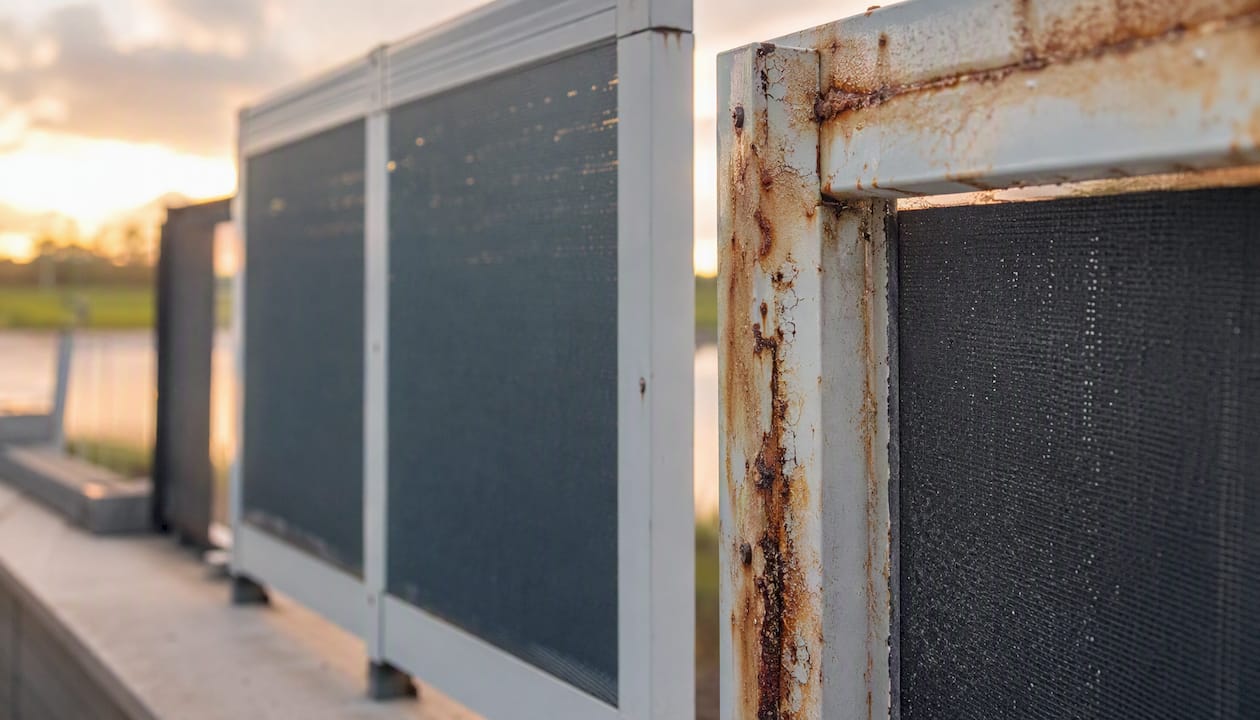
Bend and flexibility tests tell a similar story. Powder films, especially polyester-based outdoor formulations, flex with the substrate rather than cracking at bends. Liquid paint, particularly single-component systems, can crack at sharp bends if the film is too thick or the binder too rigid.
| Metric | Powder Coating | Liquid Paint |
|---|---|---|
| Typical DFT (single coat) | Approximately 60–80 microns | Approximately 15–20 microns |
| Coats to reach 60+ microns | One coat | Multiple coats |
| ASTM B117 (with phosphate prep) | Typically shows long resistance | Varies widely by system |
| Expected outdoor lifespan (metal) | Generally longer | Generally shorter with maintenance cycle |
One caveat worth stating plainly: poor pretreatment erases powder's advantage. A powder coat over rust or mill scale will fail faster than a well-applied liquid system over a properly blasted surface. The coating is only as good as what's underneath it.
What does powder coating vs painting actually cost?
Upfront, powder coating costs more. A shop needs a spray booth, an electrostatic gun, and a curing oven. That capital investment gets spread across jobs, so per-part costs drop at volume but never disappear. Liquid paint requires a spray booth for quality work but no oven, which lowers the barrier to entry.
Where the math flips is lifecycle cost. A powder-coated fence or gate that lasts 15–20 years with no recoat competes favorably against a painted version that needs stripping and repainting every 3–5 years. Each recoat cycle brings labor, surface prep, and material costs. When wet paint fails, it often triggers expensive strip-and-prepare steps that don't show up in the original quote.
The Powder Coating Institute's Coatings Comparison Calculator is the right tool for a true apples-to-apples comparison. It accounts for transfer efficiency, labor, energy, and disposal, not just material price per gallon.
A simplified 10-year example for a set of aluminum pool cage frames:
- Powder coating: Single application, higher upfront cost, no recoat needed within the period.
- Liquid paint (standard): Lower upfront cost, but one or two full recoat cycles within 10 years, each requiring prep labor.
- Water-based acrylic (on-site): Competitive upfront cost, field-applied without transport, recoat interval depends on coating quality and climate exposure.
Items to confirm when comparing quotes:
- Surface prep method (chemical wash, phosphate, sandblast) and who pays for it
- Specified DFT and how it's verified
- Transport costs if parts must leave the site
- Masking scope for hardware, glass, and adjacent surfaces
- Touch-up scope and warranty coverage after installation
Pro Tip: Ask every contractor to quote the same DFT target and pretreatment spec. A lower price that skips phosphating or specifies thinner film isn't a better deal. It's a shorter service life.
Can you repair powder coating in the field?
No, not to match the original finish. That's the clearest limitation of powder coating for homeowners. Once a powder-coated part is installed, any chip, scratch, or corrosion spot can only be addressed with a liquid touch-up paint, which won't perfectly match the original color or sheen. For a fence or gate that can be removed and sent back to the shop, a full strip and recoat is the clean solution. For a fixed structure, you're working with liquid from that point forward.
Powder suits removable metal parts and shop-applied durable finishes; liquid coating is preferred for field application and heat-sensitive substrates. That's not a knock on powder. It's just the physics of needing an oven.
Large or fixed assets, like pool enclosures, pergola frames, or structural aluminum, present a logistics problem for powder coating. Disassembly, transport, coating, and reinstallation add cost and time. For a full rebuild or new construction, powder on individual components before assembly makes sense. For a restoration of an existing structure, liquid paint applied on-site is the practical answer.
Hybrid approaches exist. Some contractors powder-coat replacement components in the shop, then use a matched liquid system for field touch-up and transition areas. The key is specifying the touch-up scope in the contract before work starts, not after the first chip appears.
Pro Tip: When getting a restoration quote, ask specifically: "What is the touch-up protocol if the coating chips in year two?" A contractor who has a clear answer, including the product they'll use and whether it's covered under warranty, is worth more than one who quotes a lower price with no answer.
Environmental and health differences between powder and paint
EPD data confirms powder coatings are 100% solids and do not emit VOCs during application and curing. That's a meaningful difference from solvent-borne liquid systems, which release volatile organic compounds as the carrier evaporates. Water-borne liquid paints are significantly better than solvent systems on VOCs but still aren't zero-emission.
For homeowners, the practical implications are:
- Powder coating shops don't produce solvent-laden air emissions during application, which simplifies regulatory compliance and reduces odor near residential areas.
- Overspray from powder can be collected and reused, which is why transfer efficiencies of 95–98% are achievable in optimized operations. Liquid overspray is waste.
- Solvent-borne liquid paint requires proper ventilation, respiratory protection, and disposal of solvent-contaminated waste streams. Water-borne systems are easier to handle but still require proper disposal.
- Worker exposure to powder during application requires respiratory protection against fine particulates. It's a different hazard than solvent exposure, but not zero risk.
For on-site pool enclosure restoration, water-based acrylics are the responsible choice. Low odor, no solvent emissions, and safe for use around occupied homes. Homeowners with children or pets nearby don't need to vacate for days. That's a real-world advantage that doesn't show up in a lab test.
For a broader look at how VOC emissions factor into home renovation decisions, UPVC respraying vs replacement offers a useful parallel from the window and door refinishing world.
Which substrates and jobs suit each system?
The substrate determines the system more than any other factor. Powder coating requires metal that can be grounded, handled through a spray booth, and placed in an oven. That covers steel, aluminum, and most ferrous and non-ferrous metals. It does not cover wood, most plastics, rubber, or any assembly with pre-installed electronics or heat-sensitive components.
Powder coating is the right call for:
- Removable metal parts: wheels, rims, gates, fences, outdoor furniture frames
- New construction components before assembly (pool cage sections, railings, brackets)
- Industrial or commercial parts needing consistent, high-volume throughput
- Any metal part where maximum corrosion resistance and long service life justify the shop logistics
Liquid paint is the right call for:
- On-site structures that can't be disassembled: pool enclosures, pergolas, existing railings
- Wood, composite, masonry, and stone surfaces
- Heat-sensitive assemblies with rubber seals, plastics, or electronics
- Color-critical work requiring precise field matching
- Small runs, one-off repairs, or projects where transport cost exceeds coating benefit
Pool enclosures in Central Florida sit squarely in the liquid paint column. The aluminum frames are fixed, the mesh is already installed, and the structure can't go into an oven. Water-based acrylics applied on-site handle the humidity, UV exposure, and salt air that Central Florida delivers year-round. For pool cage upkeep in that climate, coating selection is one of the most consequential decisions a homeowner makes.
Pool-enclosure restoration: why Mrpoolscreen uses water-based acrylics on-site
A typical pool cage restoration project starts with the same set of problems: chalky or peeling paint on aluminum frames, rust bleeding from steel fasteners, and screen mesh that's either torn or sagging. The structure is sound, but it looks neglected and the corrosion is spreading.
Mrpoolscreen's approach addresses each failure point directly. Rusted fasteners are replaced with stainless steel or Nylotech hardware, which eliminates the primary corrosion source. Frames are cleaned, treated for any remaining rust, and repainted with water-based acrylic coatings suited for on-site application. The result is a restored enclosure that can save homeowners up to 60% compared to a full rebuild, without the disruption of disassembly.
The choice of water-based acrylics isn't a compromise. It's the technically correct decision for field restoration work.
Water-based acrylics cure at ambient temperature, carry near-zero VOC emissions, and bond well to properly prepared aluminum and steel. For a fixed structure in a Florida climate, they deliver the color retention, UV resistance, and flexibility that the application demands, without requiring the homeowner to disassemble and transport a structure that was never designed to be moved.
For coastal or near-coastal properties, where salt air accelerates corrosion on any exposed metal, the fastener upgrade matters as much as the coating. Stainless steel fasteners paired with a quality acrylic topcoat outperform a powder-coated frame held together with corroding carbon steel hardware.
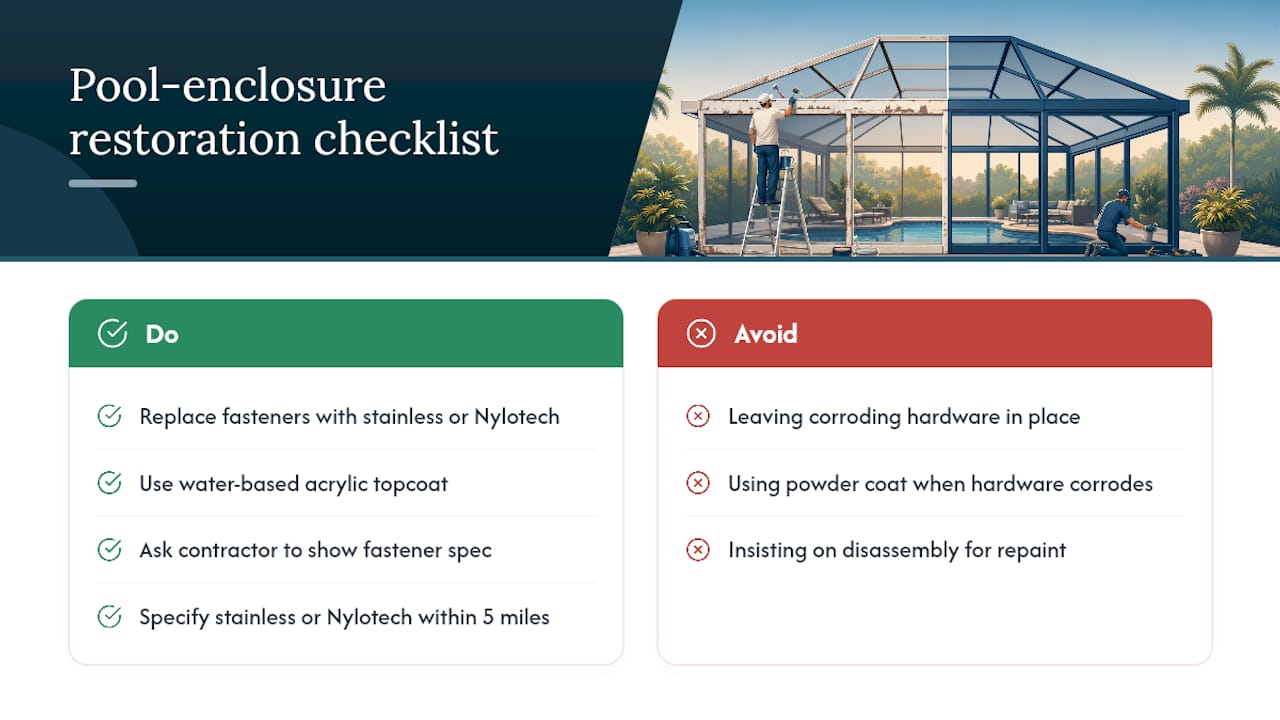
Pro Tip: If your pool cage is within five miles of the coast or a saltwater body, specify stainless steel or Nylotech fasteners explicitly in your restoration contract. Ask the contractor to show you the fastener spec before work begins. Coating the frame while leaving corroding hardware in place is a short-term fix.
For more on what drives frame corrosion and how to address it before recoating, pool screen frame corrosion covers the failure modes in detail.
How to decide: a checklist and the right questions to ask
The decision between powder coating and liquid paint comes down to six factors. Work through them in order:
Decision checklist:
- Can the part be removed and transported to a shop? If no, liquid paint is your system.
- Is the substrate metal only, or does it include wood, plastic, or rubber? Non-metal substrates require liquid paint.
- What's the target service life? 15+ years with minimal maintenance points to powder; 5–7 years with planned recoats is workable with quality liquid systems.
- Is color matching to an existing finish required? Liquid paint gives far more flexibility.
- What's the budget structure? Higher upfront cost with lower lifecycle cost (powder) vs. lower upfront with periodic recoat costs (liquid).
- Are there environmental or occupancy constraints on-site? Water-based liquid systems are the low-impact choice for occupied homes.
Questions to ask your contractor or coating shop:
- What DFT will you achieve, and how do you verify it?
- What pretreatment process do you use (chemical wash, phosphate, blast)?
- What's the warranty, and does it cover touch-up and corrosion?
- For powder: what's your oven size, and does my part fit without modification?
- For liquid: what's the VOC content of the coating, and is it water-borne?
- What's your touch-up protocol if the coating fails within the warranty period?
Pro Tip: Ask for a hybrid quote when you have a mix of removable and fixed components. New replacement sections can be powder-coated in the shop; existing fixed frames get a matched liquid system on-site. Specify that the contractor will provide the liquid touch-up product for your records so you can handle minor chips yourself.
The coating choice most homeowners get wrong
Most people frame this as powder coating vs. paint and assume powder wins automatically. It doesn't. Powder wins for the specific conditions it was designed for: a shop environment, a metal part that can be moved, and a batch process where oven cure is practical. Outside those conditions, it's not the better system. It's just the more expensive one.
What actually matters for a pool enclosure in Florida is whether the coating can be applied correctly on-site, whether it bonds to aluminum that's been properly cleaned, and whether it holds up to UV, humidity, and the occasional pressure wash. A water-based acrylic applied over well-prepared aluminum with stainless fasteners holding everything together will outlast a powder coat applied to a structure with corroding hardware and inadequate prep. The coating is the last line of defense, not the first.
The other thing most guides skip: the recoat cost for liquid paint is only painful if you ignore it at the quoting stage. Build it into the lifecycle math from day one, use the Powder Coating Institute's calculator for removable parts, and get a contractor who will specify DFT and pretreatment in writing. The homeowners who end up unhappy are almost always the ones who compared sticker prices without comparing specs.
For pool enclosures specifically, the question isn't really powder vs. paint. It's whether you're working with a contractor who understands the substrate, the climate, and the difference between a coating that looks good on day one and one that still looks good in year eight.
Mrpoolscreen restores pool cages in Central Florida
A deteriorating pool enclosure doesn't need to be replaced. Mrpoolscreen's restoration service addresses rust, peeling paint, and worn screens at a fraction of full rebuild cost, typically saving homeowners up to 60% while extending the life of the structure by years.
The process uses water-based acrylic coatings applied on-site, stainless steel or Nylotech fasteners to eliminate the corrosion source, and re-screening with the mesh type that fits your needs. No disassembly, no transport, no weeks without your pool area. Work is done at your property, usually within one to three days depending on scope.
If your cage is showing rust stains, chalky frames, or torn screens, the pool screen restoration service page has full details on what's included. You can also request a free estimate directly, and Mrpoolscreen will assess your enclosure and give you a clear scope and price before any work begins.
Authoritative sources and further reading
- Powder Coating vs Paint: Coating Differences, Uses & Limitations
- Powder Coating vs Liquid Painting: Which Is Right for Your Project? | Moorhouse Blog
- Powder Coating Institute – Coatings Comparison Calculator (product page)
- Environmental Product Declaration – POWDURA® ECO - TGIC Free
- Powder Coating vs Wet Paint: The Real Numbers After 15 Years in the Shop
- Powder Coating vs Liquid Paint: OEM Guide for Large-Scale Mfg
- Liquid or powder coating: which one to prefer and why? (RIPOL)
- Powder Coating vs. Paint (Finishing Systems blog)
- Powder Coating vs Paint: An In-Depth Comparison (SendCutSend blog)