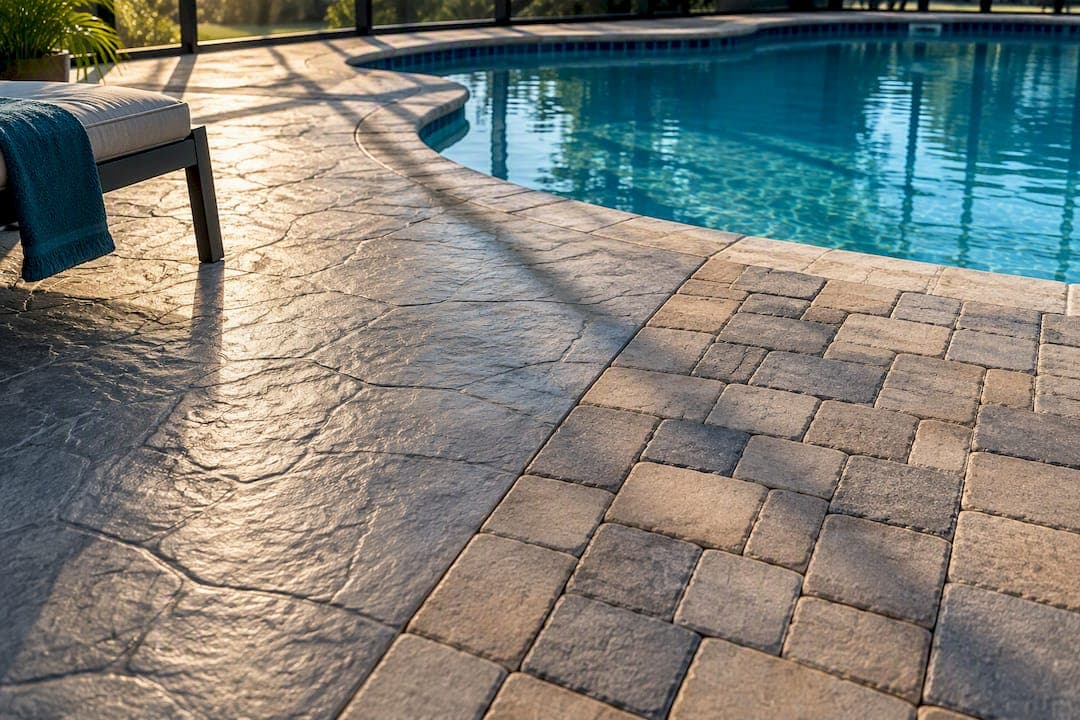
If your existing slab is structurally sound and you just want a fresher look, refinishing or staining stamped concrete is usually the cheaper, faster fix. If your deck is cracking, settling, or you're tired of scorching your feet every July, pavers over that same concrete are the better long-term move. A site inspection still decides the final call, since hidden slab damage changes the math on cost and lifespan either way.
TL;DR:
- Refinishing stamped concrete is cheaper upfront but requires resealing every one to three years to maintain color and slip resistance.
- Installing pavers over an existing slab offers greater durability, with a lifespan of 15 to 25 years, and easier, quicker repairs for individual units.
- Pavers handle ground movement better due to their modular nature, making them more suitable for shifting soils and low spots.
- Both options perform differently in hot climates, with lighter pavers staying cooler and pavers flexing better on sandy or expansive soils.
- Full slab replacement is costly and disruptive but necessary if the slab has major structural damage or persistent drainage issues.
Table of Contents
- Stamped Concrete Vs Pavers: How Each Process Actually Works
- Pros and Cons: Which Fits Your Priorities?
- What Do Stamped Concrete and Pavers Cost, and How Long Do They Take?
- Maintenance: What Ongoing Upkeep Actually Looks Like
- Full Replacement, Refinish, or Pavers: How to Decide
- Design Options: Matching Style to Material
- Environmental Impact: Which Material Has a Lighter Footprint
- Drainage: Why Water Movement Changes the Right Choice
- Does Climate Change Which Option Makes Sense?
- Resale Value: Does the Material Choice Actually Matter?
- What Warranties Should You Expect?
- An Editorial Take: The Restoration Bias Most Guides Miss
- How Mr. Pool Screen Can Help With Your Pool Deck
- Sources
- FAQ
Stamped Concrete Vs Pavers: How Each Process Actually Works
Refinishing stamped concrete and installing pavers over an old slab are almost opposite philosophies. One renews a surface that's already there. The other builds a new, modular surface on top of it.
Staining or resurfacing stamped concrete starts with cleaning the slab, patching minor cracks, and applying a stain or acrylic topcoat, usually finished with an anti-slip additive broadcast into the sealer. The catch is that this is a topical fix. Pool chemicals, chlorine splash, and Florida sun break down acrylic sealers faster than almost any other outdoor coating, which is why stamped concrete needs more frequent resealing than most homeowners expect. Skip a cycle and the surface loses grip long before it loses color.
Pavers over concrete work differently. This only works when the existing slab is structurally sound, because the slab becomes the base layer. Installers clean and level it, add a bedding layer of sand or thin mortar, set the pavers, lock the perimeter with edge restraints, and sweep polymeric sand into the joints to lock everything in place.
A few things separate the two approaches once they're in the ground:
- Repairability: A cracked or stained paver can be pulled and swapped in minutes. A damaged patch of stamped concrete usually needs a color match that never blends perfectly.
- Modularity: Pavers shift slightly with ground movement instead of cracking outright, which matters more than most people realize until they've watched a slab split down the middle.
- Surface heat: Light-colored pavers stay noticeably cooler underfoot, while dark stamped concrete can reach very high surface temperatures on bright afternoons, potentially causing discomfort.
- Slip resistance: Stamped concrete needs an anti-slip additive reapplied with every reseal, while textured paver surfaces hold their grip without a maintenance cycle.
- Lifespan: Pavers commonly last 15 to 25 years or more, while stamped overlays typically run 10 to 15 years before they need another full refinish.
Pros and Cons: Which Fits Your Priorities?
- Stamped concrete refinishing. Upfront cost is the lowest of any option here, and a crew can usually finish in one to three days. The tradeoff shows up later: it needs resealing every few years to hold color and grip, and any crack repair tends to leave a visible patch. Surface heat is also a real concern on dark colors during peak summer.
- Pavers over concrete. Installed cost runs higher than a simple refinish, but you're buying 15 to 25 years or more of service life and a surface where individual units can be swapped without a color-match headache. Barefoot comfort is noticeably better on lighter-toned pavers, and slip resistance holds up without a reapplication schedule.
- Full slab replacement. This is the most disruptive and expensive route, but it's the only real answer when the substrate itself has failed. It resets the clock on lifespan and gives you a clean base for either stamped concrete or pavers going forward.
For a homeowner who wants the cheapest path to a better-looking deck this season, refinishing wins. For someone planning to stay in the house another decade and wants to stop dealing with hot feet and hairline cracks, pavers usually pay for themselves in avoided maintenance.
What Do Stamped Concrete and Pavers Cost, and How Long Do They Take?
Budgets vary by region, slab condition, and pattern complexity, but the general bands hold up across most quotes homeowners get.
Pro Tip: Get at least two on-site estimates before committing. A quote made from photos alone almost never catches hairline cracks or drainage slope issues that change the price.
A concrete overlay typically runs $3 to $10 per square foot, full stamped concrete refinishing lands around $8 to $15 per square foot, pavers installed over an existing slab run $10 to $20 per square foot, and a full replacement climbs to $15 to $30 per square foot.
Timeline follows the same pattern. Pavers installed over concrete typically wrap in three to five days because there's no demolition involved. A full replacement, by contrast, usually takes 10 to 14 days once you factor in demolition, regrading, pouring, and curing. Weather delays curing time on any concrete work, and if a contractor finds substrate damage mid-project, expect the schedule to stretch further while they address it before moving forward.
Maintenance: What Ongoing Upkeep Actually Looks Like
Stamped concrete demands a tighter maintenance calendar than most homeowners plan for. Pool chemicals and constant UV exposure break acrylic sealers down faster than almost any other outdoor application, which is why owners who skip a reseal cycle often notice fading and reduced slip resistance within a year or two.
- Reseal stamped concrete every 1 to 3 years depending on sun exposure and pool chemical use.
- Reapply anti-slip additive with each reseal, not just the initial installation.
- Sand and reseal paver joints roughly every 2 to 4 years to keep polymeric sand locked in place.
- Spot-replace individual cracked or stained pavers as needed rather than resurfacing the whole deck.
- Use a penetrating sealer rather than a topical one on pavers near saltwater pools, since it resists chloride damage better over time.
Small resealing jobs on stamped concrete are within reach for a confident DIYer, but joint work on pavers and any color-matching on stamped surfaces is where hiring a specialist pays off. A detailed guide on stone and masonry deck sealing walks through when a homeowner can handle it solo and when it's smarter to call in help.
Full Replacement, Refinish, or Pavers: How to Decide
Run through this before you call a contractor:
- Measure your cracks. Cracks wider than a quarter inch, exposed rebar, or repeated drainage failures point to full replacement, not a surface fix.
- Check crack pattern. Hairline cracks limited to control joints are usually safe to refinish; random spiderweb cracking suggests the slab itself is failing.
- Consider your soil. In sandy or shifting soil common across much of Florida, pavers tend to outperform monolithic slabs long-term because they flex instead of cracking.
- Weigh your timeline. If you need the deck usable within a week, pavers-over-concrete beats a full tear-out.
- Ask your contractor: What's the slab's current condition? Will pavers void any existing warranty? What's the anti-slip plan? How often will this need resealing or joint work? What's included if a repair is needed in year three?
Design Options: Matching Style to Material
Stamped concrete wins on pattern variety in a single continuous surface. You can mimic slate, wood, flagstone, or brick in one seamless pour, which makes it a strong fit for curved deck edges or free-form pool shapes where cutting individual pavers would be expensive and slow.
Pavers offer something stamped concrete can't fake as convincingly: genuine texture and dimension. Because each unit is a separate piece, you get real depth between joints, the option to mix colors in a running bond or herringbone pattern, and an easy way to add a contrasting border without repainting anything. Travertine pavers in particular have become a popular high-end choice around pools because they combine that natural stone look with cooler surface temperatures.
The tradeoff is repair versus refresh. If your stamped pattern fades or a section cracks, matching the exact stamp texture and color years later is genuinely difficult, even for experienced crews. A faded paver, by comparison, gets pulled and swapped without disturbing the rest of the deck. If your design priority is a continuous, uninterrupted surface, stamped concrete still delivers that better than any paver layout can.
Environmental Impact: Which Material Has a Lighter Footprint
Refinishing an existing slab is the lower-impact choice by default, simply because it reuses material that's already in the ground instead of manufacturing and transporting new product. Staining or resurfacing generates far less construction waste than any option that involves demolition.
Pavers carry a heavier upfront environmental cost, since manufacturing concrete or stone units and trucking them to your site both add carbon impact that a resurface skips entirely. But pavers claw some of that back over time. A single cracked unit gets replaced instead of resurfacing an entire deck, which means less material waste over a 20 year span compared to redoing a full stamped concrete surface every decade or so.
Full replacement is the heaviest footprint of the three, combining demolition debris with new material production. If sustainability is a real priority alongside budget, refinishing an existing slab that's still structurally sound is the option that keeps the most material out of a landfill.
Drainage: Why Water Movement Changes the Right Choice
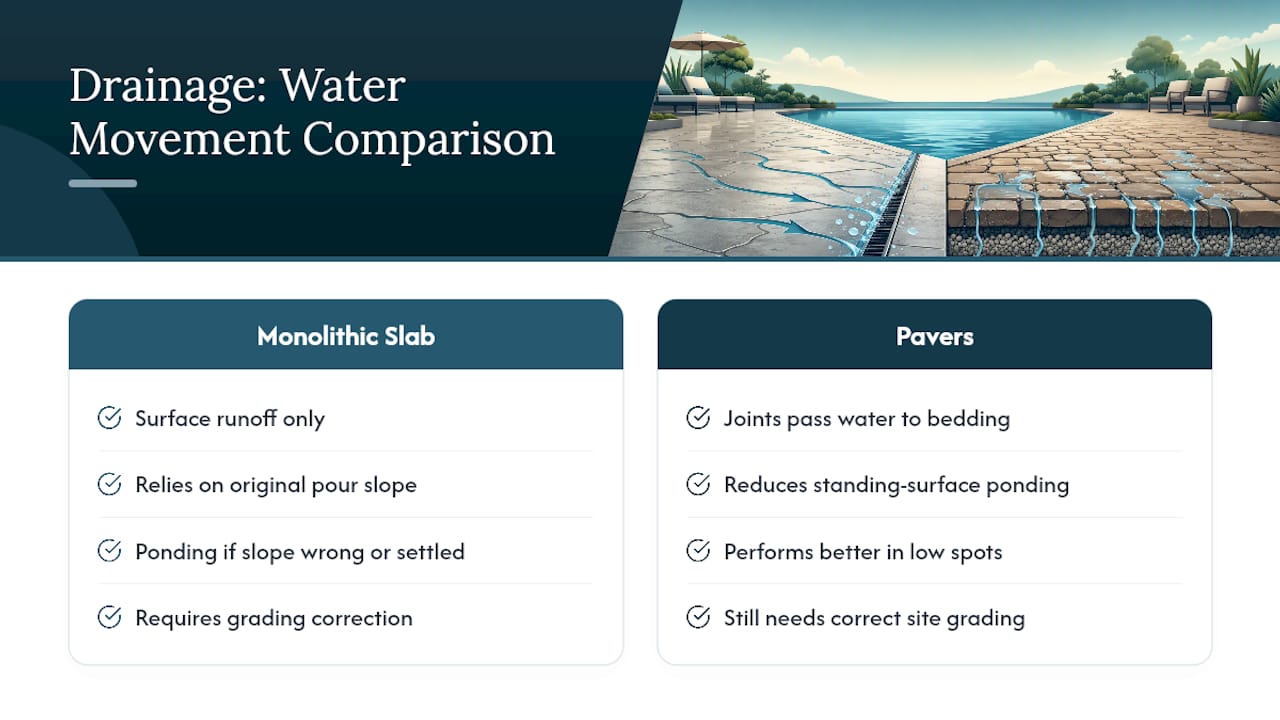
A monolithic slab, whether plain or stamped, relies entirely on its original pour slope to move water away from the pool. If that slope was cut wrong at installation, or if the ground beneath it has settled since, water pools on the surface. That standing water is exactly the kind of persistent drainage failure that pushes a deck toward full replacement rather than a simple reseal.
Pavers handle water differently. The joints between units let some water pass through to the bedding layer below rather than forcing every drop to run across the surface, which reduces the standing-water problem that plagues aging slabs. That's part of why pavers tend to perform better in low spots or areas where a slab has already shown mild ponding.
Neither option fixes a grading problem on its own. If your yard slopes water toward the house instead of away from the pool, that's a site issue a contractor needs to address before laying either material, and it's worth asking about directly during your estimate.
Does Climate Change Which Option Makes Sense?
Heat and humidity punish these materials differently. In hot, sun-heavy climates, dark stamped concrete absorbs and holds heat far more aggressively than lighter pavers, which is a real barefoot safety issue for kids and pets during peak afternoon hours.
Soil behavior matters just as much as temperature. In sandy or expansive soil common across much of Florida, pavers tend to outperform a rigid slab because individual units flex with minor ground shifts instead of cracking under stress. A monolithic pour has no give, so the same soil movement that a paver joint absorbs shows up as a crack line in concrete within a few seasons.
Humidity and frequent rain add another wrinkle for both materials, since standing moisture accelerates sealer breakdown on stamped concrete and can wash out unstabilized paver joint sand if it isn't polymeric. Homeowners in consistently wet regions should ask contractors specifically about drainage slope and joint sand type rather than assuming any standard installation will hold up the same way it would in a drier climate.
Resale Value: Does the Material Choice Actually Matter?
Buyers touring a home with a pool notice the deck before almost anything else outside. A cracked, faded slab reads as deferred maintenance, even if the pool itself is in perfect shape, and that impression can shave real dollars off a buyer's opening offer.
Pavers tend to carry a slight resale edge because appraisers and buyers alike associate them with a premium, custom build rather than a standard concrete pour. That perception holds even when the actual price difference between a well-maintained stamped deck and a paver deck is smaller than buyers assume.
That said, a freshly refinished stamped concrete deck in good condition photographs well and shows fine on a listing. The bigger resale risk isn't the material, it's neglect. A deck of either type that's overdue for maintenance sends the same negative signal to a buyer's inspector, so the more relevant question for resale value is upkeep history, not which material sits underfoot.
What Warranties Should You Expect?
Warranty terms vary by installer, but a few patterns show up consistently across quotes. Refinishing and staining work often carries a shorter warranty window than a full paver installation, since it's a topical treatment rather than a structural build, and most reputable contractors will spell out what's covered if the sealer fades or peels early.
Paver installations, because they involve more labor and materials, often come with a longer warranty covering settling, shifting, and joint sand loss, though the specific years vary by contractor and product line. It's worth asking directly whether a warranty covers labor, materials, or both, since some cover only the paver units themselves and leave labor for a callback repair uncovered.
Always get warranty terms in writing before signing, and ask what voids coverage. Pressure washing at the wrong PSI or skipping a scheduled reseal are common exclusions that catch homeowners off guard later.
An Editorial Take: The Restoration Bias Most Guides Miss
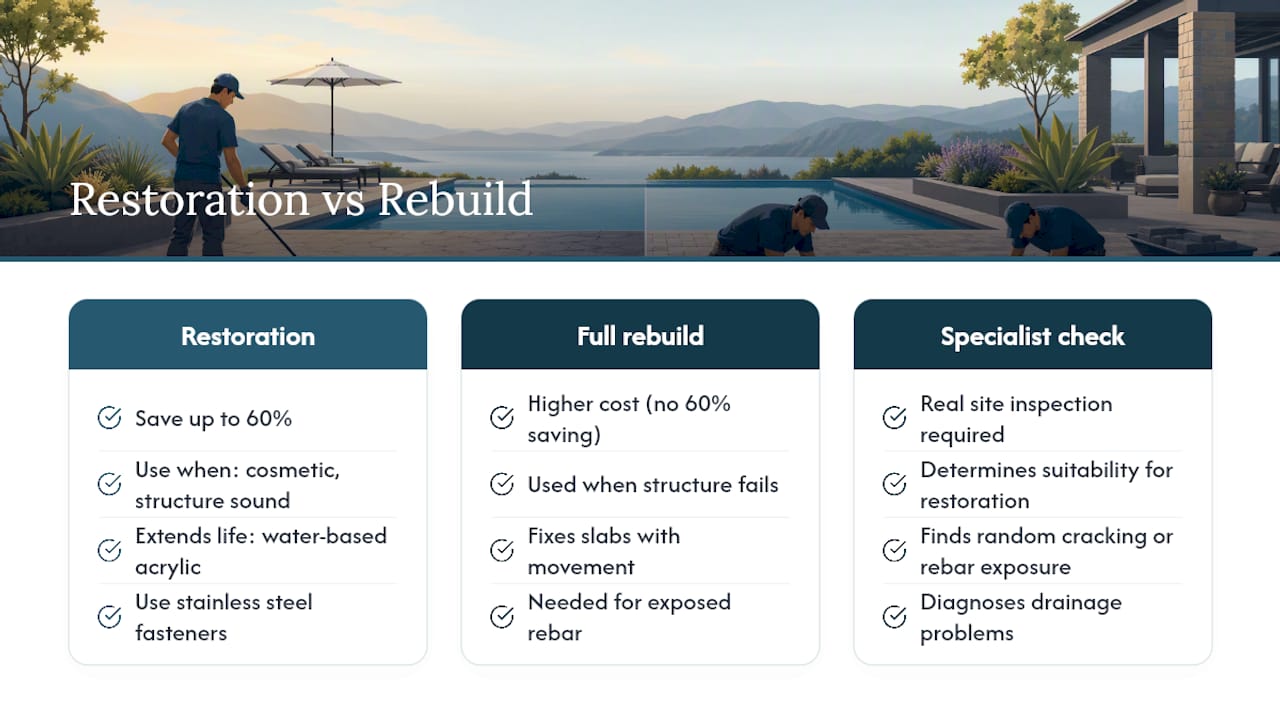
Most comparisons online treat this like a clean binary: pavers for the long haul, concrete for the budget-minded. That framing skips the most common real-world scenario, which is a homeowner staring at a deck that's ten years old, cosmetically tired, but structurally fine. In that case, the deck doesn't need a decision between two building materials. It needs restoration.
Mr. Pool Screen's documented approach to pool cage and deck restoration has shown that homeowners can often save up to 60% compared to a full rebuild by refinishing what's already there instead of tearing it out. That number only holds when the underlying structure is sound, which is exactly why a real site inspection matters more than any cost chart. Water-based acrylic coatings and stainless steel fasteners can extend the life of a restoration meaningfully beyond a bargain reseal job, but they still can't fix a slab with structural movement. If your deck shows random cracking, exposed rebar, or drainage that won't resolve no matter how many times you regrade it, restoration isn't the answer. A specialist assessment is the fastest way to find out which category your deck actually falls into.
— Michel
How Mr. Pool Screen Can Help With Your Pool Deck
If your slab still has good bones, refinishing it costs a fraction of what pavers or a full rebuild would run, and Mr. Pool Screen's pool deck staining service is built exactly for that situation. It's the option for homeowners who want their deck looking new again without the disruption of a multi-week replacement project.

Every job starts with an honest look at what's actually going on beneath the surface, including whether your existing coating needs full removal or just prep and a fresh application. If your pool cage is showing the same wear and tear as your deck, the pool screen restoration service addresses rust, weathering, and loose fasteners with stainless steel hardware built to outlast a standard patch job. Before your estimate, have a few photos ready, note any cracks or areas that pool regularly, and mention if you're working around an upcoming event. If safety monitoring around the pool area is also on your mind, this guide to pool-area security cameras is worth a look too. Reach out through Mrpoolscreen to schedule a site visit and get a straight answer on whether your deck is a refinish candidate or needs something more.
Sources
- Pool Deck Resurfacing Options: Pavers Over Concrete Vs. Full Replacement - Signature Landscape
- Pavers vs Concrete Around Pool: Real-World Application Showcase | BuildMat Insight
- Concrete vs Pavers Florida Pool Deck: Which Is Better?
FAQ
Is Stamped Concrete or Pavers Better Around a Pool?
It depends on your slab's condition and priorities. A structurally sound slab with only cosmetic wear usually favors refinishing stamped concrete for cost, while a cracking or settling deck favors pavers over concrete for long-term durability and cooler footing.
How Much Does It Cost to Convert Stamped Concrete to Pavers?
Installing pavers over an existing concrete slab typically runs $10 to $20 per square foot, compared to $8 to $15 per square foot for a full stamped concrete refinish. Exact pricing depends on slab condition and paver material chosen.
How Often Does Stamped Concrete Need Resealing Near a Pool?
Most stamped concrete around pools needs resealing every one to three years because pool chemicals and UV exposure break down acrylic sealers faster than in other outdoor settings. Skipping a cycle increases both fading and slip risk.
Can Pavers Be Installed Directly Over Existing Concrete?
Yes, as long as the underlying slab is structurally sound with no major cracking or drainage failure. The process involves leveling, a bedding layer, edge restraints, and polymeric sand joints, and typically finishes in three to five days.
Does Mr. Pool Screen Offer Pool Deck Staining or Restoration?
Yes. Mr. Pool Screen provides pool deck staining for homeowners refinishing an existing slab and pool screen restoration for aging enclosures. Current pricing is available through a site-specific estimate rather than a published rate.