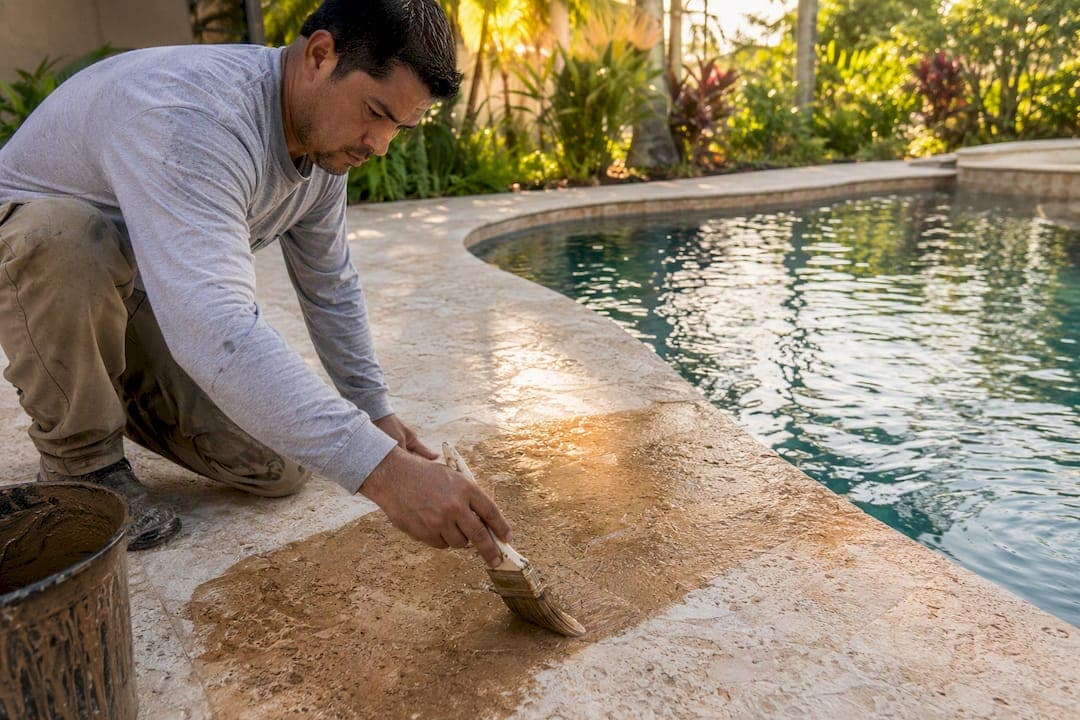
If your stone pool deck looks faded, blotchy, or stained, the fix is one of two things. Staining restores or changes the color, while sealing protects the color that's already there. You need staining when chlorine and sun have bleached the stone or left it patchy. You need sealing when the color still looks good but water is soaking in fast and stains are getting harder to lift.
Before you touch a brush or sprayer, work through this:
- Sweep and blow off debris, then rinse with a pH-neutral cleaner
- Test a hidden corner for porosity and check whether an old sealer is still active
- Confirm the timeline: clean and prep first, then stain or seal, then let it cure, then inspect before anyone walks on it
Key Takeaways
Staining restores faded stone color while sealing protects the color already there, and both depend entirely on proper prep and testing.
| Point | Details |
|---|---|
| Stain vs. seal decision | Stain to fix fading or blotching; seal to protect color that already looks right. |
| Test before you commit | Run a water-bead test and a hidden-area color test before applying any product. |
| Poultice for tough stains | Use a covered poultice for 24 to 48 hours on rust, wine, or food stains before escalating. |
| Budget realistically | Expect $3 to $8 per square foot for staining, more with heavy prep or stone resetting. |
| Call a pro for complex jobs | Mrpoolscreen handles staining and full deck restoration when prep or damage goes beyond a DIY fix. |
Table of Contents
- Stone Pool Deck Staining vs. Sealing: Which One Do You Actually Need?
- Prep and Cleaning Checklist Before You Stain or Seal
- How to Remove Rust, Wine, and Algae Stains From Stone
- Choosing and Applying the Right Stain or Sealer
- Maintenance Schedule and What the Project Will Cost
- Troubleshooting: What to Avoid and When to Stop
- Why a Professional Restoration Often Beats a DIY Weekend
- Get a Professional Assessment for Your Stone Pool Deck
- Sources
Stone Pool Deck Staining vs. Sealing: Which One Do You Actually Need?
Sealing locks in the stone's current color and blocks water, oil, and chemical intrusion. Staining changes the color, usually to fix sun bleaching, chlorine splash marks, or a deck that never looked right after installation.
Flagstone and most sandstones take stain evenly because they're porous enough to absorb pigment. Dense granites and some polished marbles resist stain and often look better simply sealed and left at their natural color. Chlorine and saltwater both pull minerals out of stone over years, and UV does the rest, fading warm tones toward gray. If your deck has gone gray or blotchy, staining is usually the only way back to a uniform look.
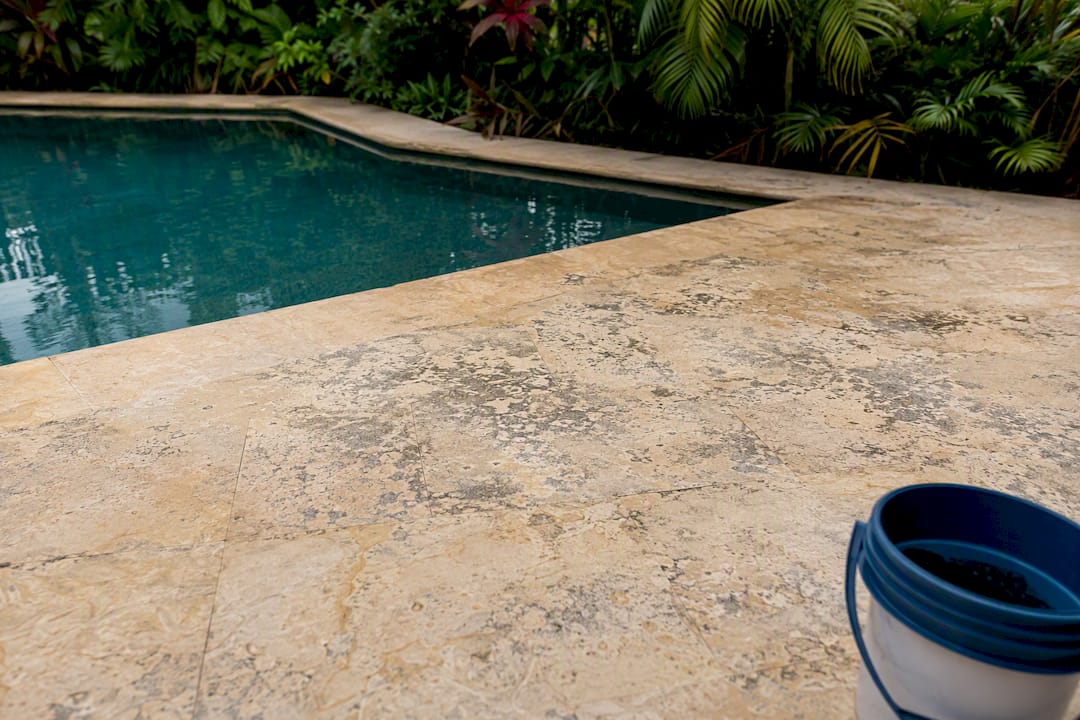
A properly sealed stone deck typically holds its finish for two to three years before it needs attention again. The most common mistake homeowners make is skipping the porosity test and applying sealer over stone that's still damp underneath, which traps moisture and clouds the finish.
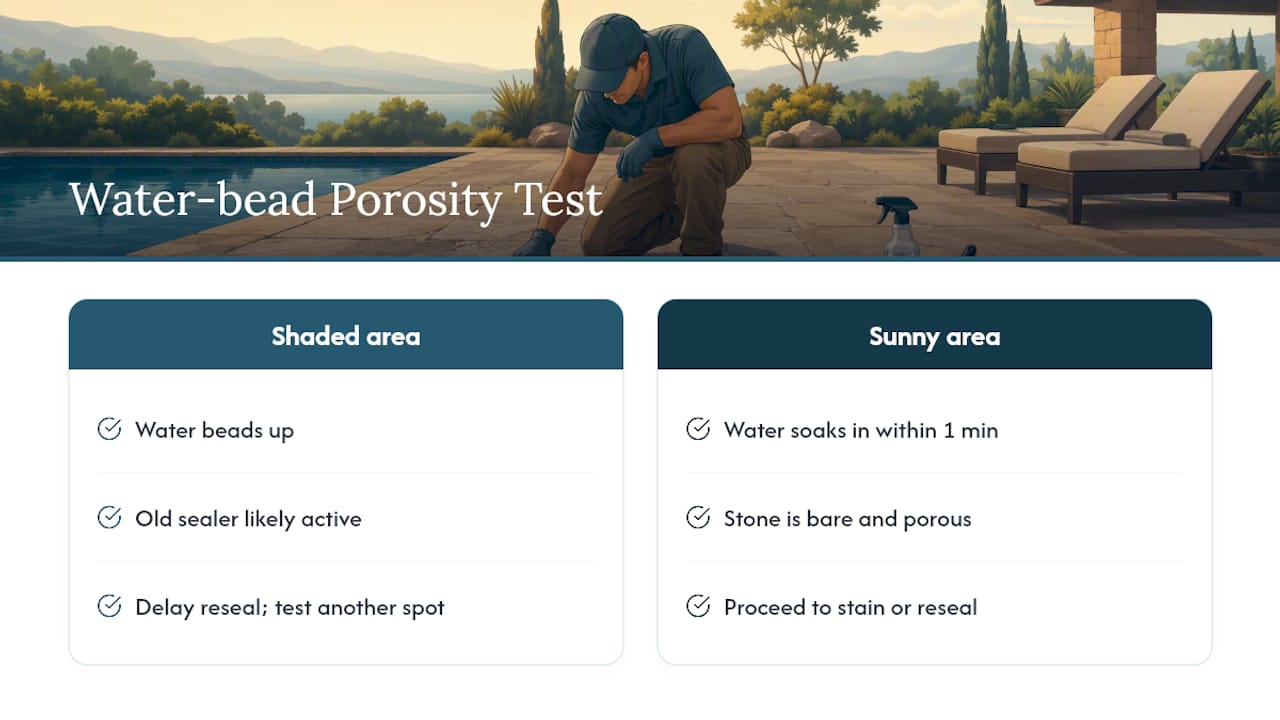
Pro Tip: Splash a few drops of water on the deck. If it beads up, an old sealer is likely still active. If it soaks in within a minute, the stone is bare and ready for product.
Prep and Cleaning Checklist Before You Stain or Seal
Skipping prep is the single fastest way to waste a full day of work. Stain and sealer only bond well to a clean, dry, bare surface, and every step below exists to get you there.
- Clear debris weekly with a broom or leaf blower so grit doesn't grind into the stone underfoot.
- Wash the deck with a pH-neutral cleaner and water, working in sections so nothing dries before you rinse it.
- Rinse with a garden hose rather than a pressure washer for routine cleaning. High pressure can chew into softer stones like limestone or sandstone.
- Run a water-bead test on three or four spots around the deck, since sun exposure and foot traffic wear sealer unevenly.
- Strip any failing old sealer and let the surface dry fully, often 24 to 48 hours depending on humidity, before applying anything new.
If you spot a partner resource worth bookmarking, this step-by-step tile-cleaning guide covers similar prep logic for pool-adjacent stone surfaces.
Pro Tip: Do the water-bead test in the shadiest part of the deck and the sunniest part separately. UV breaks down sealer faster than shade does, so results often differ by a full season of wear between the two spots.
How to Remove Rust, Wine, and Algae Stains From Stone
Most stains on a pool deck fall into three categories, and each one needs a different fix.
- Rust stains from patio furniture or irrigation respond to a rust-specific poultice. Mix the cleaning agent with an absorbent powder into a paste, spread it an eighth to a half inch thick, cover it airtight with plastic, and leave it for 24 to 48 hours.
- Wine and food stains lift well with a poultice made from 20-volume hydrogen peroxide mixed with an absorbent like diatomaceous earth. Test on a small area first since peroxide can lighten some dyed or tinted stones.
- Moss and algae usually respond to a non-acidic spray-and-leave treatment like Wet & Forget, which needs no scrubbing but takes days to weeks to show full results.
Repeat a poultice application once if the stain fades but doesn't fully clear. If a second round makes no visible progress, stop. Pushing further risks etching the stone permanently, and that's the point to call in a professional rather than experiment with stronger chemicals.
Choosing and Applying the Right Stain or Sealer
Two sealer types dominate the market. Impregnating sealers penetrate the stone's pores and block stains while letting the stone breathe, keeping its natural texture and color. Topical sealers sit on the surface, which can look glossy but also trap moisture underneath and eventually peel.
Stain choice matters just as much. Water-based decorative stains give predictable, even color and clean up easily, while acid-based stains react chemically with the stone for a more variegated, natural look that's harder to control on a first attempt.
- Test the product on a hidden section and confirm the color before committing to the whole deck.
- Apply with a pump sprayer for even coverage, or a roller for smaller sections, working in light misted layers rather than one heavy coat.
- Avoid letting product pool in low spots. Pooling causes dark blotches once the stain cures.
- Let each layer dry fully before adding the next, and avoid staining when temperatures or humidity are extreme.
| Approach | Best For | Typical Result |
|---|---|---|
| Impregnating sealer | Protecting existing color without changing look | Stains resist, natural texture stays intact |
| Water-based stain | Homeowners wanting predictable, even color | Consistent tone, easier cleanup |
| Acid-based stain | Faded stone needing a natural, variegated look | Deeper color variation, less predictable |
Water-based decorative stains are the safer starting point for most DIYers. Acid stains, uneven porosity, or a deck with extensive old sealer to strip are the moments to hire a contractor instead of pushing through a weekend project. If you're still weighing DIY against hiring out, this breakdown of staining pool pavers yourself walks through where the real risk sits.
Maintenance Schedule and What the Project Will Cost
Plan to reseal an impregnating sealer regularly, checking with the water-bead test rather than guessing by the calendar. Between reseals, sweep weekly and wash with a pH-neutral cleaner monthly or seasonally, more often if trees drop debris nearby.
- Reseal check: annually, reseal fully every 2 to 3 years
- Routine sweep: weekly
- Deep wash: monthly or seasonally
- Budget: $3 to $8 per square foot for staining, with a typical 400 to 600 square foot deck landing between $1,200 and $4,800
Extensive prep, resetting loose stones, or stripping heavy old sealer push costs toward the top of that range fast.
Troubleshooting: What to Avoid and When to Stop
Pressure washing feels like the fast fix, but high pressure abrades both the stone surface and any existing sealer. Only use it if you're resealing immediately afterward.
- Skip pressure washing unless a fresh reseal follows right away
- Wear gloves and eye protection with peroxide poultices or algae sprays, and rinse thoroughly afterward
- If a stain lightens the stone itself rather than lifting the surface deposit, that's likely permanent etching. Stop and call a professional before trying a stronger chemical.
Why a Professional Restoration Often Beats a DIY Weekend
Staining a stone deck looks simple until you hit a stone that's absorbing unevenly, an old sealer that won't fully strip, or a stain that's gone from cosmetic to structural. Mrpoolscreen handles pool deck staining alongside full pool enclosure restoration, using water-based acrylic coatings and stainless fasteners built for outdoor exposure rather than one-season fixes.
A contractor also carries the judgment call DIY guides can't give you: knowing when a deck needs full stone resetting versus a simple reseal, and knowing which stains are cosmetic versus permanent before you spend a weekend finding out the hard way.
— Michel
Get a Professional Assessment for Your Stone Pool Deck
Mrpoolscreen gives you what a weekend of trial-and-error can't: a contractor who's already seen how your specific stone type reacts to chlorine, sun, and old sealer, before a single drop of stain hits the deck.

That matters most when your deck has multiple problem spots at once, faded color in one corner, a failing old sealer in another, maybe a stone that's started to lift near the coping. Mrpoolscreen's pool deck staining service uses water-based acrylic coatings and handles the prep work, including old sealer removal and stone assessment, that trips up most DIY attempts. You can browse finished projects in the project gallery to see what a full restoration looks like before requesting your own estimate.
Sources
For manufacturer application steps, see the decorative stain installation guide and the poultice stain removal method.
- How to Clean and Maintain a Stone Pool Deck
- How to Best Clean Natural Stone Around the Pool?
- INSTALLATION INSTRUCTION (Preferred Deck’s Decorative Stain)
- The poultice method: deep stain removal from stone