
For most pool decks, light-to-mid neutrals win: sandy tan, light gray, blue-gray, and off-white keep the surface walkable in bare feet while still looking sharp against blue water. The single rule that matters more than any color chip is this: pick something in that lighter range, then confirm it in a real sun test before you commit to gallons of coating or a full paver order.
Everything else is trade-offs. Lighter tones stay cooler but show dirt and sunscreen streaks faster. Darker tones hide grime but can turn into a stovetop by 2 PM. The fix is simple:
- Tape off a two-foot test patch and check it underfoot at midday, not just visually.
- Choose a textured or matte finish with slip resistance built in, not a smooth glossy coat.
- Save darker shades for shaded borders or covered lanai sections where foot contact is brief.
Pro Tip: Light colors can run 20 to 40 degrees Fahrenheit cooler underfoot than dark ones on a sunny day. That gap is the difference between a comfortable walk to the water and a hop-scotch sprint.
Key Takeaways
The best pool deck color choice balances heat comfort, material behavior, and finish safety, with light-to-mid neutrals and a tested sample patch outperforming guesswork every time.
| Point | Details |
|---|---|
| Start with lighter neutrals | Sandy tan, light gray, blue-gray, and off-white stay cooler underfoot and suit most homes. |
| Always test a real patch | A two-foot sample checked in midday sun prevents costly, hard-to-reverse mistakes. |
| Match color to material | Travertine and porcelain run cooler than concrete, so pigment choice should follow the substrate. |
| Prioritize prep over paint | Cleaning, etching, and priming determine coating lifespan more than the color itself. |
| Call a pro for lasting coatings | Mrpoolscreen restores decks and enclosures with acrylic coatings and stainless fasteners built for humid, sun-heavy climates. |
Table of Contents
- Pool Deck Color Ideas Worth Considering for Your Space
- How Your Deck Material Changes the Color Equation
- Coloring and Coating Techniques That Actually Hold Up
- Getting the Finish Right: Safety Meets Upkeep
- What to Budget and When to Schedule the Work
- What Restoration Work Teaches You About Prep
- The One Rule I'd Follow Above All Others
- Ready to Get Your Deck Color Right the First Time?
- Frequently Asked Questions
- Sources
Pool Deck Color Ideas Worth Considering for Your Space
Here are ten color directions that consistently work around pools, with the heat, upkeep, and pairing notes that actually matter once the sun hits the surface.
1. Sandy Tan or Sandstone
This is the safest bet for most Florida backyards, and for good reason. Sandy tan hides pollen, leaf litter, and the occasional flip-flop scuff mark while staying comfortable underfoot even in direct sun. It pairs naturally with travertine coping, tan pavers, and just about any house exterior from white stucco to brick. Go with a textured, matte finish here since gloss tends to make sandstone look plasticky rather than stone-like.
2. Light Gray or Platinum
Light gray reads modern and pairs beautifully with black or dark bronze pool fencing and contemporary architecture. It runs slightly cooler than tan in direct comparison tests because gray pigments reflect a broader light spectrum, though the difference is marginal in practice. The downside: gray shows oil spots and algae bloom faster than tan, so it demands a more consistent cleaning routine.
3. Blue-Gray
Blue-gray decking echoes the pool water itself, creating a more cohesive look than most homeowners expect from a single color choice. It works especially well with darker pool interiors (pebble finishes, dark plaster) where you want the deck to feel like an extension of the water rather than a hard break. Avoid pairing it with warm-toned brick homes. It can clash rather than complement.
4. Off-White or Cream
Benjamin Moore's exterior color guidance recommends crisp off-whites like White Diamond OC-61 or White Heron OC-57 specifically because they let the pool water become the visual focal point instead of competing with it. Off-white stays among the coolest options underfoot, but it is also the least forgiving when it comes to stains, tire marks from pool furniture, and general grime. Reserve it for decks you are genuinely willing to hose down weekly.
5. Soft Taupe or Greige
Greige splits the difference between warm tan and cool gray, and it is quietly becoming one of the more requested shades for new construction pool decks. It hides dirt nearly as well as tan while reading more contemporary, closer to gray. This is a strong middle-ground pick if you cannot decide between the two.
6. Warm Terracotta or Muted Clay
Terracotta and muted clay tones lean into the nature-inspired palette trend that is shaping a lot of 2026 pool projects. They pair naturally with Spanish-style or Mediterranean homes and warm-toned brick. Because clay tones sit slightly darker than sand or off-white, they run a bit warmer underfoot, so they work best in partial shade or paired with a cool-deck additive.
7. Slate or Charcoal (Accents Only)
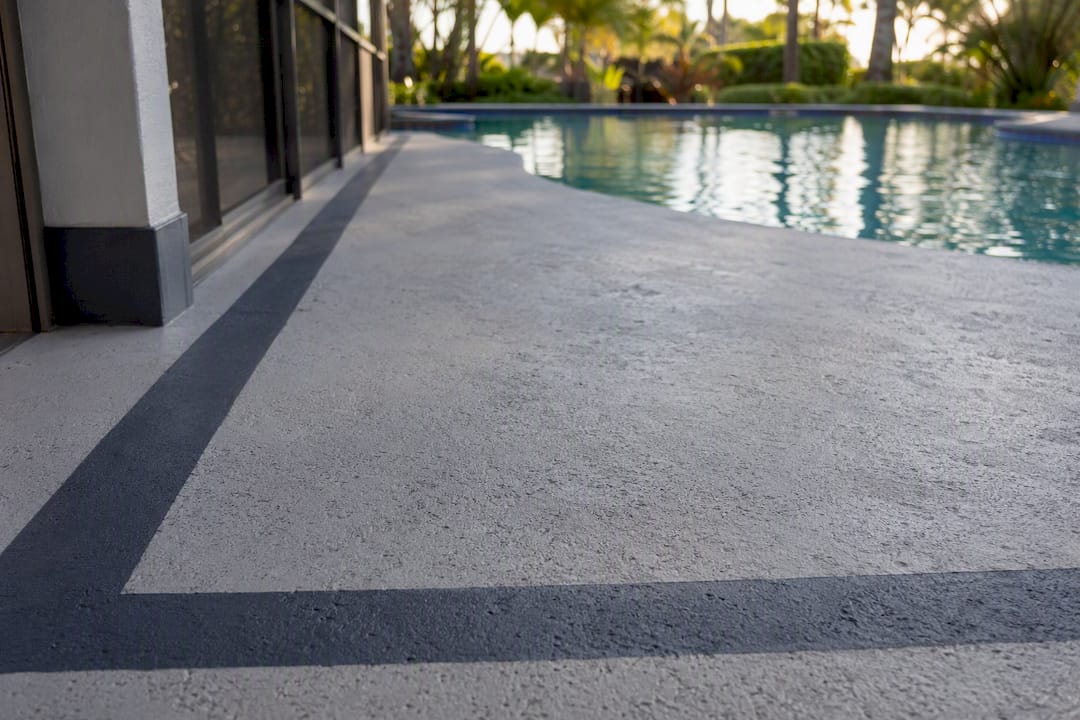
Full charcoal decks look striking in photos and miserable in July. Use slate or charcoal as a border, a step accent, or a narrow band around the pool's edge instead of the main walking field. A darker border also does double duty as a visual cue for where the pool edge begins, which matters more than most homeowners realize until someone misjudges the step at dusk.
8. Multi-Tone Flake Systems
Flake broadcast systems blend several colors into one textured surface, and they have become one of the more popular ways to color a deck heading into 2026. The mixed tones camouflage dirt, leaf stains, and wear patterns far better than a flat single color, which is exactly why they show up so often in high-traffic commercial pool areas now migrating to residential backyards.
9. Warm Wood-Look Browns
If your deck material is a wood-look composite rather than concrete or stone, warm honey and driftwood browns give you the cabana feel without the maintenance headaches of actual wood near a chlorinated pool. These tones hide water spots well and coordinate naturally with teak or resin furniture.
10. Two-Tone Border With a Lighter Main Field
Pairing a lighter main field with a slightly darker perimeter band isn't just decorative. A darker border against a lighter field improves edge definition, helping people spot the pool's boundary at a glance while the bulk of the deck stays cool. It is a simple design trick that solves both the aesthetic and safety problem at once.
How Your Deck Material Changes the Color Equation
Color chips look identical in the store. They do not perform identically once installed, because the material underneath changes how a color reads, how hot it gets, and how long it lasts.
Travertine and porcelain stay noticeably cooler underfoot than poured concrete, even in the same shade, because of how each material absorbs and releases heat. Porcelain pavers also have near-zero water absorption, meaning the color you install is close to the color you will see in five years, whereas concrete and natural stone can shift with sealer wear and mineral staining. Pavers and natural stone also mask minor color variation between batches far better than a single poured concrete slab, where an uneven pour can leave visible blotching in bright light.
Stamped concrete has its own quirk worth flagging: the texture stamping process tends to make a given pigment read darker than the same color on smooth concrete, simply because the recessed grooves hold shadow. If you are set on stamped concrete, size your pigment order lighter than you think you need, or lean on a cool-deck acrylic topcoat to offset the visual and thermal darkening.
A few practical rules to carry into any material conversation:
- Match your deck's undertone (warm or cool) to your coping and pool interior finish before locking in a color.
- In consistently hot climates, weight the decision toward material and coating performance first, aesthetics second.
- Ask any contractor directly how a specific pigment performs on the specific material you're installing. Chip cards rarely tell the whole story.
Coloring and Coating Techniques That Actually Hold Up
Once you know the color, you need the right application method. Integral color, acid stains, water-based stains, and dry-shake hardeners remain the standard toolkit for coloring poured concrete, and each behaves differently over time.
- Integral color gets mixed into the concrete before it's poured, so the color runs all the way through the slab and won't peel or chip away at the surface.
- Acid stains react chemically with the concrete to produce mottled, variegated tones that never look flat, but the results vary by slab and are hard to fully predict.
- Water-based stains offer more consistent, predictable color with a wider palette, though they sit closer to the surface than acid stains.
- Dry-shake color hardeners get broadcast onto fresh concrete and troweled in, adding both color and surface hardness in one step.
- Acrylic cool-deck coatings go over existing concrete and are formulated specifically to reflect heat while adding a textured, slip-resistant surface.
- Flake and epoxy or polyurea systems layer colored flake into a resin base, and UV-stable polyaspartic and polyurea formulas resist the yellowing and fading that plain epoxy suffers under constant pool-deck sun exposure.
Pro Tip: Skip the DIY route on acid stains and polyurea systems unless you've done it before. Proper prep, moisture testing, and primer determine whether a coating lasts ten years or peels in one. That prep work is the single most common failure point on redo jobs.
Simple acrylic recoats on an already-sealed deck are reasonable DIY territory. Anything involving acid etching, moisture barriers, or multi-layer flake systems is worth handing to a professional. Our pool deck paint versus stain guide breaks down which method fits which existing surface.
Getting the Finish Right: Safety Meets Upkeep
Color choice and finish choice aren't separate decisions. A gorgeous shade on a slick, glossy surface is a liability the first time someone steps out of the pool wet.
- Choose matte or textured finishes over anything glossy, especially around the water's edge and on pool steps.
- Add anti-slip additives at broadcast time rather than trying to retrofit traction later.
- White and cream decks show dirt, sunscreen oil, and algae fastest, so budget for more frequent cleaning.
- Medium tones like tan, gray, and greige hide day-to-day grime best between deep cleans.
For upkeep, run through this seasonal rhythm:
- Rinse the deck monthly to clear pollen, leaf debris, and sunscreen buildup before it stains.
- Reseal natural stone or travertine roughly every one to three years depending on sun exposure.
- Recoat acrylic cool-deck coatings every three to five years as the surface layer wears thin.
- Check anti-slip texture annually. It wears down with foot traffic long before the color fades.
If your deck has already developed slick spots near the steps or shallow end, our guide to fixing a slippery pool deck walks through the fastest fixes without a full redo.
What to Budget and When to Schedule the Work
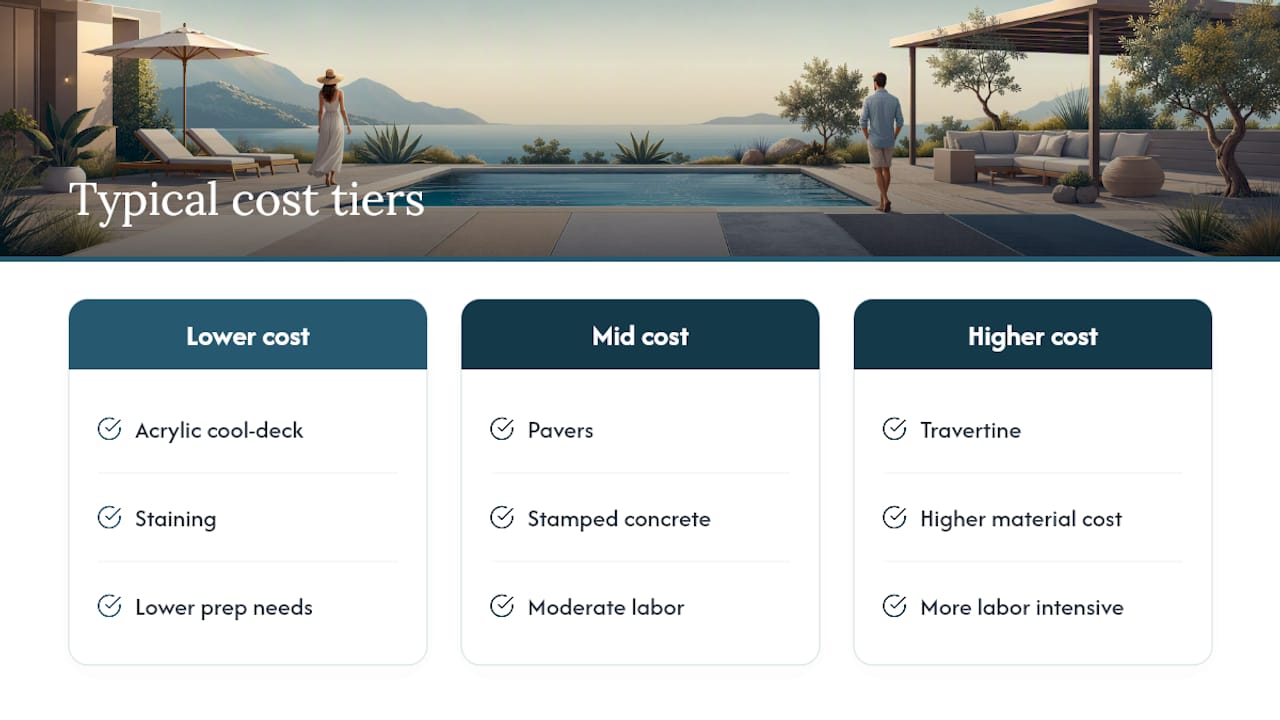
Costs vary widely by material and prep needs, but rough per-square-foot ranges hold steady across most quotes: acrylic cool-deck coatings and staining tend to land at the lower end, pavers and stamped concrete in the middle, and travertine at the top given its labor and material cost. Our pool deck painting cost breakdown covers current ranges in more detail.
Timeline-wise, expect three phases: prep and repair (cracks, cleaning, etching), the color or coating application itself, and cure time before anyone walks or swims. Cure windows shift by product, so always confirm them with your installer rather than assuming a fixed number of days. Costs climb fastest when a deck needs structural crack repair, drainage correction, or custom border detailing before any color goes down.
What Restoration Work Teaches You About Prep
Years of restoring pool enclosures and decks across Central Florida have made one thing obvious: the color someone picks almost never causes the failure. Bad prep does.
The decks that fail early almost always skipped a step, not a shade. Cleaning, etching, crack repair, primer, and two full coats, in that order, is what separates a coating that lasts a decade from one that's peeling in eighteen months.
A dependable prep sequence looks like this:
- Pressure wash and degrease the entire surface before anything else touches it.
- Etch or mechanically abrade concrete so the coating actually bonds instead of sitting on top.
- Repair cracks and low spots before color goes down, not after.
- Prime, then apply two full coats, broadcasting anti-slip granules where foot traffic is heaviest.
Water-based acrylic coatings and stainless steel fasteners hold up noticeably better in Florida's humidity and occasional salt exposure than standard hardware, which is a big part of why restoration can preserve a deck's existing look while cutting costs against a full rebuild.
The One Rule I'd Follow Above All Others
If you take one thing from this: pick the color for how it feels on your feet at 2 PM in July, not how it photographs at golden hour. Everything else, coping match, house tone, border accents, is negotiable after that.
Run through it in order: climate first, material second, then coordinate water, coping, and house tone together. Test a real patch in real sun before buying anything in bulk. And for coatings meant to last, get a professional opinion on prep. That's where projects actually go wrong.
Ready to Get Your Deck Color Right the First Time?
Picking the shade is the easy part. Getting a coating or stain to actually survive Central Florida sun, humidity, and pool chemicals for a decade is where most DIY projects and lower-grade contractor jobs fall apart. Mrpoolscreen restores pool decks and enclosures using water-based acrylic coatings and stainless steel fasteners built for exactly that kind of exposure, and restoration typically costs a fraction of tearing out and replacing a deck outright.
If your existing deck has rust stains bleeding through the coating, cracks that keep reopening, or a finish that's gone slick and dangerous, that's usually a sign the prep or materials were wrong from the start, not the color. Mrpoolscreen handles the full sequence: cleaning, repair, priming, and coating, plus re-screening and hardware replacement on the enclosure itself if that's part of the picture. Check the pool screen restoration page for what's included, or browse the project gallery to see before-and-after results on decks that started out looking a lot like yours. Reach out for a quote before you commit to a full color and material plan.
Frequently Asked Questions
What is the best color for a pool deck that stays cool in the sun? Light-to-mid neutrals like sandy tan, light gray, and off-white perform best, since darker colors can run 20 to 40 degrees hotter underfoot on a sunny afternoon.
Should pool deck color match the coping or the house? Aim for undertone harmony rather than an exact match. A warm tan deck generally pairs better with warm-toned coping and brick, while cool grays suit modern homes with dark trim.
Are dark pool deck colors ever a good option? Dark tones work best as accents, a border, a step edge, or a small shaded section, rather than the full walking surface, since heat buildup makes large dark areas uncomfortable barefoot.
How long do pool deck coatings typically last before they need recoating? Acrylic cool-deck coatings generally need a recoat every three to five years, while natural stone and travertine typically need resealing every one to three years depending on sun exposure.
Is it better to stain or paint a concrete pool deck? Stains tend to hold up longer and fade more gradually than paint, but the right choice depends on your existing slab condition. Our paint versus stain guide breaks down which fits which situation.
Sources
- Colored concrete for pool decks — ConcreteNetwork
- Pool Deck Ideas: Best materials, colors & layouts for 2026 — PoolPad
- 2026 pool deck coating color trends — TSR Concrete Coatings
- Pool deck paint colors: Best cool, safe picks — DG Floors