The fastest reliable slippery pool deck fix is a two-step plan: make the area safe today with temporary traction, then choose either a grit-in-sealer coating or a textured overlay based on what your deck actually needs. Film-forming acrylic sealers with polymer grit additives handle sound surfaces well. Failing sealer, structural cracks, or persistent pooling water call for a professional textured overlay or full restoration.
Immediate actions you can take right now:
- Lay non-slip mats or traction tape over the worst hazard zones
- Pressure wash to remove algae, sunscreen film, and pool chemical residue
- Photograph the deck surface in good light to document peeling, cracks, or low spots
- If the sealer is peeling in multiple layers or water pools after rain, call a pro before applying any coating
OSHA slip-and-fall standards and ASTM wet-slip test protocols both flag pool decks as high-risk surfaces, particularly when wet. Mrpoolscreen offers deck restoration services for homeowners in Central Florida who need more than a weekend fix.
Key Takeaways
The most reliable slippery pool deck fix pairs immediate temporary traction with a surface-matched semi-permanent coating or professional overlay, chosen based on the actual condition of your deck.
| Point | Details |
|---|---|
| Temporary traction first | Lay non-slip mats and pressure wash before planning any coating; cleaning alone often restores grip. |
| Match fix to deck condition | Sound sealer: use polymer grit in acrylic sealer or an anti-slip coating. Peeling sealer or cracks: get a pro. |
| Recoat intervals matter | Film-forming acrylic sealers need recoating every 18–24 months; penetrating sealers last 3–5 years. |
| Overlays outlast topical fixes | Textured polymer overlays last 5–10 years and correct drainage problems that coatings cannot fix. |
| Mrpoolscreen for restoration | Mrpoolscreen provides deck staining, grit seal-coat, and full textured overlays for Central Florida homeowners. |
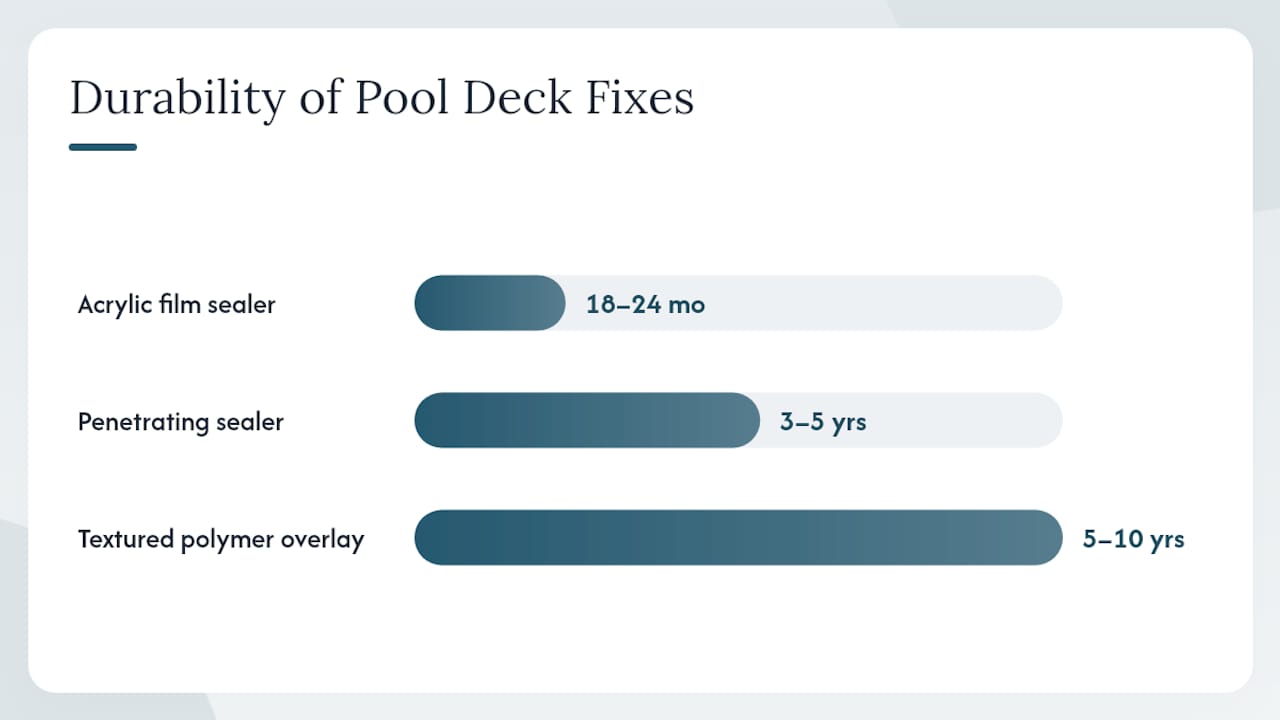
Table of Contents
- How do you assess a slippery pool deck before fixing it?
- Temporary, same-day fixes to stop slips today
- DIY semi-permanent fixes: grit additives, non-slip coatings, and spray texture
- When should you hire a pro for pool deck restoration?
- How do you choose the right fix or the right contractor?
- How long do pool deck fixes last, and what maintenance do they need?
- What wet-slip standards apply to pool decks?
- What Mrpoolscreen sees most often on Central Florida pool decks
- Mrpoolscreen restores pool decks in Central Florida
- Sources
How do you assess a slippery pool deck before fixing it?
Start with a slow walk around the deck when it is dry, then again after hosing it down. You are looking for four things: surface texture, sealer condition, drainage, and structural integrity.
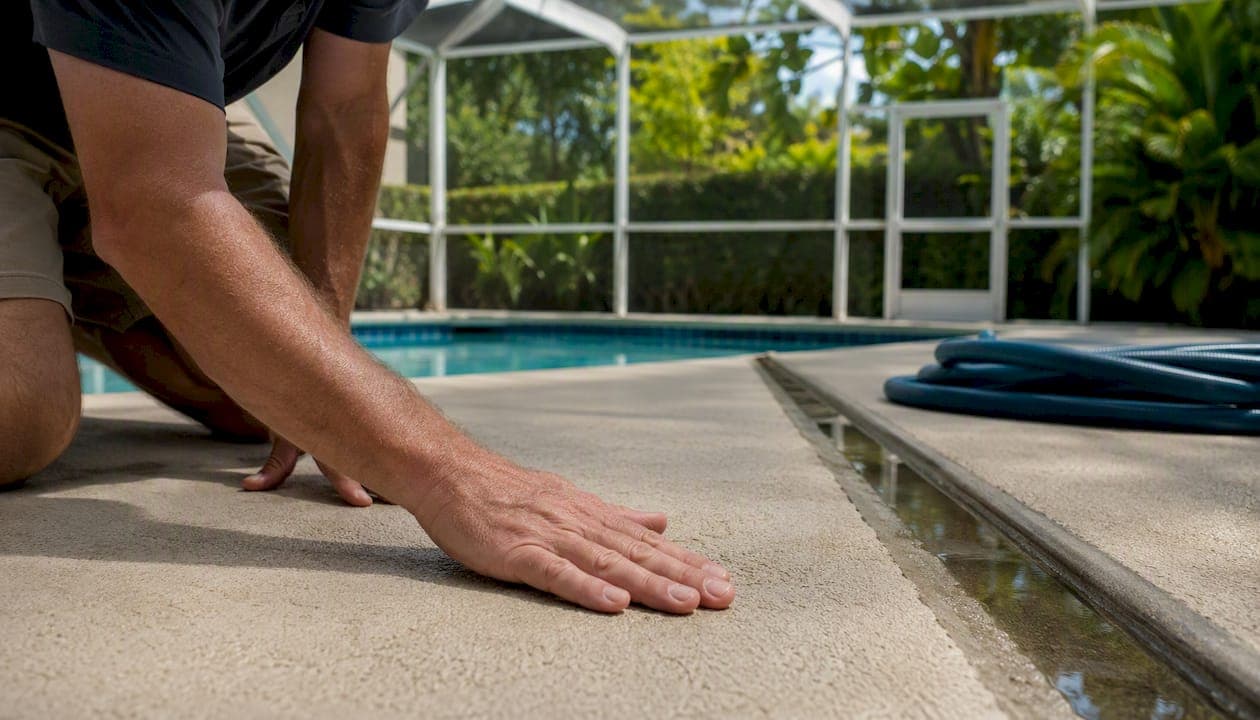
Surface texture: Run your hand across the deck. A glossy, smooth film means a film-forming sealer has built up, possibly over several recoat cycles. Exposed aggregate or a broom finish means the original texture is still doing some work.
Sealer condition: Peeling or bubbling sealer is a red flag. One peeling layer is a maintenance issue. Multiple layers lifting together means the bond has failed and no topical coating will stick reliably.
Drainage and slope: Low spots where water collects after rain or splashing are both a slip hazard and a sign that topical fixes alone will not solve the problem. A textured overlay can correct pitch; a coat of sealer cannot.
Structural damage: Cracks wider than a hairline, heaving sections, or soft spots underfoot push the timeline from "maintenance window" to "act now." Use the pool screen safety inspection checklist as a starting framework for your walkthrough.
Timeline guide:
- Same day: visible algae slick, smooth wet surface, no structural damage
- Days to weeks: single-layer peeling sealer, minor surface wear, no pooling
- Weeks to months: multi-layer sealer failure, cracks, pooling water, full resurfacing needed
Temporary, same-day fixes to stop slips today
These options reduce risk while you plan the permanent solution. None of them replace a proper non-slip pool deck coating, but they buy you time safely.
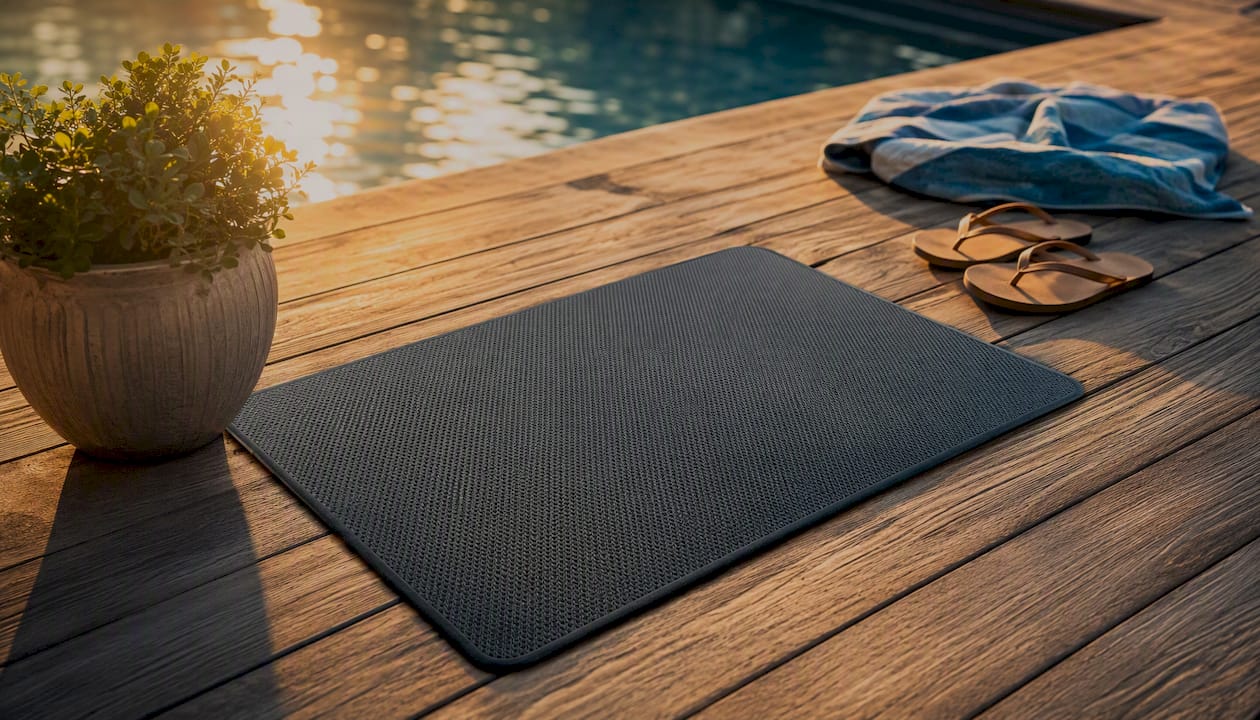
- Non-slip mats and runners: Place rubber-backed pool mats at entry/exit points and along the most-used paths. Choose open-grid designs that drain quickly and do not cover floor drains.
- Traction tape: Adhesive anti-slip strips work well on steps and narrow ledges. They are inexpensive and go down in minutes.
- Pressure washing: Algae, sunscreen, and pool chemicals are among the most common causes of slippery decks. A thorough wash with a pool-safe detergent often restores meaningful traction on its own.
- Temporary broom-finish rugs: Outdoor rugs with a stiff texture add grip in high-traffic zones near the pool edge.
Cost for temporary measures runs low, typically $20–$80 for mats and tape. They last weeks to a few months with regular use before edges lift or grip degrades.
Pro Tip: Never place mats directly over a floor drain or in a position where a curled edge creates a tripping hazard. The fix should not create a new risk.
DIY semi-permanent fixes: grit additives, non-slip coatings, and spray texture
For a sound deck with intact sealer, a homeowner can apply a non-slip pool deck coating over a weekend. The three main routes are polymer grit blended into a film-forming acrylic sealer, a purpose-built anti-slip acrylic coating, or a spray texture product.
Choosing the right product
Polymer grit additives suspend evenly in acrylic sealers and are translucent, so they do not cloud a colored or stamped finish. Aluminum oxide beads are heavier and can sink to the bottom of the mix or shift the color of a decorative surface. For most residential pool decks, polymer grit is the better call.
Film-forming acrylic sealers hold grit well and enhance color, but they sit on top of the surface and wear sacrificially. Penetrating silane/siloxane sealers absorb into the concrete and do not add a film, so grit additives do not bond to them the same way. Match your grit approach to the sealer type already on your deck.
Products like Deck-O-Grip non-skid acrylic coating combine the film and the slip-resistant additive in one formula, covering 300–600 sq ft per gallon and drying to the touch in roughly 30–60 minutes.
Application steps
- Clean the surface to bare, sound concrete (CSP 1–2 profile). Remove all oil, algae, and loose sealer.
- Test a small patch first. Grit size, sealer type, and existing finish interact differently on stamped or colored concrete.
- Mix polymer grit into the sealer per manufacturer instructions, stirring continuously during application.
- Apply with a roller, not a sprayer. Spray application is not suitable for grit-containing sealers because grit clogs nozzles and distributes unevenly.
- Allow full cure before foot traffic, typically 24–48 hours depending on temperature and humidity.
| Method | Best for | Appearance impact | Durability | Cost | Cure time | Wet-slip performance |
|---|---|---|---|---|---|---|
| Polymer grit in acrylic sealer | DIY, sound deck | Minimal color shift | 18–24 months | Low | 24–48 hrs | Good |
| Anti-slip acrylic coating (e.g., Deck-O-Grip) | DIY, decorative concrete | Slight sheen | 18–24 months | Low–medium | 30–60 min touch-dry | Good |
| Spray texture coating | DIY, large flat areas | Visible texture | 2–3 years | Medium | 24 hrs | Very good |
| Textured polymer overlay | Pro, failing sealer or cracks | New surface look | 5–10 years | High | 48 hours | Excellent |
Pro Tip: Always test a 2-sq-ft patch in an inconspicuous area and let it cure fully before committing to the whole deck. What looks right dry can look very different wet.
When should you hire a pro for pool deck restoration?
Some conditions are beyond what a weekend DIY project can fix reliably. Call a professional when you see any of these:
- Multiple sealer layers peeling simultaneously
- Cracks wider than a hairline or sections that flex underfoot
- Water pooling in low spots after every rain or splash
- A large-scale resurfacing goal (color change, full texture overhaul)
A professional contractor will strip failing coatings, repair cracks, level low spots, and apply a polymer-modified textured overlay that bonds to the slab. Unlike topical grit, the texture in an overlay is part of the material itself and does not wash off over time. UV exposure and pool chemicals that shorten the life of topical coatings have far less impact on a properly bonded overlay.
Before restoration, a Central Florida homeowner's pool deck had a smooth, worn acrylic finish that became dangerously slick when wet. After Mrpoolscreen stripped the failing sealer, repaired surface cracks, and applied a textured water-based acrylic coating, the deck passed a wet-surface walk test and the homeowner reported no further slip incidents. See before/after documentation in the project gallery.
Ballpark costs vary by scope. A small patch repair with a non-slip coating runs a few hundred dollars. Full deck resurfacing with a textured overlay on a standard residential pool deck typically ranges from $1,500 to $4,500 depending on area, prep needed, and material choice. Timeline from assessment to walkable surface is usually 3–5 days.
How do you choose the right fix or the right contractor?
Decision flow:
- Is the deck safe to use right now? If not, apply temporary traction immediately.
- Is the sealer intact and the slab sound? A grit-in-sealer or anti-slip acrylic coating is a reasonable DIY fix.
- Is the sealer peeling, are there cracks, or does water pool? Stop here and get a professional assessment.
Questions to ask any contractor:
- What surface preparation method do you use, and will you show me the profile before coating?
- Which specific products are you applying, and can you provide the manufacturer's technical data sheet?
- Do you offer a test patch before full application?
- What is the cure time before we can use the pool area?
- Do you carry liability insurance and can you provide local references?
- How do your materials perform against ASTM wet-slip test standards?
Red flags to watch for:
- Vague timelines ("a few days, give or take")
- Refusal to do a test patch
- No mention of surface prep beyond a quick wash
- Pressure to resurface the entire deck when only one section is failing
- No local references or before/after photos
When a contractor mentions ASTM or OSHA wet-slip guidance without being prompted, that is a good sign they understand what the finished surface actually needs to do.
How long do pool deck fixes last, and what maintenance do they need?
Expected lifespan depends heavily on UV exposure, pool chemical contact, and foot traffic. Central Florida conditions are among the harshest in the country for coatings.
Film-forming acrylic sealers need recoating every 18–24 months under normal conditions. Penetrating silane/siloxane sealers last roughly 3–5 years between treatments. Textured overlays, when properly bonded, hold up for 5–10 years before any significant resurfacing is needed.
Warning signs that traction has degraded:
- The surface looks glossy when wet
- Grit feels worn smooth underfoot
- Algae slicks return quickly after cleaning
- Sealer is flaking or peeling at edges
| Treatment | Expected lifespan | Recoat/retreat interval | Key maintenance |
|---|---|---|---|
| Film-forming acrylic sealer with grit | 18–24 months | 18–24 months | Rinse weekly, pressure wash quarterly |
| Penetrating silane/siloxane sealer | 3–5 years | 3–5 years | Rinse weekly, check bead test annually |
| Anti-slip acrylic coating | 18–24 months | 18–24 months | Avoid harsh cleaners, rinse after pool use |
| Textured polymer overlay | 5–10 years | 5–10 years | Pressure wash annually, reseal surface coat as needed |
Pro Tip: Rinse the deck after every pool session to remove chlorine and sunscreen residue. That single habit extends the life of any coating by reducing the chemical load that degrades the binder.
Use the pool enclosure upkeep guide for a broader maintenance schedule that covers the full pool area.
What wet-slip standards apply to pool decks?
OSHA's walking-working surfaces standard identifies wet surfaces as a primary slip hazard and sets the expectation that employers (and by extension, property managers) maintain surfaces that reduce that risk. ASTM C1028 and the updated ASTM F2508 provide the test methods most commonly referenced for measuring wet-slip resistance on concrete and coated surfaces.
The practical gap most homeowners miss: many sealers pass a dry-surface test but fail when wet. A smooth film-forming sealer can feel perfectly safe in bare feet on a dry day and become genuinely dangerous after a splash. That is why wet-slip performance, not just dry appearance, is the right standard to hold any coating to.
What to ask or insist on:
- Request wet-slip test data from any contractor proposing a coating product
- Ask for a small-area wet test before full application, especially on stamped or colored concrete
- If a product's technical data sheet does not mention wet-slip performance, ask the manufacturer directly
This article is general guidance. If your deck shows structural cracking, heaving, or persistent water infiltration, get a professional structural assessment before applying any surface treatment.
What Mrpoolscreen sees most often on Central Florida pool decks
Most pool decks in Central Florida fail for the same reason: a film-forming acrylic sealer gets recoated every couple of years without the previous layer being stripped. After three or four cycles, the bond between layers weakens, the surface becomes smooth and glossy, and the first wet season turns it into a slip hazard. The fix looks like a coating problem. It is actually a prep problem.
Overlays outperform topical fixes in this climate not because they are thicker but because they reset the surface entirely. Water-based acrylic coatings applied over a properly prepared slab bond differently than a sealer rolled over a previous sealer. The texture is in the material, not sitting on top of it.
The other thing worth saying: the best time to schedule deck restoration is not during peak pool season. Cure times are affected by heat and humidity, and Florida summers push both to extremes. Scheduling in late fall or early spring gives coatings the best chance to cure properly before heavy use begins.
Mrpoolscreen restores pool decks in Central Florida
Mrpoolscreen handles the full scope of deck restoration that goes beyond what a weekend coating project can achieve: deck staining and painting, seal-coat application with polymer grit, textured overlays, and complete resurfacing for decks with failing coatings or surface damage. The work uses water-based acrylic coatings and industrial-grade materials, and restoration typically costs up to 60% less than a full deck rebuild.
An on-site assessment covers surface condition, sealer type, drainage, and scope. You leave with a clear timeline and a written estimate. Browse finished projects in the project gallery to see what restored traction and fresh color look like on decks similar to yours, then get online pricing to start your estimate.
Sources
- How to Fix Slippery Concrete - Concrete Network
- Concrete Pool Deck Sealers for Slip Resistance & Protection
- Pool deck safety guide: slip-resistant outdoor concrete
- Deck-O-Grip Non Skid Acrylic Coating - 1 Gallon
- How to Make Pool Concrete Less Slippery - AquaDoc