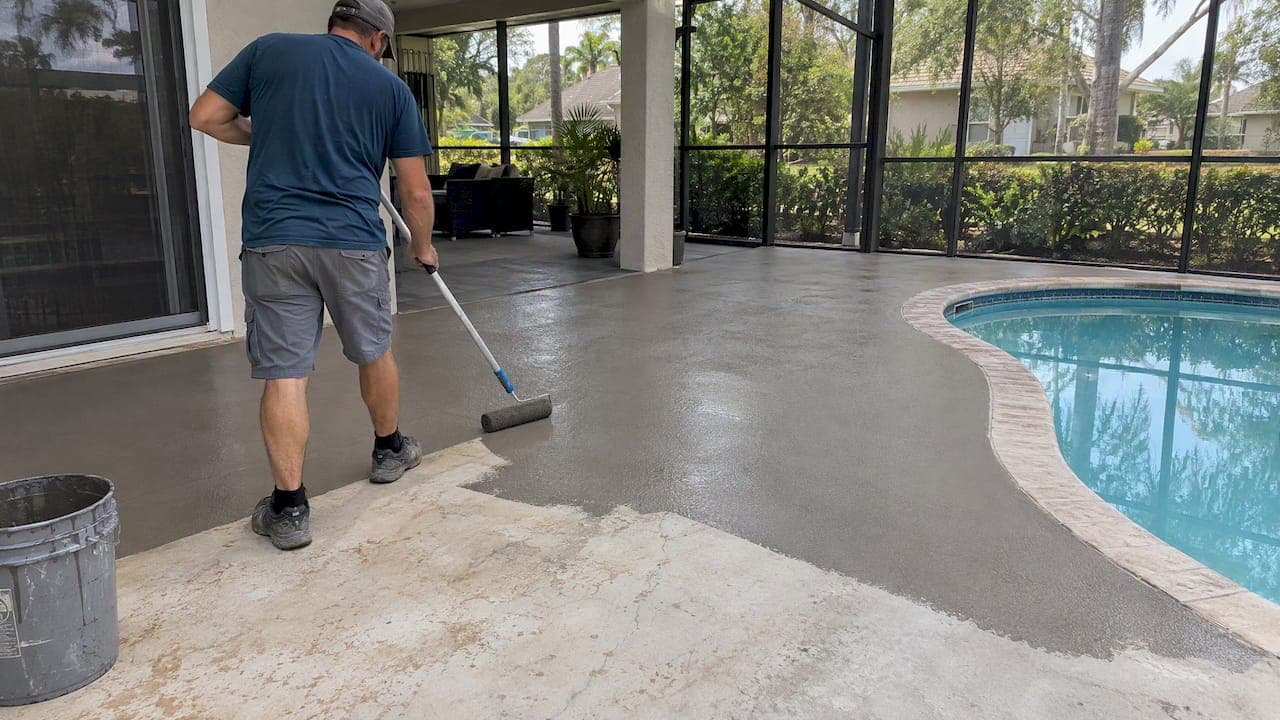
Most Florida homeowners pay between $800 and $5,600 to stain a pool deck, depending on size and stain type, while full resurfacing runs higher. For decks in decent shape, water-based stain is usually the most cost-effective starting point. The two things that swing your price most are how much repair the slab needs and whether you live in a coastal county.
TL;DR:
- The cost to stain a 400-square-foot pool deck in Florida ranges from $1,600 to $4,800, depending on stain type and slab condition.
- Heavy cracking or salt damage can add $2 to $5 per square foot for prep work, significantly increasing the overall price.
- Coastal locations require about 15% to 20% higher costs due to marine-grade material needs and salt-removal procedures.
- A small, damage-free deck can often be DIY-stained with water-based products, but projects involving chemicals or structural issues require a licensed contractor.
- Final costs are driven more by slab condition and prep work than by the chosen stain or finish, making accurate assessment crucial before bidding.
Table of Contents
- How much does it cost to stain or resurface a pool deck in Florida?
- What line items push your quote higher or lower?
- What would your deck actually cost? Three worked examples
- Should you DIY it or hire a pro, and how do you pick one?
- Mr. Pool Screen's approach to Florida pool deck staining
- What actually matters when you're budgeting this project
- Getting an accurate quote from Mr. Pool Screen
- FAQ
- Sources
How much does it cost to stain or resurface a pool deck in Florida?
Pricing depends heavily on the finish you choose, and each comes with a different lifespan and upkeep schedule. Water-based stain runs $4 to $8 per square foot in Florida, and it holds color more evenly across large areas than acid stain, which costs $6 to $12 per square foot but gives a richer, more variegated look that many homeowners prefer for smaller accent zones, according to decorative concrete pricing data. Acrylic coatings land at $8 to $12 per square foot and cure fast, while knockdown texture resurfacing, the workhorse finish in Florida pool markets, typically costs $6 to $10 per square foot. Cool deck coatings run $7 to $11 per square foot, and stamped overlays top the list at $12 to $25 or more per square foot, per Florida resurfacing cost data.
- Water-based stain: lasts 3 to 5 years before recoating, lowest material cost per square foot.
- Acid stain: lasts 5 to 10 years but shows wear unevenly, better for accents than full decks.
- Knockdown or acrylic resurfacing: lasts 7 to 10 years, higher upfront cost, fewer touch-ups.
These totals use the per-square-foot ranges above and the $800 to $5,600 band reported for 400 to 700 square foot pool decks.
What line items push your quote higher or lower?
Two quotes for the same square footage can differ by thousands, and the gap almost always comes down to prep work and location. Cracked, pitted, or salt-damaged concrete needs grinding, crack injection, and leveling before any stain or coating goes down, and that prep alone often adds $2 to $5 per square foot to the job, according to pricing analysis for Florida decorative concrete.
- Surface condition: heavy cracking or salt intrusion can add $2 to $5 per square foot in extra prep.
- Material upgrades: slip-resistant aggregates and UV-stable pigments cost more but hold up better under Florida sun.
- Location: coastal counties see a 15% to 20% premium due to marine-grade material requirements, per Florida resurfacing data.
- Timing: contractors book up fastest in spring, so quotes often run higher right before pool season.
- Permitting: Florida counties classify pool deck resurfacing as a repair or alteration, which can trigger requirements for slip-resistant finishes and proper depth-marker placement, per Manatee County's resurfacing guidance.
Coastal properties often need salt-contamination removal before resurfacing, which raises prep costs by roughly 15% to 20% compared to inland jobs, according to Florida cost data. That single factor explains a lot of the price gap homeowners see between quotes from inland and beachside contractors.
What would your deck actually cost? Three worked examples
Numbers are easier to plan around when they are tied to a real deck size. Here is what a homeowner might expect to pay once prep and sealer are included, not just the bare material cost.
A 300-square-foot knockdown resurfacing job commonly lands between $1,800 and $3,000 once labor and materials are factored in, per Florida pricing data.

Should you DIY it or hire a pro, and how do you pick one?
A small, structurally sound deck with no major cracking is a reasonable DIY candidate for basic water-based stain. Anything involving acid stain chemicals, slip-resistant sealers, or visible structural damage is worth handing to a licensed contractor, both for safety and for a result that holds up.
- Confirm the contractor is licensed and insured for concrete or decorative coatings work in Florida.
- Ask for local references and photos of completed pool decks, not just general concrete work.
- Get the prep plan in writing, including grinding, crack repair, and leveling steps.
- Confirm warranty terms and expected cure time before the deck is walkable.
Watch for red flags: no written prep plan, a vague start-to-finish timeline, or a bid far below everyone else's. A full project, from prep through final cure, typically runs a few days to about a week depending on size and weather.
Pro Tip: Ask every contractor the same three questions, prep steps, warranty length, and cure time, so you're comparing apples to apples instead of just a bottom-line number.
Mr. Pool Screen's approach to Florida pool deck staining
A company working in Central Florida restores pool decks and the enclosures around them, which matters when staining work happens near an existing screen structure that needs protecting from overspray. The process uses water-based acrylic coatings and stainless steel fasteners on related enclosure hardware, paired with careful masking to keep stain off screens, pavers, and landscaping.
- Water-based acrylic coatings chosen for durability against Florida sun and humidity.
- Masking and prep steps designed to protect surrounding pool cage structures.
- A process stated to cost less and move faster than full replacement.
Readers comparing stain types in more depth can see the acid versus water-based stain breakdown or the deck paint versus stain comparison on the company's blog.
What actually matters when you're budgeting this project

The number that gets the most attention in most pricing guides is the per-square-foot rate, but that figure is almost never what determines your final bill. Prep work, driven by crack damage and salt exposure, routinely swings a quote by more than the stain type itself does. Homeowners who fixate on choosing between acid stain and water-based stain while ignoring slab condition usually end up surprised by the final invoice.
The conventional advice to "get three quotes" is fine but incomplete. What matters more is getting three quotes that scope the same prep work, because a low bid that skips grinding or crack injection is not actually cheaper, it just defers the cost to next year's recoat. If you prioritize one thing, prioritize an honest assessment of your slab's condition before you compare stain colors or finish types. That assessment, more than anything else, decides whether you are looking at a $1,500 job or a $6,000 one.
— Michel
Getting an accurate quote from Mr. Pool Screen
If a pool deck needs staining and an enclosure is showing its age at the same time, both can be handled without needing two separate contractors tracking two separate timelines. Their pool deck staining service uses water-based acrylic coatings and careful masking to keep overspray off your screens and landscaping, and the company backs its restoration work with a three-year warranty, completed, by its own account, faster and for less than full replacement.
To get a quick, accurate quote, measure your deck's total square footage and take a few close-up photos of any visible cracking, pitting, or discoloration. If your pool cage also needs attention, mention it, since Mr. Pool Screen's pool screen restoration service can be scoped alongside the deck work.
- Measure total deck square footage, including any curved or stepped sections.
- Photograph cracks, pitting, or stains so the estimate reflects real prep needs.
- Note whether your pool cage or screen enclosure needs restoration at the same time.
Request your estimate through Mr. Pool Screen's homepage or go straight to the deck staining page to start the conversation.
FAQ
What type of stain is best for a pool deck?
Water-based stain is generally the most practical choice for full pool decks because it applies evenly across large areas and costs $4 to $8 per square foot, according to Florida decorative concrete pricing. Acid stain gives a richer, more variegated look but costs more and is better suited to smaller accent areas.
How much stain for 400 square feet?
A 400-square-foot pool deck typically costs $1,600 to $4,800 to stain, depending on whether you choose water-based or acid stain, based on Florida pool deck stain pricing. The same size falls within the broader $800 to $5,600 range reported for decks between 400 and 700 square feet.
What's the average cost for a 20x20 deck?
A 20 by 20 foot deck is 400 square feet, which typically runs $1,600 to $4,800 for staining or $2,400 to $4,000 for resurfacing, using the same per-square-foot ranges applied to larger Florida pool decks. Actual cost depends heavily on slab condition and finish choice.
How much does it cost to paint a concrete pool deck?
Pool deck painting costs are generally comparable to or slightly below staining costs, though paint tends to wear faster under Florida sun and pool chemical exposure. For a closer comparison of durability and pricing between the two finishes, see the deck paint versus stain breakdown.
How often does a Florida pool deck need to be restained?
Water-based stain typically needs recoating every 3 to 5 years, while acid stain can last 5 to 10 years before it needs attention, based on typical Florida maintenance cycles. Heavy pool chemical exposure and direct sun can shorten both timelines.
Sources
- Decorative Concrete Cost Per Square Foot In Florida (2026) - CHC
- Pool Deck Resurfacing in Florida — Costs & Options (2026)
- Pool resurfacing acknowledgement / county requirements (Manatee County sample)