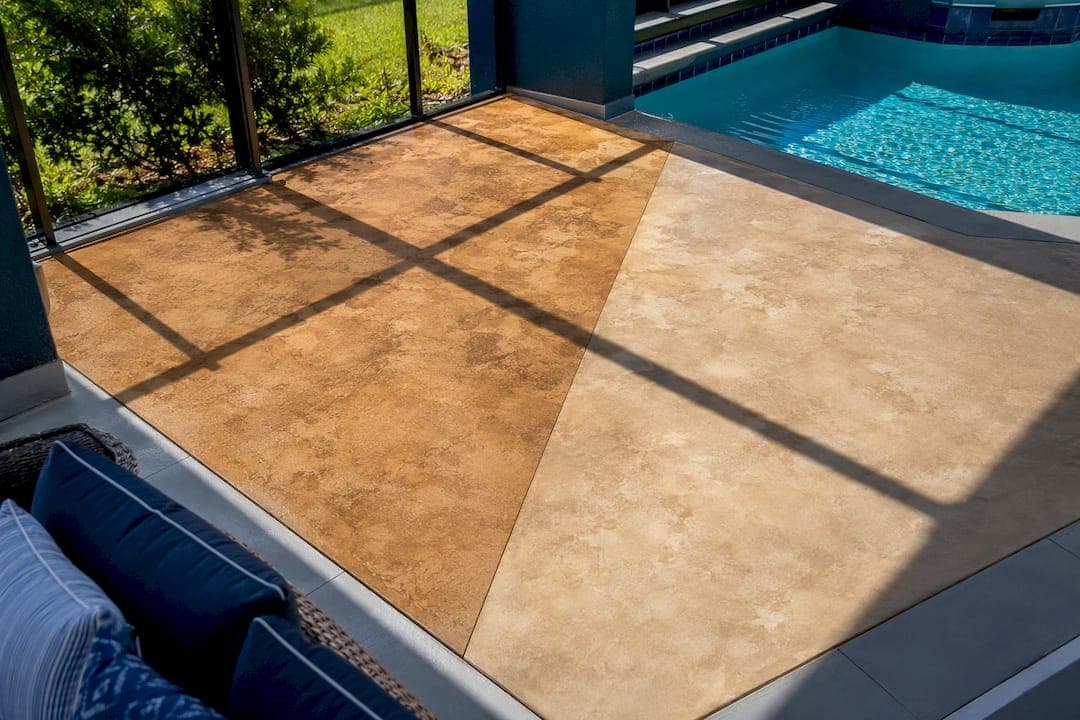
Pick acid stain when you want organic, marble-like variegation and don't mind some unpredictability. Pick water-based stain when you want a wider, more consistent color palette with easier application and cleanup. Acid stain demands more labor and safety gear; water-based trades some depth of character for control. Either way, run a test patch first and check your slab's porosity before committing to either system.
TL;DR:
- Acid stains are limited to earth tones and produce unpredictable, variegated results that depend on slab chemistry, making consistency difficult.
- Water-based stains offer a broader color palette, with results that are more predictable and less affected by the concrete's mineral composition.
- Acid staining involves chemical reactions requiring neutralization and multiple rinses, while water-based staining is gentler with simpler cleanup and no neutralization.
- For old, dense, or previously sealed slabs, water-based stain is often more reliable due to its lack of chemical reaction dependence.
- Proper surface preparation, including a test patch, is essential for both systems to achieve the desired aesthetic and avoid blotchy or uneven color.
Table of Contents
- Acid Stain vs Water-Based Stain: The Quick Comparison
- How Do Acid and Water-Based Stains Actually Work?
- What's Different About Applying Each Stain?
- Which Look Fits Your Design: Organic or Controlled?
- How Long Do These Stains Last, and What Maintenance Do They Need?
- How Do You Decide Which Stain Is Right for Your Project?
- How Mrpoolscreen Approaches Pool Deck Staining
- What Actually Matters When Choosing a Stain
- Ready for a Real Estimate on Your Pool Deck?
- Sources
Acid Stain vs Water-Based Stain: The Quick Comparison
Acid stain is a reactive chemical solution of metallic salts and hydrochloric acid that etches into concrete and reacts with the lime content in the slab, producing color that's chemically bonded and permanent. Water-based stain is a pigment-carrying liquid that soaks into the pores of the concrete without triggering any chemical reaction, which is why it's sometimes called a water-based concrete stain rather than a true stain in the acid sense.
The tradeoffs break down clearly once you line them up:
- Color range: Acid stains are limited mostly to earth tones, terra cottas, and some blues and greens. Water-based stains cover an expanded palette, including grays, blues, and custom-matched hues.
- Predictability: Acid results vary by slab chemistry, so the same product can look different from one driveway to the next. Water-based results are far more consistent slab to slab.
- Cleanup and safety: Acid stains need neutralization and residue scrubbing after the reaction runs its course. Water-based products clean up with soap and water and generally carry lower VOC content.
- Best-fit scenario: Homeowners chasing a rustic, one-of-a-kind stone look tend to land on acid. Homeowners who want a specific designer color, or who need to match an existing patio, usually land on water-based.
Most contractors keep both on the truck. The right call depends on your slab and your design goal, not on which product is objectively "better."
How Do Acid and Water-Based Stains Actually Work?
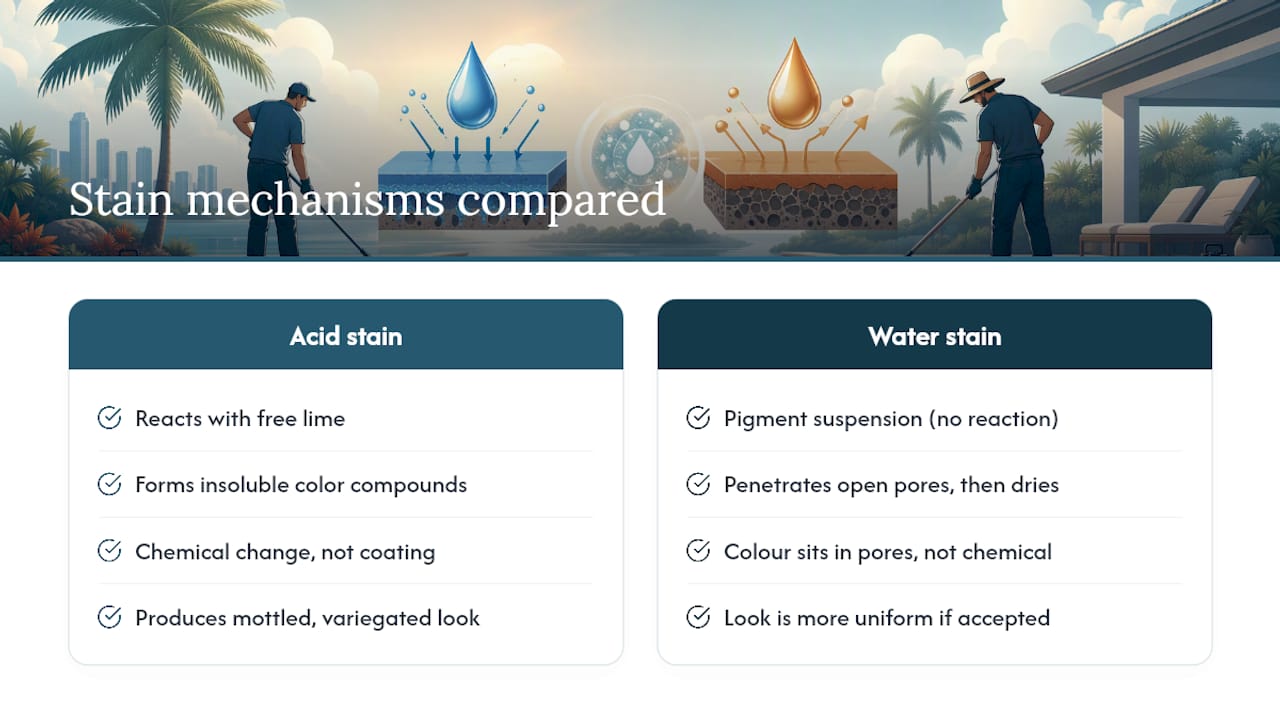
Acid stain works because concrete is alkaline. The acid in the solution etches the surface just enough to expose calcium hydroxide (free lime), and the metallic salts react with that lime to form insoluble color compounds locked into the top layer of the slab. That's why the color from acid staining is a genuine chemical change, not a coating sitting on top. It also explains the mottled, variegated look. No two batches of concrete cure with identical mineral distribution, so the reaction never lands the same way twice.
Water-based stain skips the chemistry lesson. It's a suspension of pigment particles, sometimes with acrylic resin carriers, that penetrates the open pores of the concrete and deposits color as it dries. There's no reaction to wait on and no variation driven by lime content. The tradeoff is that penetration depends heavily on how open and clean those pores are. A dense, troweled, or previously sealed surface won't accept pigment evenly, and that limitation shows up fast in a test patch.
That test patch matters more than most people assume, since it's the only way to see how your specific slab will behave before you commit product to the whole deck.
What's Different About Applying Each Stain?
Both systems start the same way: strip old coatings, degrease, and open up the surface pores so the product can actually penetrate — learn more on how to prepare your property for a new concrete patio at Trew Landscape. Beyond that first step, the workflows diverge fast.
- New pours (acid only): Wait until enough free lime has risen to the surface, usually a few weeks of cure time, before applying.
- Acid application: Apply the solution, let it react for the specified window, then neutralize with a baking-soda-and-water solution to stop the etching.
- Acid cleanup: Scrub and rinse repeatedly to remove all residue. Skipped residue causes cloudy, uneven color later.
- Water-based prep: Dampen the slab first (saturated-dry, not wet) so the stain doesn't flash-dry and leave lap marks.
- Water-based application: Apply in multiple thin coats, building depth of color rather than trying to nail it in one pass.
- Water-based cleanup: Rinse tools with soap and water. No neutralization step required.
Acid stains involve corrosive chemicals, so respirators, gloves, and eye protection are non-negotiable, along with real ventilation if you're working indoors. Water-based products are gentler to handle but still deserve basic PPE. The acid workflow also stretches your timeline, since you're budgeting for reaction time, neutralization, and multiple rinse cycles the water-based process doesn't need.
Pro Tip: Test both systems on a scrap slab or hidden corner using the exact mix ratios you plan to use on the full project. Contractors who skip this step are the ones who end up with blotchy patios and unhappy homeowners.
Which Look Fits Your Design: Organic or Controlled?
Acid stain gives you something water-based simply can't fake: authentic, variegated earth tones that read like natural stone or aged marble. No two square feet look identical, which is the whole appeal if you're after a rustic Tuscan patio or a floor that feels handcrafted rather than manufactured.
Water-based stain gives you the opposite strength: control. If your designer specified a particular slate gray or a cool blue-green to match your pool water, water-based is how you actually hit that number consistently across the whole deck.
Design considerations worth weighing before you pick a lane:
- Acid stains can be layered with dyes or tints afterward to deepen shadows or correct blotchy areas.
- Water-based products let you blend custom colors on-site, which is handy for matching an existing hardscape.
- Combining both systems on one project (acid as a base, water-based for accent zones) is common among pros chasing a layered effect.
- Heat-reflective, lighter colors have become popular for pool decks specifically, and water-based stains make that palette far easier to achieve consistently. Our pool deck color guide covers which tones actually stay cooler underfoot.
Always order sample boards or do a full-size mock-up before signing off on a color, especially with acid stain where the final result won't reveal itself until the reaction finishes.
How Long Do These Stains Last, and What Maintenance Do They Need?
Both stains hold up well over the long haul, but the sealer sitting on top does most of the heavy lifting for durability. Once acid stain reacts with the slab, that color change is permanent and won't wear off, but the surface still needs sealer to resist staining, abrasion, and moisture intrusion. Water-based stain is more dependent on the sealer for wear resistance since the pigment sits closer to the surface.
Common failure points and fixes:
- Sealer delamination from moisture trapped underneath. Fix: strip and reseal with a breathable product rated for the surface.
- Abrasion wear in high-traffic zones. Fix: reseal on a schedule rather than waiting for visible dulling.
- Moisture-triggered darkening on acid stains containing copper salts, which can shift tone outdoors when exposed to standing water repeatedly.
- Contamination staining from oils or chemicals. Fix: clean promptly and choose a sealer rated for the exposure.
Exterior surfaces like pool decks typically need resealing every one to three years depending on foot traffic and sun exposure; interior floors can often stretch longer between coats. One limitation worth flagging early: very old, heavily ground, or previously coated slabs may not react well to acid stain at all because there isn't enough exposed lime left to trigger the reaction. That's exactly the kind of slab where water-based stain tends to be the more reliable path.
How Do You Decide Which Stain Is Right for Your Project?
Run through this before you call anyone:
- Design goal: Organic and one-of-a-kind, or a specific, repeatable color?
- Slab condition: New pour, aged concrete, or previously sealed/ground surface?
- Color precision: Do you need to match an existing patio, siding, or pool tile?
- Exposure: Full sun and pool chemicals, or a covered interior floor?
- Timeline: Can the project accommodate acid's reaction and neutralization window?
- Maintenance tolerance: Are you comfortable resealing every couple of years?
If you're interviewing a contractor, these ten questions separate the pros from the guesswork:
- Will you run a test patch before starting the full job?
- How will you profile or open the slab if it's dense or previously sealed?
- What's your neutralization process for acid stain, and how many rinse cycles?
- Which sealer do you recommend for this specific exposure, and why?
- What warranty do you offer on color and sealer performance?
- Can I see photos of a project on a similar slab age or condition?
- How will you handle uneven porosity across the same slab?
- What's your estimated timeline including reaction and drying windows?
- How do you correct blotchy or inconsistent color after the fact?
- What maintenance schedule do you recommend once it's sealed?
Watch for red flags: any contractor who skips the test patch step, refuses to profile a dense surface, or promises an exact color match on acid stain before seeing your slab. Acid stain's outcome depends on your concrete's chemistry, not the contractor's confidence level. If your slab is old and heavily troweled, and someone still pushes acid stain without hedging on the result, that's a scenario worth questioning. A homeowner staining pavers or a small accent area might be fine going the DIY route; our guide on staining pool pavers yourself walks through where that line sits.
How Mrpoolscreen Approaches Pool Deck Staining
Mrpoolscreen works almost exclusively with water-based acrylic coatings for pool deck staining across Central Florida, and that's not a default out of convenience. Pool decks sit in direct sun, get splashed with chlorinated water constantly, and need slip resistance on top of good looks. Water-based acrylic systems give predictable color that holds up to UV exposure and lets us match specific tones homeowners want, rather than leaving the final result to slab chemistry we can't control ahead of time.
Our pool deck staining service covers concrete, stone, and paver surfaces, and our stone deck staining guide breaks down porosity and prep considerations specific to natural stone decking. For homeowners weighing paint against stain in Florida's humidity, our comparison of deck paint vs. stain covers why the two aren't interchangeable choices.
What Actually Matters When Choosing a Stain
Most articles on this topic treat acid and water-based stain like a spec sheet comparison, feature by feature, as if one will eventually win on points. That framing misses the actual decision. Your slab already decided part of this for you before you started researching. If it's old, ground down, or previously sealed, acid stain may barely react no matter how good the contractor is, and no amount of enthusiasm for that marbled look changes the chemistry.
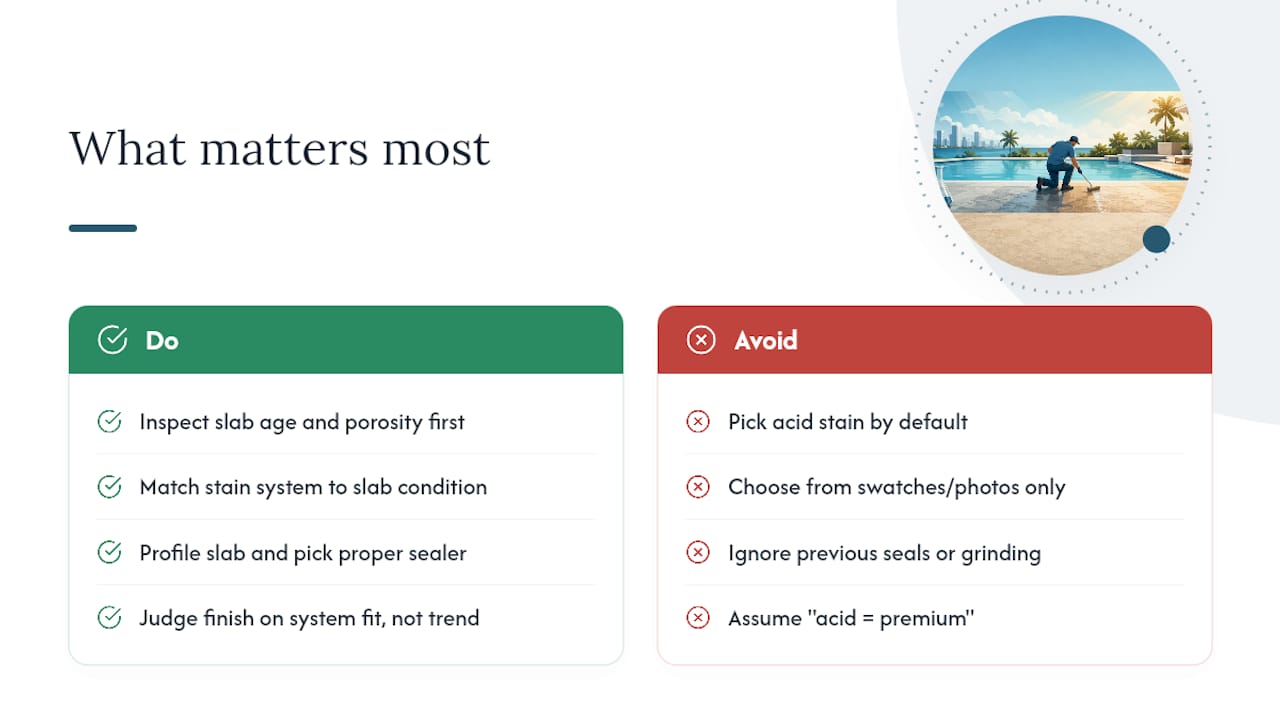
The advice I'd push back on hardest is the idea that acid stain is automatically the "premium" or more authentic choice. It's not more skilled work, it's a different tool for a different outcome. Water-based stain applied well, on a properly profiled slab, with the right sealer, can look every bit as intentional as an acid finish. It just looks intentional in a different way.
What should come first, before color swatches or Pinterest boards, is an honest look at your slab's age and porosity. That single factor eliminates half the guesswork and points you toward the system that will actually perform, not just the one that photographs better in a showroom sample.
— Michel
Ready for a Real Estimate on Your Pool Deck?
If your pool deck is faded, slick, or just tired of fighting Florida sun, Mrpoolscreen gives you a faster, more predictable path than trial-and-error DIY staining: a licensed crew that already knows how Central Florida slabs, sun exposure, and pool chemistry behave together.

Before your estimate, have a rough idea of your deck's age, whether it's been sealed or painted before, and the color direction you're leaning toward. Those three details drive most of the cost and material decisions. Our pool deck staining page walks through the materials and process in more detail, and our project gallery shows real before-and-after results on decks similar to yours. If your pool cage needs attention too, our pool screen restoration service handles that in the same visit. We'll always recommend a test patch before committing to a full deck, on any surface, with any product. Reach out through Mrpoolscreen to schedule your estimate.
Sources
- Concrete Coloring Comparison Chart - Concrete Network
- Acid or Water-based Stains for Decorative Concrete - Concrete Decor
- 7 Questions on Staining Concrete - For Construction Pros
- Acid Stain vs. Water-Based Stain: What's the Difference? - Decorative Concrete of Austin