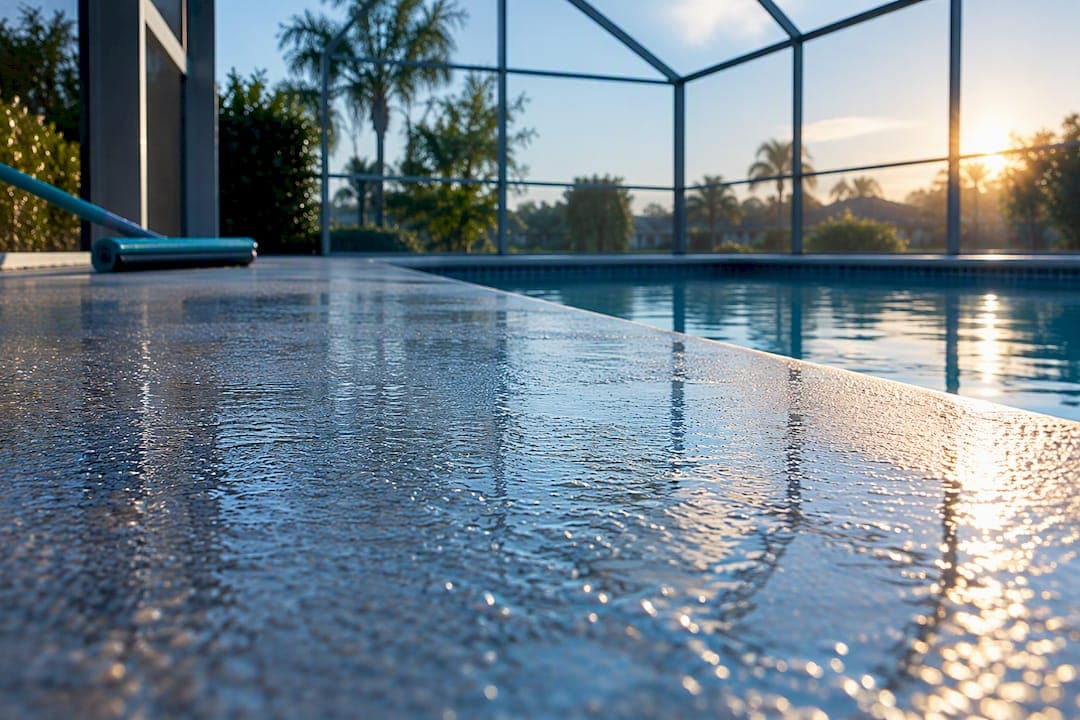
Light-colored porcelain pavers and travertine deliver the best mix of coolness and traction for most homeowners, while textured acrylic "cool deck" coatings and exposed aggregate offer a strong budget middle ground. Skip dark, sealed stamped concrete unless it carries anti-slip additives. Look for a wet PTV of 40 or higher on any surface you're considering, and treat that number as non-negotiable near steps. Compare two or three finalists against your budget and climate before you sign a contract.
TL;DR:
- Light-colored porcelain pavers and travertine provide the best combination of thermal comfort, traction, and durability for pool decks.
- Acrylic coatings and exposed aggregate are effective budget options that improve slip resistance and heat reflection, especially for existing concrete surfaces.
- Ensure the deck has a wet PTV of 40 or higher and confirm anti-slip additives and proper sealing are included before installation.
- Dark or glossy surfaces, including stamped concrete without anti-slip treatment, are unsafe and tend to trap heat, making them unsuitable for sun-exposed areas.
- Regular resealing and testing after sealing are necessary to maintain slip resistance and surface safety over the long term.
Table of Contents
- Popular Pool Deck Texture Options, and When Each One Makes Sense
- Safety and Slip Resistance: What the Codes Actually Require
- Heat and Comfort: Choosing Textures That Stay Cool
- Maintenance, Chemical Exposure, and What It All Costs
- How to Choose: A Simple Decision Framework
- How Mr. Pool Screen Approaches Deck Surfacing and Restoration
- Balancing Beauty and Safety
- Get a Pool Deck Estimate From Mrpoolscreen
- Standards Worth Checking Yourself
- Sources
- FAQ
Popular Pool Deck Texture Options, and When Each One Makes Sense
Homeowners shopping pool deck texture options usually run into eight material families, and each solves a different combination of budget, climate, and style. Here's how they stack up against each other.
Acrylic textured coatings (knockdown or orange-peel). These go over existing concrete and create a slip-resistant texture without a full tear-out. Manufacturers market variants like cushioned, splash-zone finishes specifically for barefoot traction and heat reduction, which makes them one of the most common cool deck coatings choices in warm climates.
- Best for: existing concrete decks that need a facelift, not a rebuild
- Installed cost: moderate
- Maintenance: reseal every 2 to 5 years depending on sun exposure
- Caveat: quality depends entirely on surface prep; skip a step and it peels within a season
Exposed aggregate. Stone or pebble embedded in concrete and lightly ground down gives natural traction without a separate anti-slip additive.
- Best for: homeowners who want durability and don't mind a rougher underfoot feel
- Installed cost: moderate
- Maintenance: reseal every 3 to 5 years with a penetrating sealer
- Caveat: dark aggregate gets hot fast; stick to light stone if the deck sits in full sun
Broom-finish and textured concrete. The cheapest option that still passes muster on traction when finished correctly.
- Best for: tight budgets and functional, no-frills decks
- Installed cost: moderate
- Maintenance: reseal every 2 to 3 years
- Caveat: looks utilitarian; not the pick if resale curb appeal matters
Stamped concrete. Mimics slate, stone, or brick at a fraction of the price, and it's genuinely handsome when done well. It's also the finish most likely to disappoint on traction. Stamped surfaces sealed with standard surface-film acrylics often turn slippery when wet, which means installers need to broadcast anti-slip polymer additives into the final coat.
- Best for: homeowners prioritizing looks who are willing to pay for anti-slip treatment
- Installed cost: moderate to high
- Maintenance: reseal every 2 to 3 years, more often than plain concrete
- Caveat: never accept a stamped deck without a documented anti-slip additive
Travertine and porcelain pavers. Natural stone and vitrified 20mm porcelain both balance thermal comfort, traction, and long-term durability better than almost anything else on this list. Porcelain resists chemical staining and near-zero water absorption; travertine feels closer to a spa but is more porous and vulnerable to etching from acidic pool chemicals.
- Best for: homeowners investing in a long-term, low-maintenance deck
- Installed cost: relatively high
- Maintenance: minimal resealing for porcelain; travertine needs periodic sealing to fight staining
- Caveat: porcelain costs more upfront but rarely needs resealing, so lifetime cost often lands lower
Brick, pavers, and pedestal porcelain systems. Individual units set on sand or a pedestal base drain well and let you swap out a single damaged piece instead of resurfacing the whole deck.
- Best for: decks where repairability and drainage matter more than a seamless look
- Installed cost: moderate to high
- Maintenance: occasional joint sand replenishment and leveling checks
- Caveat: uneven settling over years can create trip hazards if the base wasn't compacted properly
Wood and capped composite. Genuinely comfortable underfoot when shaded, but composite decking absorbs heat aggressively in direct sun and dark boards can fade.
- Best for: shaded decks or northern climates with less intense sun
- Installed cost: moderate to high
- Maintenance: annual cleaning; wood needs periodic sealing or staining
- Caveat: a bad match for decks that bake in full southern exposure
Spray-applied cushioned systems and play-zone coatings. Rubberized, softer underfoot finishes built for splash pads, kiddie zones, and decks where comfort and fall protection outrank a high-end stone look.
- Best for: family pools with young kids or diving boards
- Installed cost: moderate
- Maintenance: reseal every few years; monitor for wear in high-traffic spots
- Caveat: fewer aesthetic options than stone or pavers
Safety and Slip Resistance: What the Codes Actually Require
The 2024 International Swimming Pool and Spa Code sets the legal floor for pool deck traction under Section 306, requiring surfaces to be slip resistant and referencing either a P4 pendulum classification (AS4586) or a minimum wet DCOF of 0.42 under ANSI A326.3. That's the minimum a code inspector checks, not the number a homeowner should aim for.
Safety consultants routinely recommend going well past code minimums. Industry testing labs suggest a wet PTV of 40 or higher for barefoot pool decks, with even higher thresholds for ramps and steps where a fall carries more risk. Pendulum testing (PTV) and DCOF testing measure similar things differently, but the pendulum method more closely simulates a wet, bare foot sliding across a surface, which is exactly the failure mode that matters around a pool.
What to request before you sign anything:
- Written test results or a manufacturer spec sheet showing the anti-slip additive used
- Confirmation of sealer type, penetrating versus surface film, since film-forming sealers can slick up a previously safe surface
- Higher traction thresholds specifically for steps, ramps, and pool entries
- A post-sealing traction retest, since some installers only test before the final seal coat goes on
Pro Tip: Ask your contractor to test traction after the deck is fully cleaned and sealed, not just after the base texture is cut. A deck that passes traction testing before sealing can still fail after a glossy topcoat goes on.
Heat and Comfort: Choosing Textures That Stay Cool
Solar Reflectance Index, or SRI, measures how much heat a surface reflects versus absorbs. Higher SRI means a cooler surface underfoot, and it's often more useful to a homeowner than a paint chip.
Traction and heat management pull in slightly different directions: the coarse texture that grips best also tends to trap and absorb more heat, so light-colored, textured surfaces generally beat dark, rough ones on both counts at once. The materials that consistently run coolest include:
- Light travertine and vitrified porcelain pavers, both naturally high SRI
- Textured acrylic cool-deck coatings, engineered specifically to knock down surface temperature
- Exposed aggregate using light-colored stone rather than dark pebble
Beyond material choice, texture itself helps by reducing the actual skin contact area on hot concrete, and shade sails or nearby planting cut ambient deck temperature further. Dark composite decking and dark-stained concrete are the two worst offenders in full Florida sun, and a glossy surface-film sealer can also change how hot a deck feels even when the base material hasn't changed.
Maintenance, Chemical Exposure, and What It All Costs
Pool decks live under near constant sun, splash, and chemical exposure, and that combination dictates how often you'll be resealing or repairing.
- Reseal cycles: concrete and stone typically need resealing every 2 to 5 years; porcelain pavers need little to none
- Chemical resistance: dense concrete and porcelain hold up well against chlorine and salt; travertine and some limestones etch more easily and need more careful sealing
- Cost bands: broom-finish concrete and basic acrylic coatings sit at the low end; exposed aggregate and stamped concrete land in the middle; travertine and 20mm porcelain sit at the top, though porcelain's near-zero maintenance often lowers its lifetime cost
- Resurfacing versus replacement: a deck with sound structure but a worn or slippery surface is usually a resurfacing candidate; cracked, heaving, or badly draining slabs need full replacement first
Anti-slip additives and sealer choices both add modest upfront cost but change your maintenance schedule. A penetrating siloxane sealer on exposed aggregate or broom-finish concrete often delivers better long-term value than a decorative stamped surface that needs frequent resealing to stay both attractive and safe.
How to Choose: A Simple Decision Framework
Rank your priorities in this order and it gets a lot easier to eliminate options fast: traction first, heat comfort second, budget third, maintenance last. A deck that looks stunning but burns feet or gets slick when wet isn't a deck you'll actually enjoy.
Contractor questions to ask before signing anything:
- Can you show me wet traction test data or a product data sheet for this exact finish?
- What's the installation method, and how many days does prep and cure take?
- What warranty covers the coating or sealer against peeling, fading, or slip failure?
- Do you have photos of completed projects similar to my deck's size and shape?
- Can I contact two or three past customers directly?
Red flags that should stop you: no traction testing offered at all, a sealed-only finish with no anti-slip additive on a stamped or smooth surface, and a quote significantly lower than competitors with no references to back it up.
Pro Tip: A deck that's structurally sound but slippery or ugly is almost always a resurfacing job, not a tear-out. Full replacement makes sense only when the slab itself is cracked, settling unevenly, or draining water toward the house instead of away from it.
How Mr. Pool Screen Approaches Deck Surfacing and Restoration
Mrpoolscreen specializes in restoring pool enclosures and screen structures across aging cages, and that same attention to substrate condition carries over into deck work. The process starts with an inspection of the existing surface, followed by prep work, then a recommended texture or coating matched to the deck's exposure and current wear.
The process includes application of water-based acrylic coatings and use of corrosion-resistant fasteners on structural hardware, favoring durable materials designed for outdoor exposure. Where a deck needs added grip, non-slip additives get worked into the finish rather than left as an afterthought. Careful masking protects screens, pavers, and landscaping from overspray during the coating process, and every job comes with a defined warranty so homeowners know exactly what's covered if a finish underperforms.

Balancing Beauty and Safety
Homeowners chase the look first and the traction second, and that's backwards. A gorgeous stamped deck that turns into a skating rink when the sprinklers hit it isn't a design win. My advice: pick your material for safety and heat performance first, then work backward to find a color or pattern you like within that shortlist. Get a wet traction test in writing before anyone starts mixing coating.
— Michel
Get a Pool Deck Estimate From Mrpoolscreen
Mrpoolscreen offers a restoration service that can be faster and less costly than full teardown and rebuilds, using durable coatings and providing a warranty on the finished work. If your current deck is slippery, faded, or just tired looking, Pool Deck Staining can transform concrete, wood, masonry, or stone without the cost or downtime of full replacement.
An estimate starts with an on-site inspection of your current surface and screen enclosure, followed by a clear recommendation on texture, coating, and any anti-slip additive your deck needs. Homeowners dealing with a rusted or deteriorating cage alongside a worn deck can also look into Pool Screen Restoration to handle both problems in one project. Reach out to Mrpoolscreen for a free deck and enclosure assessment, and get a written scope before any work begins.
Standards Worth Checking Yourself
- ISPSC Section 306 slip-resistance requirements
- Pendulum (PTV) slip testing guidance
- Material selection frameworks covering SRI and DCOF
Sources
- 2024 International Swimming Pool and Spa Code (ISPSC) — Section 306 (sample)
- Pool Decking Materials: A Data-Driven Selection Framework | BuildMat Insight
- Planning concrete around pools — Pool deck concrete guide
FAQ
What should I use for pool deck texture?
For most homeowners, textured acrylic cool-deck coatings, exposed aggregate, or light-colored porcelain pavers offer the best combination of grip and heat comfort. Whatever you choose, confirm it hits a wet PTV of 40 or higher before installation.
What are the best coating options for pool decks?
Textured acrylic coatings, often called cool deck systems, are the most common coating choice because they add traction and reduce surface heat over existing concrete. Mrpoolscreen applies water-based acrylic coatings specifically chosen for durability under constant sun and pool chemical exposure.
What is the best material to use for a pool deck?
Vitrified 20mm porcelain pavers and light travertine generally perform best on the metrics that matter most: traction, chemical resistance, and thermal comfort. Budget-conscious homeowners often do better with exposed aggregate or broom-finish concrete sealed with a penetrating sealer.
What are some cool deck options for my pool?
Light-colored textured acrylic coatings, light travertine, and vitrified porcelain pavers all rank high for Solar Reflectance Index, meaning they stay noticeably cooler underfoot in direct sun. Avoid dark composite decking or dark-stained concrete if your deck gets full afternoon sun.
How much does Mrpoolscreen charge for pool deck staining?
Pricing depends on your deck's size, current material, and condition, so Mrpoolscreen provides quotes after an on-site inspection rather than a flat rate. Current details are available on the Pool Deck Staining page.