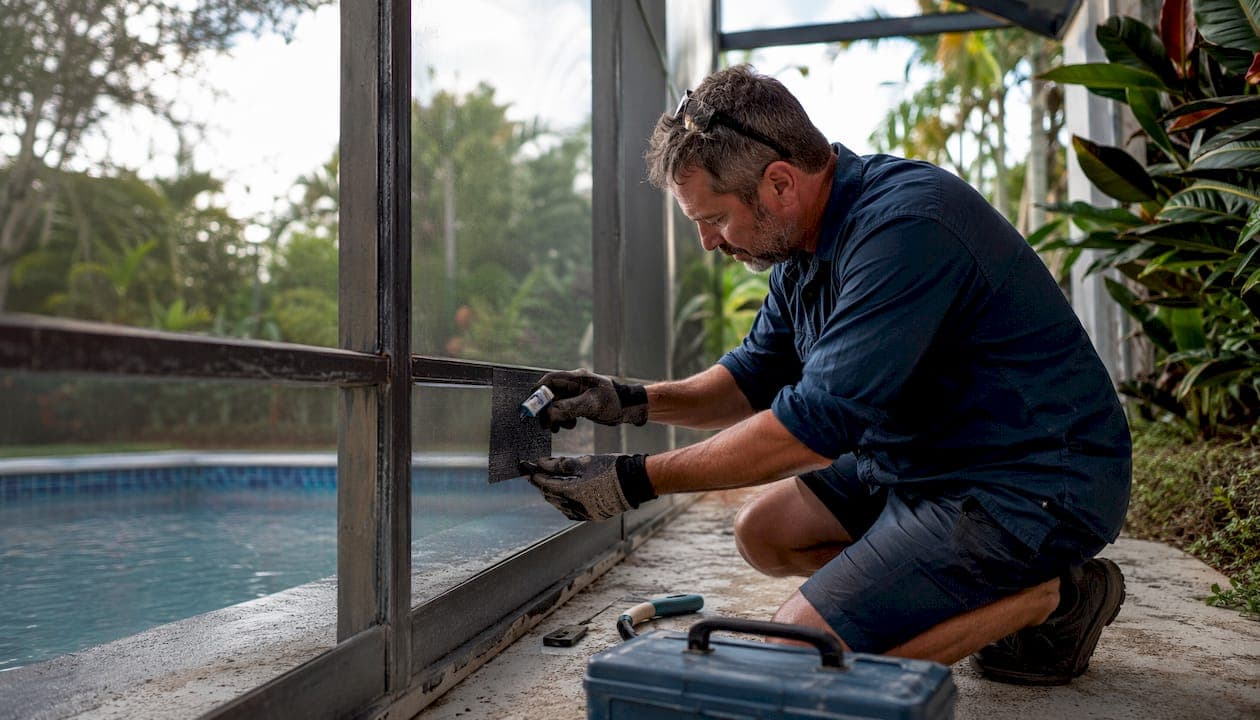
The most sustainable choice for an aging pool enclosure is targeted restoration, not full replacement. Start with panel patching or single-panel swaps for isolated damage, move to spline replacement and frame reinforcement where needed, and specify recycled aluminum, stainless steel fasteners, and UV-stable mesh throughout. Done right, this approach can save up to 60% compared to a full rebuild.
The five methods worth knowing:
- Targeted panel patching — closes small tears before they spread
- Single-panel replacement — swaps one damaged section without disturbing the frame
- Spline replacement — restores the rubber channel that holds mesh tight
- Frame reinforcement — stabilizes bent or corroded aluminum without full demolition
- Corrosion-resistant hardware swap — replaces rusted fasteners before they loosen panels
Get a photo record of every damaged area, then call for an on-site inspection and written estimate before committing to any scope.
Table of Contents
- What are the main sustainable pool screen repair methods?
- Which materials make pool screen repairs truly sustainable?
- What does a professional sustainable restoration actually look like?
- When should you repair vs. replace the enclosure?
- What routine maintenance can you do to extend enclosure life?
- Why is restoration greener than a full rebuild?
- What results do Mrpoolscreen restorations deliver?
- What safety and code checks are required before repairs?
- Key Takeaways
- Why restoration-first is the right call
- Mrpoolscreen brings sustainable restoration to Central Florida homeowners
What are the main sustainable pool screen repair methods?
Repair categories break down by damage type, and matching the method to the problem is what keeps the footprint low.
Targeted patching works for tears under a few inches. A patch of matching UV-stable mesh, bonded with compatible adhesive, stops the tear from spreading and buys time until a full panel swap makes sense. Single-panel replacement is the next step up: one frame bay gets new mesh and spline while everything else stays intact. This is the right call when a single panel is brittle or badly torn but the surrounding structure is sound.
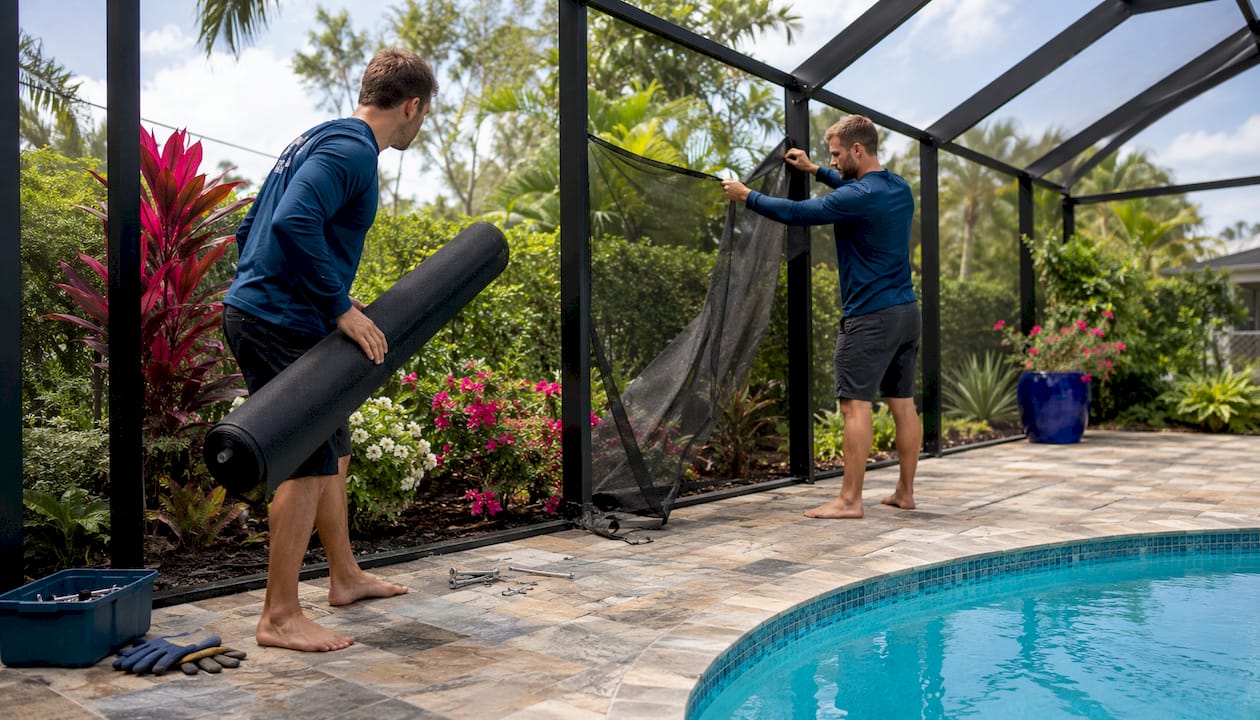
Full rescreen replaces all mesh panels across the enclosure while keeping the existing frame. It costs more than spot repairs but far less than a rebuild, and it resets the mesh lifecycle across the whole structure. Frame repair and reinforcement addresses bent extrusions, cracked welds, or loose anchor points. A contractor straightens or splices aluminum sections and re-anchors them to the slab. Hardware replacement is often the most overlooked method: swapping corroded screws and latches early prevents panels from loosening and avoids the structural damage that follows.
Pro Tip: Schedule frame and hardware work in the shoulder season (October through February in Central Florida) rather than right after a storm. Contractors are less backlogged, lead times on materials are shorter, and you can address storm damage before the next hurricane season opens.
Which materials make pool screen repairs truly sustainable?
Material choice determines whether a repair lasts eight years or twenty. Specify these:
- Recycled or powder-coated aluminum frames — recycled aluminum framing cuts raw-material extraction and, when the frame is eventually retired, the metal is fully recyclable again.
- Stainless steel fasteners — resist salt air and pool-chemical corrosion far longer than galvanized alternatives, reducing how often hardware needs replacement.
- Water-based acrylic coatings — lower VOC output than solvent-based products and bond well to aluminum frames; Mrpoolscreen uses industrial-grade water-based acrylics as a standard specification.
- UV-stable fiberglass or polyester mesh — application-matched mesh options (lower-panel insect screen vs. solar-protection mesh) extend service life by matching the product to the actual exposure.
- Recyclable vinyl spline — the rubber channel that holds mesh in the frame; choose a spline rated for UV exposure so it doesn't crack and release the panel prematurely.
When reviewing a contractor's bid, ask for the material grade on aluminum extrusions, the coating type and VOC rating, the fastener finish (316 stainless is the right spec near saltwater), and the mesh UV rating. Vague answers on any of these are a red flag.
What does a professional sustainable restoration actually look like?
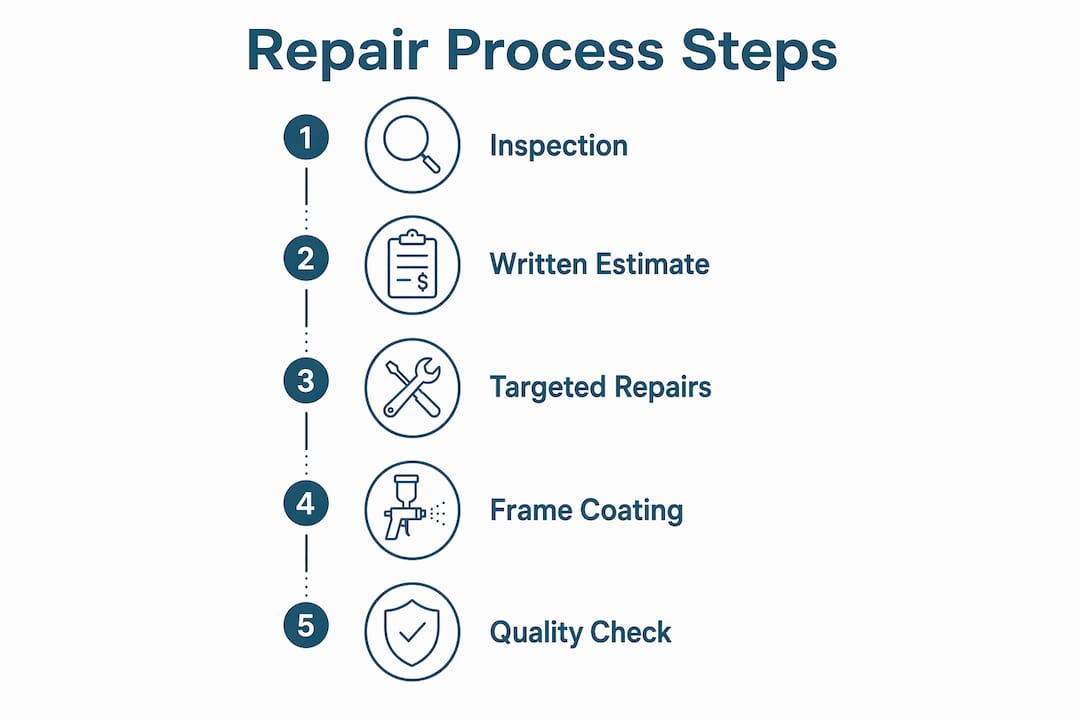
The workflow follows a clear sequence: inspection, written estimate, targeted repairs, frame coating, quality check, and warranty handoff. Here is what each stage involves and what to expect on timing and cost.
Pro Tip: If your enclosure took storm damage, wait for the adjuster's visit before scheduling restoration work. A written estimate from a licensed contractor often supports the insurance claim and can offset out-of-pocket costs.
| Planning factor | Typical range or figure |
|---|---|
| Mesh lifespan in humid climates | UV-stable mesh in humid climates lasts 8–15 years; use this range to plan repairs vs. replacement. |
| Potential savings vs. full rebuild | Significant savings compared to a full rebuild |
| Inspection to project completion | 1–3 weeks depending on scope and material lead times |
| Water waste avoided (no pool drain needed) | Avoids large volumes of water normally lost during draining |
The inspection is where scope gets defined. A contractor walks the structure, photographs every damaged panel and corroded fastener, checks frame anchors, and tests gate hardware. The written estimate breaks out labor and materials by category so you can see exactly what you are paying for. Targeted repairs come next: mesh and spline first, then hardware, then frame coating. A final quality check confirms gate self-close and latch function before the warranty document is handed over.
When should you repair vs. replace the enclosure?
Most relatively new enclosures with limited panel damage are strong candidates for targeted restoration. Beyond that threshold, the math shifts.
Repair is the right call when:
- The frame is structurally sound with no bent or cracked extrusions
- Fewer than one in five panels are torn or brittle
- Fasteners show surface rust but anchors are still tight
- The enclosure is under roughly ten years old with no prior major repairs
Replace or do a full rescreen when:
- Multiple panels are brittle across the whole structure (a sign the mesh has exceeded its 8–15 year lifespan)
- Frame extrusions are bent, cracked, or pulling away from slab anchors
- Fastener corrosion has loosened panels in more than one bay
- The enclosure has failed a prior repair and tears are recurring quickly
Safety note: A bent or anchor-compromised frame is a structural issue, not a cosmetic one. Do not attempt to patch mesh on a frame that moves or flexes — get a professional structural inspection first.
What routine maintenance can you do to extend enclosure life?
Consistent upkeep every 3–4 months is what keeps minor wear from becoming a resource-intensive repair. Visual inspections on this cadence, combined with one professional inspection per year, catch problems early.
- Rinse the mesh with a gentle garden hose from inside the enclosure outward. Skip pressure washers — they force water into spline channels and accelerate deterioration.
- Check for small tears along the lower panels and corners, where debris impact is highest. Mark any tear larger than an inch for repair before the next storm.
- Trim overhanging branches to at least three feet from the enclosure. Branches scrape mesh during wind and deposit debris that holds moisture against the frame.
- Inspect hinges, latches, and door closers. Apply a silicone-based lubricant to hinges; test that the gate self-closes and latches without force.
- Replace corroded screws proactively. A single loose fastener lets a panel flutter, which enlarges tears fast. Swap any screw showing white or orange corrosion for 316 stainless. Check the signs of fastener failure before they become a bigger problem.
- Stop and call a pro if you find a bent frame member, a loose anchor bolt, or a gate that no longer self-closes. These are not DIY fixes.
For working near the pool edge, wear non-slip footwear and keep tools away from the water. A pool screen maintenance checklist helps you stay consistent across seasons.
Why is restoration greener than a full rebuild?
Every full enclosure rebuild consumes virgin aluminum, generates landfill waste from the old frame and mesh, and often requires draining the pool. Restoration avoids most of that.
- Less raw material: Reusing the existing frame means no new aluminum extrusion is needed for the structure. When recycled aluminum is specified for repairs, the embodied energy is a fraction of virgin production.
- Less landfill waste: A targeted panel swap discards one mesh section. A full rebuild discards the entire frame, all mesh, all hardware, and the old spline.
- Water conservation: Keeping the pool full during screen repairs avoids the environmental cost of draining. Draining a typical pool is the equivalent of dumping 213,333 bottles of water, plus the chemical rebalancing and energy needed to refill and reheat.
- Lower coating emissions: Water-based acrylic coatings used on frame restoration have significantly lower VOC output than solvent-based alternatives, improving air quality during application.
Pro Tip: During the estimate phase, ask the contractor which removed components can be recycled and whether the old mesh will be disposed of at a recycling facility. A contractor who has a clear answer is operating at a higher standard.
What results do Mrpoolscreen restorations deliver?
Mrpoolscreen's restoration work in Central Florida consistently addresses the same pattern: weathered frames, corroded fasteners, and brittle mesh that make an enclosure look and feel like it needs full replacement when it does not.
In a typical project, the contractor arrives for an on-site inspection, photographs the damage, and delivers a written estimate within days. Restoration scope usually covers targeted panel replacement, spline renewal, stainless fastener upgrades, and a water-based acrylic frame coating. The result is a structure that looks new and performs to its original specification, at a fraction of rebuild cost.
Before-and-after documentation is standard. Mrpoolscreen's project gallery shows completed restorations with the specific methods and materials used, giving homeowners a realistic picture of outcomes before committing to a scope. Every project includes a maintenance plan so the restored enclosure stays in condition between professional visits.
What safety and code checks are required before repairs?
Pool enclosures in the United States are subject to pool barrier codes that govern gate function, fence height, and structural integrity. Before any repair work begins, confirm these with your local building department:
- Gate self-close and self-latch: Most jurisdictions require pool barrier gates to close and latch automatically from any open position. Repair work that disturbs the gate frame or hinges must restore this function before the job is complete.
- Barrier height and gap requirements: Check that panel replacement does not introduce gaps large enough for a child to pass through. Local codes typically specify maximum opening sizes.
- Structural anchors: Any frame repair that touches slab anchors may require a permit. Ask your contractor whether the scope triggers a permit requirement in your county.
Code reminder: Pool barrier rules exist to prevent drowning. Never leave a gate unlatched or a panel missing overnight during a repair project. If the enclosure must be open, use a temporary barrier.
For structural frame work, a licensed contractor should pull the permit. Cosmetic repairs (mesh and spline only) typically do not require one, but confirm with your local building department. A pool screen safety inspection checklist can help you verify compliance before and after work is done.
This article is general information, not legal or safety advice. Confirm current code requirements with your local building department or a licensed contractor for your specific situation.
Key Takeaways
Targeted restoration using recycled aluminum, stainless steel fasteners, and UV-stable mesh is the most sustainable and cost-effective approach for most aging pool enclosures, saving homeowners up to 60% versus a full rebuild.
| Point | Details |
|---|---|
| Restoration saves significantly | Targeted repair can save up to 60% compared to a full enclosure rebuild. |
| Mesh lifespan guides timing | UV-stable mesh in humid climates lasts 8–15 years; use this range to plan repairs vs. replacement. |
| Inspect every 3–4 months | Routine visual checks catch small tears and corroded fasteners before they require major work. |
| Specify industrial-grade materials | Ask for recycled aluminum, 316 stainless fasteners, water-based acrylic coatings, and UV-rated mesh. |
| Mrpoolscreen for professional restoration | Mrpoolscreen provides on-site inspections, written estimates, and warranted restorations in Central Florida. |
Why restoration-first is the right call
The conventional wisdom says a badly weathered pool enclosure needs to come down. After seeing how many structures get condemned to the landfill when targeted restoration would have done the job, that assumption deserves a harder look.
Most aging enclosures fail at the mesh and hardware level, not the frame. The aluminum extrusion is often structurally sound for years past the point where the mesh has given out. Treating a mesh problem as a frame problem is how homeowners end up spending three times what the job actually requires.
The environmental case reinforces the financial one. Every pound of virgin aluminum avoided, every pool kept full through an in-place repair, and every gallon of solvent-based coating replaced with a water-based alternative adds up across thousands of Florida enclosures. Restoration-first is not a compromise. It is the technically correct answer for the majority of structures that come through the door.
Mrpoolscreen brings sustainable restoration to Central Florida homeowners
Mrpoolscreen is the alternative to a full enclosure rebuild for homeowners in Central Florida who want a lasting result without the cost or waste of starting from scratch. The team uses industrial-grade restoration methods — water-based acrylic coatings, 316 stainless fasteners, and UV-stable mesh — and backs the work with a written warranty.
Every project starts with a free on-site inspection and a written estimate that breaks out scope by category. Before you book, have these ready: photos of the damage, the approximate age of your enclosure, and a list of visible issues (torn panels, corroded screws, gate problems). That information lets the team scope the work accurately and give you a number you can actually plan around. Request your inspection at mrpoolscreen.com and see completed projects in the restoration gallery before you decide.