
Responsible pool enclosure upkeep is the routine cleaning, inspection, and timely repair of screens, frames, fasteners, and gates to preserve safety, appearance, and structural life. A well-maintained enclosure can last 15–20+ years; neglecting upkeep leads to premature rescreening, corroded frames, and safety gaps. The CPSC's pool barrier guidance sets the floor: a minimum four-foot climb-resistant barrier with self-closing, self-latching gates and latches positioned at child-resistant heights. That's not optional maintenance. That's the baseline every homeowner should meet before worrying about aesthetics.
Your core upkeep routine at a glance:
- Monthly: Visual walkaround for torn mesh, loose fasteners, gate latch function, and corrosion signs
- Every few months: Deeper inspection of frames, seals, anchors, and door tracks
- Every few months: Deep clean (screens, frames, glass panels, drainage areas)
- Yearly: Professional inspection, especially for older enclosures
- After every major storm: Immediate safety check before anyone uses the pool area
Table of Contents
- What responsible pool enclosure upkeep actually looks like day to day
- How to clean your pool enclosure without damaging it
- Your monthly inspection checklist: what to look for and when to call a pro
- Preventive measures that actually slow down wear
- Patch, rescreen, or restore: how to make the right call
- Season-by-season maintenance: what to do and when
- Safety and compliance: the non-negotiable part of pool enclosure upkeep
- Realistic lifespans and cost expectations for pool enclosures
- Key Takeaways
- Why proactive upkeep pays off more than most homeowners expect
- Mrpoolscreen restores what most homeowners think needs replacing
- Useful sources and further reading
What responsible pool enclosure upkeep actually looks like day to day
Most homeowners treat their enclosure like a set-it-and-forget-it structure. That's the mistake. Responsible upkeep means treating the enclosure the same way you'd treat a roof: regular checks, quick fixes before they spread, and a seasonal deep clean that resets the baseline.
The practical routine breaks into three layers. First, cleaning keeps mold, algae, and corrosion from taking hold. Second, inspection catches the small failures — a loose screw, a small tear, a sticky latch — before they become expensive ones. Third, timely repair closes the loop. A torn screen left for two months becomes a sagging panel. A rusted fastener ignored for a season becomes a compromised frame joint.
The importance of pool enclosure maintenance compounds over time in both directions: consistent care extends lifespan and lowers total cost; deferred care accelerates deterioration faster than most homeowners expect.
How to clean your pool enclosure without damaging it
Cleaning frequency depends heavily on your environment. Near the coast or in high-humidity regions, rinse your enclosure every few weeks to prevent salt and algae buildup. Inland homeowners in drier climates can stretch to monthly rinsing, but a deep clean every 3–6 months is the standard regardless of location.
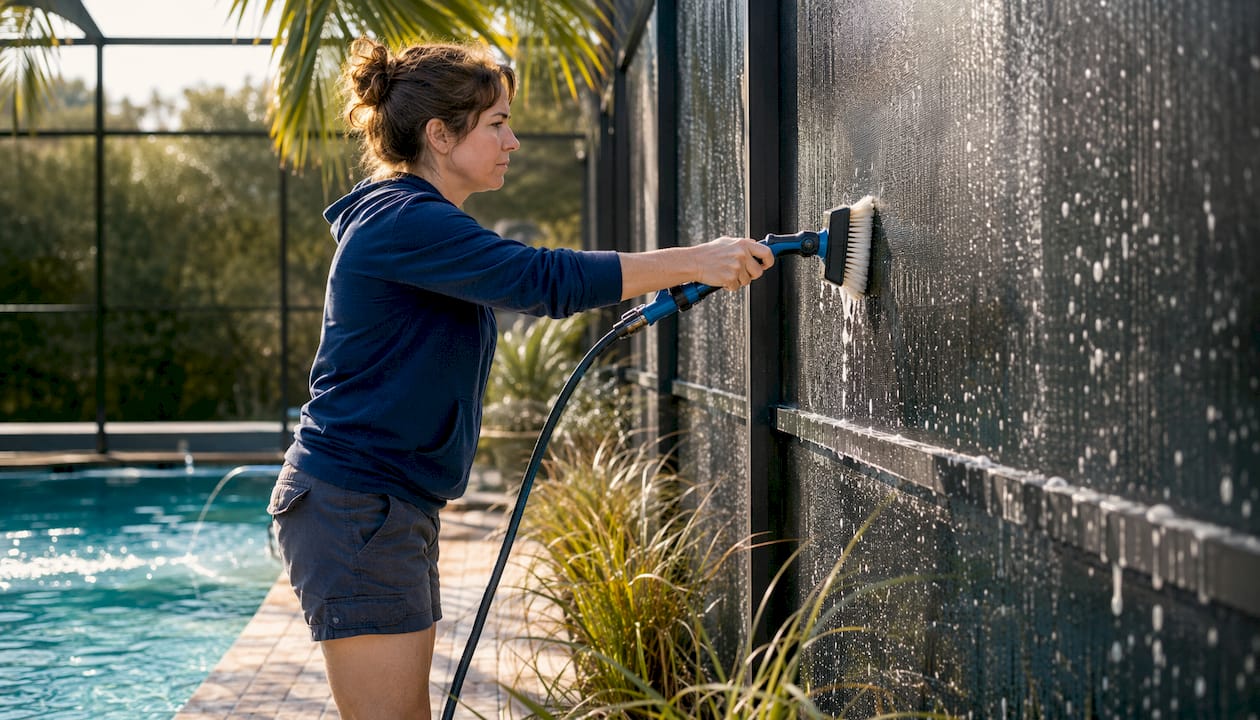
For mesh screens: Use a garden hose and a soft-bristle brush with a mild soap solution. Work top to bottom so debris rinses down and out. Avoid high-pressure washers on mesh — even a moderate-pressure setting can stretch or tear the weave and loosen spline from the frame channel. For stubborn mildew spots, a diluted white vinegar solution works without damaging the mesh or frame coating.
For glass or polycarbonate panels: A squeegee and a mild soapy solution handle most grime. A vinegar-and-water mix cuts through mineral deposits without streaking. Avoid harsh solvents or bleach on aluminum frames — they strip protective coatings and accelerate oxidation.
For door tracks and hinges: Skip WD-40. It attracts dust, breaks down into a gummy residue, and makes the problem worse within weeks. Use a silicone-based lubricant instead — it stays clean, repels moisture, and won't degrade rubber seals.
Step sequence that works:
- Clear loose debris by hand or with a dry brush before wetting anything
- Rinse the full structure with low-pressure water to loosen surface grime
- Apply mild soap solution with a soft brush, working panel by panel
- Rinse thoroughly from top to bottom
- Allow to air dry, or wipe frames with a clean cloth to prevent water spots
Pro Tip: Clean in the early morning or late afternoon. Cleaning during peak midday heat causes soap solutions to dry too fast, leaving residue and streaks on frames and glass panels that require a second pass to remove.
Your monthly inspection checklist: what to look for and when to call a pro
A monthly walkaround is a brief check that catches problems before they turn into expensive repairs. Walk the full perimeter, check every door, and look at the frame joints at ground level where moisture collects.
Check these items every month:
- Torn, sagging, or discolored mesh panels
- Loose, missing, or visibly rusted fasteners and screws
- Bent or bowed frame sections
- Gaps at door frames or where panels meet the slab
- Self-closing gate function (does it close and latch without assistance?)
- Latch operation and height (latch should sit at or above 54 inches per CPSC guidance)
- Standing water near anchor points or along the base
- Mold or mildew growth on frames and screen edges
- Seal condition around doors and panel edges
Every 3–4 months, go deeper: check anchor bolts at the slab, inspect frame joints for hairline cracks or separation, and test every door hinge for smooth operation. Schedule a professional pool screen safety inspection once a year and immediately after any hurricane or severe storm.
Pro Tip: After each inspection, take three or four photos of any issues you find and log them with the date in a notes app or a simple spreadsheet. That photo record matters for insurance claims and helps you track whether a problem is getting worse between visits.
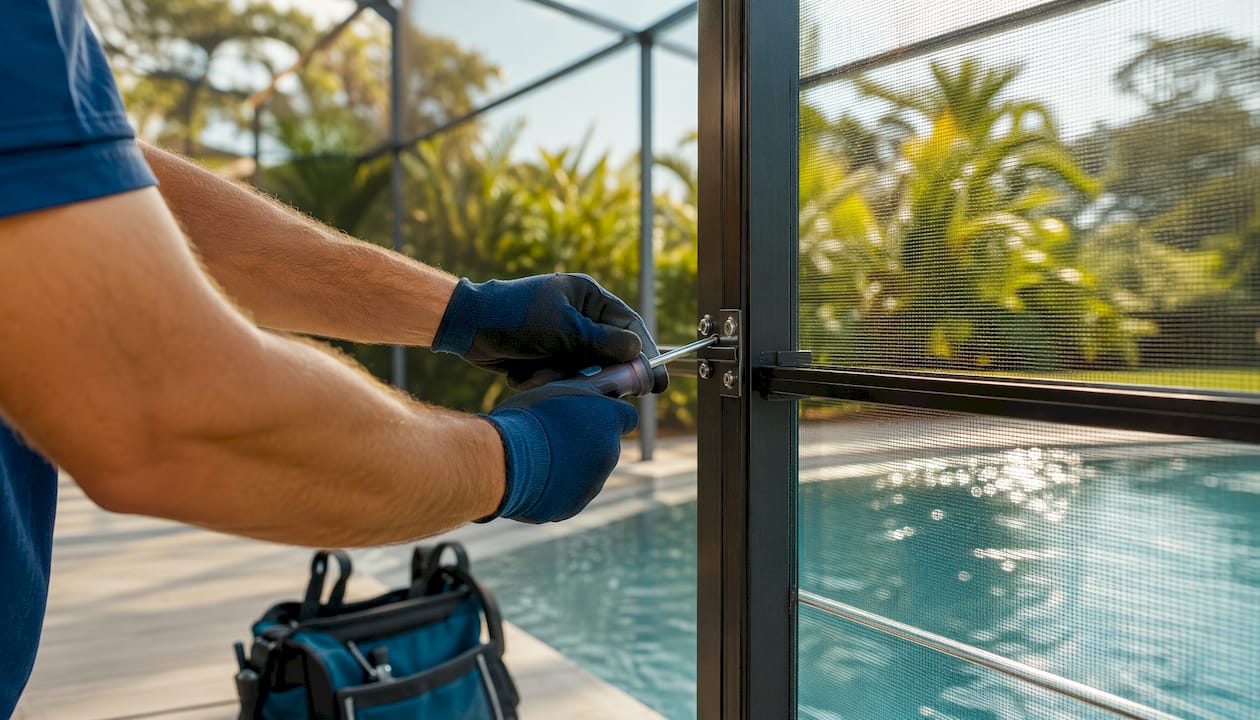
Owner-fixable items include minor screen patches, tightening loose screws, and applying lubricant to stiff hinges. Bent frames, anchor failures, widespread corrosion, and any gate that won't self-latch reliably belong on a professional's list.
Preventive measures that actually slow down wear
The best pool enclosure care routine is one that prevents failures rather than just responding to them. A few material and site-management choices make a measurable difference in how long your enclosure holds up.
Fasteners and coatings matter most. Standard steel fasteners corrode quickly in humid or coastal environments. Replacing them with stainless alternatives stops the corrosion cycle at its source. Water-based acrylic coatings on aluminum frames add a protective layer that resists UV degradation and moisture penetration. UV-resistant sealants around panel edges and door frames prevent water intrusion that leads to frame separation.
Site management is underrated. Overhanging branches drop debris onto screens and trap moisture against frames. Trim them back at least a few feet from the enclosure. Remove standing water around the base after rain. Control ground-level plant growth that presses against the screen panels and holds humidity against the mesh.
Pro Tip: Before hurricane season, apply a fresh coat of protective coating to aluminum frames and inspect all sealant lines. That one pre-season hour prevents the post-storm repairs that cost far more.
| Material or Measure | Primary Benefit | Longevity Impact |
|---|---|---|
| Stainless fasteners | Corrosion resistance in humid/salt-air environments | Prevents frame joint failure; extends structural life |
| Water-based acrylic coating | UV and moisture protection for aluminum frames | Slows oxidation and surface degradation |
| UV-resistant sealant | Seals panel edges against water intrusion | Reduces frame separation and mold entry points |
| Silicone-based lubricant | Keeps tracks and hinges operating cleanly | Prevents wear and rust on moving hardware |
| Vegetation management | Reduces debris load and moisture retention | Lowers mold risk and screen abrasion |
Patch, rescreen, or restore: how to make the right call
This is where most homeowners waste money. They patch one panel, then another, then another, and two years later they've spent more than a full rescreen would have cost — with uneven tension across the structure and no improvement in overall protection.
A practical decision flow:
- Identify the problem type. Is it one isolated tear, a few failing panels, or widespread sagging and brittleness across the structure?
- Assess age and spread. Enclosures 10–15 years old with mesh that is brittle, faded, or sagging across multiple panels have reached the rescreen threshold. Repeated failures in different locations signal the same thing.
- Check the frame and fasteners. If the frame shows systemic corrosion or bent sections, a rescreen alone won't solve the problem. Structural restoration or professional evaluation is the next step.
- Minor patch: One or two small tears on a younger enclosure with sound frames and tight fasteners. A patch kit from a home improvement store handles this.
- Full rescreen: Multiple failing panels, uneven tension, or mesh older than 10–12 years. Rescreening restores uniform tension across all panels and delivers consistent protection.
- Structural restoration: Corroded or bent frames, failing anchor points, or widespread fastener failure. This addresses the bones of the structure, not just the skin.
A common Gulf Coast scenario: A homeowner near Tampa notices three torn panels and a fourth that's sagging after two seasons of salt air exposure. Each panel was patched individually over 18 months. The right call at that point is a full rescreen — the mesh has lost uniform tension, and the salt environment will keep accelerating failure. Patching a fourth time is money spent on a temporary fix.
For sagging screen panels specifically, the repair decision depends on whether the spline channel is still intact. If the channel is damaged or the frame is bowed, a professional assessment is the only responsible path.
Pro Tip: When you call a restoration company, ask them to inspect the fasteners and frame joints during the same visit. A rescreen on a frame with corroding fasteners will need to be redone sooner than it should.
Season-by-season maintenance: what to do and when
Pool enclosure care isn't a once-a-year event. Each season brings a different set of risks, and a short seasonal checklist keeps you ahead of them.
Spring: Deep clean the full structure after winter. Inspect for any damage from cold temperatures or winter storms. Check all sealant lines and reapply where cracked. This is the best time to schedule a professional inspection if you haven't had one in the past year.
Summer: Mildew grows fast in heat and humidity. Rinse screens more frequently and check for algae on the lower panels and frame base. Inspect door hardware monthly since heat accelerates metal expansion and can affect latch alignment.
Fall: Clear leaves and debris before they block drainage channels. Check that water drains freely away from anchor points. Inspect for any screen damage from summer wind events. This is also the right time to apply protective coatings before the next storm season.
Winter (cold regions): Remove accumulated snow loads carefully to avoid frame stress. In Florida and the Gulf Coast, winter is typically the lowest-risk season, but post-cold-snap inspections for any sealant cracking are worth the 10 minutes.
Storm prep checklist:
- Tighten all visible screws and fasteners
- Clear gutters and drainage channels
- Secure or remove any loose objects near the enclosure
- Document the current condition with photos before the storm
Post-storm actions: Walk the full perimeter before anyone uses the pool. Look for bent frame sections, large tears, and any gate that no longer closes properly. Document all damage with photos. If frames are bent or multiple large tears are present, call a professional before using the pool area.
After any storm with salt spray, rinse the entire enclosure with fresh water within 24 hours. Salt residue left on aluminum frames and fasteners accelerates corrosion faster than almost any other environmental factor.
Safety and compliance: the non-negotiable part of pool enclosure upkeep
Safety isn't a maintenance category you get to defer. A pool enclosure that looks fine but has a gate that doesn't self-latch is a liability, not a protection.
The baseline requirements from U.S. pool safety guidance:
- Barrier height: minimum 4 feet, climb-resistant on all sides
- Gates: self-closing and self-latching, opening away from the pool
- Latch height: at or above 54 inches from the ground
- No climbable objects (furniture, planters, equipment) within reach of the barrier
Monthly safety upkeep tasks:
- Test the self-closing action on every gate: release it from fully open and confirm it closes and latches without assistance
- Verify latch operation by hand
- Check that no furniture or equipment has been placed against the barrier
- Look for any gaps at the base or sides of the enclosure where a child could pass through
Documented inspections carry real weight for insurance and liability purposes. A dated photo log showing consistent gate maintenance and barrier integrity is the kind of record that matters if an incident ever occurs. The pool enclosure safety inspection steps recommended by pool safety professionals include noting latch height, gate swing direction, and barrier condition in writing, not just a visual check.
Treating safety as part of the maintenance routine rather than a separate concern is what separates responsible upkeep from cosmetic upkeep. The gate latch gets tested the same day you check the screens.
Realistic lifespans and cost expectations for pool enclosures
A properly maintained enclosure can last 15–20+ years, assuming consistent cleaning, timely fastener replacement, and at least annual professional checks. Skipping maintenance can significantly reduce this lifespan, especially in coastal or high-humidity environments.
The 10–15-year mark is the professional evaluation threshold. At that age, even a structurally sound enclosure benefits from a professional assessment of frame condition, anchor integrity, and fastener corrosion before problems become structural.
Cost expectations by repair type (qualitative ranges):
- Small patch repairs: Low cost, DIY-friendly for minor isolated tears on younger enclosures
- Panel rescreening: Moderate cost per panel; full rescreen of a standard enclosure represents a meaningful investment but far less than a rebuild
- Structural restoration: Higher cost than rescreening alone, but addresses frame, fasteners, and coatings together; often the most cost-effective path for enclosures showing systemic wear
- Full rebuild: The most expensive option; warranted only when the frame is beyond restoration
The rule of thumb: when more than a third of your panels are failing or the frame shows corrosion at multiple joints, repeated patching costs more over two years than a full rescreen or restoration. For aging pool enclosures approaching the 15-year mark with visible frame wear, restoration typically delivers better long-term value than piecemeal repairs.
| Maintenance Task | Recommended Frequency | Typical Lifespan Benefit |
|---|---|---|
| Rinse and visual check | Monthly (every few weeks near coast) | Prevents mold and corrosion buildup |
| Deep clean | Every 3–6 months | Extends screen and frame surface life |
| Deeper structural inspection | Every 3–4 months | Catches fastener and frame issues early |
| Professional inspection | Annually + after major storms | Validates structural integrity |
| Professional evaluation | At 10–15 years of age | Determines restoration vs. rebuild path |
Key Takeaways
Responsible pool enclosure upkeep combines monthly safety checks, seasonal deep cleaning, and timely repair decisions to protect a structure that can last 15–20+ years when properly maintained.
| Point | Details |
|---|---|
| Monthly inspection is the foundation | Check mesh, fasteners, gate latch function, and barrier integrity every month without skipping. |
| Clean by environment, not just calendar | Rinse every few weeks near the coast; deep clean every 3–6 months regardless of location. |
| Safety standards are non-negotiable | Maintain a minimum 4-foot barrier and self-latching gates with latches at or above 54 inches. |
| Know when to rescreen vs. patch | Multiple failing panels or brittle mesh on a 10–15-year-old enclosure calls for a full rescreen, not more patches. |
| Mrpoolscreen offers restoration as an alternative to full rebuild | Professional restoration addresses weathering, rust, and frame wear and can save homeowners up to 60% compared to a full rebuild. |
Why proactive upkeep pays off more than most homeowners expect
The pattern I see most often is this: a homeowner defers the monthly walkaround for a season, misses a rusted fastener cluster near the base, and six months later has a frame joint that needs professional repair. The repair cost is real. The frustration is avoidable.
What proactive upkeep actually delivers isn't just a longer-lasting enclosure. It's fewer emergency calls, lower total maintenance spend over a decade, and a pool area that stays usable and safe through storm seasons rather than going out of service after them. The homeowners who get the most out of their enclosures are the ones who treat the monthly walkaround as a 10-minute habit, not an optional task.
Mrpoolscreen's restoration work consistently shows the same outcome: enclosures that looked like candidates for full replacement, brought back to sound structural condition with water-based acrylic coatings and stainless fasteners, at a fraction of rebuild cost. The before-and-after results make the case better than any description. Restoration can save homeowners up to 60% compared to a full rebuild, and the industrial-grade materials used in that process outlast the standard hardware that came with most aging enclosures.
The homeowners who wait until the frame is visibly failing pay the most. The ones who schedule a professional evaluation at the 10–15-year mark, catch problems early, and invest in protective coatings before hurricane season pay significantly less over the life of the structure.
Mrpoolscreen restores what most homeowners think needs replacing
Saving up to 60% compared to a full rebuild is the number that gets attention, but the real value is what Mrpoolscreen delivers beyond the cost: a restored enclosure with industrial-grade stainless fasteners, water-based acrylic coatings, and a professional assessment that identifies structural issues before they become emergencies. The service covers the full scope — safety evaluation, corrosion remediation, rescreening, and protective coating application — so homeowners aren't coordinating three separate contractors.
If your enclosure is showing wear, salt damage, or has crossed the 10-year mark, a professional pool screen restoration assessment is the right next step. Before you book, ask these six questions:
- What does your inspection cover, and will you assess the frame and anchors, not just the screens?
- What materials do you use for fasteners and coatings?
- What warranty do you offer on rescreening and restoration work?
- How long does a standard restoration take from assessment to completion?
- Will the pool area be usable during the work?
- Can you provide a written cost estimate before work begins?
Contact Mrpoolscreen to schedule your assessment and get a clear picture of what your enclosure actually needs.
Useful sources and further reading
The following resources were used to support the guidance in this article and are worth bookmarking for ongoing reference:
- Pool Safely — U.S. Consumer Product Safety Commission — Primary source for U.S. pool barrier and gate safety requirements
- CPSC Pool Safety Steps (PDF) — Official CPSC guidance on barriers, self-latching gates, and drain safety
- CDC Healthy Swimming — Pool Safety Guidelines — Four-sided fencing and self-latching gate recommendations
- HealthyChildren.org — Pool Fence Safety — Pediatric guidance on barrier height, latch placement, and climb resistance
- Fabri-Tech — Florida Pool Screen Repair & Maintenance Guide — Inspection timelines and rescreen decision criteria
- White Aluminum — Pool Enclosure Maintenance Tips — Seasonal maintenance and material care guidance
- Mrpoolscreen — Pool Screen Restoration, Orlando, Florida — Restoration service overview and assessment process
- Mrpoolscreen Blog — Pool Screen Safety Inspection Checklist — Step-by-step homeowner inspection guide
- Mrpoolscreen Blog — Aging Pool Enclosure Repair Checklist — Guidance for enclosures approaching the 10–15-year evaluation window
- Silicone vs. Oil-Based Lubricant — Gator Sliding Doors — Why silicone lubricant outperforms WD-40 for outdoor door tracks