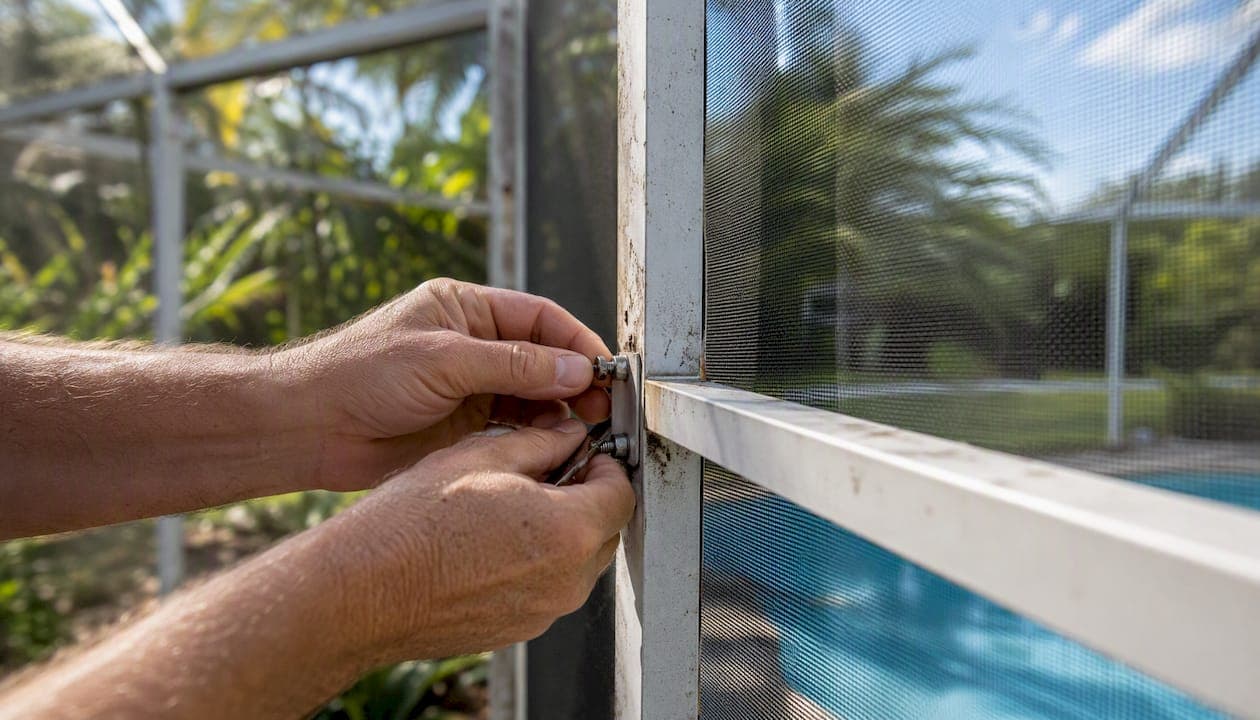
Most pool cage wind noise comes down to three fixable problems: loose or sagging screen panels, worn or failing fasteners at the connection points, and pool equipment vibration that gets mistaken for wind. Fix those three in order and you'll eliminate the majority of the whistling, rattling, and drumming that shows up on breezy days. None of this requires a rebuild.
Here's why those three matter more than anything else. A screened enclosure isn't a solid wall, it's a frame holding thousands of small openings, and wind pushes through that mesh rather than just against it. When panels are loose or a connection has started to fatigue, that airflow has something to vibrate against, and vibration is what you're hearing as noise. Pump and motor vibration produces a similar sound signature, which is why homeowners often blame the wind when the real culprit is sitting in the equipment pad.
Run through this before you call anyone:
- Walk the perimeter and press on each screen panel. If it flexes or drums under light pressure, tension or fastening is off.
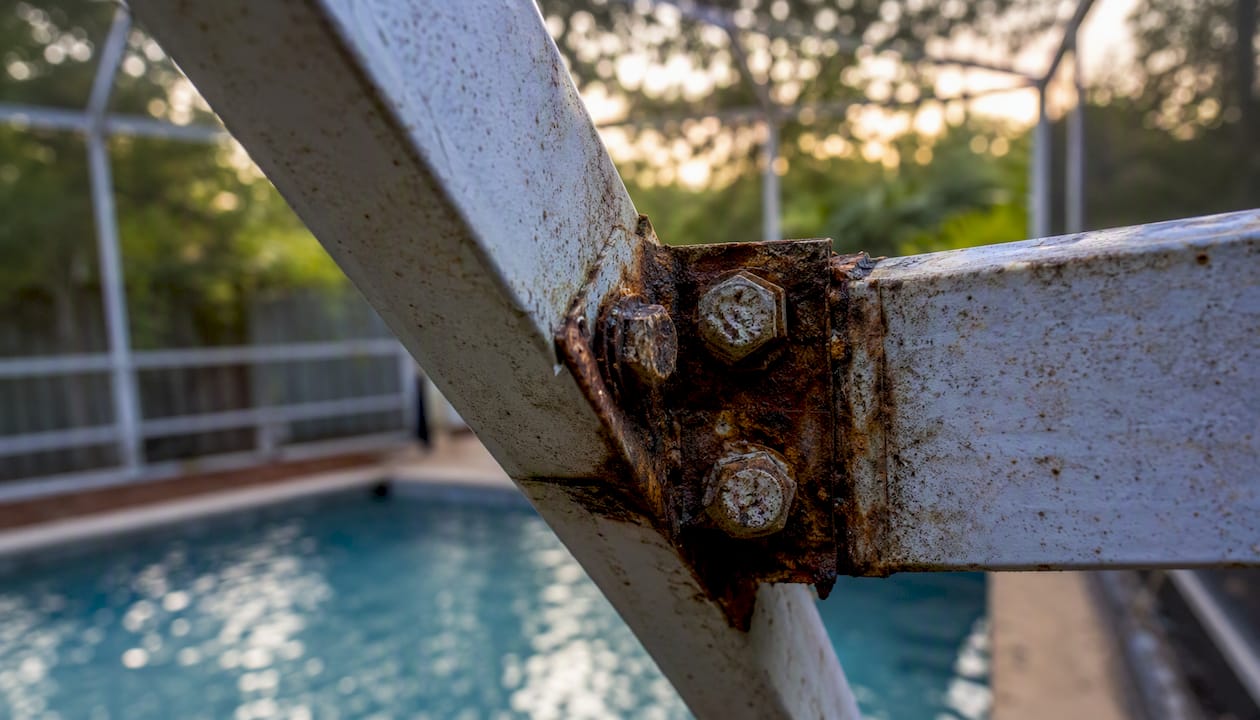
- Check visible screws and clips at the frame joints for rust streaks, elongated holes, or wobble.
- Turn your pool pump off for two minutes during a windy period. If the noise continues, it's structural. If it stops and restarts with the pump, it's mechanical.
- Look at where PVC plumbing touches the screen frame or a wall. Contact points transmit vibration like a drumhead.
- Avoid tightening anchors into concrete or stucco that's already crumbling. That makes things worse, not better.
Pro Tip: Grab a helper and gently shake a screen panel from opposite corners while the other person watches the frame joints. Visible movement at the corner brackets, even a fraction of an inch, usually means the fastener has already started to pull loose.
Key Takeaways
Most pool cage wind noise traces back to loose screens, degraded fasteners, or equipment vibration, and fixing those three resolves the majority of cases without a rebuild.
| Point | Details |
|---|---|
| Diagnose before fixing | Test whether noise persists with the pump off to separate wind issues from mechanical ones. |
| Retension and refasten first | Slack screens and corroded fasteners cause most flutter and buzzing noise. |
| Isolate equipment vibration | Vibration pads and proper pump clearance stop mechanical noise from mimicking wind noise. |
| Match mesh to wind zone | Denser meshes like hurricane screens cut noise but demand stronger connections and anchors. |
| Restore before you rebuild | Mrpoolscreen's restoration process replaces fasteners, recoats frames, and re-screens panels at a fraction of full-rebuild cost when the frame itself is sound. |
If you notice repeated fastener failure, sagging panels you can't retension, or any sign the frame itself is compromised, get a professional inspection before the next storm season rather than after it.
Table of Contents
- How Screened Enclosures Interact With Wind
- Is the Noise Coming From Wind or From Your Pool Equipment?
- Which Screen Mesh Actually Cuts Down Noise?
- What Structural Factors Drive Wind Noise and Failure Risk
- What Can Homeowners Fix Without Calling a Contractor?
- When Should You Call a Professional Instead of DIY-ing It?
- Can Restoration Fix Wind Noise Without a Full Rebuild?
- A Contractor's View on Cost, Safety, and Sound
- Getting an Estimate When Restoration Is the Right Call
- Frequently Asked Questions
- Sources
How Screened Enclosures Interact With Wind
A pool cage doesn't resist wind the way a house does. A house wall is a solid surface, so wind either pushes on it or doesn't. A screen enclosure is porous, which means wind passes through the mesh, and the load on the structure comes from that flow rather than from pressure alone. Wind-tunnel research cited in Texas Department of Insurance guidance on screen enclosure wind loads confirms this flow-through behavior changes how pressure gets distributed across the roof and walls of a cage compared to a solid building.
That difference is exactly why screen enclosures are designed to give a little under wind, rather than stand rigid like a wall. Engineers actually want some flex in the system, because a structure that "releases" pressure gradually is less likely to fail catastrophically than one that fights the wind head on. The problem is that uneven screen tension, a torn panel, or an oversized panel that wasn't designed for the wind load in your area turns that intentional flexibility into a rattling, buzzing mess. Picture wind moving through thousands of tiny mesh openings: if the screen is taut and evenly tensioned, that air passes through with barely a whisper. If the mesh has slackened or a section of spline has popped out of its channel, the fabric starts fluttering against the frame, and that flutter is the buzzing or humming you hear on gusty afternoons.
Screen enclosures aren't meant to block wind. They're meant to let it pass through in a controlled way. Noise shows up exactly where that control breaks down.
Pro Tip: Run your hand flat across a screen panel from top to bottom. A properly tensioned screen feels like a drumhead, firm and even. If you feel a wave or slack pocket partway down, that's where the noise is originating.
Is the Noise Coming From Wind or From Your Pool Equipment?
The fastest way to tell the difference is timing. Wind-driven noise rises and falls with gusts and stops almost entirely on calm days. Equipment noise runs on a schedule, tied to when your pump or filter system cycles on, regardless of what the weather is doing outside.
Work through this sequence before assuming it's the enclosure:
- Note what time the noise happens and check it against your pump's run schedule.
- Stand at different points around the cage. Wind noise tends to concentrate near torn or loose panels; equipment noise gets louder as you approach the pad.
- Cycle your pump through its speed settings if you have a variable-speed model. A change in pitch that tracks with pump speed points to mechanical, not wind.
- Press firmly on a nearby frame post during a gust. If the whole section resonates like a tuning fork, that's a structural connection issue.
- Check whether the sound persists on a still day. Constant noise with no wind almost always means cavitation, a worn bearing, or plumbing contact, not the enclosure.
Homeowner diagnostics from Back Bay Pools' guide to reducing pool equipment noise lay out specific signatures worth knowing: grinding usually points to worn bearings, screeching often means a failing motor, and a hydraulic roar with visible bubbles at the pump basket signals cavitation rather than anything wind related. The most common culprits behind cage noise, wind and mechanical combined, tend to be:
- Loose or corroded fasteners at panel corners and roof beams
- Torn or slack screen fabric that's lost its tension
- Oversized panels that were never designed for local wind speeds
- Shallow anchor embedment into aging concrete
- Worn pump bearings or motor mounts
- Cavitation from a clogged skimmer basket or undersized plumbing
- Rigid PVC plumbing resting directly against the frame
One safety note worth repeating: never open an electrical panel or pump housing to chase a noise yourself. If a sound traces back to the motor or wiring, that's the point to call a licensed pool equipment technician rather than a screen contractor.
Which Screen Mesh Actually Cuts Down Noise?
Denser, stronger mesh generally reduces the fluttering and whistling associated with wind noise, but it also changes how wind loads pass through the panel, which means frame and connection requirements shift too. You can't just upgrade the screen and ignore what's holding it in place.
Homeowners rescreening a cage typically choose between four mesh categories, and each one trades airflow for strength differently:
| Mesh Type | Noise Behavior | Airflow / Visibility | Best Fit |
|---|---|---|---|
| 18/14 standard | Moderate flutter risk if under-tensioned | High airflow, good visibility | Standard enclosures in low to moderate wind zones |
| 20/20 no-see-um | Tighter weave reduces small-gap whistling | Reduced airflow, finer visibility, blocks tiny insects | Homes with heavy bug pressure near wooded lots |
| Pet / super screen | Thicker strands dampen vibration but add weight | Lower airflow than standard mesh | Households with dogs or cats that scratch or lean on screens |
| Hurricane / high-wind screen | Densest weave, most resistant to flutter-driven noise | Lowest airflow of the group, heavier visual profile | High-wind coastal zones and homes rated for stronger design wind speeds |
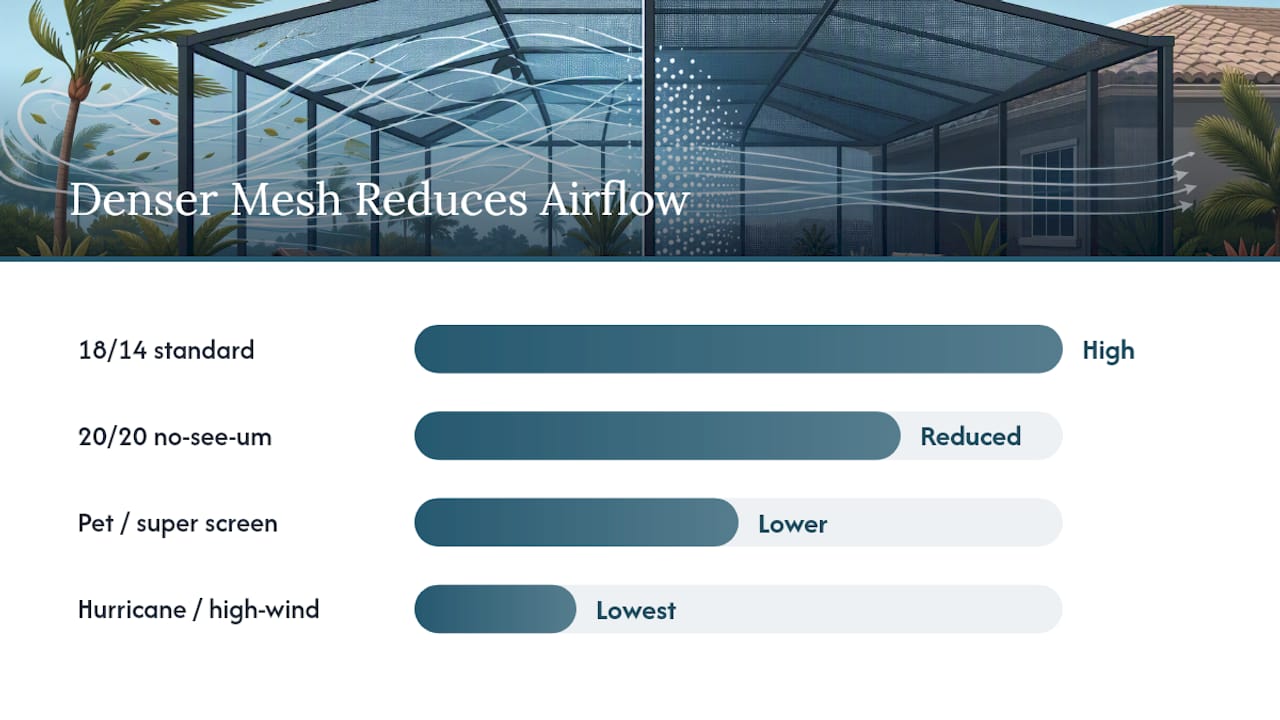
The trade-off isn't just about noise. Denser mesh like hurricane screens catches more wind load per square foot, which means the frame, connections, and anchor points need to be rated for that added force. This is where a lot of DIY rescreening jobs go wrong: someone upgrades to a heavier mesh to cut down on noise, but the existing fasteners and panel spacing weren't designed to handle the extra load, and now the connections are the weak point instead of the screen.
A few things worth knowing before you pick a mesh:
- Pet and super screens resist tearing but transmit more vibration if tension isn't dialed in correctly.
- 20/20 no-see-um mesh cuts down on whistling through fine gaps but reduces airflow enough to matter in Florida summers.
- If your existing frame shows any signs of connection stress, rescreening alone won't solve the noise. Address the frame first.
- Cost-wise, rescreening a panel is almost always cheaper than upgrading hardware, but skipping the hardware check just delays the real fix.
What Structural Factors Drive Wind Noise and Failure Risk
Weak connections and oversized, unsupported panels are the single biggest driver of both wind noise and outright structural failure in screen enclosures. The engineering standard behind this is ASCE 7, which sets the design wind speed a structure needs to withstand based on geographic location, and that figure drives everything downstream: anchor spacing, panel dimensions, and bolt sizing. In much of Florida, design wind speeds vary depending on the zone, and a cage engineered for the lower end of that range will behave very differently in a storm than one built for the upper end.
Laboratory testing on aluminum screen enclosure connections found that screw pullout and hardware fatigue at the host connection, where the cage frame attaches to the house, are among the leading causes of enclosure collapse. Researchers behind this experimental host connection study built fragility curves that map the probability of failure against wind speed, and the pattern is consistent: connections with smaller screws, sparse layouts, or undersized angle brackets fail at meaningfully lower wind speeds than reinforced ones. Separate structural analysis work modeling enclosures for 150 mph wind loading found that no single code covers every enclosure configuration, which is why engineers often combine ASCE guidance with project-specific criteria for local wind zones.
If you're getting work done, or reviewing engineered drawings for a new build, this is what should be on the page:
- The design wind speed the structure is rated for, referenced against ASCE 7
- A documented anchor schedule showing spacing and embedment depth
- Bolt and screw sizes specified for each connection type, not just "standard hardware"
- Panel dimensions that match the rated wind load, especially for larger roof spans
- Permit documentation, since most municipalities require it for structural screen work
Pro Tip: Check the screws at your cage's roof-to-post connections for rust bleed streaks running down the aluminum. That staining is often the first visible sign a fastener is corroding from the inside before it ever loosens visibly.
What Can Homeowners Fix Without Calling a Contractor?
Retensioning loose screens, swapping out corroded fasteners, and isolating your pool equipment from vibration are the three fixes you can tackle yourself or with a handyman, and together they resolve most wind-noise complaints without touching the frame's structure. None of these require a permit.
Work through them in this order:
- Retension slack screens. Pull the spline out of the channel, re-stretch the mesh evenly, and reseat the spline. Uneven tension is the number one cause of flutter noise.
- Replace visible corroded fasteners. Swap rusted screws for stainless steel or Nylotech hardware, which resists corrosion far longer than standard galvanized screws in a pool environment.
- Check fastener torque at accessible joints. Snug, don't overtighten. Stripping a screw hole in aging aluminum creates a bigger problem than the one you started with.
- Isolate plumbing contact points. Add rubber padding anywhere PVC pipe touches the frame or a wall to stop vibration transfer.
- Add vibration isolation pads under your pump and filter. This is one of the most effective, lowest-cost mechanical fixes available, and pairing it with a variable-speed pump running at lower RPM cuts noise further since these pumps operate more quietly at reduced speeds.
- Set up a temporary windbreak on the prevailing-wind side of the cage using a solid panel or dense hedge if noise spikes only during specific wind directions.
Pro Tip: Keep pool equipment at least a few feet from walls and the cage frame when possible. Tight clearance turns a nearby surface into a sounding board for motor vibration.
Beyond the pump itself, Back Bay Pools notes that sealing a motor in an airtight box to quiet it down usually backfires by trapping heat and shortening its lifespan. Addressing vibration at the source works better than trying to muffle it after the fact.
A few things to avoid entirely: never enclose a pump motor in a sealed box hoping to dampen sound, never overtighten anchors into concrete or stucco that's already crumbling, and never attempt structural repairs to the frame or connections yourself. That work needs a permit and, often, engineered drawings. For broader upkeep beyond noise fixes, Mrpoolscreen's homeowner upkeep guide covers the maintenance rhythm that keeps small issues from becoming expensive ones.
When Should You Call a Professional Instead of DIY-ing It?
Call a contractor once you see repeated fastener pullout, a large panel that needs full replacement, or any structural work that requires a permit, because those situations go beyond what tensioning or hardware swaps can fix. Trying to patch a genuine structural problem with retail screws and caulk usually just delays a bigger repair bill.
When you're collecting quotes, ask for these specifics in writing:
- Engineered drawings showing the proposed design wind speed and how it maps to ASCE 7 requirements for your zone
- A documented anchor schedule with bolt sizes and embedment depth
- Material specifications for both mesh and fasteners, not vague descriptions like "heavy duty"
- Whether the contractor pulls the permit or expects you to
- Warranty terms covering both materials and labor
Rough cost and timeline expectations vary by scope, but the pattern homeowners typically run into looks like this:
- Rescreening a section (fabric only, screen frame): usually the fastest turnaround, often completed in a single day
- Fastener or anchor repair: moderate cost, typically a day or two depending on how many connection points need attention
- Partial structural repair (damaged posts or beams): longer timeline, may require engineering sign-off and permitting before work starts
- Full enclosure replacement: the most expensive and time-intensive option, reserved for frames with widespread structural failure
Get at least two written quotes before committing to anything beyond a simple rescreen. A quote that skips engineered drawings entirely, or that can't tell you the design wind speed it's building to, is a red flag regardless of how competitive the price looks. If a storm caused the damage you're now dealing with, Mrpoolscreen's storm damage repair guide breaks down what repair steps typically apply and where the cost savings usually come from.
Can Restoration Fix Wind Noise Without a Full Rebuild?
Restoration solves most wind-noise problems for less than a full rebuild whenever the frame itself is structurally sound and the failures are limited to fasteners, coatings, or the screen fabric. A sound frame with bad hardware is a very different repair than a frame that's failing structurally, and the first case almost never needs a rebuild.
A typical restoration project follows a pattern like this:
- Condition on arrival: Rust staining at connection points, several visibly loose panels, and a persistent low buzz during moderate wind that the homeowner had already ruled out as pump noise.
- Diagnosis: Frame integrity checked at each host connection; corrosion found on roughly a third of visible fasteners, with screen tension noticeably slack on two full panels.
- Restoration steps: Corroded screws replaced with stainless steel or Nylotech hardware, frame coated with an industrial-grade water-based acrylic finish, affected panels fully re-screened and retensioned.
- Post-restoration check: Panels tested by hand-pressure for flutter, connections rechecked for tightness, and the homeowner walked through a calm-day and windy-day comparison.
The frame told us everything we needed to know. It wasn't failing, it just needed its connections and coating brought back to where they should have been years earlier.
A reputable restoration quote should hand you specifics, not vague promises. Ask for material specs on the coating and fasteners being used, a written warranty, and dated pre- and post-restoration photos. You can see what that documentation looks like in practice in Mrpoolscreen's project gallery, which shows before-and-after results from completed restorations.
A Contractor's View on Cost, Safety, and Sound
People tend to treat wind noise as an annoyance to live with, right up until it turns out to be the first audible sign of a connection that's been quietly failing for a couple of years. The pattern shows up over and over: a homeowner mentions the whistling has "always been there," and then a closer look finds screws that are barely seated anymore. Noise isn't just an acoustic nuisance. It's frequently the cage telling you something about its hardware before that hardware actually gives out.
The instinct to jump straight to a full rebuild is usually the wrong one, though. Most of the enclosures I'd flag as noisy have frames that are perfectly capable of standing for another decade or two. What they need is targeted work: better fasteners, a proper coating, and screens tensioned the way they were designed to be. A rebuild only makes sense when the frame itself has failed, not when the frame is fine and the connections around it aren't.
If your contractor can't tell you the design wind speed your cage should meet or can't explain why they're recommending a rebuild over targeted repair, get a second opinion before you sign anything.
Getting an Estimate When Restoration Is the Right Call
If your frame is structurally sound and the problem sits in the fasteners, the coating, or the screen fabric, restoration is almost always the better value than tearing the whole enclosure out and starting over.

Homeowners choose restoration over a full rebuild for a few consistent reasons. It typically costs a fraction of a rebuild since you're not paying to remove and reframe a structure that's already sound. It moves faster, since there's no engineering redesign phase required when the frame itself doesn't need it. And it's far less disruptive to your yard and pool deck than a full teardown and rebuild.
To get an accurate estimate, take photos of any visibly loose panels, rusted fasteners, or torn screen sections, and note where you've heard the noise loudest and under what wind conditions. A written quote from Mrpoolscreen will spell out the materials being used, including stainless steel or Nylotech fasteners and water-based acrylic coatings, along with a warranty and documented before-and-after photos so you know exactly what you're paying for. If your enclosure sounds like a candidate for restoration rather than replacement, request a free estimate and get a firsthand look at what the restoration process involves for your specific cage.
Frequently Asked Questions
Does a heavier screen mesh always mean less wind noise? Not automatically. Denser mesh like hurricane or pet screens does reduce flutter compared to standard 18/14 mesh, but it also increases the wind load your frame and connections need to handle. Upgrading mesh without checking hardware can shift the noise problem to the connections instead of solving it.
Can I reduce pool cage wind noise myself, or do I need a contractor? Retensioning screens, replacing visible corroded fasteners, and adding vibration isolation pads to your pool equipment are all homeowner-level fixes. Anything involving the frame's structural connections, large panel replacement, or permitted work needs a licensed contractor.
How do I know if my pool cage is rated for my area's wind speed? Check for engineered drawings referencing ASCE 7 design wind speed, which varies by zone and often falls between 140 and 170 mph in Florida. If you don't have this documentation, a contractor can assess your existing structure against current code requirements.
Is it normal for a pool cage to make noise in moderate wind? Some airflow sound through mesh is normal since screens are designed to let wind pass through. Persistent rattling, buzzing, or drumming usually signals loose tension, a failing fastener, or a panel that needs attention rather than something to just live with.
Will a variable-speed pool pump actually reduce noise near my cage? Yes. Variable-speed pumps run considerably quieter at lower speeds than single-speed pumps, and pairing one with vibration isolation pads addresses mechanical noise that often gets mistaken for wind noise coming from the enclosure itself.
Sources
- Experimental investigation of host connections in aluminum screened enclosures (FSU repository)
- Screen Enclosure Wind Loads (Texas Department of Insurance document)
- How to reduce pool equipment noise in Cape Coral (Back Bay Pools)
- Structural analysis of outdoor enclosures for 150 mph wind loading (DDB analysis)