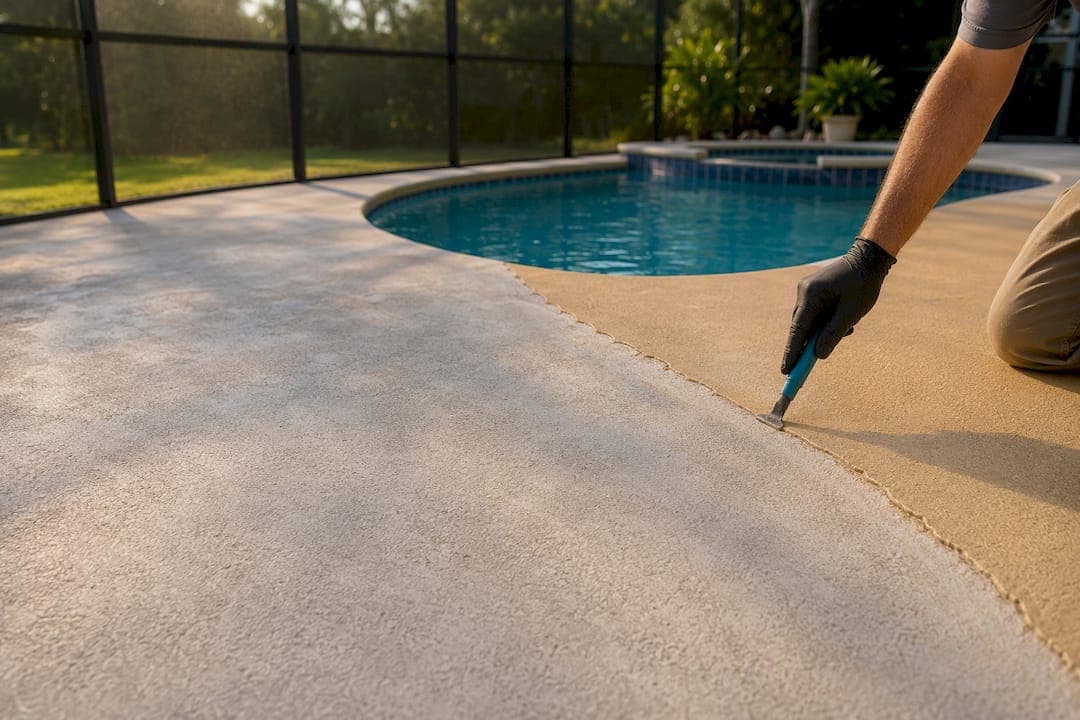
If your pool deck is structurally sound and just faded from sun and chemicals, deep clean it and either restain the surface or apply a tinted sealer. If the existing coating is peeling, chalking, or lifting off in sheets, strip it first and either restain the bare slab or install a new resurfacing system. Either way, mix in a traction additive and put a reseal date on your calendar.
TL;DR:
- Most faded pool decks can be restored through cleaning, repair, and resealing without full replacement unless there is structural damage or persistent moisture issues.
- Check for adhesion failure by peeling with tape; if coating chips, stripping and reapplication are necessary, not simple cleaning.
- Surface damage such as cracks wider than a quarter inch or spalling must be repaired before applying new color, or the finish will fade unevenly.
- Use 2,500 to 3,000 PSI pressure washing with proper surface prep, and apply stains or sealers when temperatures are between 50 and 90 degrees Fahrenheit out of direct sunlight.
- Resealing should be done every 2 to 7 years to maintain color and protect against UV damage, with more frequent upkeep required for south-facing or high-traffic decks.
Table of Contents
- What's Causing Your Faded Pool Deck Color, and What Should You Do About It?
- Step-by-Step: How to Restore Color to a Faded Concrete Pool Deck
- What's the Best Color for a Pool Deck in Full Sun?
- Which Materials and Coatings Hold Color Best Over Time?
- How Much Does It Cost to Repaint or Restore a Pool Deck?
- How Often Should You Reseal a Pool Deck to Keep the Color?
- What Do Real Pool Deck Restoration Projects Actually Look Like?
- How Do You Measure How Faded a Pool Deck Really Is?
- What Other Environmental Factors Speed Up Pool Deck Fading?
- What Mistakes Do Homeowners Make Restoring a Pool Deck?
- When Does a Faded Deck Signal a Structural Problem?
- The Smartest Way to Think About a Faded Pool Deck
- Get Your Faded Pool Deck Professionally Restored
- Sources
- FAQ
What's Causing Your Faded Pool Deck Color, and What Should You Do About It?
Fading is rarely one problem. It's usually three or four working together: UV breakdown of pigment, chlorine or salt residue etching the surface, sealer wearing thin, and years of bare feet dragging grit across the same six square feet by the ladder. Before you buy a single can of stain, walk the deck and actually diagnose what you're dealing with.
Start with an adhesion check. Press a strip of packing tape onto a faded or discolored patch, then rip it off fast. If chips of coating come with it, the finish has failed and no amount of cleaning will fix the color. That's a strip-and-recoat job, not a wash-and-reseal one.
Next, look at color uniformity. Faded but even color across the whole deck, with no lifting, usually means the substrate is fine and the pigment or sealer has simply broken down from years of sun exposure. That's the easiest and cheapest scenario to fix, and it's the one most homeowners are actually dealing with when they search for help.
Then check for cracking and spalling. Hairline cracks (thinner than a credit card) are cosmetic and don't affect the color job. Wider cracks, or spots where the surface has spalled and popped off in chunks exposing aggregate underneath, need repair before any color goes down, or the patch will telegraph through and fade differently than the surrounding slab.
Finally, check for moisture. Press your palm flat on a shaded section in the morning. If it feels damp or you see a dark ring after a few hours, water is moving up through the slab, which usually points to drainage or vapor issues underneath. That's the one condition where you stop the color project and call a professional, because coating over a wet slab is how you end up doing this twice.
What this checklist tells you:
- Faded but structurally solid, no adhesion failure, no cracking: clean, then restain or apply a tinted sealer.
- Even color loss with a peeling or flaking topcoat: strip the old coating, then restain or recoat.
- Cracking wider than a quarter inch, spalling, or exposed rebar: repair first, then color.
- Persistent dampness, efflorescence (white powdery residue), or a hollow sound when you tap the surface: get a professional assessment before doing anything cosmetic.
A faded pool deck usually does not need full replacement. Cleaning, correct surface prep, and restaining or recoating restore most decks without tearing anything out. Replacement only enters the conversation when the slab itself has failed structurally, not when it's simply lost its color.
Step-by-Step: How to Restore Color to a Faded Concrete Pool Deck
Once you know your deck's condition, the restoration sequence is the same whether you're doing it yourself on a Saturday or handing it to a contractor: clean, repair, prep, color, seal, add traction. Skip a step and the new color fails faster than the old one did.
1. Pressure wash and deep clean. Use 2,500 to 3,000 PSI with a fan tip, holding the wand at least 12 inches off the concrete to avoid etching lines into a soft or old slab. A concrete-safe degreaser handles sunscreen and body-oil buildup near the steps and ladder. For algae or mildew in shaded corners, a bleach-based cleaner or a dedicated concrete mildew treatment works better than plain detergent, since regular soap just spreads spores around instead of killing them.
2. Spot-treat stains before you touch the whole deck. Rust from patio furniture or metal pool equipment needs an oxalic-acid-based rust remover, not a general cleaner. Oily stains from grills or lounge chairs respond to a poultice, a paste cleaner left to sit and draw the oil out over several hours, rather than a quick scrub.
3. Repair cracks and damage. Hairline cracks get a flexible polyurethane or acrylic crack filler that moves with seasonal temperature swings. Wider cracks or spalled sections need a cement-based patch or, for structural gaps, an epoxy injection that bonds to both sides of the crack. Let any patch cure fully, typically 24 to 48 hours, before moving on.
4. Prep the surface. If there's an old coating that's delaminating, it has to come off completely, either by grinding, scraping, or a chemical stripper matched to the coating type. Bare, uncoated concrete that's never been etched benefits from a mild acid wash or mechanical profiling with a diamond grinder to open the pores so new color actually bonds instead of sitting on top and peeling within a season.
5. Apply the color. Stains and tinted sealers go on with a sprayer or roller in thin, even coats, typically two coats at the manufacturer's stated coverage rate, which runs 200 to 400 square feet per gallon depending on the product. Work when surface temperature is between 50 and 90 degrees Fahrenheit and out of direct afternoon sun, which causes the material to flash-dry and lap-mark. Products like one-step tinted sealers combine color and protection into a single application, which shortens the whole project by a full coat.
6. Seal and add traction. Sealing after color application protects the pigment from chlorine and UV, and skipping it is the single most common reason a fresh color job fades again within a year or two. Traction additive gets either broadcast over the wet final coat by hand or mixed directly into the sealer at a calibrated ratio before application; both methods work, but mixed-in grit gives more consistent slip resistance across the whole deck than broadcasting, which can leave uneven patches if you're not experienced with the technique. If your current deck already feels slick when wet, our guide on fixing a slippery pool deck walks through retrofit options.
Pro Tip: Test your traction additive on a scrap piece of concrete or an inconspicuous corner first. Too much grit feels like sandpaper on bare feet; too little defeats the purpose. You're aiming for a texture you'd want to walk across barefoot at 2 p.m. in August.
What's the Best Color for a Pool Deck in Full Sun?
Color choice isn't just aesthetic. It changes how hot the deck gets underfoot, how visible future stains and wear will be, and whether the whole yard looks pulled together or mismatched.
Dark colors absorb more solar radiation and run noticeably hotter in direct sun, which matters if anyone in the house walks the deck barefoot in July. Light-colored materials stay significantly cooler underfoot than dark surfaces in hot climates, which is why most professionals steer full-sun decks toward tan, sand, or light gray rather than charcoal or brick red, even when the darker tone photographs better.
That said, pure white shows every leaf stain, sunscreen smudge, and algae streak within weeks. The sweet spot for most homeowners is a mid-tone: warm taupe, weathered sand, or a soft terracotta that hides everyday grime without turning into a skillet by mid-afternoon.
Matching your deck to the rest of the house matters more than picking a color in isolation:
- Stucco homes generally pair well with warm sand or beige tones that echo the exterior finish.
- Brick homes look intentional with terracotta, rust, or warm taupe decking rather than cool grays that clash.
- Natural stone coping (travertine or flagstone) reads best against a complementary tan or putty-colored deck rather than a stark contrast.
- Pool coping color should ideally sit one or two shades lighter or darker than the deck field, not identical, or the whole area looks flat.
Before committing to a full-deck color, test a sample patch and evaluate it at different times of day. A color that looks perfect at 10 a.m. can shift dramatically under afternoon glare or next to blue pool water reflecting light back onto the surface. Paint a two-foot square in an out-of-the-way spot and check it at morning, midday, and dusk before you commit gallons of product to the whole deck.
Which Materials and Coatings Hold Color Best Over Time?
Not every deck surface fades the same way or needs the same maintenance to keep its color. Here's how the common options actually compare once you factor in the Florida sun and pool chemicals.
Concrete stain (acid-based or water-based). Acid stains react chemically with the concrete and produce mottled, natural-looking tones that don't fade evenly, which some homeowners like and others find unpredictable. Water-based stains give more consistent, controllable color and a wider palette. Both are topical, meaning they sit in the surface rather than run through it, so they're more UV-sensitive than integral color and typically need resealing every 2 to 7 years depending on sun exposure.
Water-based acrylic coatings. These go on like paint, offer the broadest color range of any option, and are the easiest to touch up in small sections without redoing the entire deck. They're also the most exposed to peel risk if the substrate wasn't properly profiled before application, which is why surface prep matters more here than with any other system.
Cool-deck acrylic coatings. A textured acrylic topcoat engineered specifically to reflect solar heat and reduce surface temperature. They deliver a real comfort improvement over standard paint but wear faster in high-traffic zones near ladders and steps, so plan on more frequent touch-ups in those specific spots rather than resealing the whole deck on the same schedule.
Travertine and porcelain pavers. Porcelain pavers are highly color-stable and resist fading, staining, and freeze-thaw damage, but installation is more involved and requires a properly drained base to perform as advertised. Travertine offers similar heat comfort with a more natural stone look, at a similar installation complexity. Both cost more upfront than any coating system, but neither one needs recoloring the way a stained or coated surface eventually does.
Overlays and resurfacing. When a slab has enough surface damage that patching won't hold color evenly, a thin resurfacing overlay gives you a fresh substrate to color without a full tear-out. This is the right call when repair spots would otherwise show through as blotchy patches in the new finish.
| Option | Durability / longevity | Heat / reflectance | Maintenance frequency | Typical installed cost |
|---|---|---|---|---|
| Concrete stain | Moderate; reseal every 2 to 7 years | Depends on color chosen | Reseal on schedule, spot clean | Lower |
| Acrylic coating | Moderate; peel risk if underprepped | Depends on color chosen | Periodic recoat, touch-ups | Lower to moderate |
| Cool-deck acrylic | Moderate | Best among coatings for heat reduction | More frequent touch-ups in traffic zones | Moderate |
| Travertine / porcelain pavers | High; color-stable long term | Best overall, especially light tones | Low, mainly joint/grout care | Higher |
For a deeper look at how paint and stain systems perform against each other on Florida decks specifically, see our comparison of deck paint versus stain.
How Much Does It Cost to Repaint or Restore a Pool Deck?
Cost swings widely based on four things: how much prep and repair the slab needs, total square footage, the material system you choose, and whether you're paying for labor or doing it yourself.
A straightforward clean-and-reseal on a deck with no damage sits at the low end of the spectrum, since there's no repair or stripping involved. Restaining after removing an old failed coating costs more, because stripping labor adds real time to the job. Full resurfacing or a switch to pavers costs the most, but it resets the clock on color longevity entirely rather than just refreshing what's already there.
Rough cost drivers to expect:
- Cleaning and reseal: lowest cost tier, mainly labor and sealer material.
- Restaining a sound but faded deck: moderate, adds stain material and application time.
- Stripping a failed coating plus recoat: higher, strip labor is the biggest line item.
- Resurfacing or overlay: higher still, includes new material and more prep.
- Paver or travertine conversion: highest, driven by material and skilled installation labor.
Traction additive adds a modest amount regardless of which route you choose, and it's not a place to cut corners to save money. For a detailed cost breakdown by square footage and finish type, check our pool deck painting cost guide.
Timeline-wise, a straightforward clean-and-reseal can often be done in a single day if weather cooperates. Restaining after strip-out usually runs two to four days including cure time. Resurfacing projects and paver conversions run longer, often a week or more, and your pool area will be off-limits to foot traffic for most of that window while coatings cure.
How Often Should You Reseal a Pool Deck to Keep the Color?
Color you just paid to restore doesn't stay put on its own. Treat sealing the same way you'd treat an oil change: on a schedule, not just when it starts looking bad.
A realistic year-round maintenance rhythm:
- Rinse the deck weekly to clear chlorine splash-back, sunscreen residue, and pollen before they set into the surface.
- Deep clean with a concrete-safe cleaner two to four times a year, more often if you have overhanging trees or a saltwater pool.
- Reseal topical stains and coatings on a schedule of roughly every 2 to 7 years depending on UV exposure; south-facing decks in full sun sit at the shorter end of that range.
- Watch for early warning signs, dulling sheen, water that no longer beads on the surface, chalky residue on your hand after touching it, since those all mean the sealer is wearing through before color loss becomes visible.
- Saltwater pools need more frequent rinsing near splash zones, since salt residue accelerates both sealer breakdown and metal fastener corrosion nearby.
A small touch-up in a high-traffic zone, like the area right by the pool ladder, is often enough rather than resealing the entire deck. Save the full recoat for when fading or wear has spread evenly across the surface.
Pro Tip: Keep a small photo record of your deck taken from the same spot every spring. Side-by-side comparisons make it much easier to catch gradual fading before it becomes obvious enough to bother you, which is exactly when a cheap touch-up stops being enough.
What Do Real Pool Deck Restoration Projects Actually Look Like?
Pool decks across Central Florida are often restored successfully through proper cleaning, repair, and recoloring, rather than requiring full replacement. Restoration projects often involve water-based acrylic coatings and use durable fasteners on adjacent screen structures when deck restoration coincides with cage repair on aging pool enclosures.
A professionally done restoration includes correct surface profiling, traction built into the final coat, and color chosen to match the home's existing stone or stucco tones, details that are easy to skip on a DIY weekend project. Browse real before-and-after results in the project gallery to see how faded, chalky decks looked after a full restoration.
How Do You Measure How Faded a Pool Deck Really Is?
Eyeballing "faded" is subjective. A quick, low-cost way to get an objective read is the tape or paper-swatch comparison: hold a fresh paint chip or the original product's swatch card next to the deck in the same lighting and see how far the current surface has drifted from the original tone.
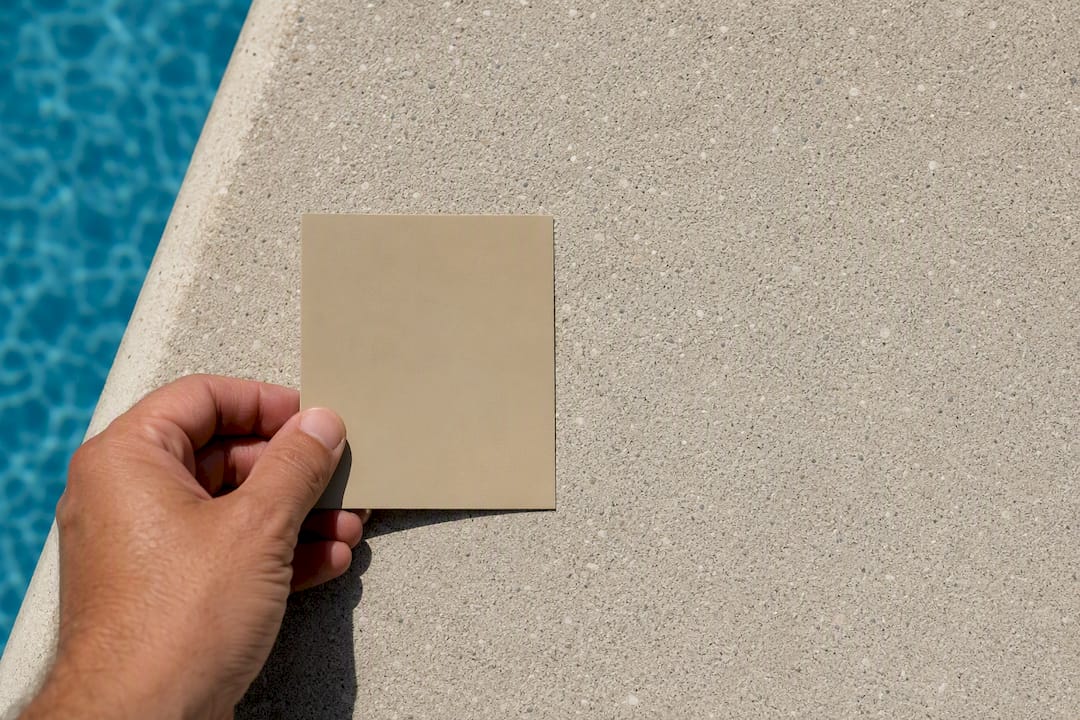
For a more precise check, take a photo of the deck at midday with your phone, then use any basic photo editor's color picker tool to sample the RGB or hex value of the faded area versus a swatch of the intended original color, if you kept the can or product code. A drift of more than roughly 15 to 20 points in brightness or saturation is usually enough to be visible to guests and worth addressing.
The tape adhesion test described earlier does double duty here. If the coating pulls up during the fade check, you're not just dealing with color loss. You're dealing with a coating failure, and that changes your restoration route entirely, from a simple recolor to a strip-and-recoat job.
Comparing a shaded section of the deck (under an umbrella or overhang) to an exposed section in full sun also tells you a lot. A big color gap between the two areas confirms UV is the primary driver and points you toward a UV-resistant topcoat or a switch to a naturally color-stable material like porcelain for the next round.
What Other Environmental Factors Speed Up Pool Deck Fading?
UV and pool chemicals get most of the blame, but your specific yard has its own fingerprint on how fast color fades.
Local climate intensity matters beyond just "hot state versus cold state." A deck facing due south with no shade fades faster than an identical deck on the north side of the same house, simply from the angle and duration of direct sun exposure across the day.
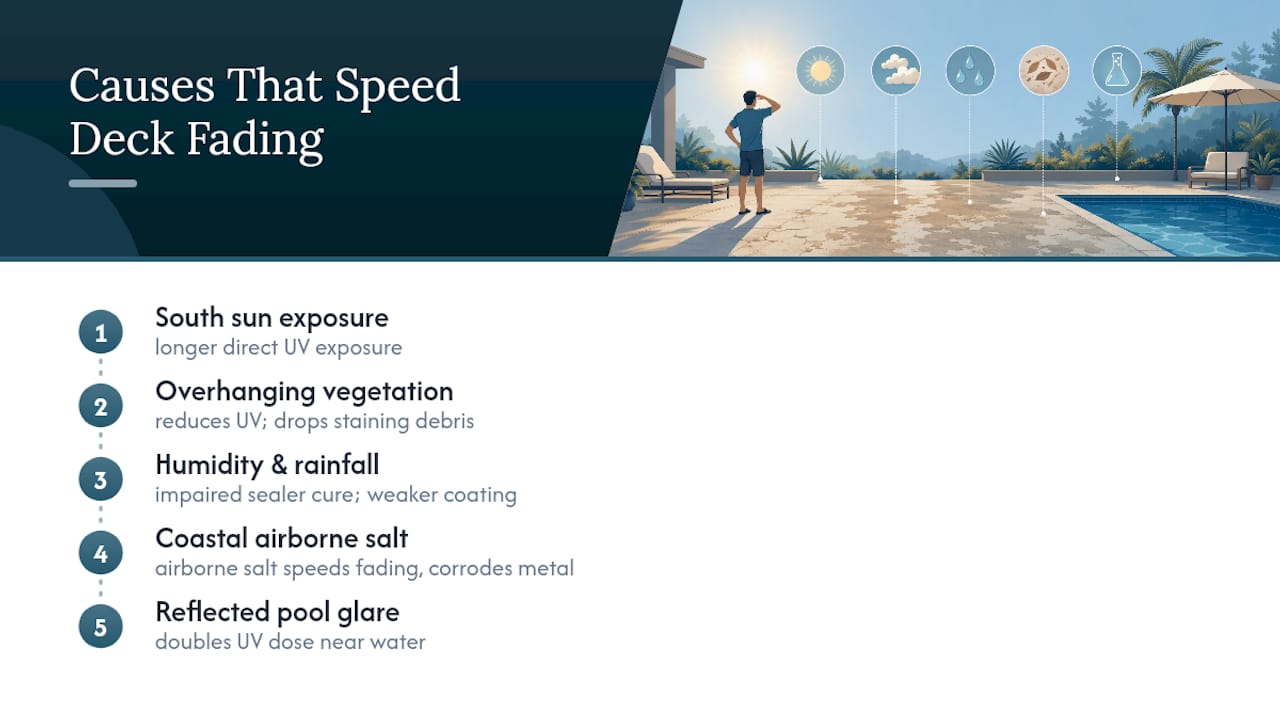
Nearby vegetation cuts both ways. Overhanging trees reduce UV exposure and slow fading in that specific area, but they also drop leaves, sap, and pollen that stain the surface and trap moisture against the coating, which can cause its own kind of localized discoloration that looks like fading but is actually organic staining.
Humidity and rainfall patterns affect how sealers cure and how long they last. A coating applied during a humid stretch may not cure as hard as one applied in dry conditions, leaving it more vulnerable to UV breakdown down the line. Coastal proximity, even without a saltwater pool, adds airborne salt exposure that accelerates both fading and fastener corrosion on nearby screen enclosures.
Reflected heat and glare off the pool water itself effectively doubles the UV dose on the deck immediately surrounding the pool compared with the outer edges of the same slab. That's part of why the perimeter closest to the water often fades noticeably faster than the back corners of the same deck.
What Mistakes Do Homeowners Make Restoring a Pool Deck?
The single biggest mistake is skipping surface prep to save a weekend. Applying stain or coating over an unetched, unprofiled slab looks fine for a few months and then peels in sheets, because the new material never actually bonded to the concrete.
A close second is choosing color purely by how a sample looks on a paint chip indoors, without testing it outside next to the actual pool water and coping. Colors shift dramatically under sunlight and against blue water reflections, which is exactly why testing a patch at different times of day matters as much as it does.
Skipping traction additive to keep the finish looking glassy is a mistake that shows up the first time someone gets out of the pool with wet feet. It's also one of the easiest fixes to build in from the start rather than retrofitting later.
Other common missteps include pressure washing at too high a PSI or too close to the surface, which etches lines into the concrete that show through any new color; using a general-purpose cleaner instead of a concrete-safe one, leaving residue that interferes with stain adhesion; and applying color in direct afternoon sun, which causes uneven flash-drying and visible lap marks. Rushing the cure time before refilling the pool or resuming foot traffic is another frequent cause of premature wear right after a restoration.
When Does a Faded Deck Signal a Structural Problem?
Fading itself is cosmetic, but certain patterns of discoloration point to something more serious underneath.
Dark, persistent staining in the same spot that won't clean off, especially near the pool's edge, can indicate water intrusion through a crack or joint, not just surface dirt. If that area also feels soft, spongy, or sounds hollow when you tap it, the slab underneath may be deteriorating, and cosmetic color work won't fix it.
Efflorescence, a white, chalky, powdery residue that keeps returning even after cleaning, means moisture is migrating through the concrete and depositing dissolved minerals on the surface. That's a drainage or vapor barrier issue, and coating over it traps the moisture rather than solving it.
Widening cracks, especially ones that have grown noticeably since last season, or cracks running vertically down the side of the deck rather than just across the surface, suggest settling or structural movement. Uneven or sunken sections near the pool coping can also mean the base underneath has washed out or eroded, which is a safety concern for anyone walking that area, not just an eyesore.
Any of these signs warrant a professional structural assessment before you spend money on color. A beautiful new stain job on a slab that's actively failing underneath is money spent twice.
The Smartest Way to Think About a Faded Pool Deck
Homeowners fixate on color when they should be fixating on the substrate first. A gorgeous stain job on a slab with hidden moisture problems or hairline cracks running deeper than they look is money that buys you maybe two good seasons before you're right back where you started.
Traction isn't optional, and I'd argue it's the one line item people are most tempted to skip to save a little money, right when it matters most. And resist the urge to chase the trendiest dark tone you saw on a design blog. A mid-tone that stays cooler underfoot and hides everyday wear will make you happier five summers from now than a deck that photographed well on install day.
— Michel
Get Your Faded Pool Deck Professionally Restored
Professional restoration services in Central Florida can help homeowners avoid guesswork on preparation, coating selection, and traction. These restoration projects often use water-based acrylic coatings for lasting color, durable fasteners where deck work overlaps with screen enclosure repair, and incorporate traction into the final coat rather than applying it afterward.
If your deck showed any of the red flags from the inspection checklist above, cracking, adhesion failure, persistent dampness, that's the moment to call in a professional assessment rather than guessing your way through a color fix. When you request an estimate, ask specifically about surface profiling method, coating brand and warranty, and how traction will be incorporated into the final coat. Explore pool deck staining services or browse the project gallery for real before-and-after results, then request a quote through the restoration services page to get a firm number for your specific deck.
Sources
- Stained Concrete Pool Decks: Ideas, Products & Real Projects – Direct Colors
- How to Refresh a Faded Stained Pool Deck – NewLook Int
- Pool Deck Ideas: Best Materials, Colors & Layouts for 2026 – PoolPad
- Pool Deck Colors in NC: Best Choices for Heat and Style – Local Concrete Contractor
FAQ
What Is the Best Color to Paint a Pool Deck?
A mid-tone like warm taupe, sand, or light gray usually works best because it stays cooler underfoot than dark colors while hiding everyday dirt and stains better than pure white.
How Much Does It Cost to Repaint a Pool Deck?
Cost depends heavily on whether the job is a simple reseal, a full restain, or a strip-and-recoat after coating failure, with prep and repair work being the biggest driver of the final price.
What's the Best Color for a Deck in Full Sun?
Light to mid-tone colors are the better call for full-sun decks, since light-colored surfaces stay noticeably cooler underfoot than dark ones in hot climates.
How Often Should a Pool Deck Be Resealed to Keep Its Color?
Topical stains and coatings typically need resealing every 2 to 7 years depending on sun exposure, with south-facing decks in full sun falling at the shorter end.
Can a Faded Pool Deck Be Fixed Without Replacing It?
Yes. Most faded decks just need cleaning, proper surface prep, and restaining or recoating, and replacement is rarely necessary unless the slab has failed structurally.