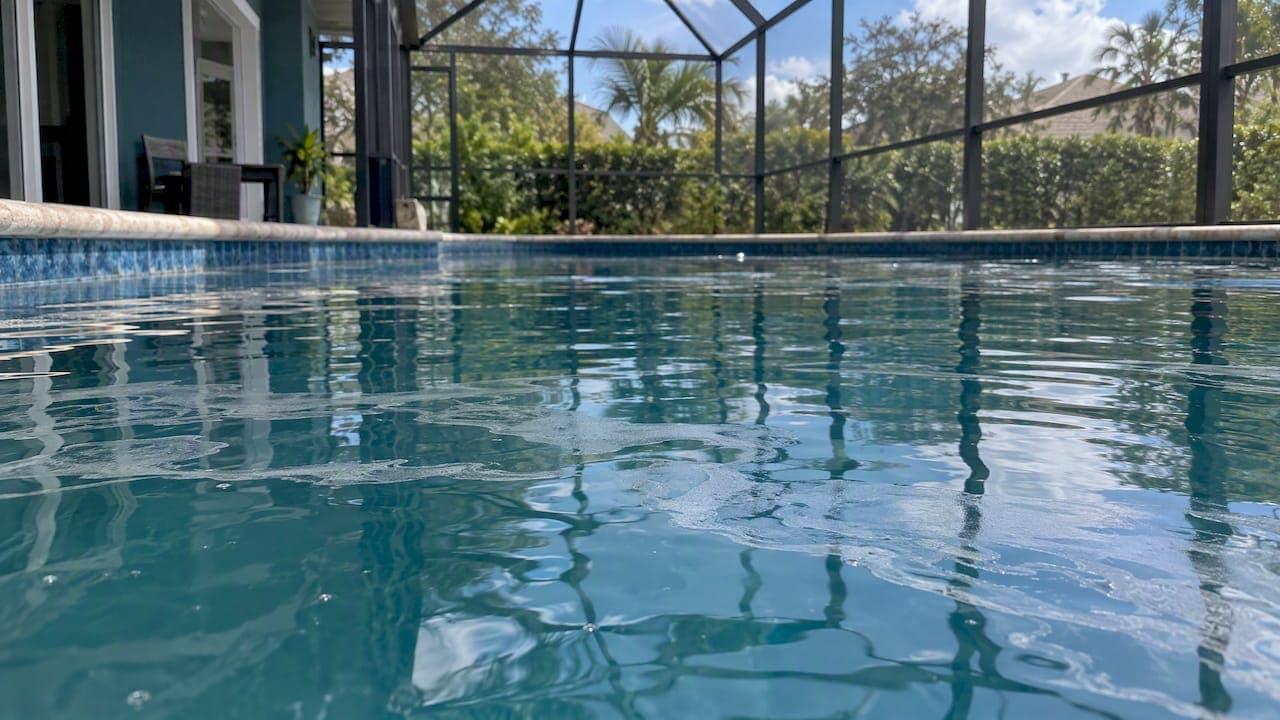
If paint overspray has landed on your pool, stay calm and keep the pump running. Do not drain the pool. Find out what kind of paint it was, skim or blot the film off the surface, then protect and clean the filter. A light dusting of water-based acrylic usually thins out and disappears in a full pool. Heavier contamination calls for an enzyme treatment and a few days of steady filtration.
We restore pool enclosures in Central Florida, and overspray is a risk on every spraying job near water. That is why we spend so much of our time on masking. Below is what to do in the first hour, what to do over the next few days, and when to call someone.
TL;DR
- Identify the paint first. Water-based (latex or acrylic) mostly dissolves or disperses. Oil-based floats as a sheen and is much harder to treat.
- Skim the surface, or blot it with clean tennis balls or paper towels, before the paint dries and reaches the filter. Keep the pump running.
- Never drain the pool over paint. It can streak the walls and floor, and an empty pool can pop out of the ground when the water table is high.
- For more than a trace, use an enzyme product rated for contaminated water, run the filter around the clock, and clean or backwash it as pressure climbs.
- Prevention is cheap: a contractor who masks the water and deck properly should never put overspray in your pool at all.
Table of Contents
- First, work out what actually landed in the water
- What to do in the first hour
- Why you should not drain the pool
- Days one to three: clean the water, not just the surface
- Is the water safe to swim in afterward?
- What if it was spray paint or something else?
- Overspray on the deck and enclosure too
- Who pays when a contractor caused it?
- Our perspective: overspray is a masking problem
- How to prevent overspray before the job starts
- Planning a cage restoration near your pool?
- FAQ
- Sources
First, work out what actually landed in the water
Three questions decide everything that follows.
- What kind of paint was it? Ask the painter for the can. Water-based paint is largely soluble. Oil-based paint does not mix with water and shows up as an oily sheen. That sheen needs to be absorbed from the surface before it reaches the filter.
- How much? A fine mist of overspray is a different problem from a dropped brush or a spilled cup. Look at the surface from a low angle in sunlight. Specks, a faint film, or white or colored flakes tell you how far this goes.
- How big is your pool? Dilution is your friend. According to industry guidance on paint drips, even a gallon of acrylic paint in a 10,000-gallon pool would be diluted significantly. The resins and binders dissolve and only some pigment may stay visible. A mist of overspray is far less than that.
If the paint is oil-based, enamel, or a solvent-thinned product, treat it as the harder case described later in this article.
What to do in the first hour
Speed matters most with a surface film. The goal is to take the paint off the water before it dries and heads for the filter.
- Leave the pump running. The skimmer and filter are what capture particles. A forum thread on a water-based spill advises keeping the pump on so the system catches what it can.
- Skim the surface. A fine-mesh skimmer net removes flakes and thicker film.
- Blot the sheen. For a light film, the same thread suggests tennis balls or dryer balls thrown on the water to soak up the paint. Clean paper towels laid on the surface also work. Do this before the paint dries, since dried paint can ruin filter cartridges.
- Don't vacuum up chunks. If there is a lot of physical debris, use a net or bucket first. Vacuuming it can clog the filter or damage the pump.
- Photograph everything. If a contractor caused this, you will want pictures of the water, the masking and the paint can label.
These steps are for ordinary water-based overspray. If you can smell solvent or see a heavy oily slick, or if the paint was a spray can product aimed near the equipment, stop and call a pool professional before running the system.
Why you should not drain the pool
Draining feels like the clean answer. It usually is not.
Pool operators note that draining can cause paint to streak and coat the walls and floor. That turns a floating problem into a surface problem that is much harder to clean. There is also a structural risk: where the groundwater table is high, an emptied pool can lift out of the ground, and that damage is generally not covered by homeowners insurance, according to the same source.
That matters in Florida, where water tables are often shallow, especially in the wet season. If someone does recommend draining, ask whether they are insured and whether they have checked the groundwater conditions at your address. The same operator guidance says water should only be removed by an insured professional who understands local groundwater.
Days one to three: clean the water, not just the surface
Once the visible film is gone, the dissolved and suspended material is what is left. This is what makes water look dull or slightly cloudy, and it can use up your chlorine.
Run the filter hard and keep it clean
For significant contamination, the pool operator guidance on paint spills calls for cleaning or backwashing the filter first, running the pump 24 hours a day, and cleaning or backwashing again as needed. Its rule of thumb is to clean the filter when pressure rises 8 to 10 psi above your clean running pressure. Check your gauge twice a day at the start.

Use an enzyme product for anything beyond a trace
The same guidance suggests an enzyme product rated for treating contaminated water. Its example is a 40 oz dose, repeated every 48 hours until the water clears. Always follow the label on the product you actually buy, because dose depends on pool volume. Industry guidance also notes that enzymes help break down contaminants and that shock treatment can help neutralize pigments.
Keep the chemistry in range
Paint overspray competes for your chlorine. The CDC explains that chlorine becomes less effective when it reacts with contaminants such as dirt, sweat and paint overspray, and the reaction can create byproducts that sting eyes and skin. So test often during cleanup.
The CDC recommends pH between 7.0 and 7.8 and at least 1 ppm free chlorine for pools. Effectiveness drops as pH climbs above 8.0, and low pH below 7.0 can corrode pipes. Keep people out of the water if you cannot hold those numbers or if the water stings.
| Situation | Likely severity | Sensible response |
|---|---|---|
| A few specks or faint film of water-based paint | Low | Skim, blot, keep the pump running, retest chemistry |
| Visible film across much of the surface | Moderate | Blot and skim fast, clean the filter, consider an enzyme dose |
| Spilled cup or more of water-based paint | Moderate to high | Net out solids, enzyme treatment, 24-hour filtration, frequent filter cleaning |
| Oil-based paint or solvent smell | High | Absorb the sheen, stop and call a pool professional |
| Paint on the equipment pad or filter box | High | Shut down, check what was hit, get professional advice |
Is the water safe to swim in afterward?
We are painters and restorers, not water chemists or physicians, so treat this as a practical rule rather than a clearance. Do not swim while there is visible film, an odd smell, cloudy water, or a chemical sting. Retest chlorine and pH. If you have kids, pets or anyone with skin sensitivity, wait until the water is fully clear and balanced.
If you want certainty about what was in the product, read the can's safety data sheet or call your local pool store or a certified pool operator. For symptoms after exposure, such as skin rash or breathing trouble, contact your doctor or poison control.
What if it was spray paint or something else?
Not every overspray is house paint. Outdoor spray paint is designed to resist water, which is exactly why it behaves differently in a pool. If the paint was aerosol, enamel or solvent-based, the dilution argument does not apply the same way.
Volatile solvents are the main concern with that kind of spill. Ask the painter for the product name and look up the safety data sheet. A local pool professional can tell you whether to treat it as a surface film or as a larger contamination. Do not guess, and do not mix cleaning chemicals into the pool to experiment.
Overspray on the deck and enclosure too
Paint that hit the water probably hit the deck and the screen as well. Soap and water often handle fresh water-based overspray on a deck. Our guide to pool deck overspray covers what to try first and when to stop and call a pro. Be careful that cleaning runoff does not wash into the pool, because the cleaners add their own chemicals to the water.
On the screen itself, overspray can clog mesh and leave a gritty film. That is a case for professional re-screening rather than scrubbing. Hard scrubbing can tear the mesh and loosen fasteners.

Who pays when a contractor caused it?
If a painter, landscaper or roofer sprayed near your pool, tell them right away, in writing, with photos. A professional contractor should have masking, tarps and a plan for water. Ask what they will do to make it right, and ask about their insurance. Keep receipts for enzyme products, filter cleaning and any water testing. We cannot give legal advice, so for a dispute over cost, talk to your insurer or an attorney.
Our perspective: overspray is a masking problem
We restore weathered and rusted pool cages across Central Florida. The work includes repainting the frame with water-based acrylic coatings, replacing rusted fasteners with stainless steel or Nylotech hardware, and re-screening. A pool is always next to the work, so protecting it is part of the job, not an extra.
Here is what we have learned. Overspray rarely comes from the spray gun being aimed at the water. It comes from wind, thin masking, rushed prep and cleanup shortcuts. Careful preparation and masking take time, and that is where cheap quotes cut corners.
When you hire anyone to spray near a pool, ask these questions:
- How will you cover the water, the deck and the equipment?
- What coating are you using, and is it water-based?
- What happens if something does land in the pool?
- What does your warranty cover?
We use industrial-grade water-based acrylic coatings, which is also why a stray mist is a much smaller problem than it would be with a solvent-based product. Our process comes with a three-year warranty. In a typical case, restoration costs well below a full rebuild, and we say up to 60% less. We do the work, we mask carefully, and we stand behind it.
— Michel
How to prevent overspray before the job starts
Whether you hire us or someone else, a few habits protect your water.
- Schedule around the wind. Spraying on a breezy afternoon is how mist travels. Ask the crew how they handle wind.
- Look at the masking before spraying begins. Walk the site. Is the deck covered? Are the pump, filter and skimmers protected?
- Ask about the pool cover. A cover or tarp over the water, secured at the edges, stops almost everything. A partial cover leaves gaps.
- Confirm the paint type. You want the product name in writing. If you know it is water-based, the worst case is far milder.
- Do a walk-through at the end. Check the water, the deck and the screen before the crew leaves. Photos then, not later.
For more on keeping the structure in good shape, see our pool screen maintenance checklist and the pool screen safety inspection checklist.
Planning a cage restoration near your pool?
If your enclosure is rusting or fading and you are weighing a rebuild, a restoration is worth pricing. We repaint, replace rusted fasteners, re-screen and, when you want it, stain or paint the deck. See our pool screen restoration service or the pool deck staining service. You can also browse finished jobs in the project gallery. We serve Central Florida homeowners, and we do not publish prices, so request an estimate for your enclosure.
FAQ
Will water-based paint overspray hurt my pool?
A small amount of water-based acrylic usually dilutes and disappears in a full pool, according to industry guidance. Skim any film, keep the pump running, and retest your chlorine and pH. Larger amounts need enzymes and more filtration.
How do I get paint film off the top of the pool water?
Skim it with a fine net, then lay clean paper towels or throw clean tennis balls or dryer balls on the surface to absorb what is left. Do it before the paint dries, since dried paint can ruin filter cartridges, as pool owners advise. Keep the pump running throughout.
Should I drain the pool after paint gets in?
No, not for a surface contaminant. Draining can streak paint onto the walls and floor, and in a high water table an empty pool can pop out of the ground, a loss generally not covered by homeowners insurance. Only an insured professional who understands local groundwater should drain.
How long until the water clears?
It depends on the amount and your filtration. The operator guidance repeats an enzyme dose every 48 hours until the water is clear, with the pump running 24 hours a day. Clean or backwash the filter whenever pressure rises 8 to 10 psi above its clean level.
Can I swim right away?
Wait until the film is gone, the water is clear, and chlorine and pH are in range. The CDC advises pH of 7.0 to 7.8 and free chlorine of at least 1 ppm. If you are unsure about the product, check its safety data sheet or ask a certified pool operator.
Sources
- Quickly Addressing Paint Drips In Your Pool, CyPaint
- Cleaning Paint Spilled in a Pool, Pool Operator Talk
- Water-based Paint Spill, Trouble Free Pool
- Home Pool and Hot Tub Water Treatment and Testing, CDC
- Guidelines for Keeping Your Pool Safe and Healthy, CDC