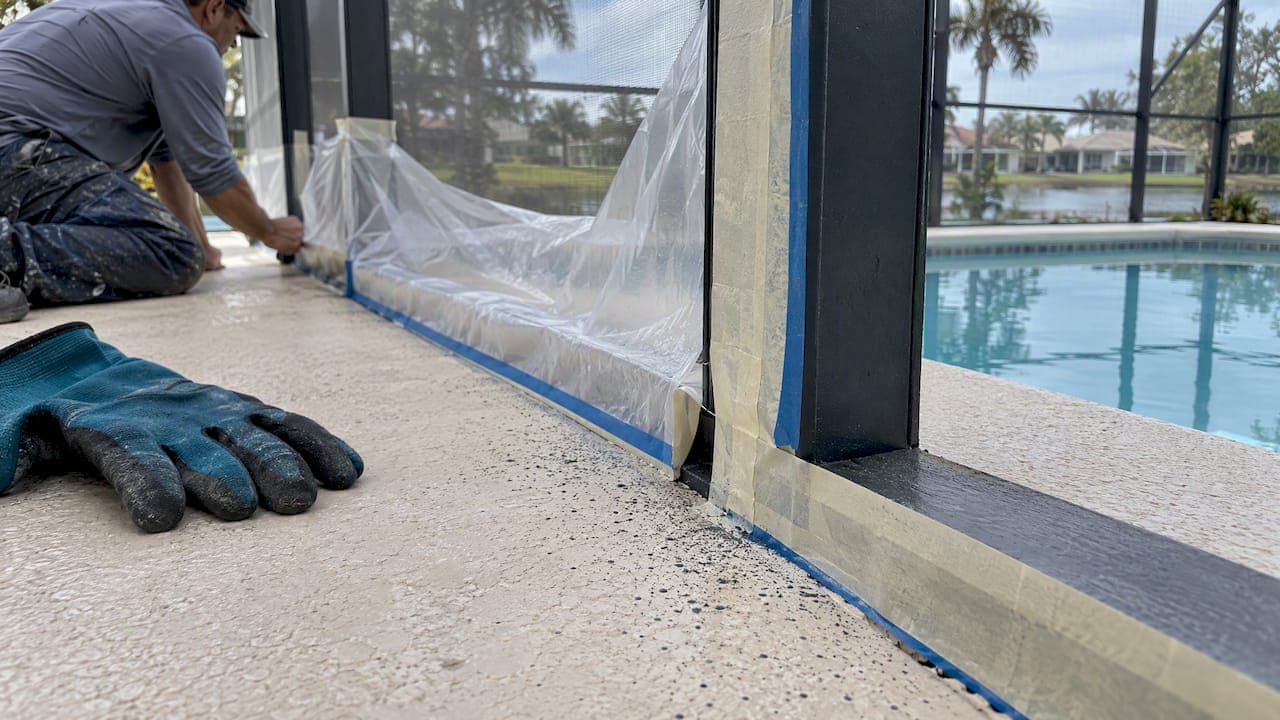
Before you spray, remove or fully cover the screens, pressure-wash and sand every frame, and mask the deck, pool edge, and landscaping with contractor plastic and painter's tape. Wear an air-purifying respirator with organic vapor cartridges for any spray work, and keep fans pulling vapors away from you and the water. If you would rather skip the work, we at Mr. Pool Screen handle all of it for you.
TL;DR:
- Test primer on a hidden patch of chalky, sun faded aluminum after cleaning; faded metal may reject a coating that looks sound while wet.
- Remove and label screen panels before spraying, photograph each position, and reinstall only after full cure; overspray is difficult to remove without damaging mesh.
- A respirator must fit tightly, and cartridges need replacement on the manufacturer’s schedule or sooner if you smell solvent; cloth masks do not filter vapors.
- Restoration can cost less than rebuilding when the aluminum frame remains sound, but bent, cracked, or corroded through frames call for replacement.
Table of Contents
- What materials and tools do you need before you start?
- How do you clean, sand, and prime the frame so paint sticks?
- How do you mask a pool cage to stop overspray?
- Which respirator and ventilation setup should you use?
- When should you paint, and how long does the project take?
- How do you finish up and protect the pool during cleanup?
- Why do homeowners hire us for pool cage painting?
- How does restoration compare with a full rebuild on cost?
- What durability and warranty should you expect after painting?
- What do restoration case studies and testimonials show?
- What do I think matters most when masking a pool cage?
- Want us to handle the masking and painting for you?
- FAQ
- Sources
What materials and tools do you need before you start?
Gather everything before the first strip of tape goes up. Stopping mid-job to hunt for a clamp is how overspray ends up on a patio chair, because wet paint waits for no one.
Masking supplies
- Contractor plastic sheeting in rolls wide enough to hang from the top rails
- Canvas or plastic drop cloths for the deck
- Painter's tape in several widths, plus foam tape for tight corners
- Zip ties, clamps, and weights to hold tarps against the wind
Prep tools and materials
- A pressure washer, owned or rented
- Sandpaper, sanding blocks, and wire brushes
- Rust converter and a metal-appropriate primer
- Tack cloths, isopropyl alcohol, or another solvent cleaner
Application gear
- An airless sprayer or an HVLP sprayer for the main coat
- Rollers and brushes for touch-ups and tight spots
Personal protective equipment
- An air-purifying respirator with organic vapor cartridges
- Nitrile or butyl gloves
- Eye protection
- Coveralls that cover your arms and legs
Pro Tip: Buy more tape and plastic than your estimate says. Running short halfway through masking is the most common reason people rush the last section and miss a gap.
How do you clean, sand, and prime the frame so paint sticks?
Paint only bonds to clean, slightly rough metal. Most coating failures trace back to skipped prep, not bad paint. Work in this order:
- Pressure-wash the whole cage. Remove grime, mildew, and the chalky oxidation that builds up on aluminum. Let everything dry completely before you touch it with abrasives, since trapped moisture ruins adhesion.
- Sand and scrape loose paint. Take off anything flaking or peeling, then feather the edges of the paint that stays so you do not leave a visible ridge.
- Attack rust. Use a wire brush on rust spots and finish with medium-grit sanding to give the metal a profile the primer can grip. Treat what remains with a rust converter, or grind it down to clean metal.
- Wipe the frame down. Use isopropyl alcohol or a solvent cleaner after sanding to remove oils and dust, then follow with a tack cloth.
- Test adhesion on faded aluminum. Prime a small hidden patch and check it after it cures. Chalky, sun-faded aluminum can reject coatings that look fine wet.
- Prime with a metal-appropriate primer. Follow the product label for coverage and recoat windows.
Ventilation matters even at the prep stage, because solvent cleaners and rust converters give off vapors. The agency guidance on spray work states it plainly:
Spray painting can create flammable or toxic atmospheres, so engineering controls and ventilation are required wherever solvent vapors present an ignition or exposure hazard. That is written for shipyards, but the physics are the same in your backyard: vapors collect where air does not move.
If rust has eaten through the metal, not just the surface, painting will hide the problem rather than fix it. Our own write-up on when DIY spray painting works and when deep corrosion calls for a pro can help you decide before you invest a weekend.
How do you mask a pool cage to stop overspray?
Overspray travels farther than most people expect, and a fine mist settles on pool water, car paint, and screen mesh. Masking is containment, so think in layers.
Remove the screens if you can
Pulling screen panels, labeling them, and storing them flat is the cleanest route. Professionals commonly remove and label screen sections and reinstall them after the paint cures, because overspray on mesh is very hard to clean off without damaging it. The tradeoff is time: removal and reinstall add effort, but you skip the most delicate masking job on the whole project.
A repeatable masking workflow
- Hang plastic sheeting from the top rails and secure it with tape and zip ties so it cannot flap loose.
- Seal the bottom edge with weights or clamps so wind cannot lift it.
- Lay weighted tarps over the deck and along the pool edge, overlapping seams by several inches.
- Cover plants, furniture, grills, and light fixtures completely.
- Move vehicles out of range, or cover them fully if they must stay.
- Run painter's tape along every edge where metal meets surface you want to keep clean, pressing it down with a putty knife.
Control airflow
Position exhaust fans so they draw vapors away from the pool and away from you. Stand upwind of your work and spray with the breeze at your back. When gusts pick up, build a temporary barrier from plastic and a few poles, or stop for the day. Wind turns a masked job into an unmasked one in seconds.
If overspray lands anyway
Fresh overspray usually comes off with soapy water and a soft cloth, so act fast. Cured spots may need a solvent that is safe for the surface, tested on a hidden area first. Deck problems have their own fixes, covered in our guide to pool deck overspray, soap first, and we also wrote a short walkthrough on fixing overspray on pool screens. When solvent starts to cloud or stretch the mesh, stop and call a professional.
Pro Tip: Spray a test pass on a scrap of plastic before you start each session. If the mist drifts past your masking line in the test, your barrier is too close.

Which respirator and ventilation setup should you use?
Paint vapors go straight to your lungs, so safety gear is not optional on a spray job. OSHA requires respiratory protection whenever contaminant levels exceed the Permissible Exposure Limit. Respiratory protection under 29 CFR 1910.134 is the standard behind that rule, and the same guidance points to air-purifying respirators with organic vapor cartridges for many painting tasks, with supplied-air respirators for confined or high-exposure situations.
Respiratory protection is required by OSHA whenever contaminant levels exceed the Permissible Exposure Limit, and an organic vapor cartridge respirator is the typical choice for open-air spray work.
- Fit matters more than price. A respirator that leaks around the face does little. Facial hair and the wrong size are the usual culprits, and a proper fit test is part of any real safety program.
- Change cartridges on schedule. Follow the manufacturer's replacement guidance, and swap them sooner if you smell solvent while wearing the mask. The EPA's paint mixing room best practices stress fit testing and cartridge-change schedules for exactly this reason.
- Use engineering controls first. The EPA's spray painting checklist recommends spray booths or vented prep stations where possible. A pool cage is open air, so approximate that with exhaust fans positioned to pull vapors away from people and water.
- Eliminate ignition sources. Solvent-containing coatings can create flammable atmospheres. Keep sparks, flames, and running electrical tools away from the work area, and read the safety data sheet for every product you open.
- Cover your skin and eyes. Nitrile or butyl gloves, eye protection, and coveralls keep solvents off your body.
When should you paint, and how long does the project take?
Humidity is the quiet saboteur. Aim for relative humidity under about 65%, and stay inside the temperature range printed on your coating's label. Our note on painting a pool cage in low humidity explains why damp air slows curing and weakens adhesion.
A realistic project plan is to pressure-wash and let the frame dry fully, sand and scrape, treat rust and make repairs, then mask everything and apply primer before spraying the finish coats and beginning the cure.

Stretch the schedule if rain or humidity shows up. Follow the manufacturer's cure times before pulling masking or reinstalling screens, since handling paint that is only skinned over leaves fingerprints and dents.
How do you finish up and protect the pool during cleanup?
Cleanup is where good jobs get damaged. Work through it in order:
- Wait for the right moment to pull tape. Remove it once the paint has skinned over but before it fully hardens, following the product's guidance. Pulling too early smears the line, and pulling too late can lift an edge. Score the paint along the tape with a blade if it has bridged the gap.
- Inspect in good light. Look for runs, thin spots, and corrosion you missed. Touch up with a brush or a light pass of spray.
- Keep the pool clean. Keep plastic over the water until all spraying and wiping is done, and keep the filtration intake clear of debris.
- Collect waste properly. Bag used plastic, rags, and tape, and dispose of leftover paint and solvent according to local rules.
- Know when to escalate. If overspray has hardened on mesh or damage is beyond a touch-up, bring in a professional rather than risk making it worse.
After the last tape comes off, the first few days still count. Our guide to protecting a freshly painted pool enclosure during curing covers what to keep off the frame while it hardens.
Why do homeowners hire us for pool cage painting?
Our standard approach is built around durability. We coat frames with water-based acrylic coatings and replace rusted fasteners with stainless steel hardware. That reflects how we work, not a rule every contractor follows.
Remove and label every screen panel before a single drop of paint leaves the sprayer. It prevents overspray on the mesh and makes the reinstall go faster.
That workflow matches what professionals commonly do, as the guidance on removing and reinstalling screen sections describes. We also back our work with a warranty, and our project gallery shows how restored cages look afterward.
Pro Tip: Photograph each panel and its position before you label it. Matching a panel to its opening is much easier with a picture than with a guess.
If your cage has advanced rust, or you simply want a second opinion, we are glad to inspect it and explain what is needed.
How does restoration compare with a full rebuild on cost?
Rebuilding a pool cage means tearing out the frame, hauling it away, and building new. Restoration keeps the structure that is still sound and renews what the weather has worn out: the coating, the fasteners, and the screens. For a cage whose frame is solid, that difference is large, and we estimate that restoration can cost less than a full rebuild. That is our own estimate for Central Florida projects, and the actual figure depends on the size of the cage and the condition of the frame.
Restoration makes sense when the aluminum is sound but the finish is chalky, faded, or streaked with rust at the fasteners. A rebuild becomes the better call when the structure itself is bent, cracked, or corroded through. A trained eye can tell the two apart in a single inspection, and that is the first thing we check.
You should also compare what each option includes. A restoration quote should name the prep work, the coating system, the fasteners, and the screen type. Vague quotes hide shortcuts, and shortcuts show up as peeling within a couple of seasons.
What durability and warranty should you expect after painting?
A good coating is only as durable as the prep under it. Even premium products fail over bare, dirty, or rusty metal, which is why the cleaning and priming steps earlier in this article matter more than the brand on the can. Some retail pool coatings, such as Hi-Build Epoxy Pool Paint, advertise long-lasting two-coat systems with multi-year service life claims, though availability and pricing vary by retailer, and those claims describe the manufacturer's expectations rather than a guarantee for your cage.
On our restoration work, we provide a warranty. Water-based acrylic coatings flex with the metal as it heats and cools, and stainless steel fasteners remove one of the most common rust sources at the screws and brackets. Together they are why we stand behind the finish.
To keep any paint job lasting, rinse the frame with fresh water periodically, touch up chips before rust gets a foothold, and avoid harsh abrasives. Pay extra attention to the first few days after painting, when the coating is still hardening.
What do restoration case studies and testimonials show?
Before-and-after photos tell the story better than any description, which is why we keep a project gallery of completed restorations. The pattern repeats across jobs: a cage that looked tired, stained, and streaked with rust trails comes back with a uniform finish and fasteners that no longer bleed orange down the frame.
Homeowners who contact us usually describe the same starting point. The cage is still structurally sound, but it looks old, and they worry that a rebuild is the only fix. An inspection often shows that restoration solves the problem at a fraction of the price.
When you review any contractor's past work, look for the details that matter: close-ups of fasteners, clean paint lines at the edges, and screens that sit tight in their frames. Ask whether the photos show jobs at least a few seasons old, since a fresh finish always looks good and aging is the real test. Ask for the warranty terms in writing too. We are happy to walk you through completed projects and answer questions about how each one was handled.
What do I think matters most when masking a pool cage?
Most advice treats masking as a chore to speed through, and that gets the priorities backward. Paint choice gets all the attention, yet the real damage on these jobs almost always comes from vapors, overspray drift, and skipped prep, not from picking the wrong color. Masking is the cheap part, and an afternoon of careful taping and tarping protects thousands of dollars of pool, deck, and screen.
What is overrated is the idea that the spray equipment makes the finish. A modest sprayer over a clean, primed, sanded frame beats a premium rig over a dirty one every time. What is underrated is wind. If it is breezy, the right call is to stop, not to hang more plastic.
If you do one thing first, take the screens off. It removes the hardest masking problem, protects the mesh, and forces you to look closely at the frame. And if the corrosion is deep or the job feels bigger than a weekend, hiring a professional is a sensible decision, not a failure.
— Michel
Want us to handle the masking and painting for you?
If you would rather not spend a weekend taping plastic and wearing a respirator, our pool screen restoration service takes the whole job off your hands. We clean and prepare the frame, mask carefully so your deck and pool stay clean, repaint with industrial-grade water-based acrylic coatings, and replace rusted fasteners with stainless steel. Every restoration comes with a warranty, so the finish is backed after we leave.

You get durability and a cage that looks new without the cost of a rebuild. Request an estimate or inspection on our Pool Screen Restoration page and we will tell you exactly what your cage needs.
FAQ
How much does it cost to paint a pool screen enclosure?
Cost depends on the size of the cage, the condition of the frame, and how much rust repair is needed. Quotes should spell out prep, coatings, fasteners, and screens. We provide estimates after inspecting the enclosure, and pricing is available on request.
Should you wear a respirator while spray painting?
Yes. OSHA requires respiratory protection when contaminants exceed the exposure limit, and an air-purifying respirator with organic vapor cartridges is a typical choice for spray work, per OSHA's painting PPE guidance. A cloth or dust mask does not filter paint vapors.
How do you paint a pool cage?
Clean and dry the frame, sand off loose paint, treat rust, wipe it down, and prime. Mask the deck, pool, and plants, then spray in dry, low-humidity weather. Let the coating cure before removing masking or reinstalling screens.
Can you paint your pool coping?
Pool coping and decks are different surfaces than a metal cage and need their own products and prep. We offer pool deck staining for concrete, wood, masonry, and stone surfaces. Check the coating label for compatibility before you buy.
Sources
- Osha
- US EPA: Best Practices for the Paint Mixing Room
- Spray Painting Best Practices Checklist
- Hazards Associated with Spray Painting in Shipyard Employment