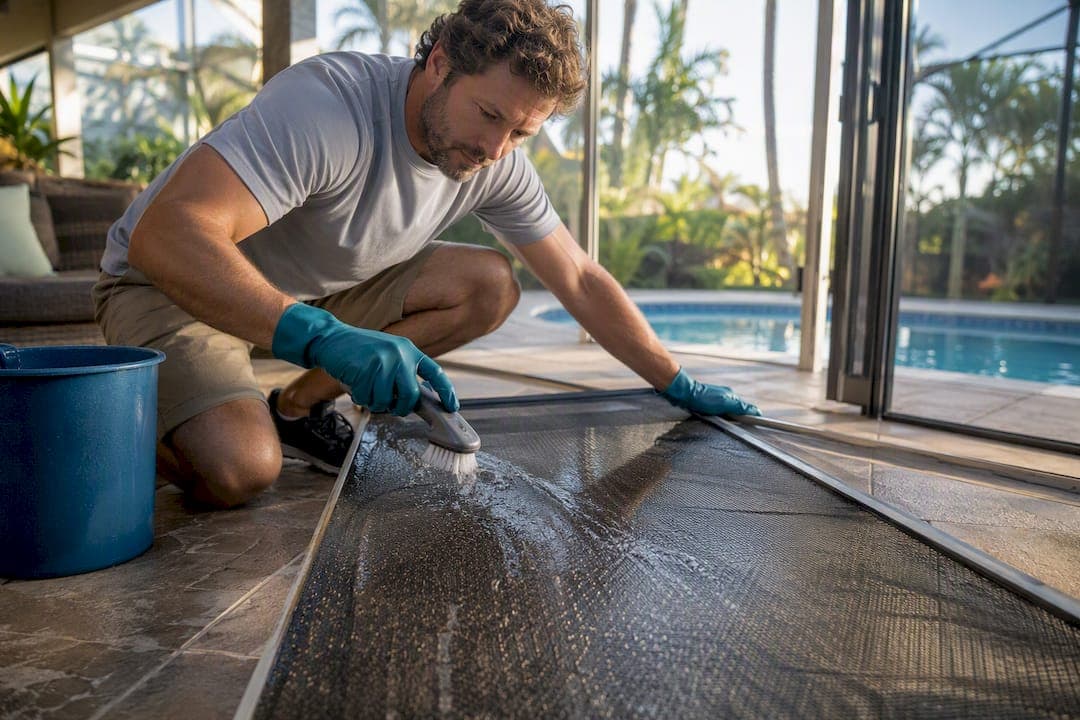
Light paint mist usually comes off pool screen mesh with warm water, mild soap, and patience. Dried paint or bonded sealer is a different story: it often welds itself to the fibers, and any attempt to force it off with pressure or harsh chemicals tends to stretch, tear, or discolor the mesh. Before you touch anything, test a small hidden patch with soapy water. If the mesh changes texture, stretches, or loses color, stop immediately and skip straight to calling a restoration pro.
TL;DR:
- Dried sealer bonded to mesh resists removal and risks tearing or discoloration if harsh chemicals or pressure are used; always test a hidden patch first.
- Fresh overspray appears chalky and smudges easily, while cured paint looks glossier and feels tacky; dried sealer sits as a clear film and is hardest to remove.
- Manual cleaning with warm soapy water, vinegar solutions, or spot treatments like alcohol is effective, but pressure washing and strong solvents can cause permanent damage.
- Proper preparation, including masking and working from top to bottom, minimizes overspray and prevents costly re-screens or mesh tears.
- When overspray persists despite spot tests or mesh shows signs of damage, professional restoration with re-screening and protective coatings is the safest, most durable solution.
Table of Contents
- Assessing Overspray on Pool Screen Mesh Before You Clean
- Safe DIY Removal Methods That Won't Wreck Your Screen
- Step-by-Step Workflow for Removing Overspray Safely
- Tools and Chemicals That Cause Permanent Screen Damage
- When to Stop and Call a Professional Restoration Service
- Prevention Checklist for Your Next Painting Project
- How Long Cleaning and Drying Actually Takes
- Cleaning Overspray in Corners, Seams, and Curved Panels
- Staying Safe During Overspray Cleanup
- An Editorial Take on Why Overspray Keeps Happening
- Mr. Pool Screen: When Restoration Beats More Scrubbing
- Sources
Assessing Overspray on Pool Screen Mesh Before You Clean
Not all overspray behaves the same way, and figuring out which kind you're dealing with tells you whether a bucket of soapy water will fix things or whether you're heading toward a re-screen. Fresh mist has a dull, chalky look and often smudges under a fingertip. Wet paint that's had a day or two to cure looks glossier and feels tacky rather than powdery. Dried sealer is the toughest customer. It's usually clear or amber, sits in a thin film, and resists a fingernail scratch test.
Screen age and material matter just as much as the overspray itself. A ten-year-old fiberglass screen has already lost some flexibility to sun exposure, so it tears more easily under scrubbing than a newer polyester or solar screen.
Before committing to a full cleaning session, run this quick check:
- Rub a small hidden section with a damp soapy cloth for 15 seconds.
- Watch for color transfer onto the cloth, which suggests the paint hasn't fully cured and may lift.
- Feel for fiber distortion or stretching, a sign the mesh is already compromised.
- Check whether the overspray sits on the surface (good sign) or has soaked into the weave (bad sign).
Safe DIY Removal Methods That Won't Wreck Your Screen
Start gentle and only escalate if the mild approach fails. Most homeowners overcorrect by reaching for something strong on day one, and that's how a $20 cleanup turns into a $2,000 re-screening job.
- Warm soapy water first. Mix about one tablespoon of mild dish soap per gallon of warm water and work it in with a soft-bristle brush. This safe dilution ratio is the standard starting point in most professional cleaning guides, and stronger concentrations actually leave behind residue that attracts more dirt.
- White vinegar for mildew and mineral spots. A 1:3 vinegar to water solution handles mildew, hard water deposits, and light sealer haze without damaging the weave, as long as you rinse thoroughly afterward.
- Isopropyl rubbing alcohol for stubborn paint specks. Reserve this for small, isolated dots of dried paint, and only after a spot test confirms the mesh tolerates it. Don't let it sit wet for long near aluminum frames or anywhere close to pool water.
What you should skip entirely: WD-40 and undiluted strong solvents. It might seem like a natural fix since it's marketed as a grease cutter, but manufacturer guidance itself cautions against using it around pools because it leaves a residue that attracts dirt and can degrade certain mesh coatings over time.
Pro Tip: Always work from the top of the panel downward. Gravity carries loosened dirt and cleaner residue down through the mesh, so cleaning bottom-up just redeposits grime on sections you already finished.
Step-by-Step Workflow for Removing Overspray Safely
Once you've identified the overspray type and confirmed the mesh holds up to a spot test, follow this sequence rather than improvising.
- Gear up and protect the pool. Wear rubber gloves and eye protection. Lay a tarp or float cover over the pool surface so drips and runoff don't end up in the water.
- Gather your tools. You'll want a bucket, a soft-bristle brush, a garden hose fitted with a fan nozzle (never a pressure washer), microfiber towels, white vinegar, and isopropyl alcohol for spot treatment only.
- Rinse top-down. A gentle hose rinse loosens surface dust and gives you a cleaner view of exactly where the overspray sits.
- Apply the soap solution. Work it in with slow, circular motions using the soft brush, section by section.
- Spot-treat remaining specks. If soap alone doesn't lift a spot, dab (don't scrub) with alcohol on a cloth, checking every few seconds for color transfer.
- Rinse immediately and thoroughly. Any product left sitting on the mesh dries into a film that's harder to remove than the original overspray.
While you work, watch for fraying threads, mesh pulling loose from the spline channel, or any stretching in the weave. Any of those is your cue to stop. Once finished, pull off masking material, check the aluminum frames for leftover residue, and if any cleaning product got into the pool, test your water chemistry before swimming again.
Tools and Chemicals That Cause Permanent Screen Damage
The instinct to "just blast it off" is exactly how a manageable overspray problem becomes a full panel replacement.
- Pressure washers. Even at moderate settings, the concentrated water stream can push mesh out of its spline channel, stretch the weave, or tear fibers outright — pressure washing is a common cause of screen damage, not a fix for it.
- Bleach and strong solvents. These weaken mesh fibers over repeated exposure and corrode the protective coating on aluminum frames, leading to premature rust.
- Stiff-bristle brushes and wire pads. They grab and pull individual fibers rather than lifting dirt off the surface, and each pass creates tiny tears that widen every time you clean the screen afterward.
When to Stop and Call a Professional Restoration Service
Some overspray simply isn't a DIY job, no matter how careful you are. Watch for these red flags:
- Overspray that doesn't lift at all during a spot test after a full minute of gentle scrubbing.
- Industrial-grade sealer or oil-based coating that's chemically bonded to the mesh (these often require full re-screening rather than cleaning).
- Visible mesh distortion, sagging, or a spline channel that's already popped loose.
- Damaged or corroded fastener points around the frame.
A full professional repaint and re-screen job, including masking and cleanup, generally takes several days depending on enclosure size and how much of the screen needs replacing rather than repainting. Restoration also tends to cost meaningfully less than tearing out and rebuilding an entire cage, since the aluminum frame structure usually stays intact and only the coating and mesh get renewed.
Professional restoration work generally covers re-screening with fresh mesh, repainting with water-based acrylic coatings that resist chalking and fading, and replacing corroded fasteners with stainless steel hardware instead of the standard steel screws that rust within a few seasons. Mrpoolscreen documents this kind of work in its project gallery, which is worth a look if you want to see what a full restoration actually changes visually.
Prevention Checklist for Your Next Painting Project
The cheapest overspray removal is the one you never have to do. Before any painter or sprayer gets near your enclosure, run through this list:
- Require full masking of the pool water, deck, screen frames, nearby plants, and any neighboring property with plastic and paper sheeting, not just plastic sheeting draped loosely.
- Ask to see the masking plan before work starts. Contractors who prioritize masking and wind checks treat it as the single biggest overspray control, above any spray technique.
- Confirm the crew is watching wind conditions and will pause on gusty days.
- Cover the pool surface and plan for the pool to sit unused for a few days during and after spraying.
- Remove small furniture, toys, and loose items, and arrange for delicate screen panels to be temporarily removed if the job calls for heavy spraying nearby.
How Long Cleaning and Drying Actually Takes
A single screen panel with light mist overspray usually takes 10 to 15 minutes to clean with the soap and brush method, plus another 5 minutes for the vinegar or alcohol spot treatment if needed. For a full enclosure with multiple panels, budget half a day for a thorough job done right, including rinse-downs between sections.
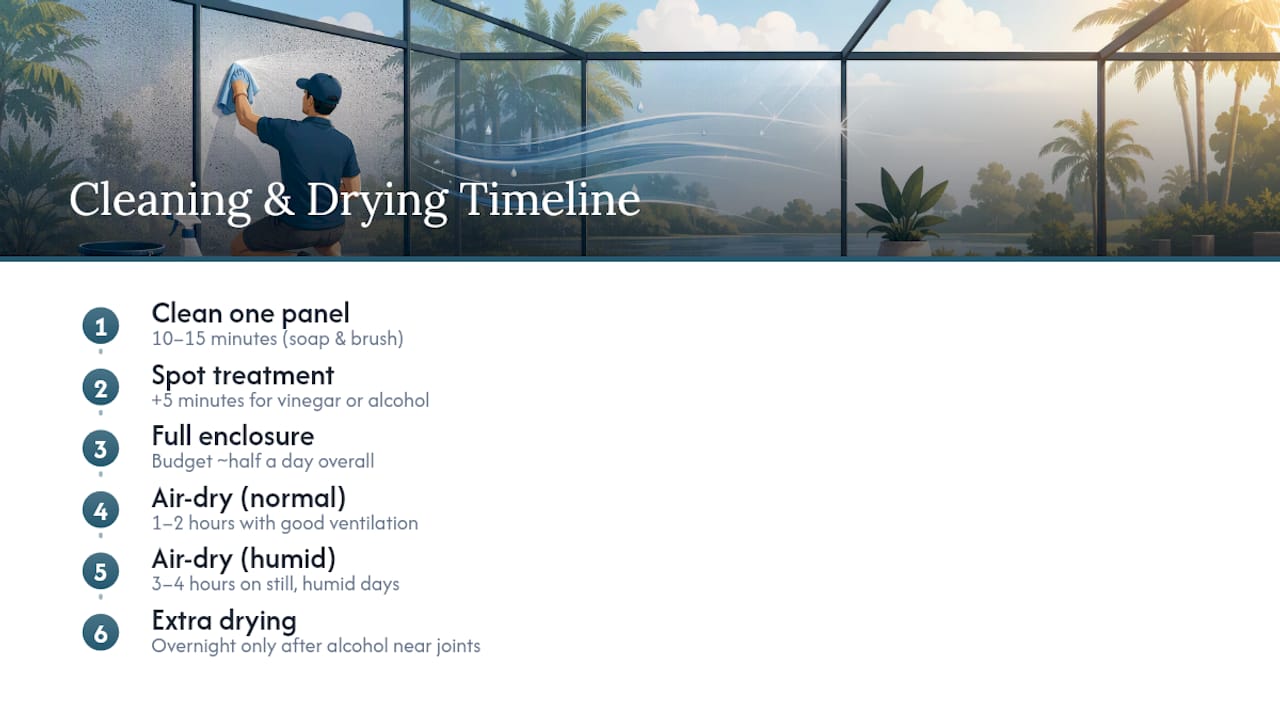
Drying time depends heavily on Florida humidity and airflow. Under normal conditions with good cross-ventilation, mesh panels air-dry within 1 to 2 hours after the final rinse. On humid, still days, that stretches to 3 or 4 hours before the screen is fully dry to the touch. Don't rush this part. Reapplying any second-round spot treatment to still-damp mesh just spreads whatever residue is left rather than lifting it.
If you're treating multiple problem spots across a large cage, plan the work in stages rather than trying to finish everything in one session. Clean and rinse one section fully, let it dry, then inspect before moving to the next. This staged approach also makes it much easier to catch fiber damage early, since wet mesh can hide stretching or fraying that becomes obvious once it dries.
Overnight drying is rarely necessary for soap and vinegar treatments. Reserve that longer wait only for sections where you used isopropyl alcohol near frame joints, just to be safe before anyone leans against that section of screen.
Cleaning Overspray in Corners, Seams, and Curved Panels
Flat, open sections of screen are the easy part. Corners near the spline channel, tight seams around door frames, and curved panel sections at the roofline are where overspray likes to hide and where a soft brush struggles to reach.
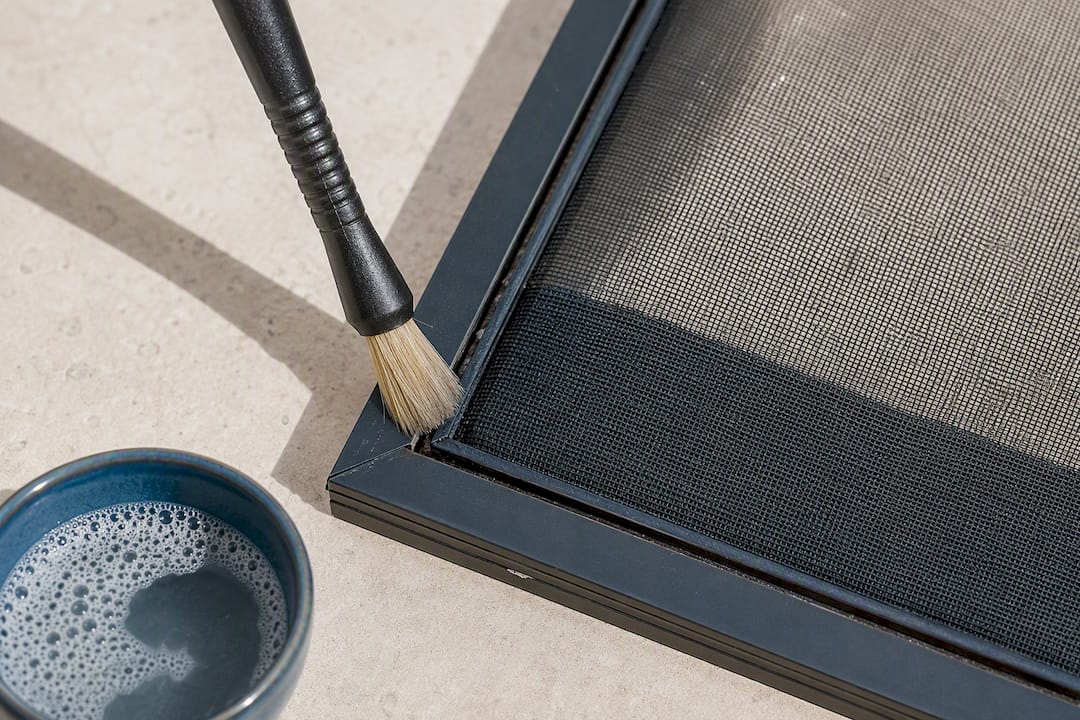
For spline channels and corner seams, swap the brush for a soft toothbrush or a small detailing brush. The narrow bristle head gets into the groove without putting pressure on the mesh itself, which is the part you're trying to protect. Work in short strokes rather than long sweeping motions, since long strokes near a channel edge are what tend to pop mesh loose.
Curved roofline panels present a different problem: access. Rather than climbing on ladders and scrubbing overhead at an awkward angle, use a hose-end sprayer with a fan nozzle held at a slight downward angle so runoff clears the panel instead of pooling against the frame. Pair that with a long-handled soft brush designed for car washing, which gives you reach without forcing you into a bad angle that increases the chance of pressing too hard.
Door frames and hinge areas deserve extra caution. Overspray here often mixes with existing grease or hardware lubricant, which changes how it responds to cleaning. Test these spots separately, even if the rest of the panel cleaned up fine, since hardware residue can make a normally safe cleaner behave differently.
Staying Safe During Overspray Cleanup
Ventilation and protective gear aren't optional extras here, especially if you're working with isopropyl alcohol or vinegar solutions in an enclosed lanai space. Keep enclosure doors open on multiple sides to create cross-airflow, particularly if you're doing spot treatments that involve alcohol fumes.
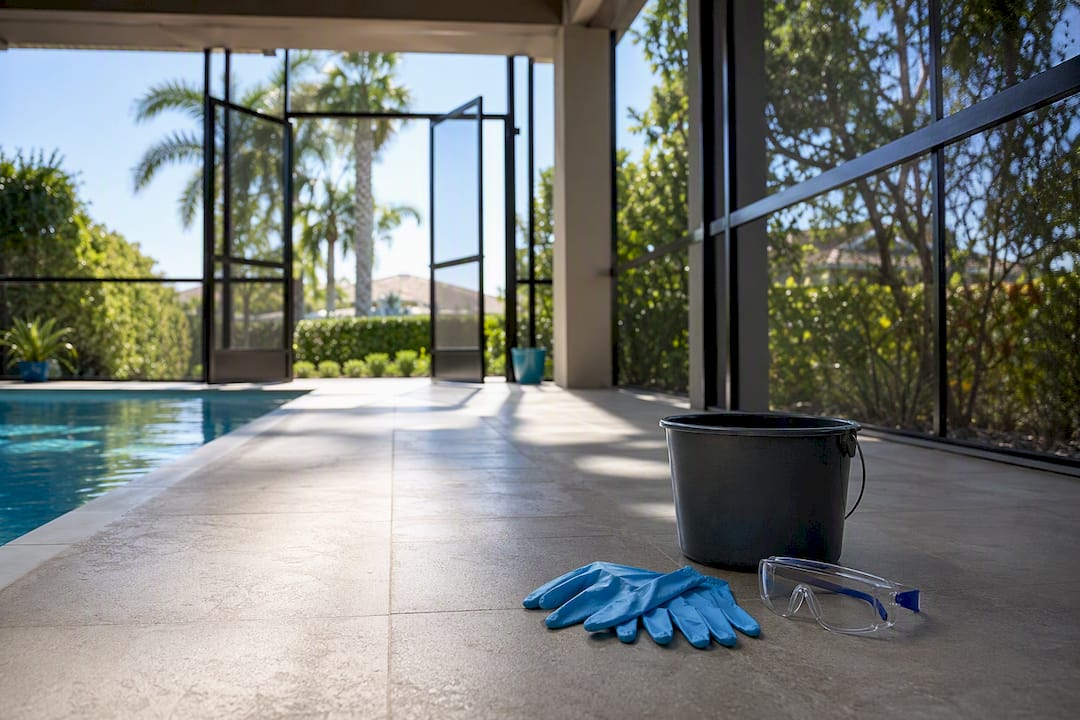
Wear rubber or nitrile gloves throughout, not just during the solvent step. Dish soap solutions seem harmless, but repeated exposure over an hour of scrubbing dries out skin and can irritate anyone with sensitive hands. Safety glasses matter more than people expect, since flicked droplets from a scrub brush travel farther than you'd guess, especially overhead on roofline panels.
Keep pets and kids away from the work area while cleaners are wet on the mesh, and don't let anyone swim in the pool until you've confirmed no cleaning product dripped into the water. If soap or vinegar solution did contact the pool, a quick chemistry check before swimming again is worth the five minutes it takes.
Store any leftover alcohol or vinegar solution away from pool chemicals like chlorine tablets. Mixing cleaning products with pool chemicals, even accidentally through storage proximity, creates fumes nobody wants to breathe in a confined space.
An Editorial Take on Why Overspray Keeps Happening
Most overspray cases trace back to the same handful of causes: masking that covers the obvious spots but skips corners, painters who don't check wind before firing up a sprayer, and rushed jobs where speed wins over precaution. The single habit that prevents the most damage isn't a cleaning product at all. It's insisting on a full walk-through with the painter before they start, confirming every inch of pool surface and screen is covered, not just the areas facing the house.
— Michel
Mr. Pool Screen: When Restoration Beats More Scrubbing
If your spot test failed, the sealer won't budge, or the mesh already looks stretched, more scrubbing isn't the answer. Professional restorers use water-based acrylic coatings and stainless steel fasteners instead of standard hardware that rusts quickly, and full restoration typically costs less than tearing out the cage and starting over.

Most restoration projects, from initial inspection through final repaint, take several days depending on how much re-screening is involved. You get a fresh, factory-look finish and hardware that is more durable. If you're weighing whether your screen is salvageable or already past the point of DIY, start with a look at the pool screen restoration services page, then request online pricing to get a real number for your enclosure instead of guessing.
Sources
For safe cleaning ratios and step-by-step rinsing, Affordable Lanai's cleaning guide covers the method in detail. For pressure washer risks, see Back Bay Pools' damage warnings. For contractor masking standards, EFC Contractors' painting guide lays out what a proper prep job looks like. For a broader look at separating screen upkeep from pool water care, see pool maintenance workflow guidance.
- How to Clean Pool Screen Enclosure (Step-by-Step Without Damaging the Screen)
- How to Clean Pool Cage Screens Without Damage
- Screen Enclosure Painting Guide for Fort Myers and Naples Homes
- Prepare your pool (WD-40 guidance)