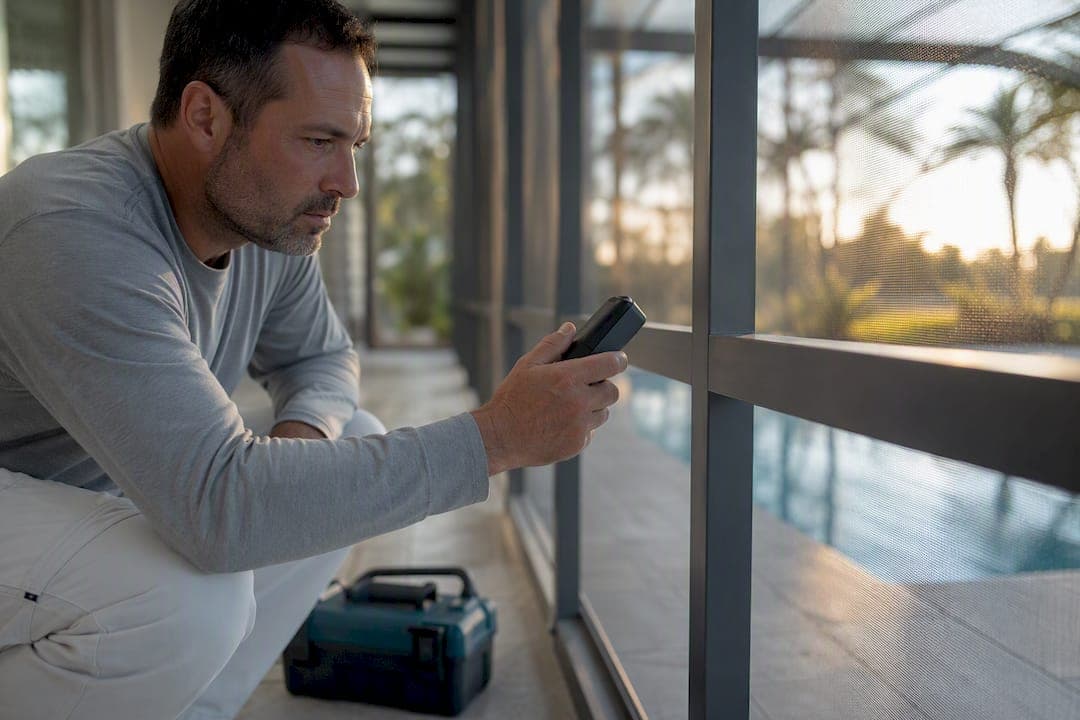
Paint a pool cage when relative humidity is consistently below about 60 to 65% and temperature sits roughly between 50°F and 85°F, and only after real surface prep with an aluminum bonding primer. Skip either condition and you're gambling with bubbling, peeling, or a coating that never fully bonds. If your cage has severe corrosion, spans two stories, or has sections you can't safely reach, that’s a job for a restoration specialist, not a Saturday project.
TL;DR:
- Painting in humid climates requires at least 48 hours of weather with humidity below 65% and temperatures between 50°F and 85°F for proper adhesion and curing.
- Surface preparation involving thorough sanding to remove oxidation and replacing rusted fasteners is crucial to ensure a long-lasting finish that doesn't peel or bubble within a year.
- DTM acrylic paint is the recommended coating for residential pool cages, especially in humid areas, with heavier corrosion or salt exposure needing urethane-modified options.
- Full cure time ranges from 24 to 72 hours depending on humidity, and painting outside ideal conditions greatly increases the risk of adhesion failure and premature damage.
- Serious corrosion, hard-to-reach sections, or structural issues warrant professional restoration with industrial-grade materials and stainless fasteners, not DIY repainting.
Table of Contents
- Your Weekend Painting Checklist for Humid Climates
- How Do You Remove Oxidation Before Painting?
- What's the Best Paint for a Pool Cage in Humid Climates?
- How Long Does Pool Cage Paint Take to Cure in Humidity?
- Should You Spray or Brush Paint a Pool Cage?
- How Often Should You Maintain a Painted Pool Cage?
- When Restoration Beats a DIY Repaint
- Not Sure Your Cage Is a DIY Job? Here's What to Check First
- Sources
- FAQ
Your Weekend Painting Checklist for Humid Climates
Before you open a paint can, run through this sequence. It takes ten minutes and saves you from redoing the entire job in six months.
- Check the forecast for a 48 hour stretch with relative humidity under 65% and temps between 50°F and 85°F. A basic hygrometer or a weather app with hourly RH data works fine.
- Gather your materials: degreaser, an aluminum-specific bonding primer, a DTM or water-based acrylic topcoat, sanding sponges or abrasive pads, and stainless replacement fasteners if any screws are rusted.
- Work in this order: clean, inspect, sand and repair, prime, topcoat, then let it cure fully before any pool splash-back or rain exposure.
- Red flags that mean call a professional: flaking paint over more than 30% of the frame, structural rust at joints, or any section you'd need a ladder taller than six feet to reach safely.
Pro Tip: Paint a small test patch on a shaded section first. If it's tacky after four hours in your current weather, humidity is too high, and you should wait a day rather than push through the whole cage.
How Do You Remove Oxidation Before Painting?
That dull, chalky film on an aging aluminum pool cage isn't dirt. It's oxidation, and it's the number one reason repaint jobs fail within a year. Paint bonds to the chalk layer instead of the metal underneath, so the new coat peels off in sheets, taking the chalk with it. ShunShelter's guide on pool cage painting makes the same point contractors repeat constantly: sand to sound metal, or don't bother painting at all.
Here's the cleaning and prep sequence that actually holds up:
- Degrease the frame with a mild detergent to strip sunscreen residue, pollen film, and general grime.
- Rinse thoroughly, then let the aluminum dry completely, ideally overnight.
- Hand-sand or use an abrasive pad on every rail and post to remove the chalky oxidation layer. If it rubs off gray on your fingers, you're not done yet.
- Spot-sand any heavily corroded areas down to bare metal.
- Replace corroded screws and clips with stainless steel or Nylotech hardware before priming, since rusted fasteners will bleed through new paint within months.
Avoid high-pressure washing here. It can force water behind screen spline and warp thin aluminum members that were never built to take that kind of force. A garden hose and elbow grease do less damage and prep the surface just as well.
Pro Tip: If a section feels soft or flexes when you press it, that's more than surface oxidation. It's likely internal corrosion, and painting over it just hides a structural problem instead of fixing one. For a deeper look at why coatings fail even after prep, see why paint peels on aluminum enclosures.
What's the Best Paint for a Pool Cage in Humid Climates?
The right coating system has to survive three things at once: constant moisture, direct UV, and low-level chlorine off-gassing from the pool below. Not every exterior paint handles that combination.
- DTM (Direct-to-Metal) acrylic is the standard recommendation for most residential cages. It's a water-based acrylic formulated to adhere directly to aluminum without extensive priming steps, and it resists UV yellowing better than older alkyd formulas. Contractors in Florida commonly spec Sherwin-Williams Pro Industrial DTM Acrylic or an equivalent for exactly this reason. It handles the fast recoat windows that afternoon rain patterns demand.
- Alkyd or urethane-modified DTM coatings step in when a cage has heavy prior corrosion or sits near saltwater, where chloride exposure eats through standard acrylics faster.
- Aluminum bonding primer still matters even with a self-priming acrylic, particularly on bare or sanded metal, since it creates a mechanical and chemical grip the topcoat alone can't match. Our guide on primer rules for pool enclosures breaks down which combinations are compatible.
- Sheen and color choices affect more than looks. Lighter, satin or low-sheen finishes hide water spotting and thermal expansion marks far better than gloss, a principle interior finish guides on sheen selection apply to painted surfaces generally.
How Long Does Pool Cage Paint Take to Cure in Humidity?
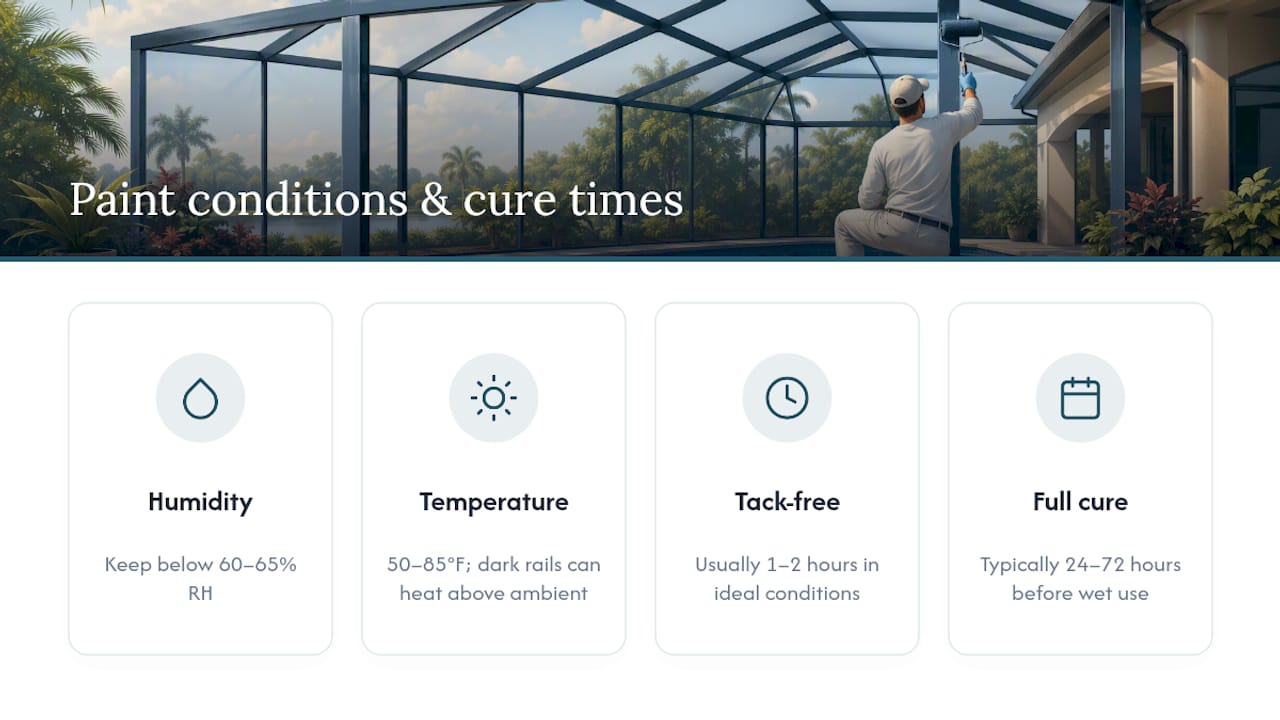
The window you're aiming for is relative humidity below 60 to 65%, and temperatures between roughly 50°F and 85°F, according to weather guidance for pool cage painting. Outside that range, you're courting uneven drying, bubbling, and adhesion failure.
Humidity above that threshold traps moisture directly under the curing film, forming a vapor barrier between the coating and the metal. The paint looks dry on top while staying soft underneath, which is exactly how premature peeling starts.
Direct sun adds a second variable. A dark aluminum rail sitting in full afternoon sun can hit surface temperatures well above the ambient air reading, so touch-test the metal before you paint, not just the thermometer. Most water-based acrylics go tack-free within one to two hours in ideal conditions, but that stretches significantly as humidity climbs. Full cure, the point where the coating can handle rain or pool splash without damage, typically needs 24 to 72 hours depending on humidity and film thickness. Test adhesion on a small area with light fingernail pressure before considering the job done, and hold off on pool use or hose-downs near freshly painted rails until you're past that cure window.
Should You Spray or Brush Paint a Pool Cage?
Spray application, using HVLP or airless equipment, reaches backsides of screen frames, fastener holes, and tight joints that a brush or roller simply can't cover. Contractor practice supports this: professional application guides point to spray plus two full coats as the standard for durable results in harsh outdoor climates. That complete coverage matters more than it sounds. Any bare aluminum left exposed at a joint becomes the spot where corrosion restarts within a season.
If you're rolling or brushing by hand, follow this sequence:
- Apply the first coat thin. A heavy first pass traps solvent and slows curing.
- Wait for the manufacturer's stated recoat window, which stretches longer in humid air, before applying the second coat.
- Check joints, corners, and fastener heads for full coverage before calling it finished.
- Do a final visual pass in bright daylight to catch thin spots or missed sections.
The mistakes that ruin most DIY jobs are predictable: painting over chalky oxidation instead of sanding it off, painting during a humid stretch because the calendar said it was time, skipping primer to save a step, and rushing the second coat before joints have fully released trapped moisture. Pro Tip: Run your hand along every painted rail after the final coat cures. Any tacky or gritty spot means that section needs rework now, not after the next rainstorm finds it for you.
How Often Should You Maintain a Painted Pool Cage?
A good paint job isn't a one-time event. Regular upkeep is what separates a coating that lasts a few years from one that holds up for a decade.
- Rinse the frame monthly with a garden hose to clear pollen, salt film, and chlorine residue before it builds up.
- Increase rinse frequency if you're near saltwater or run a heavily chlorinated pool, since both accelerate coating breakdown.
- Check hardware and screen spline twice a year, tightening loose fasteners and noting any movement after storms.
- Handle small chips or scratches immediately: sand the spot, clean it, prime it, then touch up before corrosion gets a foothold.
Regular maintenance routines like monthly rinses and biannual fastener checks extend coating life meaningfully in humid or coastal regions, and it's the cheapest insurance you'll ever buy for a paint job. For a realistic sense of how long a well-maintained finish should last, our breakdown on pool cage paint longevity walks through what Florida homeowners can reasonably expect.
When Restoration Beats a DIY Repaint
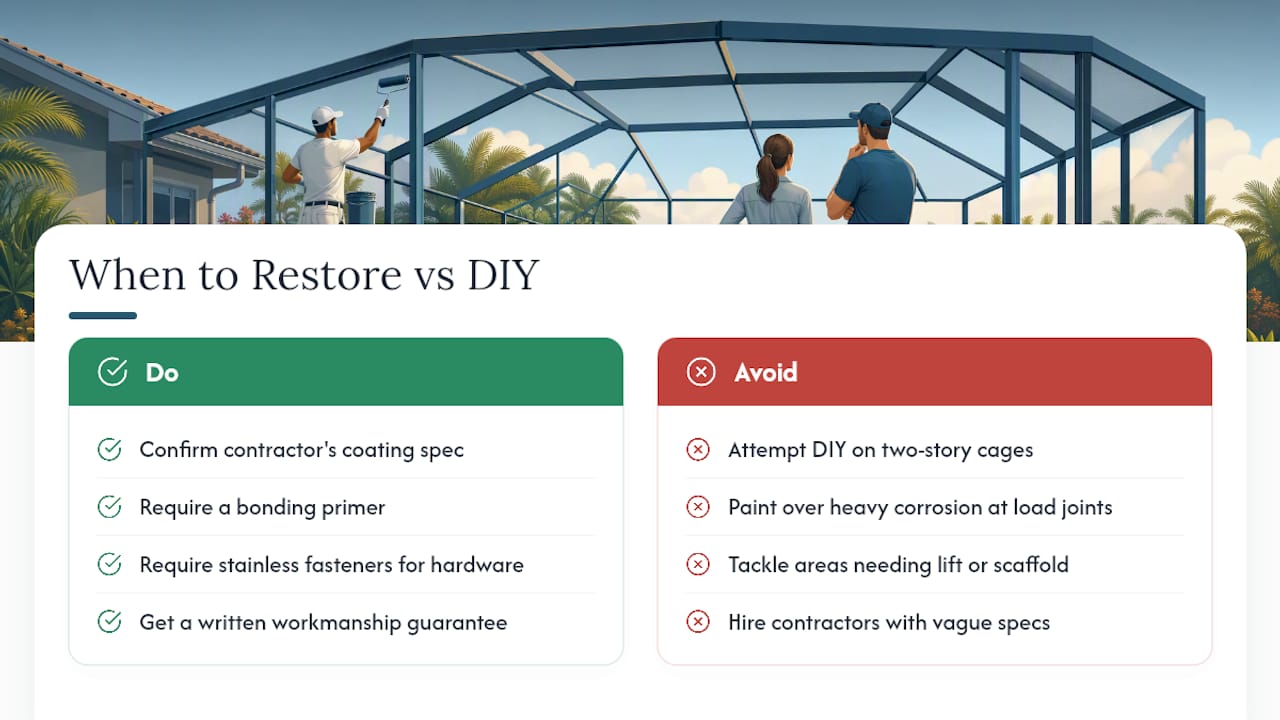
A professional restoration process depends on prep and materials to determine whether a coating survives Florida humidity. Crews use industrial-grade water-based acrylic coatings and replace corroded hardware with stainless fasteners rather than reusing what's already failing.
Two-story cages, heavy corrosion at load-bearing joints, and sections requiring lift or scaffold access are where DIY stops making sense. If a contractor can't clearly explain their coating spec, confirm they're using a bonding primer, and stand behind the work with a written guarantee, keep looking. The homeowners who get the best results are the ones who know exactly which category their cage falls into before they pick up a brush or a phone.
— Michel
Not Sure Your Cage Is a DIY Job? Here's What to Check First
If your cage has advanced corrosion, spans two stories, or has sections you genuinely can't reach without a ladder taller than six feet, hire a professional rather than risk a fall or a repaint that fails within a season. These cases typically require professional handling, using industrial-grade acrylic coatings and stainless steel fasteners, often costing less than a full enclosure rebuild.

Before hiring anyone, ask four questions: What coating system are they specifying, and is it a DTM or water-based acrylic rated for your climate? Do they use a bonding primer on aluminum, or skip straight to topcoat? Will corroded fasteners be replaced with stainless or Nylotech hardware, not just painted over? And what guarantee backs the finished work? A contractor who answers all four without hesitation is one worth hiring.
If your cage matches any of the red flags above, the next step is simple: get a free restoration estimate from Mrpoolscreen and find out whether restoration or a full rebuild makes more sense for your specific situation.
Sources
- Pool Cage Painting Tampa & Westchase FL | Westchase Painting
- Painting Your Pool Cage: Tips, Benefits, And Best Practices | ShunShelter
- Pool Cage Painting Guide: Prep, Timing & Finish Options
FAQ
Can You Paint a Pool Cage in Florida's Humidity?
Yes, but only within a specific window: relative humidity below 60 to 65% and temperatures between roughly 50°F and 85°F, per weather guidance for pool cage painting. Painting outside that range risks trapped moisture and premature peeling.
What Happens if You Paint Over Oxidized Aluminum?
The new coating bonds to the chalky oxidation layer instead of the metal, so it peels off in sheets within months. Sanding to bare, sound metal and using an aluminum bonding primer is the fix.
How Long Should Paint Cure Before Pool Use?
Full cure typically takes 24 to 72 hours depending on humidity and film thickness, and you should avoid splashing water on freshly painted rails until that window passes.
Is DTM Acrylic the Best Paint for a Pool Cage?
DTM acrylic is the standard choice for most residential cages because it adheres directly to aluminum and resists UV, though heavier corrosion or coastal salt exposure sometimes calls for a stronger urethane-modified option.
When Should I Hire a Restoration Company Instead of Painting Myself?
Hire a professional like Mrpoolscreen when you see advanced corrosion, structural rust at joints, a two-story cage, or sections you can't safely access, since these situations need specialized equipment and materials beyond a standard DIY repaint.