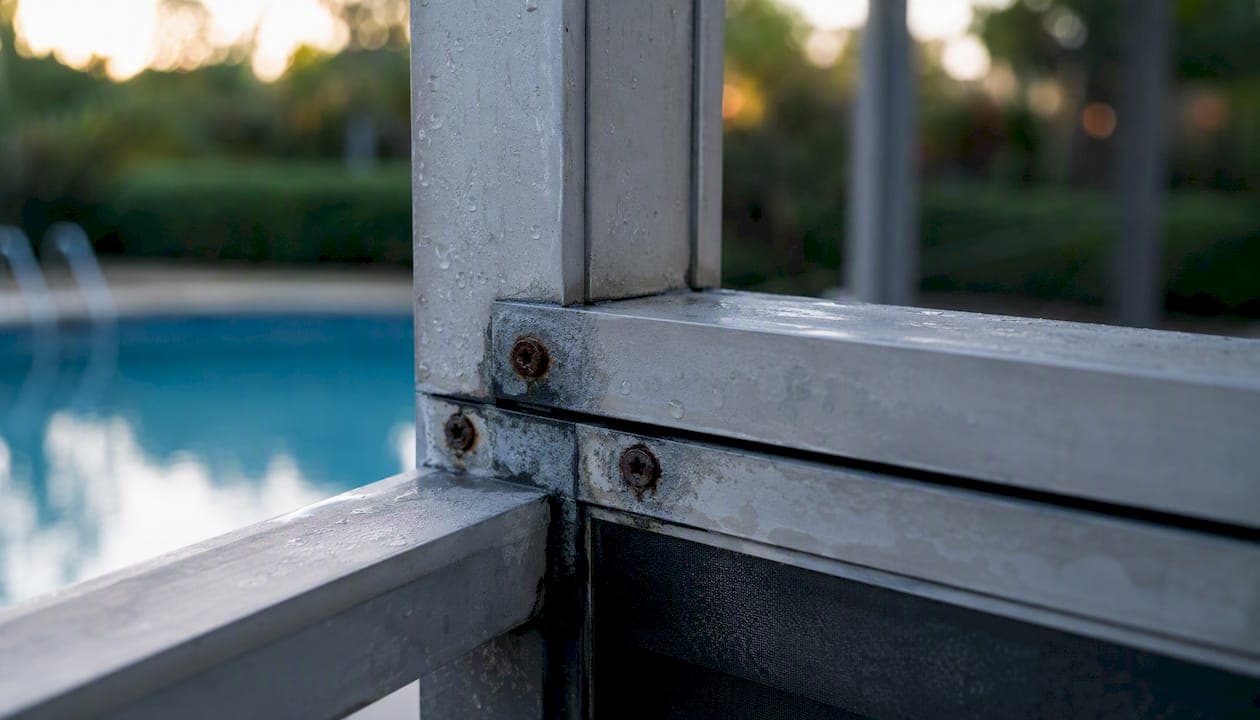
Galvanic corrosion on a pool enclosure happens when two dissimilar metals touch through a conductive liquid, and one metal slowly sacrifices itself to protect the other. It is not the same as ordinary rust. The most important thing you can do right now: stop water from sitting at metal junctions, and photograph every joint, fastener, and base plate before the damage spreads further.
- Isolate the contact point where possible. Dry the area and keep it dry.
- Document everything with close-up photos of pitting, white powder, brown streaks, and loose fasteners.
- Do not cut or disconnect bonding wires without an electrician. Equipotential bonding is a safety system.
- For a professional assessment of the damage, pool screen restoration from Mrpoolscreen is a cost-effective alternative to a full rebuild.
Pro Tip: Take your photos in morning light when moisture is still visible on the metal. Wet surfaces reveal pitting and staining that dry metal hides.
Key Takeaways
Galvanic corrosion on a pool enclosure is an electrochemical process driven by dissimilar metals in wet contact, and the most effective long-term fix combines correct-grade fasteners, electrical isolation, and maintained coatings rather than paint alone.
| Point | Details |
|---|---|
| Break the galvanic cell first | Isolate dissimilar metals with nylon or neoprene washers before applying any coating. |
| Fastener grade matters | Use 316 stainless in saltwater or coastal environments; 304 is the minimum for freshwater inland pools. |
| Small anodes corrode fast | A single galvanized fastener in an aluminum frame can pit out in one wet season due to the area effect. |
| Coatings are maintenance, not a cure | Paint slows electrolyte access but does not stop corrosion if electrical contact between metals remains. |
| Mrpoolscreen restoration | Replaces fasteners, isolates junctions, and applies industrial coatings, saving up to 60% versus a full rebuild. |
Table of Contents
- What galvanic corrosion actually does to your pool cage
- Why pool cages are especially vulnerable to galvanic attack
- How to inspect your pool enclosure and when to act
- Concrete prevention steps and a homeowner maintenance plan
- How to fix existing corrosion safely
- Targeted repair, rescreening, or full rebuild: how to choose
- When to hire a restoration specialist and what to expect
- What most homeowners get wrong about corrosion prevention
- Mrpoolscreen restores what corrosion has damaged
- Sources
What galvanic corrosion actually does to your pool cage
The short version: one metal acts as a battery's negative terminal (the anode), the other acts as the positive terminal (the cathode), and any conductive liquid between them completes the circuit. The anode corrodes. The cathode stays intact. TWI's technical guidance identifies four components that must all be present for galvanic corrosion to occur:
- Anode: the less noble metal (aluminum, zinc, galvanized steel)
- Cathode: the more noble metal (stainless steel, copper)
- Return current path: direct electrical contact between the two metals
- Electrolyte: any conductive liquid, including pool splash, humidity, or salt spray
Break any one of those four links and the corrosion stops or slows dramatically.
Ordinary rust is a different process. Iron oxidizes when it contacts oxygen and moisture, with no second metal required. Galvanic corrosion needs that second, more noble metal to drive the reaction. That distinction matters practically: a rusty steel fastener in a steel frame is just oxidation. The same fastener threaded into an aluminum frame, wet with pool water, is a galvanic cell actively consuming the aluminum around it.
The galvanic series ranks metals by electrochemical potential. Aluminum and zinc sit near the anodic (sacrificial) end. Stainless steel and copper sit near the cathodic (protected) end. The farther apart two metals sit in that series, the faster the attack on the anodic one.
| Metal | Position in galvanic series | Behavior when paired with a more noble metal |
|---|---|---|
| Zinc (galvanized coating) | Anodic (sacrificial) | Corrodes first, protects the cathode |
| Aluminum | Anodic | Pits and loses material at contact points |
| 304 stainless steel | Moderately noble | Cathode in most pool-enclosure pairings |
| 316 stainless steel | Noble | Cathode; resists chloride attack better than 304 |
| Copper | Noble | Strongly cathodic; accelerates attack on aluminum |
Why pool cages are especially vulnerable to galvanic attack
Pool enclosures supply every ingredient a galvanic cell needs, in abundance. The frame is almost always aluminum. The fasteners, clips, and base-plate anchors are often galvanized steel or a mixed grade of stainless. Pool water, humidity, and splash provide a near-constant electrolyte. The result is a structure that is, by design, a collection of galvanic cells waiting to activate.
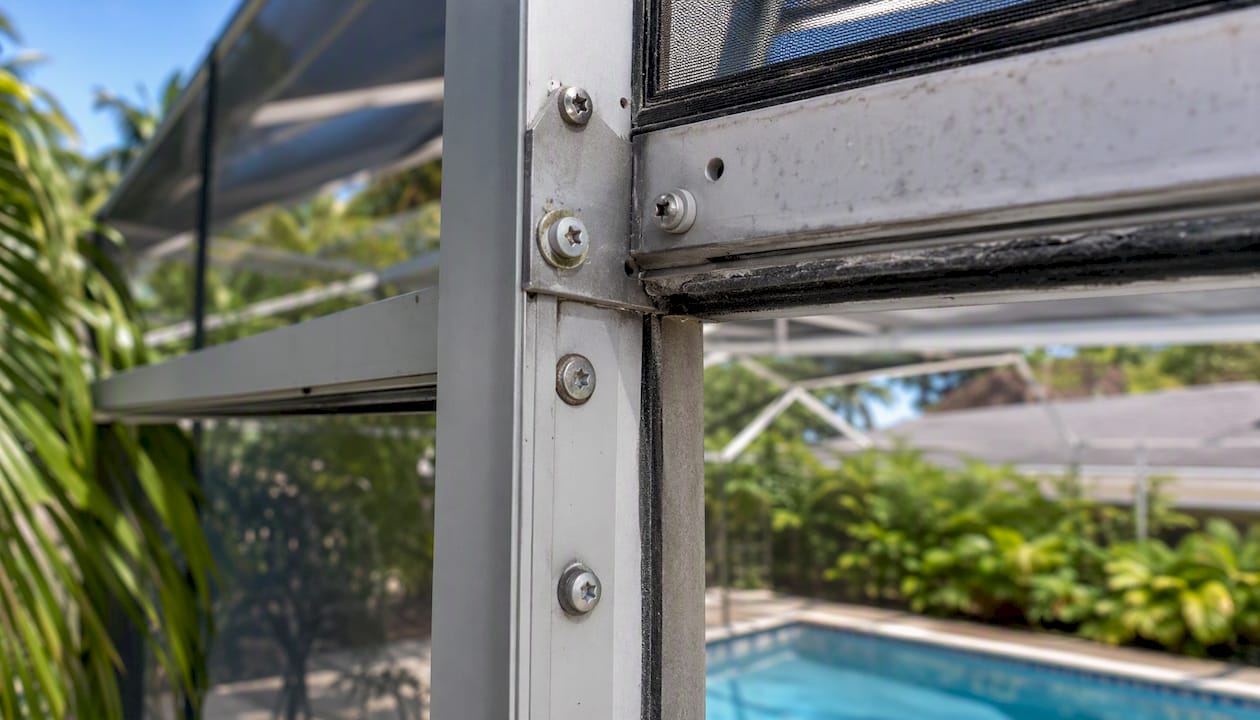
The area effect described in Atlas Tech Note No. 7 makes this worse: when a small anodic part (a single fastener) connects to a large cathodic surface (an aluminum frame panel), the attack concentrates on that small fastener with disproportionate intensity. A single wrong-grade screw can pit out in months under those conditions.
Environmental accelerants specific to pool enclosures:
- Chlorine and pool chemicals lower the pH of splash water and increase its conductivity, raising the corrosion rate on exposed aluminum and zinc.
- Saltwater pools carry dissolved chlorides that are far more conductive than fresh water, accelerating galvanic action at every metal junction. Coastal properties face the same risk from salt spray even with a freshwater pool.
- High humidity and pooled water at footings keep base plates and anchor bolts wet for extended periods, sustaining the electrolyte layer that drives the cell.
- Concrete footings can introduce additional electrochemical complexity. Moisture wicking through concrete carries dissolved salts and minerals that act as electrolytes at the base-plate connection.
Saline groundwater near canals or coastal areas raises the risk further. Cape Coral Pool Authority notes that saline groundwater intrusion can pull the structural bonding circuit into the corrosion cell itself, which means the equipotential bonding system designed to protect swimmers can inadvertently accelerate metal loss at footings.
How to inspect your pool enclosure and when to act
Start at the top and work down, then circle the perimeter at ground level. The most urgent damage is almost always at the base.
Quick visual cues that require escalating responses:
- White powder or chalky deposits on aluminum: early-stage oxidation or galvanic pitting. Monitor and clean.
- Brown streaks running down from fasteners: iron oxide from a corroding steel fastener staining the aluminum below. Replace the fastener soon.
- Pitting or cratering at screw holes: the aluminum around the fastener is being consumed. Repair within weeks, not months.
- Loose or spinning fasteners: the surrounding metal has lost enough material that the fastener no longer grips. Structural concern; act now.
- Cavity or void at base plates: the most serious finding. The aluminum extrusion at the footing connection may be hollow. Call a professional.
Practical inspection checklist — use this on your next walk-around and photograph each item:
- Check every visible fastener head for rust staining or surface pitting.
- Probe each fastener gently with a screwdriver. It should feel solid. Any wobble or spin means the surrounding metal is gone.
- Look at the underside of horizontal members where water pools after rain.
- Examine base plates and anchor bolts at the concrete footing. Look for rust staining on the concrete below the plate.
- Check screen spline channels for trapped debris and moisture.
- Look for white powder or blistering paint along vertical extrusions, especially near joints.
- Inspect any point where a wire or conduit contacts the frame.
For a more detailed checklist, the pool screen safety inspection guide from Mrpoolscreen covers additional structural and safety items worth reviewing alongside corrosion checks.
Decision thresholds:
- Surface staining only, fasteners solid: clean, monitor every six months.
- Fastener rust staining with minor pitting: replace fasteners within 30–60 days.
- Loose fasteners, visible pitting in the frame: schedule professional repair.
- Base-plate cavity, structural cracking, or footing corrosion: stop using the enclosure for recreation and call a specialist.
Concrete prevention steps and a homeowner maintenance plan
The two highest-leverage actions are stopping electrical contact between dissimilar metals and limiting how long the junction stays wet. Everything else is secondary.
Prioritized prevention measures:
- Replace galvanized or wrong-grade fasteners with 316 stainless steel. In a chloride-exposed environment (saltwater pool, coastal location), 304 stainless is not enough. My Pool Calculator's corrosion guidance recommends 316 stainless for chloride exposure and notes that sacrificial anode kits typically last 2–5 years before needing replacement.
- Use nylon or polymer isolation washers at every dissimilar-metal junction. Nylotech-coated fasteners and neoprene gaskets break the electrical contact path without requiring structural changes.
- Improve drainage at footings. Grade soil or deck material away from base plates so water does not pool at the most vulnerable connection point.
- Apply and maintain compatible coatings on both metals. Coating only the cathode while leaving the anode exposed can actually accelerate attack on the anodic area when the coating eventually fails, as TWI explains in its prevention guidance. Coat both surfaces or neither.
- Keep pool chemistry balanced. A pH of 7.2–7.8 and free chlorine near 1–3 ppm reduces the corrosive aggressiveness of splash water on metal surfaces.
Fastener and material selection at a glance:
| Environment | Recommended fastener | Isolation needed? | Notes |
|---|---|---|---|
| Freshwater pool, inland | 304 stainless | Yes, nylon washer | Minimum acceptable spec |
| Saltwater pool or coastal | 316 stainless | Yes, neoprene gasket | Standard for chloride exposure |
| Canal-adjacent or high humidity | 316 stainless | Yes, neoprene gasket | Inspect footings annually |
| Any aluminum-to-steel junction | 316 stainless or Nylotech | Yes | Avoid galvanized entirely |
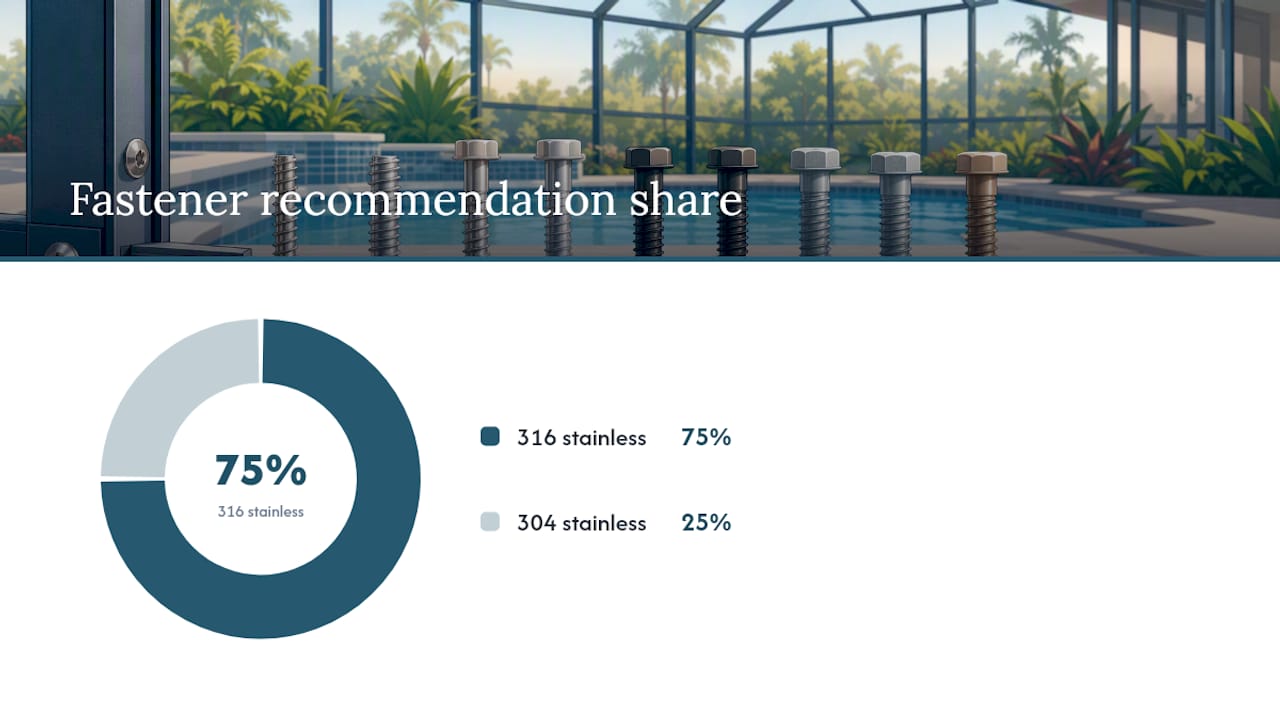
Galvanize It's guidance on dissimilar metal contact recommends aiming for a roughly 10:1 anode-to-cathode area ratio where possible, which in practice means using larger anodic components or selecting fastener materials that are close in the galvanic series to the frame material.
Maintenance schedule:
- Every 6 months: visual inspection of all fasteners and base plates; clean debris from spline channels and horizontal members.
- Annually: probe all fasteners, check coating integrity, recoat any areas showing bare metal or blistering.
- Every 2–5 years: replace sacrificial anodes if installed; consider a professional corrosion assessment on older structures.
Pro Tip: Replacing all exposed galvanized fasteners with 316 stainless is one of the lowest-cost, highest-impact steps a homeowner can take. On a typical pool cage, the fastener cost is modest compared to the structural damage a single corroded anchor can cause.
How to fix existing corrosion safely
Surface-level galvanic attack can be stabilized temporarily with the right steps. Deep pitting, base-plate loss, or any structural weakening needs a professional. Here is the sequence for what you can safely address yourself:
- Document first. Photograph every affected area before touching anything. You need a baseline.
- Dry the junction. Stop water from reaching the corroded area. Redirect drainage, cover temporarily, or seal nearby gaps.
- Remove rusted fasteners carefully. Use penetrating oil, wait 20 minutes, then back them out slowly. Avoid snapping them off flush with the frame.
- Inspect the hole. If the aluminum around the fastener hole is pitted but solid, you can re-tap or use a slightly larger replacement fastener. If the material crumbles, that section needs professional repair.
- Install correct-grade replacements. 316 stainless with a nylon or neoprene isolation washer. Never reinstall galvanized hardware.
- Clean remaining metal. Use a wire brush or fine abrasive to remove loose corrosion product. Rinse with fresh water and dry completely.
- Apply a compatible primer and coating. Use a product rated for aluminum and outdoor exposure. Apply to both the frame surface and the fastener head.
- Monitor the repair. Check it at 30 days and again at 6 months. If corrosion returns at the same point, the electrical contact path is still active and a professional isolation solution is needed.
Safety notes: wear gloves and eye protection when removing corroded fasteners. Never cut or disconnect bonding wires or equipotential bonding conductors. These are part of your pool's electrical safety system.
Rough cost ranges for common repairs:
For step-by-step rust removal guidance, the pool screen rust removal guide covers temporary stabilization measures appropriate for homeowners before a professional assessment.
Targeted repair, rescreening, or full rebuild: how to choose
The decision comes down to how far the corrosion has spread and whether the frame itself is structurally sound.
- Targeted repair is the right call when corrosion is localized: a handful of fasteners, one or two joints, surface staining without structural loss. Cost is lowest, and a well-executed repair on a sound frame can add years of service life.
- Rescreen and restore fits structures where the frame is largely intact but fasteners are widely compromised, screen mesh is torn or sagging, and coatings have failed across most surfaces. This is the middle path: more thorough than spot repair, far less expensive than tearing everything down. Mrpoolscreen's restoration approach covers this scope in detail.
- Full rebuild is warranted when base plates are hollow, multiple vertical members show structural pitting, or the footing connections are compromised. A structure with foundation-level corrosion is a safety issue, not just a cosmetic one.
Decision guide by damage level:
- A few corroded fasteners, no frame pitting, coatings mostly intact: targeted repair, $300–$800 typical.
- Widespread fastener rust, faded or peeling coatings, screen damage in multiple panels: rescreen and restore, typically 40–60% less than a rebuild.
- Structural cracking, hollow base plates, footing corrosion visible: rebuild required; get a structural assessment first.
Age matters too. A 10-year-old enclosure with moderate corrosion is a strong candidate for restoration. A 25-year-old structure with widespread frame loss may not justify the investment in anything short of a rebuild.
When to hire a restoration specialist and what to expect
Call a specialist when you find any of the following: structural parts that flex or move under light pressure, base-plate connections that show cavity corrosion, more than a few loose fasteners across the structure, or any footing corrosion you cannot fully see. These are not DIY situations.
What a professional restoration typically includes:
- On-site assessment and corrosion mapping (photographing and probing every joint and base plate)
- Fastener removal and replacement with correct-grade stainless (316 for chloride environments)
- Electrical isolation at dissimilar-metal junctions using neoprene or polymer gaskets
- Surface preparation: cleaning, priming, and application of industrial-grade coatings to both frame and fastener heads
- Re-screening with appropriate mesh type if panels are damaged
- Post-work inspection and documentation
Questions to ask any contractor before signing:
- What fastener grade do you install, and do you include isolation washers?
- What coating system do you use, and what is its expected service life?
- Does the scope include electrical isolation at base plates?
- What warranty do you offer on labor and materials?
- Can you show me before-and-after photos from similar projects?
Mrpoolscreen's restoration process replaces rusted fasteners with stainless hardware, applies water-based acrylic coatings rated for outdoor aluminum, and re-screens damaged panels, producing documented results that can save homeowners up to 60% compared to a full rebuild while restoring both structural integrity and appearance.
For real project examples, the Mrpoolscreen project gallery shows before-and-after results from Central Florida restorations.
What most homeowners get wrong about corrosion prevention
The conventional wisdom is to paint the frame and call it done. That instinct is understandable, but it misses the mechanism. Galvanic corrosion is electrical. A coating slows electrolyte access, but if the electrical contact between dissimilar metals remains, corrosion continues under the paint. When the coating eventually fails, which it will, the attack resumes exactly where it left off, often hidden from view until the damage is severe.
The more durable fix is to break the electrical contact first, then coat. Nylon washers, polymer-coated fasteners, and correct material selection do more lasting work than any paint product applied over a live galvanic cell. Coatings are a maintenance item, not a solution.
The second thing homeowners underestimate is the area effect. A single small galvanized screw in a large aluminum panel is not a minor problem. That small anodic fastener, connected to a large cathodic surface, corrodes at an accelerated rate because the cathodic area drives the reaction harder. One wrong fastener can hollow out the surrounding aluminum in a single Florida wet season.
Mrpoolscreen restores what corrosion has damaged
Replacing a pool enclosure in Central Florida costs significantly more than restoring one. Mrpoolscreen's restoration service addresses galvanic damage directly: rusted fasteners come out and 316 stainless replacements go in with proper isolation hardware, industrial water-based acrylic coatings go on both frame and fastener heads, and damaged screen panels are re-screened to match. The result is a structure that looks clean, holds its fasteners, and is protected against the electrochemical conditions that caused the original damage.
DIY stabilization measures are sometimes the right first step, but they are temporary when the galvanic cell is still active. A professional restoration breaks the cell, seals the metal, and documents the work. Mrpoolscreen serves homeowners across Central Florida and offers free on-site estimates. Request a quote to see what a full restoration would cost compared to rebuilding from scratch.
Sources
- What is Galvanic Corrosion and How Can it be Prevented? - TWI
- Dissimilar Metal Corrosion with Zinc
- Atlas Tech Note No. 7 - Galvanic Corrosion
- 5 Ways to Save Money on Corrosion Protection - My Pool Calculator