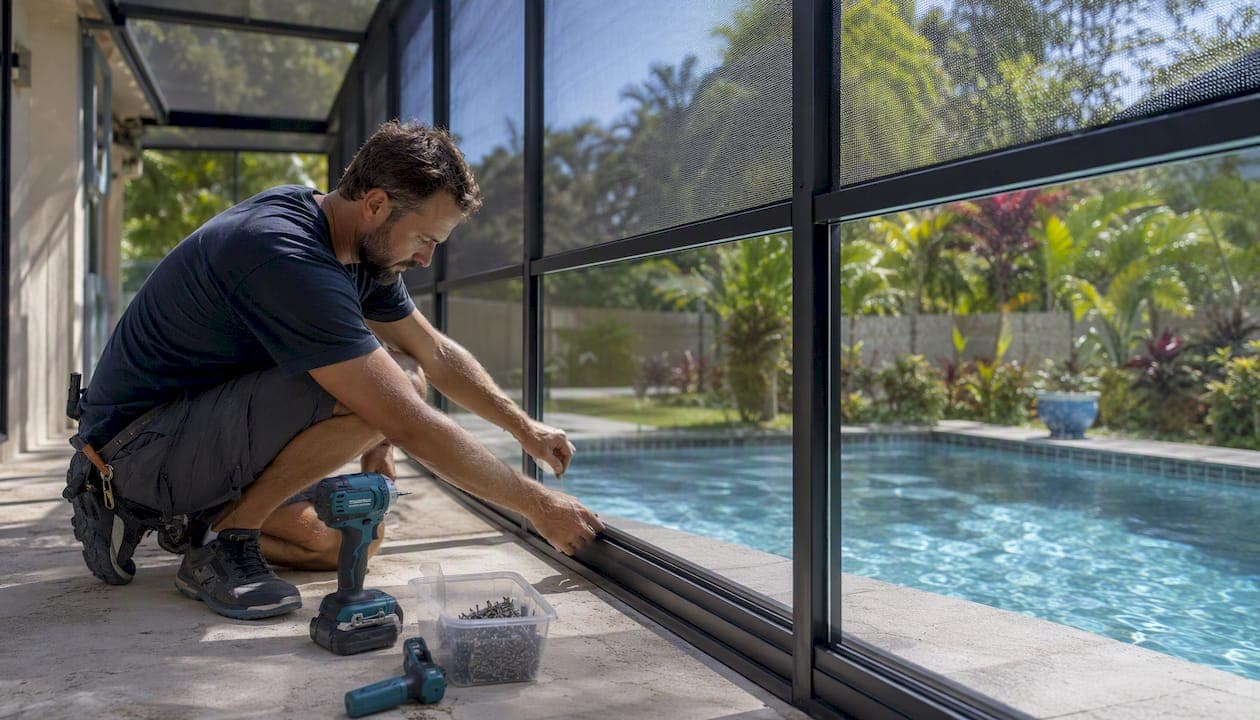
For most Central Florida homeowners, the three most practical pool cage privacy options are near-solid laminated panels (Florida Glass), high-density privacy or solar mesh, and professional re-screening with privacy-grade materials. Florida Glass gives you the most visual blockage but cuts airflow. Privacy mesh offers a reasonable balance. And if your enclosure frame is structurally sound but looking rough, professional restoration with Mrpoolscreen can deliver both improved privacy and a refreshed appearance at a fraction of the cost of a full rebuild.
Quick picks by situation:
- Maximum privacy, day and night: Florida Glass or vinyl-laminated panels at the lower sections of the cage
- Best balance of privacy, airflow, and light: High-density solar or privacy mesh (80%+ opacity)
- Perimeter fence or lower cage frame only: Vinyl windscreens or fence wraps with rust-resistant grommets
- On-demand privacy with shade control: Retractable roller shades or outdoor curtain systems
- Design-first, lower visual impact: Decorative lattice panels, vertical planters, or privacy hedges
- Aging enclosure with sound frame: Restoration and re-screening with Mrpoolscreen, which can save up to 60% versus a full rebuild (company-reported)
Key Takeaways
The most effective pool cage privacy upgrade matches your privacy goal, climate exposure, and frame condition, not just the lowest material price.
| Point | Details |
|---|---|
| Florida Glass for max privacy | Laminated panels deliver near-solid day-and-night privacy with a lifespan of 10–12+ years. |
| Solar mesh for balanced performance | High-density mesh (80%+ opacity) balances privacy, airflow, and UV shading in one material. |
| Check HOA and permits first | Many Florida HOAs and counties require approval or permits before any visible enclosure change. |
| Restoration saves up to 60% | If the frame is sound, Mrpoolscreen's restoration service can cost up to 60% less than a full rebuild (company-reported). |
| Ask installers for specs and warranty | Always get the material spec sheet and written warranty before signing any installation contract. |
Table of Contents
- What are the main pool cage privacy options side by side?
- How does Florida Glass deliver near-solid privacy for pool enclosures?
- What makes privacy mesh and solar screens worth considering?
- How do vinyl windscreens and fence wraps work for pool-area perimeters?
- Are retractable shades and outdoor curtains worth the investment?
- Which decorative and landscape options complement a pool cage?
- How do you choose the right pool enclosure privacy solution?
- What should homeowners expect to pay and how long does installation take?
- How long do privacy screens last, and what does maintenance involve?
- When does restoration make more sense than buying new materials?
- What HOA rules and local regulations apply to pool cage privacy changes?
- A practical take for Central Florida homeowners
- Mrpoolscreen handles restoration and re-screening for Central Florida homeowners
- Sources
What are the main pool cage privacy options side by side?
Before committing to any material, it helps to see how the main options stack up across the dimensions that matter most: how much they actually block views, how much air they let through, and how much they cost to install.
Quick notes:
- Florida Glass and privacy mesh pair naturally with a professional re-screening job, so if your cage needs new screen anyway, upgrading to a privacy-grade material costs relatively little extra.
- Vinyl windscreens from suppliers like FenceScreen come in custom sizes with UV-treated fabrics and rust-resistant grommets, making them a practical add-on for perimeter fencing.
- Retractable systems offer the most flexibility but require the most structural planning and periodic maintenance.
- Decorative and landscape options work best as a complement to another privacy layer, not as a standalone solution.
How does Florida Glass deliver near-solid privacy for pool enclosures?
Florida Glass is a laminated fiberglass or vinyl-laminated screen product designed specifically for pool enclosures. It looks nearly solid from the outside, blocks grass clippings, dirt, and moisture, and is waterproof enough to handle Florida's daily afternoon storms without warping or delaminating. Most installers place it along the lower sections of a cage where ground-level views are the biggest concern. Some homeowners go full-panel for maximum privacy.
Pros:
- Highest daytime and nighttime privacy of any screen-based option
- Waterproof and resistant to moisture, dirt, and debris
- Excellent insect protection (no gaps for small insects)
- Lifespan of about a decade with proper care
- Available through retail channels for DIY buyers (Amazon listings carry standard sizes)
Cons:
- Significantly reduces airflow, which can make the enclosure feel warmer
- Blocks natural light, particularly when used for full-panel coverage
- Heavier than standard screen, so frame condition matters before installation
- Higher material cost than standard mesh
For a deeper look at the material, specifications, and installation notes, the homeowner's guide to Florida Glass on the Mrpoolscreen blog covers the full picture.
Pro Tip: Install Florida Glass on the lower two to three feet of your enclosure and use a high-density solar mesh above it. You get near-solid ground-level privacy while keeping airflow and natural light in the upper sections.
What makes privacy mesh and solar screens worth considering?
Privacy and solar screens use a tighter weave than standard pool screen, which lets you see out while making it much harder for anyone outside to see in. The key variable is opacity, usually expressed as a percentage.
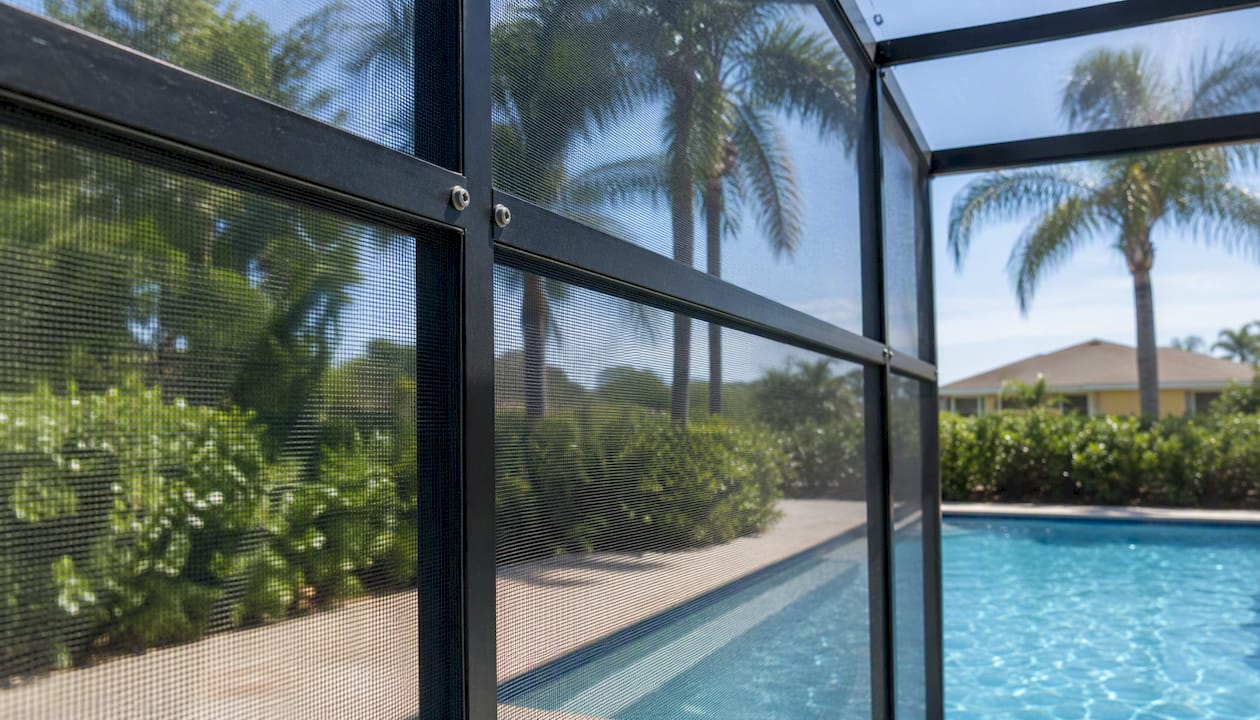
Manufacturers like Mirage Screen Systems offer motorized retractable systems and pet-resistant mesh options alongside standard fixed panels, which opens up the category considerably for homeowners with larger openings or pets that tend to push against screens.
Pros:
- Good balance of privacy, airflow, and UV protection
- Available in multiple opacity levels and colors to match enclosure aesthetics
- Motorized options add convenience for large or frequently adjusted openings
- Pet-resistant mesh resists scratching and puncture
- Works well as a full-cage re-screen upgrade during a restoration project
Cons:
- Nighttime privacy drops when interior lights are on (the light-to-dark ratio reverses)
- Higher-opacity mesh reduces airflow more than standard screen
- Motorized systems add cost and require periodic track and motor maintenance
Pro Tip: For nighttime privacy with solar mesh, add outdoor-rated string lights or landscape lighting outside the cage perimeter. Equalizing the light levels inside and outside reduces the "fishbowl" effect after dark.
Fixed tensioned privacy panels permanently attach to the cage frame and require less maintenance than track-mounted curtains, making them a strong choice in humid climates where track hardware tends to corrode.
How do vinyl windscreens and fence wraps work for pool-area perimeters?
Vinyl windscreens and fence wraps attach to perimeter fencing or the lower frame of a pool cage rather than replacing the screen itself. They're a practical option when you want to add privacy to a chain-link fence surrounding the pool area, or when you want to block ground-level views without touching the cage screen panels.
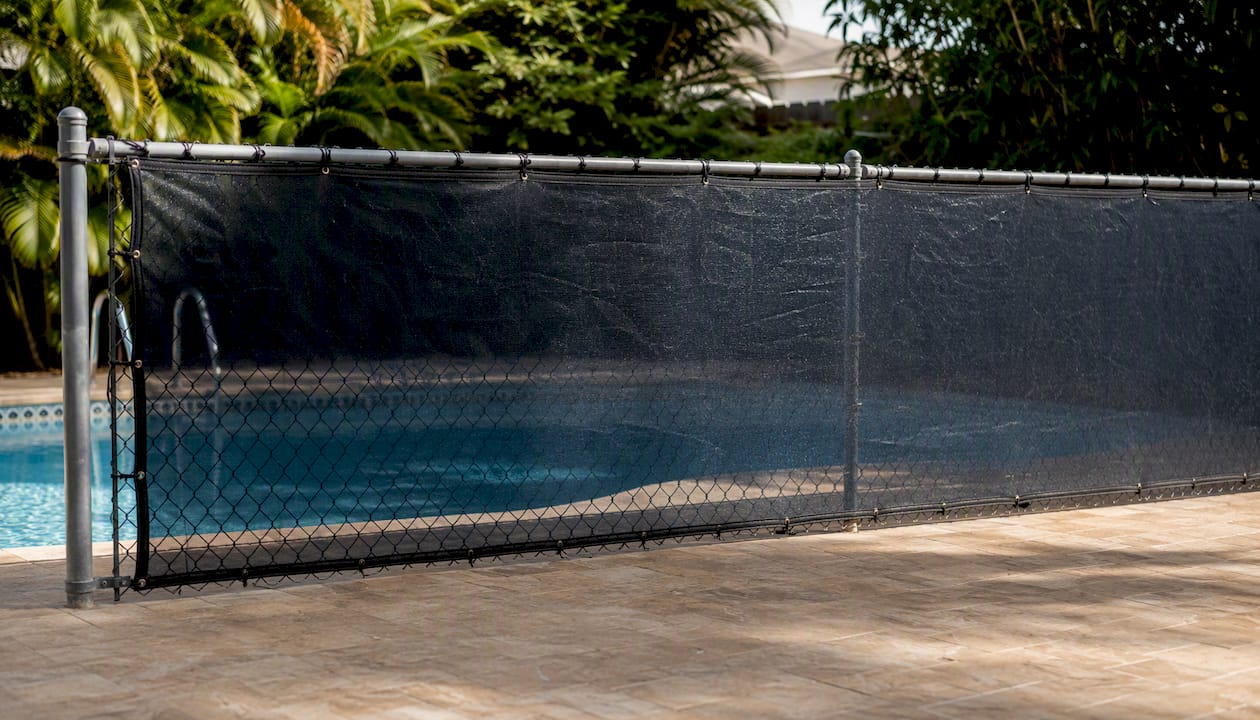
FenceScreen supplies a range of pool privacy fabrics, from breathable PVC mesh to commercial-grade vinyl that can block nearly all visibility. Custom sizing and rust-resistant grommets are standard, which matters in a salt-air or high-humidity environment where cheap hardware corrodes within a season.
Material types:
- Breathable PVC mesh windscreens: Allow some airflow, moderate privacy, lighter wind load
- Commercial-grade vinyl wraps: Near-total visual blockage, heavier, require stronger attachment hardware
- Slat inserts for chain-link: Individual slats thread through chain-link openings for a cleaner look and adjustable privacy level
Installation steps for a basic windscreen:
- Measure the fence or frame section accurately, accounting for post spacing.
- Order custom-cut fabric with reinforced grommets at regular intervals (typically every 12–18 inches).
- Attach using zip ties, bungee hooks, or stainless steel fasteners through the grommets.
- Tension the fabric evenly to prevent sagging and wind flutter.
- Inspect attachment points after the first major storm and re-tension as needed.
Commercial vinyl wraps increase wind load on the fence or frame, so if you're in a high-wind zone or hurricane-prone area, professional fastening and a wind-load assessment are worth the extra cost. Lighter PVC mesh is more forgiving and easier to remove before a storm.
Are retractable shades and outdoor curtains worth the investment?
Retractable systems give you something the fixed options can't: the ability to open the space fully when you want sun and breeze, then close it for privacy or shade in minutes. That flexibility has real value, especially for homeowners who use the pool area for entertaining.
Product families to consider:
- Outdoor curtain panels on tracks: Fabric panels that slide along a ceiling-mounted or wall-mounted track. Relatively affordable, easy to DIY with the right track hardware, and available in weather-resistant fabrics.
- Manual roller shades: Spring-loaded or crank-operated shades that roll up when not in use. Good for single openings up to about eight feet wide.
- Motorized roller systems: Remote or app-controlled, ideal for large openings or homeowners who want one-touch operation. Higher upfront cost but far more practical for openings wider than eight feet.
Installation considerations:
- The cage frame must have solid structural attachment points. Roller systems are heavier than curtain panels and need proper anchoring.
- Track-mounted curtains require periodic cleaning to prevent mold and mildew buildup in the track channel.
- Before hurricane season, retractable shades and curtain panels should come down or roll up fully. Leaving fabric exposed in high winds risks tearing the material and damaging the frame attachment.
Pro Tip: For openings wider than eight feet, go motorized. A manual crank on a large shade becomes a daily annoyance, and most homeowners stop using it within a few months. The motorized upgrade typically adds $200–$400 per panel but pays for itself in actual use.
Which decorative and landscape options complement a pool cage?
Not every privacy solution needs to be a screen or a panel. Design-first options work well when you want to soften the look of the enclosure, add greenery, or create privacy at the perimeter without altering the cage structure itself. For visual inspiration, Pinterest's pool cage privacy ideas shows a wide range of homeowner approaches, from shade sails to vertical planters.
Options worth considering:
- Powder-coated decorative panels: Metal panels with geometric or botanical cutout patterns attach to the lower cage frame or perimeter fence. They add privacy and visual interest without blocking all airflow.
- Wood or composite lattice: Classic look, works well for partial privacy. Composite holds up better than wood in Florida's humidity.
- Vertical planters and living walls: Mounted planter systems with trailing plants like pothos or ferns create a natural privacy screen. Requires regular watering and pruning.
- Privacy hedges and trees: Clusia, podocarpus, and viburnum are common choices in Central Florida. They grow dense enough to block views but need annual pruning to stay manageable.
The maintenance reality with plantings is worth stating plainly: hedges drop leaves and debris into the pool, which means more skimming. Fast-growing privacy trees planted too close to the cage can eventually push against the frame. Keep any planting at least three feet from the enclosure structure, and factor in a quarterly pruning schedule.
For more design ideas that pair well with privacy upgrades, the screen enclosure visual upgrade guide from Mrpoolscreen covers options that complement both new and restored enclosures.
How do you choose the right pool enclosure privacy solution?
The right choice depends on a handful of variables that are specific to your property, your HOA, and how you actually use the pool. Here's how to work through them.
Decision criteria:
- Privacy level needed: Do you need full day-and-night blockage, or is daytime privacy enough? Florida Glass for full blockage; solar mesh for daytime privacy with some nighttime transparency.
- Airflow priority: If the enclosure gets hot, avoid near-solid panels on all sides. Use Florida Glass on lower sections only, or choose high-density mesh over solid vinyl.
- HOA restrictions: Many Florida HOAs regulate visible changes to pool enclosures, including screen color, panel type, and added structures. Get written approval before ordering materials.
- Wind exposure: Homes on lakes, golf courses, or open lots face higher wind loads. Heavier vinyl wraps and solid panels require stronger hardware and may need a permit.
- Budget: Materials-only DIY is cheapest; professional installation with premium materials costs more but typically lasts longer and comes with a warranty.
- Permanent vs. removable: Retractable and curtain systems can be removed before storms. Fixed panels and mesh cannot.
Questions to ask any installer before signing:
- What specific material are you using, and can you provide the manufacturer's spec sheet?
- What is the warranty on materials, and what does it cover?
- How is the screen or panel attached to the frame, and what hardware do you use?
- How should I prepare the enclosure before a hurricane, and does your installation support that process?
- Do you carry liability insurance and a contractor's license in Florida?
- Can you provide references from similar jobs in the past 12 months?
Checking BBB listings for Florida screen repair contractors is a quick way to verify credentials and read customer reviews before committing.
The Central Florida privacy screen guide on the Mrpoolscreen blog also covers what to look for when hiring locally.
What should homeowners expect to pay and how long does installation take?
Costs vary significantly by material, linear footage, and whether you're doing a full re-screen or adding privacy panels to an existing structure.
Timeline expectations:
- Measurement and quote: Most installers schedule a site visit within one to two weeks. Get at least two quotes.
- Material lead time: Standard mesh and Florida Glass ship quickly. Custom-cut vinyl wraps or motorized systems may take two to four weeks.
- Installation: Most single-material jobs finish in one to three days. Full restoration projects with repainting, fastener replacement, and re-screening run two to five days.
- Seasonal demand: Spring and early summer are peak season in Central Florida. Scheduling in late fall or winter often means shorter wait times and sometimes better pricing.
Permits are typically required for structural changes to a pool enclosure but not for screen replacement. HOA approval, if required, should be secured before you order materials. Use the online pricing tool from Mrpoolscreen to get a ballpark estimate before your site visit.
How long do privacy screens last, and what does maintenance involve?
Maintenance checklist by material:
- Florida Glass / laminated panels: Rinse with a garden hose monthly to remove dirt and pollen. Inspect edges and seams annually for delamination. Check fasteners for rust every six months.
- Privacy/solar mesh: Brush off debris with a soft brush. Inspect for tears or loose spline after storms. Clean with mild soap and water once or twice a year.
- Vinyl windscreens: Check grommet attachment points after high winds. Wipe down with a damp cloth to prevent mildew. Replace UV-degraded fabric every five to eight years.
- Roller shades and curtains: Clean tracks and rollers every three to six months. Lubricate track hardware annually. Inspect fabric for UV fading and seam separation.
Lifespan expectations:
- Florida Glass: 10–12+ years with proper care
- Privacy/solar mesh: several years depending on UV exposure and storm frequency
- Vinyl windscreens: several years
- Retractable systems: 5–8 years for fabric; motors typically last longer with maintenance
- Decorative panels: 10–20+ years for powder-coated metal; 5–10 years for composite lattice
Pro Tip: Run a pool screen safety inspection every spring before peak storm season. Catching a corroded fastener or a loose spline early costs far less than emergency repairs after a storm.
Before making any visible change to your pool enclosure, check your homeowner's insurance policy and HOA covenants. Some policies require notification before structural modifications, and some HOAs restrict screen colors, panel types, or added structures. A quick call to your HOA management company and a review of your policy's "structures" section takes 30 minutes and can prevent a costly reversal.
When does restoration make more sense than buying new materials?
If your pool cage frame is structurally sound but the screen is torn, the paint is chalking, and the fasteners are rusting, a full rebuild is almost never the right answer. Restoration addresses all three problems at a fraction of the cost.
Mrpoolscreen's pool screen restoration service covers re-screening with privacy-grade or standard mesh, repainting the frame with water-based acrylic coatings that resist UV and humidity, and replacing corroded fasteners with stainless steel or Nylotech hardware. The result looks close to new and performs better than the original in most cases.
Restoration vs. rebuild: Mrpoolscreen reports that professional restoration can save homeowners a substantial portion of the total project cost compared to a full rebuild (company-reported). For a typical Central Florida pool cage showing rust, faded paint, and torn screen, that difference often runs into several thousand dollars.
A common scenario: a homeowner with a 15-year-old cage that's structurally intact but visually deteriorated. The frame passes inspection, but the screen is standard mesh with no privacy value, the paint is chalking, and several fasteners have rusted through. A full rebuild would run $15,000–$25,000 or more. A restoration with privacy mesh re-screening, fresh acrylic coating, and stainless fastener replacement comes in well under that, and the homeowner gets the privacy upgrade they wanted at the same time.
What HOA rules and local regulations apply to pool cage privacy changes?
Florida doesn't have a single statewide rule governing pool cage privacy modifications, but several layers of regulation can apply depending on where you live.
Most Florida municipalities require a building permit for structural changes to a pool enclosure, including adding solid panels or changing the frame. Screen replacement, including upgrading to privacy mesh or Florida Glass, typically falls under "like-for-like" replacement and may not require a permit, but this varies by county. Orange, Osceola, and Hillsborough counties each have their own thresholds, so confirm with your local building department before starting work.
HOA rules are often stricter than municipal codes. Common restrictions include approved screen colors (many HOAs require charcoal or black mesh), limits on solid panels visible from the street, and prohibitions on fabric curtains or windscreens on the exterior of the cage. Some HOAs require an architectural review committee (ARC) approval before any visible modification, with a review period of 30–60 days. Submit your material specs, color samples, and a simple diagram with your ARC application to avoid back-and-forth delays.
Homeowners in deed-restricted communities should also check whether privacy plantings along the pool perimeter are regulated. Some HOAs restrict hedge height or require specific plant species to maintain neighborhood aesthetics.
This is general information, not legal advice. Confirm current permit requirements with your local building department and review your HOA covenants before beginning any modification.
A practical take for Central Florida homeowners
Central Florida's combination of intense UV, high humidity, afternoon thunderstorms, and hurricane exposure changes the calculus on privacy materials in ways that matter. Fabric curtains that look great in a showroom can mildew within a season here. Cheap vinyl wraps with standard grommets corrode fast in salt-adjacent air. And any solid panel that increases wind load needs hardware rated for it.
For homeowners who want maximum privacy, Florida Glass on the lower sections with high-density solar mesh above is the combination that holds up best in this climate. It gives you ground-level visual blockage, keeps airflow in the upper cage, and uses materials designed for Florida's conditions.
For homeowners who want the best value, especially if the cage frame is sound but the screen and paint are failing, restoration with a privacy mesh re-screen is the most cost-efficient path. You get the privacy upgrade and a refreshed enclosure without paying for a new frame you don't need.
Mrpoolscreen handles restoration and re-screening for Central Florida homeowners
If your pool cage frame is structurally solid but the screen, paint, and fasteners have seen better days, a full rebuild is rarely the right call.
The process covers everything: frame repainting, corroded fastener replacement, and re-screening with the privacy material that fits your goals, whether that's Florida Glass, high-density solar mesh, or standard screen. Before and after photos in the project gallery show the difference a restoration makes on enclosures that most homeowners assumed needed full replacement.
Mrpoolscreen serves homeowners across Central Florida. To get a project estimate, visit the pool screen restoration page and request a quote directly.
Sources
- Metroscreenworks
- Privacy Panels | Fixed Pool Cage Privacy Screens for Florida | Florida Lanai Curtains
- Swimming Pool Privacy Screen & Windscreen
- Florida Glass Privacy Screen for Pool Enclosure, Lanai ...