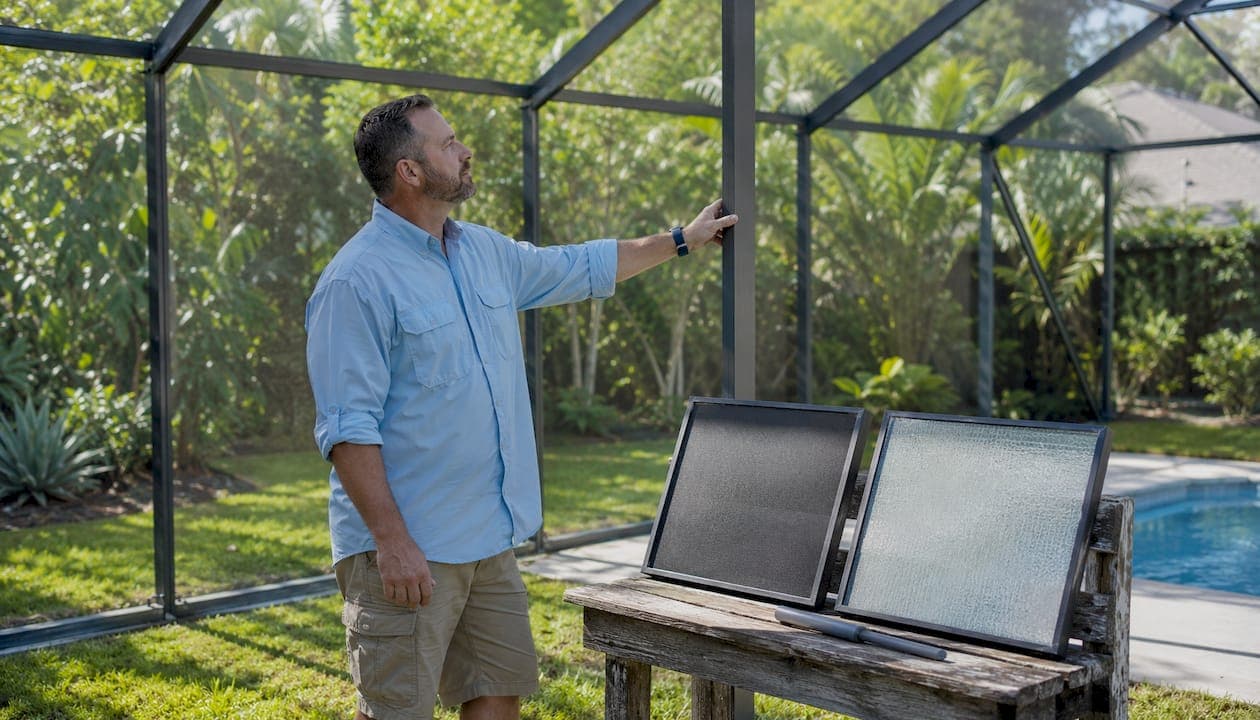
For most Central Florida homeowners, the best approach is a hybrid: fixed privacy mesh on the upper sections and Florida Glass laminated panels on the lower sections close to the ground, giving you daytime privacy and debris control without turning your enclosure into a sealed box.
Who should choose the hybrid:
- Homeowners with neighbors on one or two sides who want airflow preserved
- Anyone with an aging aluminum frame that hasn't been inspected recently
Who should go full Florida Glass:
- Homeowners on a corner lot with sightlines from multiple directions and a newer, structurally sound frame
Who benefits from adjustable options:
- Homeowners who want flexibility between open and private depending on the season or time of day
Your immediate next step: schedule a structural inspection before committing to any panel type, then view physical samples from Mrpoolscreen in both daytime and evening light.
Table of Contents
- What are the three main privacy screen options for a pool cage?
- How do Central Florida conditions affect which option lasts longest?
- What does a privacy screen installation typically cost in Central Florida?
- How do you choose the right privacy solution and contractor?
- How do you maintain privacy screens and prep for hurricane season?
- How Mrpoolscreen restores and installs privacy solutions
- Key Takeaways
- What actually drives the right privacy decision
- Ready to upgrade your pool cage privacy?
What are the three main privacy screen options for a pool cage?
Privacy solutions for pool cages fall into three categories: fixed privacy mesh, Florida Glass laminated panels, and adjustable systems.
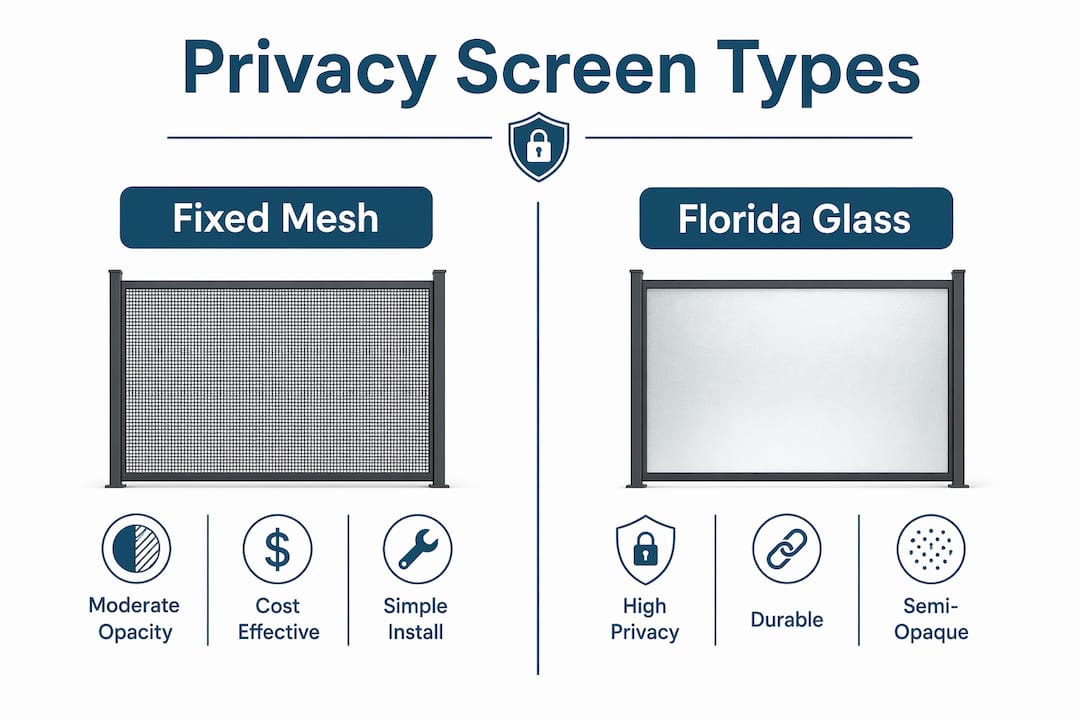
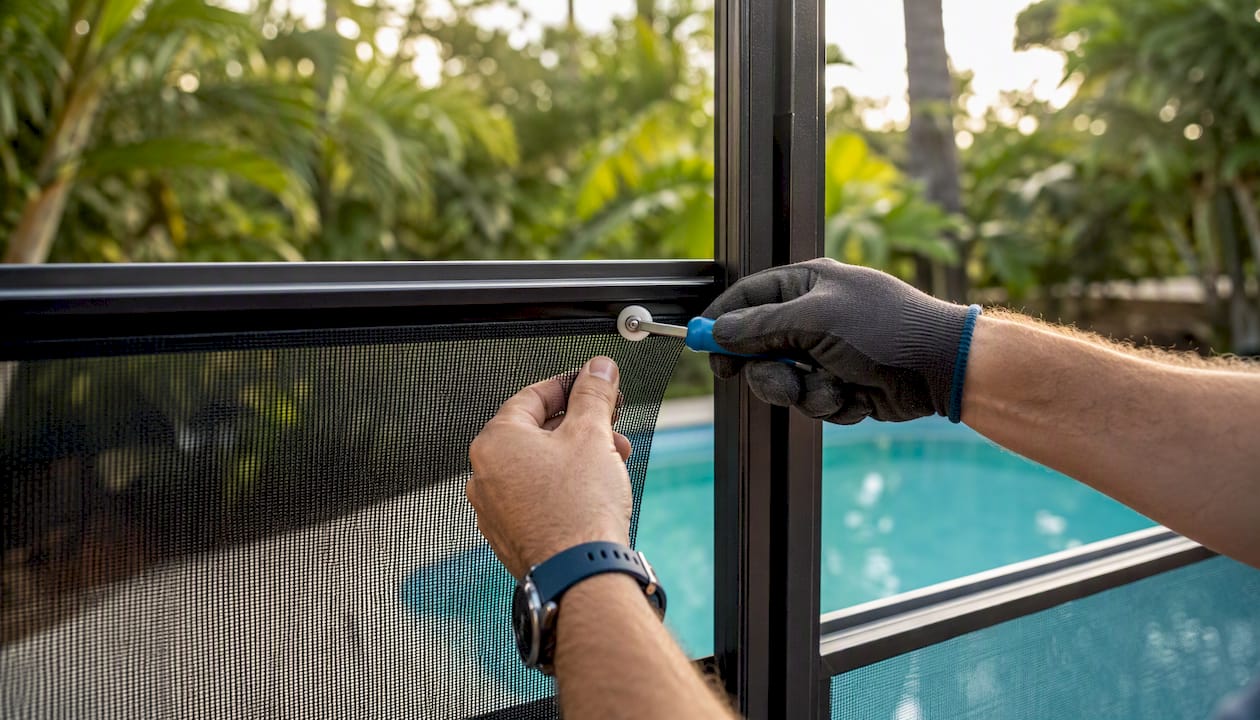
Fixed privacy mesh attaches directly to the existing frame using the same spline channels as standard screen. Tighter weaves and darker colors block a significant portion of direct sunlight while still allowing airflow and outward views. No moving parts, no tracks, no motors. Manufacturers like Phifer offer specialized meshes such as TuffScreen and Glas-Shield, each with different durability ratings and warranty terms.
Florida Glass is a laminated, semi-opaque panel that installs like screen but behaves more like a flexible solid surface. It blocks rain, grass clippings, and wind-driven debris at the base of the enclosure. The trade-off: it reduces ventilation noticeably and can become less private at night when interior lights are brighter than the outside. For a full explainer, the Florida Glass homeowner's guide covers the material in detail.
Adjustable options include manual curtains, retractable roller shades, and motorized outdoor blinds that integrate cleanly into large openings. They offer the most flexibility but add mechanical complexity and higher replacement costs over time.
A hybrid layout makes sense when you want the debris-blocking benefit of Florida Glass at ground level without sacrificing the ventilation that mesh provides above. Selective Florida Glass installation on lower panels or a single privacy wall is the most common pattern installers recommend.
| Dimension | Privacy Mesh | Florida Glass | Adjustable/Motorized |
|---|---|---|---|
| Privacy (opacity) | Moderate–High (daytime) | High (daytime), lower at night | Variable |
| Airflow | Good | Reduced | Variable |
| Weather/debris protection | Moderate | Strong | Moderate–Strong |
| Florida durability | High (UV-rated mesh) | High (with proper frame) | Moderate (motor wear) |
| Maintenance level | Low | Low–Moderate | Moderate–High |
| Typical cost shape | Lowest | Mid-range | Highest |
| Installation complexity | Low | Moderate | High |
Pro Tip: Always request a physical sample panel and prop it up in your enclosure at night with your normal interior lights on. What looks opaque at noon can reveal silhouettes at 9 PM.
How do Central Florida conditions affect which option lasts longest?
Salt air, UV intensity, and hurricane-season wind loads separate a good installation from one that fails in three years.
- Salt-air corrosion: Standard steel fasteners rust visibly within one to two seasons near the coast or in humid inland areas. Stainless steel or Nylotech hardware is the minimum standard for any retrofit on an aging aluminum frame.
- Wind loading: Florida Glass increases the effective wind sail area of your enclosure. Installing it across large sections without first inspecting frame joints and fasteners is how enclosures fail in a tropical storm.
- UV and color fade: Darker privacy meshes absorb more UV and can fade faster than lighter weaves. Specify UV-stabilized materials and confirm the manufacturer's warranty covers color retention.
- Mildew and pollen: Central Florida's humidity means mesh panels need periodic rinsing to prevent mildew buildup, especially after pollen season in spring.
- Nighttime privacy: Dense mesh and Florida Glass both scatter light well during the day. After dark, bright interior fixtures can backlight silhouettes through any screen material. Dimmable or indirect lighting inside the enclosure solves this without changing your panels.
Pro Tip: Before any panel installation on a cage older than 10 years, run through the pool screen safety inspection checklist — it flags corroded joints and loose spline channels that would fail under added panel weight.
What does a privacy screen installation typically cost in Central Florida?
| Option | Typical Material + Labor Range | Timeline |
|---|---|---|
| Privacy mesh (re-screen) | — | 1 day |
| Florida Glass panels (partial) | — | 1–2 days |
| Full Florida Glass enclosure | — | 2–4 days |
| Motorized/retractable system | — | 2–5 days |
Restoration before installation, meaning frame repainting with water-based acrylic coatings and hardware replacement, typically adds $500–$2,000 depending on the cage's condition. Mrpoolscreen's restoration approach can save homeowners up to 60% compared to a full frame rebuild, which makes it worth pricing before assuming a full replacement is necessary.
Factors that push costs higher:
- Structural repairs to bent or corroded frame sections
- Upgrading all fasteners to stainless steel or Nylotech
- Custom-sized panels for non-standard bay widths
- Local permits, which some Central Florida municipalities require for enclosure modifications
How do you choose the right privacy solution and contractor?
Start with structure, not samples. A frame that's corroded or has loose joints will fail under added panel weight regardless of which material you choose.
Step-by-step decision checklist:
- Get a structural inspection before requesting any quotes.
- View physical samples in your enclosure in both daytime and evening light.
- Decide on a hybrid or single-material plan based on your sightlines and airflow priorities.
- Get at least two written quotes that specify hardware materials and warranty terms.
- Confirm the contractor has photos of similar local jobs.
Questions to ask every contractor:
- Will you inspect the frame before quoting, or quote from photos?
- What fastener material do you use: stainless steel, Nylotech, or standard galvanized?
- What's the warranty on materials and labor?
- Do you handle cleanup and debris removal?
- Can you show me completed projects in Central Florida?
Red flags to walk away from:
- No structural inspection offered before the quote
- Refusal to use stainless or Nylotech hardware on an aging frame
- A full-enclosure Florida Glass quote with no discussion of airflow, wind load, or lighting trade-offs
DIY vs. hire a pro: Re-screening with standard mesh on a sound frame is a manageable DIY project for a handy homeowner. Florida Glass panel installation, frame repainting with water-based acrylics, and any work involving structural repairs or hardware replacement should go to a restoration contractor. The pool cage maintenance vs. repair guide helps clarify where that line sits for your specific situation.
How do you maintain privacy screens and prep for hurricane season?
Maintenance is straightforward but skipping it shortens panel life significantly in Florida's climate.
Monthly: Rinse mesh panels with a garden hose to clear pollen, mildew, and debris. Check spline channels for loosening.
Quarterly: Inspect frame joints and fasteners for rust streaks or corrosion. Wipe down Florida Glass panels with mild soap and water; check edge seals for gaps. Clean tracks on any motorized or retractable systems.
Yearly: Full pool cage upkeep inspection covering frame integrity, hardware condition, and panel tension.
Pre-hurricane season (May–June):
- Inspect all fasteners and tighten or replace any that show corrosion.
- Remove or retract motorized panels if the system allows it.
- Check that Florida Glass panels are seated firmly in their spline channels.
- Secure any loose curtain hardware or track brackets.
Post-storm:
- Walk the perimeter and check for bent frame sections before re-entering the enclosure.
- Inspect spline channels for pulled-out mesh and replace any torn panels promptly to prevent further frame stress.
Pro Tip: Salt-air corrosion accelerates after storm flooding. If your property is within 10 miles of the coast, rinse all hardware with fresh water within 48 hours of a storm.
How Mrpoolscreen restores and installs privacy solutions
Mrpoolscreen follows a five-step process on every restoration job:
- Structural inspection — assess frame condition, fastener corrosion, and spline channel integrity using the safety inspection checklist.
- Hardware replacement — swap corroded fasteners for stainless steel or Nylotech hardware throughout the frame.
- Frame repainting — apply water-based acrylic coatings to cleaned and prepped aluminum surfaces for UV and corrosion resistance.
- Privacy solution installation — install the chosen mesh type, Florida Glass panels, or adjustable system based on the homeowner's sightline and airflow priorities.
- Final inspection — verify panel tension, spline seating, hardware torque, and overall appearance before sign-off.
Materials matter here. Water-based acrylic coatings bond well to aluminum and resist Florida's UV without the VOC concerns of solvent-based paints. Stainless steel fasteners eliminate the rust streaking that ages an enclosure visually within a few seasons.
Restoration before new panel installation is almost always the right sequence. A fresh privacy screen installed on a corroded, unpainted frame looks good for one season. The same screen on a properly restored frame lasts a decade.
Browse the project gallery for before-and-after photos of completed Central Florida restorations. Every quote includes a written scope, material specifications, and a project timeline.
Key Takeaways
For most Central Florida pool cages, a hybrid of fixed privacy mesh and selective Florida Glass panels delivers the best balance of privacy, airflow, and durability, especially when paired with a proper structural restoration before installation.
| Point | Details |
|---|---|
| Hybrid is the default | Privacy mesh on upper sections plus Florida Glass on lower panels suits most Central Florida sightlines. |
| Inspect before you install | Any cage older than 10 years needs a structural check before adding heavier panels. |
| Hardware matters | Stainless steel or Nylotech fasteners prevent rust streaking and extend panel life in Florida's climate. |
| Budget realistically | Privacy mesh re-screening and partial Florida Glass installation costs vary depending on size and other factors. |
| Mrpoolscreen's restoration approach | Restoring the frame first with water-based acrylics and stainless hardware can significantly reduce costs compared to a full rebuild. |
What actually drives the right privacy decision
Most homeowners come to this decision thinking about what they want to block. The smarter question is what they want to keep: airflow, natural light, the open feel of a screened enclosure. Full Florida Glass on every panel solves the privacy problem and creates three new ones: heat buildup, reduced breeze, and a frame under more wind stress than it was designed for.
The hybrid approach isn't a compromise. It's the configuration that experienced installers actually recommend once they've seen how Central Florida homeowners use their pools. Privacy mesh handles the sightlines. Florida Glass handles the debris and splash zone at the base. The enclosure still breathes.
What gets skipped too often is the frame condition. Installing any privacy upgrade on a cage with corroded fasteners and unpainted aluminum is building on a weak foundation. The restoration step isn't optional for aging enclosures — it's what makes the privacy upgrade last.
Browse the Mrpoolscreen project gallery to see what a properly restored enclosure looks like before and after a privacy upgrade, then request a sample viewing.
Ready to upgrade your pool cage privacy?
Mrpoolscreen handles the full sequence Central Florida homeowners actually need: structural restoration first, then the right privacy solution for your specific sightlines and frame condition. That's the difference between a privacy upgrade that lasts a decade and one that looks tired in two seasons.
Services include pool screen restoration, hardware replacement with stainless steel or Nylotech fasteners, re-screening with privacy mesh or Florida Glass, and pool deck staining for homeowners bundling deck work with their enclosure upgrade.
What to expect on an inspection:
- Full structural assessment of frame, joints, and fasteners
- Physical sample demo of mesh and panel options in your actual enclosure
- Written estimate with material specs and timeline
- No-pressure quote, completed in a single visit
Request a restoration quote and get your enclosure assessed before hurricane season.
Sources and further reading
- Privacy Panels for Pool Cages — Florida Lanai Curtains
- Florida Glass Screen Reviews — InAirSpace
- Florida Glass Screen — Metro Screen Works
- Pool and Patio Screening Styles — Phifer
- Pool Screen Restoration — Mrpoolscreen
- Project Gallery — Mrpoolscreen
- Pool Screen Safety Inspection Checklist — Mrpoolscreen Blog
- What Is Florida Glass? — Mrpoolscreen Blog