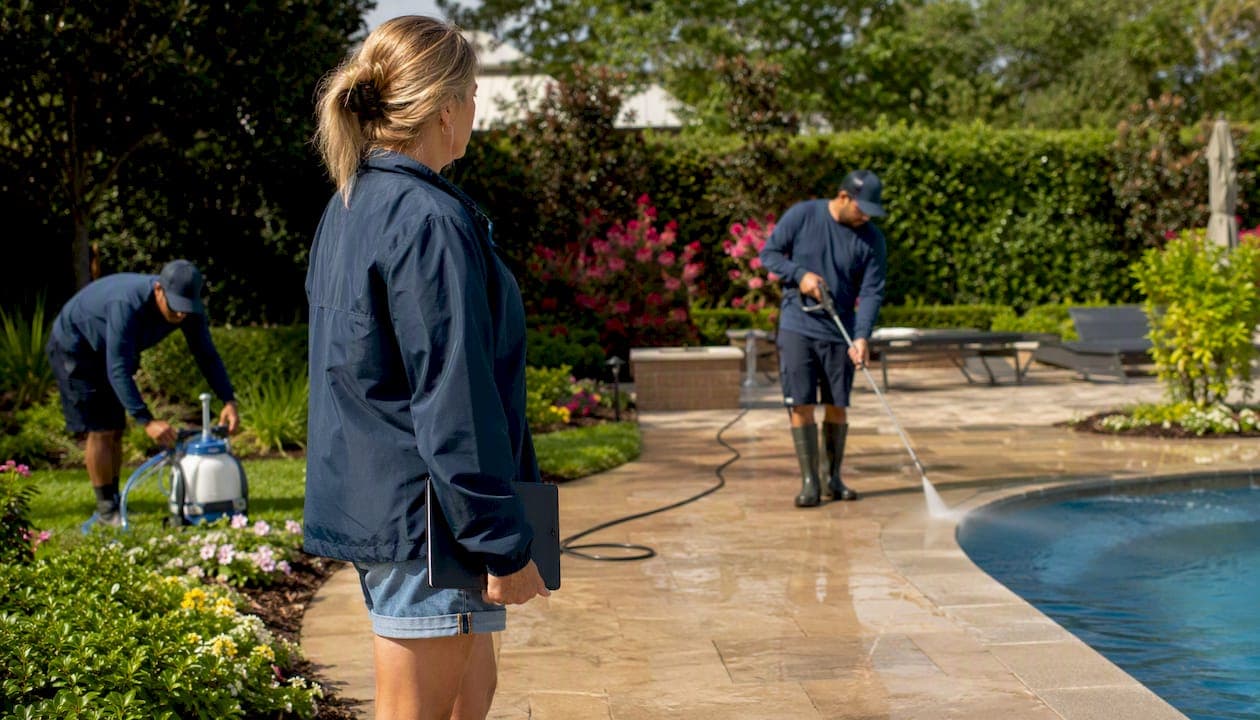
Use soft wash for roofs, siding, pool screens, and painted surfaces. Use pressure wash for concrete, pavers, and heavily soiled hardscapes. That's the short answer, and getting it backwards can void your roof warranty, tear your pool screens, or drive moisture into your walls.
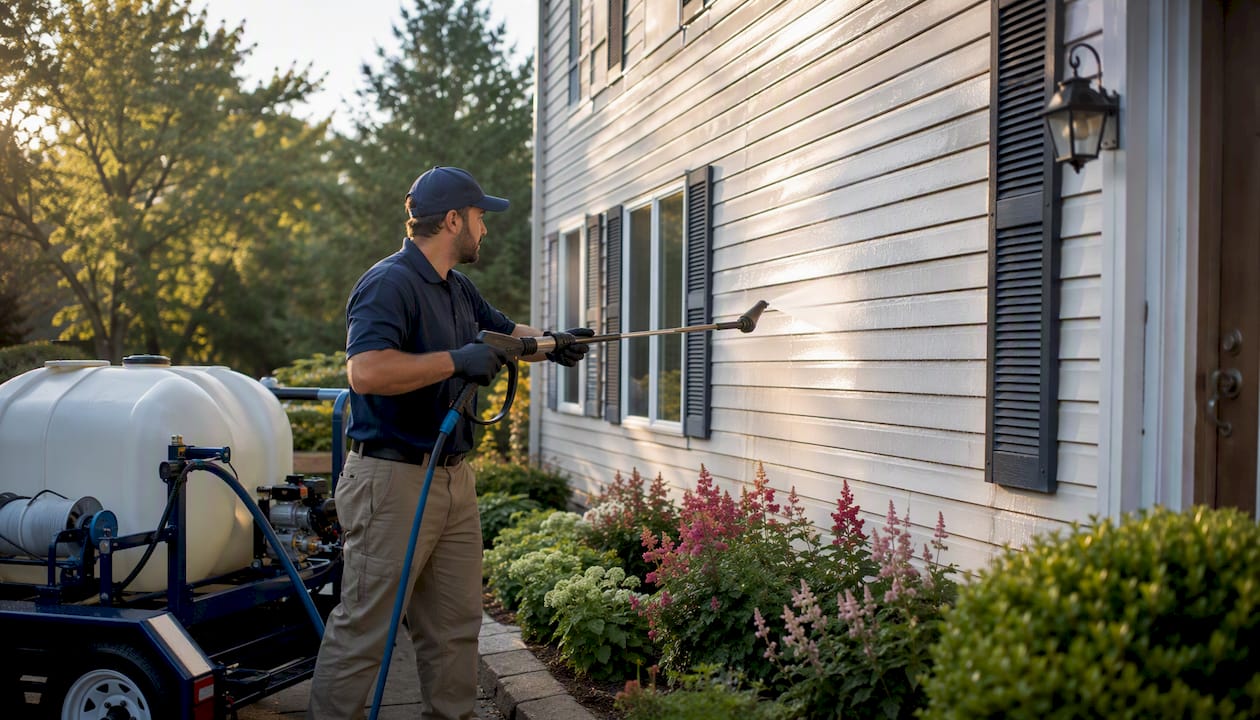
The difference comes down to mechanism. Soft washing relies on chemistry — low pressure plus biodegradable solutions like sodium hypochlorite and surfactant — to kill biological growth at the root. Pressure washing uses mechanical force, high-velocity water, to blast off inorganic grime. Neither method is universally better. They solve different problems.
For most Central Florida properties, the right strategy uses both:
- Soft wash the house exterior, roof, and pool enclosure (biological stains, algae, mildew)
- Pressure wash the driveway, sidewalks, and pool deck (embedded dirt, oil, hard-surface grime)
- Sequence matters: soft wash first, then pressure wash adjacent hardscapes to avoid chemical splash on freshly cleaned concrete
Pro Tip: Always soft wash before pressure washing on the same property visit. Rinsing soft-wash runoff off hardscapes is much easier than trying to re-clean chemical residue from a freshly pressure-washed driveway.
Table of Contents
- How soft washing actually works
- What pressure washing does (and where it belongs)
- Soft wash vs pressure wash: side-by-side comparison
- Which method does each surface actually need?
- What does each method cost, and how often do you need it?
- DIY or hire a pro? What you need to know before deciding
- When cleaning isn't enough: pool enclosure and deck restoration
- Key Takeaways
- The surface-first approach is the only one that holds up
- Mrpoolscreen handles what a wash can't fix
- Useful sources
How soft washing actually works
Soft washing is low-pressure cleaning that lets chemistry do the heavy lifting. A typical soft-wash rig operates at under 500 PSI, and for roof and siding work, pressure often drops below 100 PSI — barely more than a garden hose. The cleaning agent does the real work.
The standard chemical mix is sodium hypochlorite (bleach) diluted to a working concentration, combined with a surfactant that helps the solution cling to vertical surfaces and penetrate biofilm. Some operators add a neutralizer or odor-masking agent. The solution dwells on the surface for several minutes, killing algae, mold, mildew, and lichen at the cellular level rather than just scrubbing them off the top.
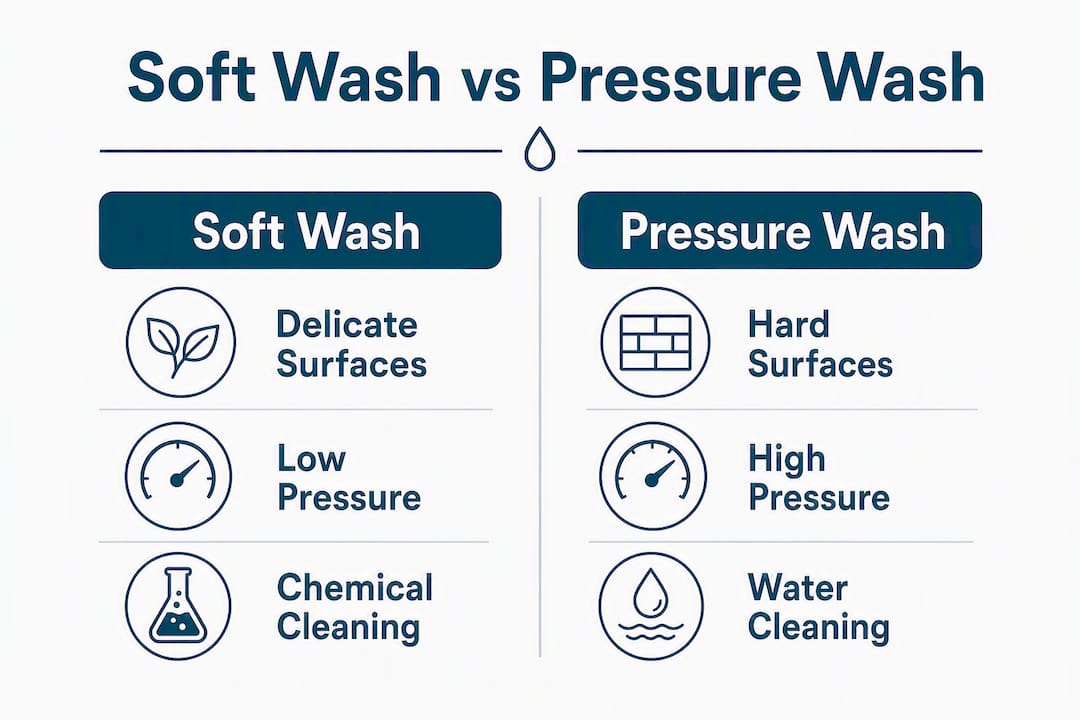
That distinction matters for longevity. Pressure washing removes what you can see. Soft washing kills the organism and its root structure, which is why industry reporting puts soft wash results at 1–3 years on siding and 2–5 years on roofs — often three to six times longer than a pressure wash on the same surface. On concrete, pressure washing is generally effective for 12–18 months before re-soiling becomes noticeable.
Key equipment and application methods:
- 12V pump systems for dedicated soft-wash rigs (high volume, low pressure)
- Downstream chemical injection through a pressure-wash trailer with a black/soap nozzle — a common dual-use setup
- Surface-appropriate dilution rates — roof mix is typically stronger than siding mix because shingles can tolerate it and the growth is more entrenched
Pro Tip: Ask any soft-wash contractor what concentration they use on roofs versus siding. A pro who gives you a specific answer (e.g., 3–6% SH for roofs, 1–2% for vinyl siding) knows what they're doing. A vague answer is a red flag.
Runoff control is non-negotiable. Reputable operators pre-rinse all landscaping before applying chemistry, protect water features and pool systems, allow proper dwell time, then rinse thoroughly. Sodium hypochlorite at working concentrations is safe for most plants when diluted by rinsing — but skipping the pre-rinse step burns foliage.
What pressure washing does (and where it belongs)
Pressure washing uses water velocity — not chemistry — to remove contaminants. A residential pressure washer typically runs 1,500–4,000 PSI, and commercial units go higher. The force strips dirt, oil, gum, algae, and embedded debris from surfaces hard enough to take it.
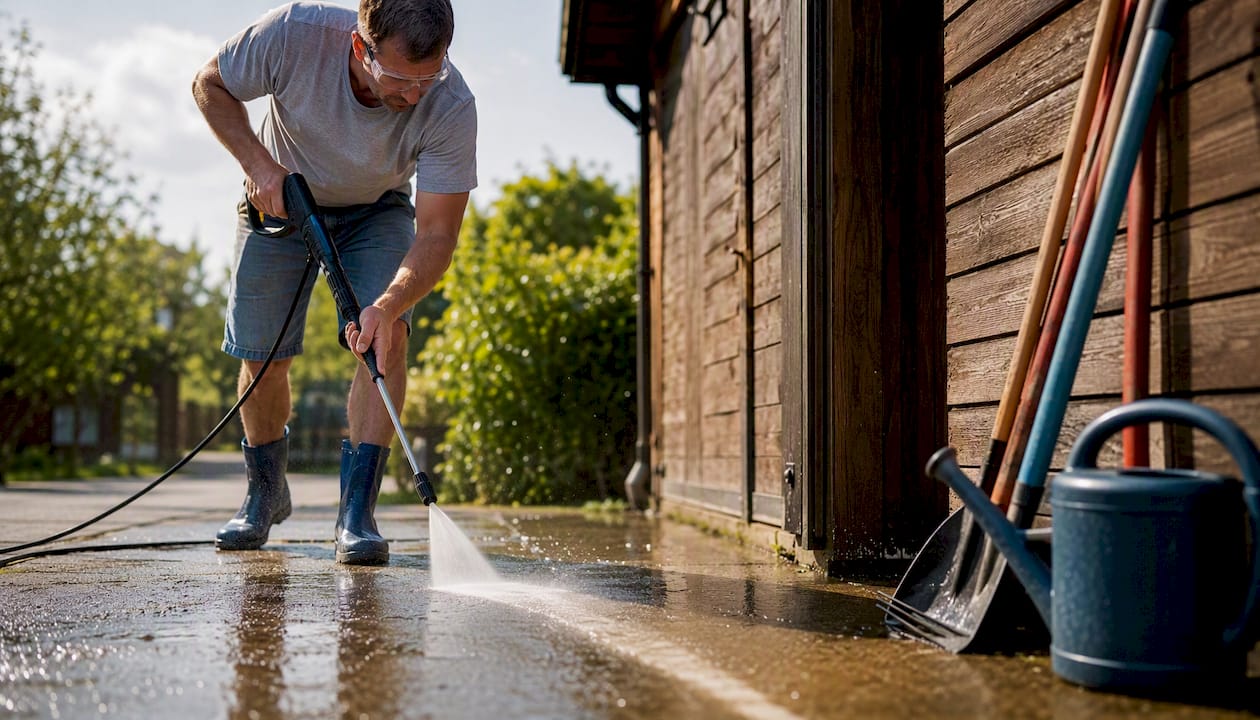
That hardness threshold is the key qualifier. Concrete, brick pavers, clay tile, and asphalt can handle the force. Asphalt shingles, vinyl siding, wood siding, aluminum screen frames, and painted surfaces cannot — at least not without real risk of damage.
Common residential pressure-wash applications:
- Concrete driveways and sidewalks — removes tire marks, oil stains, and ground-in dirt
- Brick and concrete pavers — clears moss and grime without chemical soak time
- Pool decks (concrete or masonry) — effective for surface-level algae and staining before resealing
- Fences and decks (wood) — possible at low PSI with wide nozzle, but soft wash is often safer
- Fleet vehicles and equipment — high PSI cuts grease and road grime fast
Pressure wash maintenance on concrete typically stays effective for 12–18 months in most U.S. climates before noticeable re-soiling. That's a shorter interval than soft wash on biological surfaces, but concrete doesn't harbor living organisms the same way a roof does.
Technique matters. Operator guidance recommends starting at 18–24 inches of standoff distance and using 25° or 40° nozzles on most surfaces. A 0° nozzle concentrates force into a pinpoint stream that can gouge soft concrete, strip paint, or cut right through screen mesh. A surface-cleaner attachment — a spinning bar with two nozzles — is the right tool for flat hardscapes because it produces even, streak-free results that a single wand cannot match.
Soft wash vs pressure wash: side-by-side comparison
| Dimension | Soft Wash | Pressure Wash |
|---|---|---|
| Best for (surfaces) | Roofs, siding, stucco, pool screens, painted wood | Concrete, pavers, brick, masonry, pool decks |
| Typical PSI / GPM | Under 500 PSI (often under 100 PSI) / 4 GPM | 1,500–4,000 PSI / 2–4 GPM |
| Cleaning mechanism | Chemistry kills biological growth | Mechanical force removes inorganic debris |
| Pros | Kills growth at root; longer-lasting results; safe for delicate surfaces | Fast on hard surfaces; no chemical dwell time; effective on oil and grease |
| Cons / damage risk | Chemical handling required; runoff control needed; higher upfront cost | Strips roof granules; tears screens; forces water behind siding; streaks on vertical surfaces |
| Typical cost range | Higher per job (chemistry + skill); ~$0.35–$0.40/sqft for siding (regional variance applies) | Lower per job on simple surfaces; varies by area and scope |
| Recommended frequency | Roofs: every 2–5 years; siding: every 1–3 years | Concrete/pavers: every 12–18 months |
The biggest safety gaps: pressure washing an asphalt shingle roof strips the protective granules and voids most manufacturer warranties. High pressure on pool screens tears mesh and etches aluminum framing. On vertical siding, forcing water at high PSI behind panels creates hidden moisture damage inside wall cavities — a repair bill that dwarfs the cost of a proper soft wash.
Which method does each surface actually need?
Roofs (asphalt shingle, tile, metal)
Soft wash only. The Asphalt Roofing Manufacturers Association and most shingle manufacturers explicitly prohibit high-pressure washing because it strips granules and voids warranties. A sodium hypochlorite solution kills the black streaks (Gloeocapsa magma algae) and lichen without touching the granule layer.
Vinyl and wood siding
Soft wash is the standard. High pressure forces water behind panels and into wall cavities. Wood siding at low PSI with a wide nozzle is possible, but soft wash chemistry handles mildew more thoroughly and won't raise the grain.
Stucco
Soft wash. Stucco is porous and brittle at the surface. High pressure chips the finish and drives moisture into the substrate.
Concrete driveways and sidewalks
Pressure wash. This is where high PSI earns its keep. A surface-cleaner attachment at 2,500–3,000 PSI removes years of embedded grime efficiently.
Brick and concrete pavers
Pressure wash at moderate PSI (1,500–2,500). Avoid disturbing the sand joints between pavers — keep standoff distance and use a 40° nozzle or surface cleaner.
Wood decks
Low-PSI pressure wash (600–1,200 PSI) or soft wash, depending on the condition. Soft wash handles mildew and algae; a light pressure wash preps the surface before staining or sealing. Never exceed 1,200 PSI on wood — it raises the grain and splinters the surface.
Pool screens and aluminum enclosures
Soft wash only. High pressure causes screen tearing, loosens tension, and etches aluminum framing — especially in humid, salt-air environments like Central Florida. A gentle soft-wash rinse with appropriate chemistry handles mildew and algae without structural risk. For ongoing care, the pool screen mildew stain removal guide covers step-by-step treatment.
Solar panels
Low-pressure rinse or soft wash at very low concentration. Abrasive force scratches the glass coating and reduces efficiency. Check the panel manufacturer's cleaning guidelines before applying any chemistry.
Pool decks (concrete or masonry)
Pressure wash for surface cleaning, soft wash if biological growth (algae, mildew) is the primary issue. Sequence: soft wash the enclosure first, let it rinse, then pressure wash the deck.
Pro Tip: On a mixed-surface property, map out your cleaning sequence before you start. Soft wash the house and enclosure, let runoff drain away from hardscapes, then pressure wash the driveway and pool deck. Reversing the order means chemical splash on freshly cleaned concrete.
| Surface | Recommended Method | Key Risk if Wrong Method |
|---|---|---|
| Asphalt shingle roof | Soft wash | Granule loss, voided warranty |
| Vinyl / wood siding | Soft wash | Water intrusion, paint damage |
| Pool screen / aluminum frame | Soft wash | Screen tears, frame etching |
| Concrete driveway | Pressure wash | None (correct tool) |
| Brick / concrete pavers | Pressure wash | Sand joint disruption at high PSI |
| Wood deck | Low-PSI or soft wash | Grain raising, splintering |
| Solar panels | Low-pressure rinse | Coating scratches |
What does each method cost, and how often do you need it?
Soft washing typically costs more per visit than a basic pressure wash because of chemical costs and the skill required to mix and apply solutions safely. Siding soft wash starts around $0.35–$0.40 per square foot in some markets, though regional variance is significant — Florida and the Southeast tend to run higher due to climate-driven biological growth. Always get a written estimate.
The cost-per-year math often favors soft wash on delicate surfaces. A roof soft wash that lasts 2–5 years beats two or three pressure-wash attempts that damage shingles and require re-treatment every 12–18 months.
| Surface | Method | Typical Frequency | Approx. Longevity |
|---|---|---|---|
| Asphalt shingle roof | Soft wash | Every 2–5 years | 2–5 years |
| Vinyl siding | Soft wash | Every 1–3 years | 1–3 years |
| Pool screen enclosure | Soft wash | Every 1–2 years | 1–2 years |
| Concrete driveway | Pressure wash | Every 12–18 months | 12–18 months |
| Wood deck | Low-PSI / soft wash | Annually or before resealing | 1 year |
| Brick pavers | Pressure wash | Every 12–18 months | 12–18 months |
Soft wash results last three to six times longer than pressure washing on biological surfaces like roofs and siding, which is why the upfront premium usually pays off over a two-to-five-year maintenance window. For concrete and pavers, expect pressure washing to remain effective for 12–18 months in most climates.
DIY or hire a pro? What you need to know before deciding
Some pressure-wash jobs are genuinely DIY-friendly. Renting a 2,000 PSI electric pressure washer to clean a concrete driveway or sidewalk is low-risk if you follow basic technique. Anything involving a roof, a ladder above one story, chemical mixing, or a pool enclosure is a different conversation.
When to hire a pro:
- Any roof cleaning (fall risk plus warranty implications)
- Pool screen enclosures (wrong pressure destroys screens)
- Chemical soft-wash applications (dilution errors damage plants and surfaces)
- Two-story or higher siding work
- Any surface where you're unsure of the PSI threshold
Questions to ask a contractor before hiring:
- Are you licensed and insured for exterior cleaning in Florida?
- Do you carry general liability and workers' comp?
- What chemicals do you use, and at what concentrations?
- How do you protect landscaping, pool systems, and electrical fixtures?
- Do you use dedicated soft-wash equipment or downstream injection?
- Can you provide references for roof or enclosure work specifically?
- Do you offer a written estimate and a service warranty?
Red flags to walk away from:
- Offering to pressure wash your roof (automatic no)
- No pre-rinse of landscaping before chemical application
- Vague answers about chemical mix or disposal
- No written estimate or proof of insurance
- Using a 0° nozzle on any residential surface
Pro Tip: A properly specced pressure-wash trailer with downstream injection can run both methods, but high-volume roof work typically requires a dedicated 12V soft-wash pump. Ask which setup the contractor uses for your specific job.
For pool enclosure work specifically, review the pool enclosure safety inspection checklist before any contractor arrives — it helps you spot structural issues that need repair, not just cleaning.
When cleaning isn't enough: pool enclosure and deck restoration
Soft washing and pressure washing clean surfaces. They don't fix them. If your pool enclosure has rusted fasteners, torn screens, flaking frame paint, or structural corrosion, cleaning will make it look temporarily better and nothing more.
Signs that restoration is the right call, not just a wash:
| Problem | Cleaning fixes it? | What actually fixes it |
|---|---|---|
| Algae and mildew on screens | Yes | Soft wash |
| Rust stains on aluminum frame | Partially (surface only) | Fastener replacement + recoating |
| Torn or sagging screen mesh | No | Re-screening |
| Flaking or chalking frame paint | No | Water-based acrylic recoating |
| Rusted fasteners / screws | No | Stainless steel or Nylotech hardware replacement |
| Weathered or stained pool deck | Partially | Deck staining or resurfacing |
Restoration addresses the underlying material failure. Replacing rusted fasteners with stainless steel hardware stops the rust cycle at the source. Recoating aluminum frames with a water-based acrylic coating restores the protective barrier that weather strips away. Re-screening with quality mesh brings the enclosure back to full function.
Restoration can cost 40–60% less than a full pool enclosure rebuild — and with the right materials, the results last years longer than a basic repaint.
The aging pool enclosure repair checklist walks through exactly which signs indicate repair versus full replacement, which is worth reviewing before you get any contractor estimate.
Pro Tip: If you're scheduling a soft wash for your pool enclosure, have a restoration contractor inspect the frame and fasteners at the same visit. Catching rust early costs far less than addressing structural failure after it spreads.
Key Takeaways
Soft wash kills biological growth at the root and protects delicate surfaces; pressure wash removes inorganic grime from hard surfaces — using the wrong method on the wrong surface causes damage that costs more to fix than the cleaning saved.
| Point | Details |
|---|---|
| Match method to surface | Soft wash for roofs, siding, and pool screens; pressure wash for concrete, pavers, and masonry. |
| Soft wash lasts longer | Results on roofs last 2–5 years; siding 1–3 years — three to six times longer than pressure washing on biological surfaces. On concrete and pavers, pressure washing is typically effective for 12–18 months before re-soiling. |
| Roof warranty risk | Pressure washing asphalt shingles strips granules and voids most manufacturer warranties; always use soft wash. |
| Sequence on mixed properties | Soft wash the house and enclosure first, let runoff clear, then pressure wash driveways and decks. |
| Mrpoolscreen restoration | When cleaning reveals rust, torn screens, or flaking coatings, Mrpoolscreen's pool enclosure restoration addresses the underlying damage at up to 60% less than a full rebuild. |
The surface-first approach is the only one that holds up
Most homeowners think about cleaning as a single category. It isn't. The surface you're cleaning determines everything — the pressure, the chemistry, the frequency, and whether you need a contractor with specialized equipment or just a weekend afternoon.
What gets overlooked most often is the downstream cost of the wrong method. Pressure washing a roof once to save $200 on a soft-wash quote can strip granules, trigger a warranty claim, and accelerate shingle degradation by years. Pressure washing a pool enclosure to "save time" tears screens and etches aluminum that costs real money to restore. The savings are illusory.
The mixed-method approach — soft wash for biological surfaces, pressure wash for hard hardscapes, on a staggered schedule — is how professional exterior maintenance actually works. It's not about picking a favorite method. It's about reading the surface and choosing accordingly.
For pool enclosures specifically, cleaning is often just the starting point. Frames corrode, fasteners rust, screens tear, and coatings fail. A clean enclosure that's structurally compromised is still a problem. That's where restoration comes in, and it's worth knowing the difference before you schedule any service.
Mrpoolscreen handles what a wash can't fix
When a soft wash reveals rust, flaking paint, or torn screens on your pool enclosure, cleaning was never going to be enough. Mrpoolscreen specializes in pool enclosure restoration for Central Florida homeowners — repainting aluminum frames with water-based acrylic coatings, replacing rusted fasteners with stainless steel or Nylotech hardware, re-screening with quality mesh, and refinishing pool decks in concrete, wood, masonry, and stone.
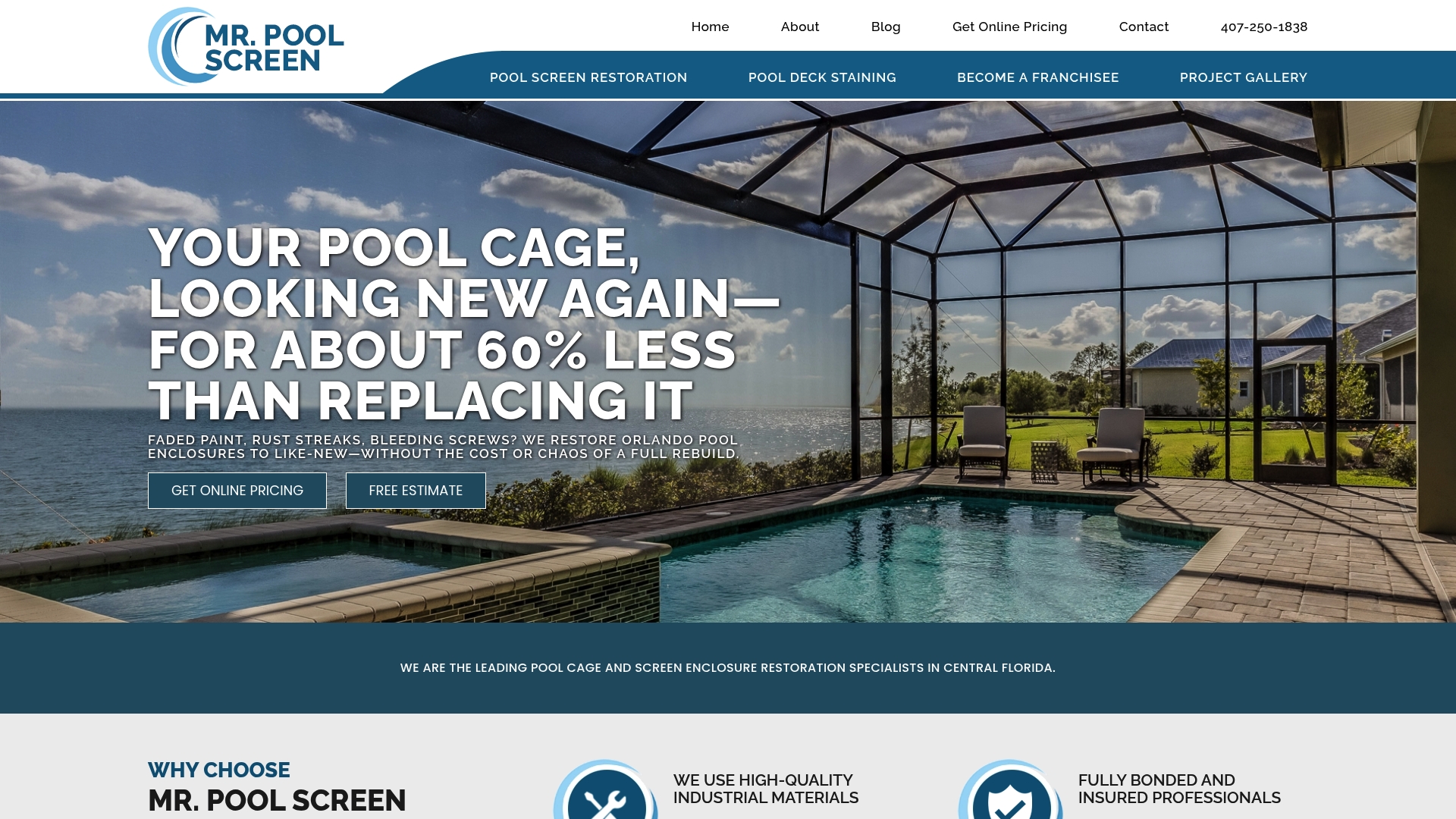
The typical restoration costs 40–60% less than a full enclosure rebuild, and the upgraded materials hold up longer than the originals. If your enclosure is showing rust, chalking paint, or sagging screens, a restoration assessment is the logical next step before those issues compound. Get a restoration quote from Mrpoolscreen and see what your enclosure actually needs.
Useful sources
The following sources back the key claims in this article and are worth bookmarking for deeper technical detail:
- Asphalt Roofing Manufacturers Association — Industry guidance on warranty-safe roof cleaning; confirms why soft washing is the required method for asphalt shingles.
- SoftWashSystems — Equipment and method standards for professional soft washing, including PSI ranges and longevity benchmarks.
- J.R. Acenstein — Pressure-wash technique guidance and surface-specific PSI recommendations for residential and commercial applications.
- Alkota — Pressure Washer Operation & Best Practices — Operator guidance on standoff distance, nozzle selection, and technique for safe pressure washing.
- Power Line Industries — Soft Wash vs Pressure Wash — Equipment setup details including downstream injection and dual-method rigs.