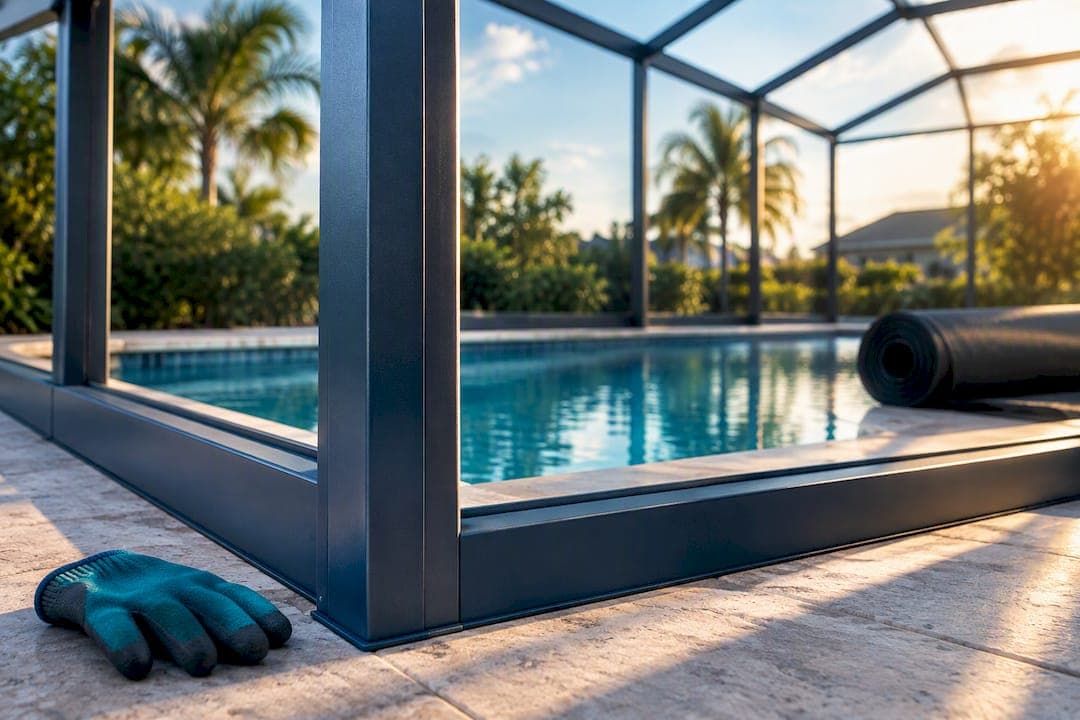
If your pool cage screens were removed, torn, or exposed to fresh paint or coatings during a renovation, you should rescreen before the enclosure goes back into regular use. The first step is a hands-on inspection of the frame, followed by confirmation from your painting or coating contractor that surfaces have cured. Most contractors want a one to two week cure window before installing new spline and mesh.
TL;DR:
- Rescreening involves replacing mesh and spline, with costs heavily influenced by enclosure height, mesh type, and access difficulty.
- Proper scheduling requires a full cure period after painting or coating, typically one to two weeks, to prevent damage to new mesh and spline.
- Heavy-duty or solar mesh options and stainless steel fasteners extend the lifespan and durability of pool enclosure screens, especially in humid or coastal climates.
- When corrosion has compromised the frame's structural integrity or panels are misaligned, a full rebuild is necessary instead of rescreening.
- Most residential enclosures can be restored effectively at a lower cost than full replacement, with a typical warranty of around three years on coatings and hardware.
Table of Contents
- What rescreening covers and when to schedule it
- How contractors price rescreening and what changes the quote
- Mesh, spline, hardware, and coating options that affect price and durability
- What happens during a rescreening job
- Scheduling guidance for coordinating renovation trades
- Aftercare: cleaning, inspections, and screen lifespan
- Inside a restoration workflow: coatings, hardware, and cure times
- Restoration or replacement: an honest read on the tradeoff
- Getting a restoration estimate for your pool enclosure
- Sources and further reading for pool owners
- FAQ
What rescreening covers and when to schedule it
Rescreening means replacing the mesh and spline that hold it in the frame's channel, along with minor hardware fixes where needed. It is a different job from a full rebuild, which replaces the aluminum frame itself, and from a partial frame repair, which fixes bent or corroded sections without a full teardown. Homeowners often confuse the three because all three can happen during the same renovation.
Timing matters more than most people expect. If your enclosure was painted or recoated as part of the renovation, the coating needs to fully cure before installers spline in new mesh. Rescreening too early can transfer wet paint onto new screen or weaken the spline's grip in the frame channel, forcing you to pay for the job twice.
- Rescreening: mesh and spline replacement, sometimes minor fastener fixes.
- Partial frame repair: fixing bent, cracked, or isolated corroded sections.
- Full rebuild: replacing the entire frame, usually required after extensive corrosion or structural collapse.
A full rebuild becomes necessary when corrosion has spread through multiple frame members, when panels are bent or pulled from their footers, or when an inspector flags the structure as unsafe to reload with mesh.
How contractors price rescreening and what changes the quote
Most rescreening quotes are built on a per-square-foot rate for the mesh and labor, plus a base or minimum fee that covers travel and setup regardless of enclosure size. Detailed cost breakdowns for rescreening projects show how these numbers shift depending on enclosure height, mesh type, and how much old material needs removal first.
Cage condition and access are the biggest swing factors in a rescreening quote. A single-story cage with ground-level access costs less to service than a two-story enclosure requiring ladders or lift equipment, and a contractor's site visit is the only reliable way to price that difference.
Watch for these line items on any estimate:
- Frame repair or spot-priming for rust spots discovered during teardown.
- Fastener replacement, especially if the original screws or clips have rusted.
- Specialty mesh upgrades, such as pet-resistant or solar screen.
- Permit or HOA approval fees in communities that require sign-off on exterior changes.
Ask for a line-item estimate rather than a single lump sum. A contractor who breaks out mesh cost, labor, hardware, and any frame work separately is easier to compare against a competing bid, and it makes change orders during the job much less painful to negotiate.
Mesh, spline, hardware, and coating options that affect price and durability
Standard fiberglass screen is the most common and least expensive choice, offering a balance of airflow and visibility that suits most enclosures. Heavy-duty or pet screen costs more but resists tearing from claws and debris, and premium options like solar or privacy mesh cut glare and heat at the expense of some airflow.
Fastener choice matters as much as mesh in humid or coastal climates. Stainless steel or Nylotech hardware resists corrosion far longer than standard zinc-plated screws, which is worth the modest upcharge on any coastal or high-humidity property.
- Standard fiberglass mesh: lowest cost, good general-purpose visibility and airflow.
- Heavy-duty or pet mesh: higher cost, better tear resistance.
- Solar or privacy mesh: reduces glare and heat, somewhat lower airflow.
- Stainless steel or Nylotech fasteners: higher upfront cost, longer service life in humid climates.
Frame coatings deserve equal attention. A water-based acrylic coating is a common recommendation for pool cage frames because it holds up to sun and moisture exposure while allowing the frame to be repainted later without heavy prep work. Coating timing directly affects your rescreening schedule, since the frame needs to cure before spline can seat properly in the channel.
If you are already investing in new screen, a color change or trim upgrade is worth considering. Options for visual upgrades to a screen enclosure add modest cost but can meaningfully change the enclosure's appearance without a full rebuild.
Pro Tip: Ask your contractor to confirm in writing that the frame coating has cured before scheduling the rescreening crew.
What happens during a rescreening job
A rescreening job follows a fairly predictable sequence, and knowing it helps you spot problems before they become expensive. The step-by-step restoration process that contractors use typically breaks down as follows.
- An estimator inspects the frame, checks fastener condition, and measures the enclosure to write a detailed quote.
- If painting or coating work overlaps with the screen job, the crew masks surfaces and coordinates timing so wet paint never touches new mesh.
- Old screen and spline are removed, and the crew inspects the frame channel for damage while replacing any compromised hardware.
- New mesh is installed and spline is rolled into the channel, then trimmed and cleaned up along every panel.
- A final walkthrough checks for loose spline, sagging panels, and gaps around doors before the job is marked complete.
Homeowners should walk the enclosure with the crew lead at the final step rather than signing off from a distance. Loose spline near corners and door frames is the most common issue that surfaces within the first few months if it is missed at handoff.
Scheduling guidance for coordinating renovation trades
The safest trade order for a pool-area renovation is structural repairs first, then painting or coating, then a cure period, then rescreening last. Doing it out of order is the single most common cause of rework, since fresh paint and new mesh do not mix well. A homeowner's guide to pool and screen enclosures covers this sequencing in more detail for larger renovation projects.
Typical stage lengths run from a same-day inspection and estimate, to several days for paint or coating application, to a one to two week cure window before rescreening can start.
- Require written confirmation from the paint or coating contractor that the cure period is complete.
- Build a few buffer days into your schedule in case weather delays coating or curing.
- Clarify up front who is responsible if one trade damages another trade's finished work.
Aftercare: cleaning, inspections, and screen lifespan
New screen mesh can last many years depending on material and exposure, but sun, salt air, and storm debris all shorten that window. Standard fiberglass mesh generally holds up well under normal residential use, while heavy-duty and solar mesh tend to last longer under the same conditions.
Routine care is simple: rinse mesh gently with a hose rather than a pressure washer, and walk the enclosure once or twice a year checking fasteners for rust and spline for gaps.
- Rinse mesh with low water pressure to avoid stretching or tearing it.
- Inspect fasteners and spline seasonally, especially after storms.
- Watch for sagging panels or small tears, which spread quickly if ignored.
Pro Tip: Fix small tears the same season you spot them. A patched inch of mesh is far cheaper than a repaneled section next year.
Red flags that call for a contractor visit include visible rust bleeding through fasteners, spline pulling loose from the channel, or mesh that has become brittle and cracks when touched. Sustainable repair choices, like the ones outlined in guidance on repair methods that extend screen life, tend to cost less over time than repeated spot fixes or an early full rebuild.

Inside a restoration workflow: coatings, hardware, and cure times
The restoration process pairs industrial-grade, water-based acrylic coatings with stainless steel fasteners, then holds to a one to two week contractor-ready cure window before the rescreening crew starts work. That sequencing is meant to prevent the exact rework problems described earlier: wet paint transferring onto new mesh or spline failing to seat properly in an uncured frame channel.
Restoring an aging pool cage instead of rebuilding it can save homeowners a significant percentage compared with a full replacement when the frame itself is structurally sound.
Warranty terms on this kind of restoration typically run three years, covering the coating and hardware against premature failure under normal residential exposure. For homeowners weighing a full rebuild against restoration, that combination of lower cost and a multi-year warranty is often the deciding factor once the frame has been confirmed sound.
Restoration or replacement: an honest read on the tradeoff

Most pool cages I see do not need a full rebuild. They need the frame cleaned up, refastened with better hardware, and rescreened on a schedule that respects cure times. Staged restoration usually delivers the better value here, because the frame itself, the expensive part, is often still sound underneath years of surface wear.
Replacement earns its cost when corrosion has eaten into structural members or panels have shifted out of alignment. Short of that, restoration is the more defensible choice for most homeowners.
— Michel
Getting a restoration estimate for your pool enclosure
If your renovation left screens damaged or your paint contractor is finishing up, a restoration estimate is the next practical step rather than jumping straight to a full rebuild. 
Mr. Pool Screen's pool screen restoration service handles frame inspection, hardware replacement, coating, and rescreening as one coordinated job, so you are not managing multiple contractors around a single cure window. Homeowners who are also refinishing concrete, wood, or stone decking as part of the same project can pair that work with pool deck staining to keep both trades on one schedule.
- A written, line-item estimate covering frame condition, hardware, mesh, and coating.
- Stainless steel or Nylotech fasteners and water-based acrylic coatings are often used as durable material options.
- Some restoration work includes a warranty covering the coating and hardware against premature failure under normal residential exposure.
Request a free assessment through the restoration landing page to get a written quote before your paint or coating contractor finishes their cure period.
Sources and further reading for pool owners
For deeper reading on sequencing and repair methods, see the guide on pool renovation versus repair and coordination tips for pool deck drainage during renovation.
- Independent guidance on repair versus rebuild decisions.
- Trade coordination advice for deck and enclosure projects.
FAQ
What is the average cost to rescreen a pool enclosure?
Cost depends on enclosure size, mesh type, and access difficulty, so estimates vary widely from one property to the next. A detailed cost breakdown for rescreening projects explains the per-square-foot and fixed-fee components that make up a typical quote.
How long do pool screens last?
Screen lifespan depends heavily on mesh type, sun exposure, and coastal salt air, with heavier mesh generally outlasting standard fiberglass. Seasonal inspections and gentle cleaning, rather than pressure washing, are the biggest factors homeowners control to extend that lifespan.
What is the average lifespan of a pool screen?
There is no single fixed lifespan since exposure conditions and mesh grade both play a large role, but heavy-duty and solar mesh options tend to outperform standard fiberglass under the same conditions. Routine inspection for spline gaps and fastener corrosion helps catch failure points before they spread.
What is the screen covering over a pool called?
The structure is commonly called a pool enclosure or pool cage, and the fabric stretched across its frame is referred to as screen or mesh. Homeowners often use "rescreening" to describe replacing that mesh and the spline that secures it in the frame channel.
How do I know if I need a full rebuild instead of rescreening?
A full rebuild is typically needed when corrosion has spread through multiple frame members or panels have bent or pulled loose from their footers. If the frame itself is structurally sound, rescreening or a broader restoration is usually the more cost-effective path.