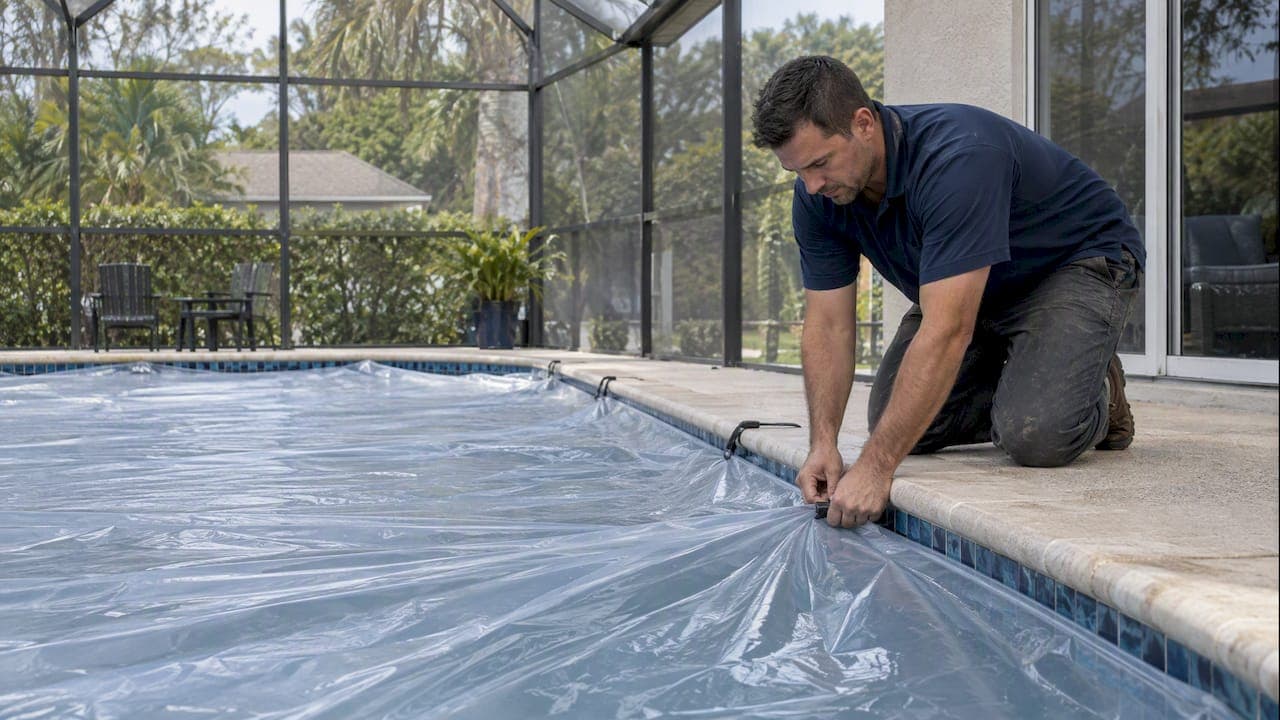
It depends on what you are painting. If a crew is painting the pool cage or the deck around the water, cover the water surface and the exposed concrete so overspray and drips stay out. If you are painting the pool shell itself, do not cover it with a tarp: the cover traps moisture, can sag onto fresh coating, and is not a substitute for the safety barrier Florida law requires.
The two jobs get mixed up in search results, so this guide separates them. We restore pool cages and decks in Central Florida, so most of what follows comes from that side of the work.
TL;DR
- Painting the cage or deck: cover the water and any surface you are not coating, with masking and plastic that is weighted down and secured. Turn the pump off for the job.
- Painting the pool shell: do not tarp it. Plan around the weather forecast instead, because trapped humidity is a cure problem.
- Rain: stop work before it starts. Manufacturer data calls for no painting if rain is expected within 4 to 6 hours, and each rainy day adds drying time.
- Safety: a tarp is never your pool barrier. Florida's Chapter 515 requires a compliant barrier, and a loose tarp that collects water becomes a hazard of its own.
- Hiring: ask any painter exactly how they mask, what they put over the water, and who removes it and when.
Table of Contents
- Two very different jobs hiding in one search
- Painting the cage or deck: what to cover and how
- Painting the pool shell: why a cover usually backfires
- Rain, humidity and cure time
- Florida's barrier rules: a tarp is not a fence
- Draining a pool to paint it in Florida
- Perspective: what we tell homeowners
- A pre-job checklist you can hand to your painter
- When restoration beats a full rebuild
- FAQ
- Sources
Two very different jobs hiding in one search
People type "cover pool during painting" for two reasons.
Job one: painting around the pool. The cage frame, the deck, the coping, a fence or the back of the house are being painted or stained. The water is not being touched, and you want it kept clean. Overspray is fine mist that drifts, and it lands on water, on pavers, and on screens you meant to leave alone.
Job two: painting the pool itself. The pool is drained, prepped and coated. Here covering seems logical, to keep out rain, leaves and debris. It is also where covering usually does harm.
Most homeowners in Florida with a screened pool are in the first group. The second group should keep reading for the section on why tarps backfire.
Painting the cage or deck: what to cover and how
Professional pool-cage sprayers do cover the water. A painter in a Paint Talk thread on covering swimming pools describes spraying enclosures over a pool and wanting overspray kept out of the water and off the deck. Their approach: a plastic tarp sized to the pool, which floats on the surface and is weighted at the edges, plus runners of the same material over exposed concrete. They also have the homeowner switch the pump off and on again so the crew carries no liability for the equipment. That is one contractor's field practice, not a code, but it matches how careful crews work.
A sensible covering plan
- Walk the job first. Decide which surfaces are being coated and which are not. Everything in the second group gets protected.
- Cover the water surface. Use plastic sized to the pool, laid flat on the water and weighted at the edges so wind cannot lift it. It should lie on the surface, not span a gap.
- Protect the deck. If the deck is not being refinished, cover exposed concrete, pavers and coping with runners or paper, taped down at the edges.
- Mask what stays unpainted. Screens, light fixtures, outlets, door hardware, and the house wall where the cage meets it.
- Turn off the pump and any automatic fill or cleaner for the duration.
- Remove covers promptly. Pull the water cover once spraying is finished and the wind has settled, not days later. A cover left on collects rain and debris.
Careful prep and masking are how we avoid overspray and stains on our own jobs. It is the part of the work homeowners rarely see and the part that separates a tidy finish from a speckled deck.
Wind is the real enemy
Overspray travels farther than people expect, and a breezy afternoon can carry it over a covered pool onto the lanai furniture. Spraying on calm mornings, and brushing or rolling near the water's edge, cuts the risk. Our guide on when the weather is right for painting a pool cage covers temperature, humidity and wind in more detail.
Painting the pool shell: why a cover usually backfires
If the pool is drained and being coated, the instinct to throw a tarp over it is understandable. The paint makers say otherwise, in effect. Coatings cure by letting moisture and solvents leave the film. A sheet over the surface does the opposite.
The guidance comes down to three points.
- Preparation decides the outcome. One manufacturer's data sheet says improper surface preparation causes roughly 90% of pool paint failures. The surface must be clean, dry and sound before any coat.
- Dry means dry. The same sheet recommends five days of dry, sunny weather before a condensation test: tape plastic to the floor and walls for four hours, and if moisture forms, wait 24 hours and test again. A coating manufacturer's application guide describes the same plastic-sheet check.
- Weather is managed by timing. Professionals pick the window instead of trying to hide the pool from the sky.
A tarp over drained, freshly coated or still-drying shell works against all three. It holds humidity against the surface, and any sag lets the sheet touch uncured paint. The likely results are blistering, peeling or a soft, tacky finish. If you have already seen blisters on a deck coating, our post on testing three cores before fixing pool deck paint blisters explains how to diagnose them.
The water-collection problem
A flat sheet over a pool is a basin. Rain pools in the middle, the weight pulls the sheet down, and it can drag into the pool. The Sumter County, Florida pool safety page warns against covers held down by water tubes or weights because wind blows them into the yard or the pool, and it distinguishes those from an attached safety cover. Wet plastic is also slick: the EPA notes that precipitation makes plastic sheeting slippery in exterior renovation work, which is why it advises handling the water that collects on it. Anyone stepping on a wet sheet near an open pool is at risk.

Rain, humidity and cure time
Weather is where most painting plans fail, so build the schedule around it.
| Factor | What the manufacturer data says | What it means for you |
|---|---|---|
| Rain window | Do not paint if rain is expected within 4 to 6 hours | Check the hourly forecast, not the daily one |
| Full cure | Typically 3 to 7 days before refilling | Do not fill on day two because the surface feels dry |
| Rain during cure | One extra drying day for each day of precipitation | Add buffer days to your plan |
| Humidity | Extends the cure time significantly | Early summer afternoons in Florida are a poor bet |
The figures come from Rust-Oleum's acrylic pool paint data sheet. Always read the sheet for the exact product on your job, because products differ.
The same sheet describes this paint as suitable for damp surfaces, which is a reminder that products vary a great deal. Do not assume your coating tolerates what another one does.
For cages and decks, drying and cure are different things. Paint can be dry to the touch in a few hours and still be soft underneath. Our pool cage paint drying time plan separates the touch-dry window from the full cure, and our guide to repainting a pool deck explains why to keep the surface protected for 48 dry hours after the final coat.
If rain shows up mid-job
Stop and secure the site. Do not stretch a tarp over wet, uncured paint and walk away. If masking plastic is already on the ground or the water, check it for collected water before anyone steps on it, and drain it carefully away from the pool and the work area. Resume only when surfaces are dry again. A delayed day costs far less than stripping a failed coat.
Florida's barrier rules: a tarp is not a fence
Florida homeowners have one more constraint. Chapter 515 of the Florida Statutes sets the residential pool safety requirements, and section 515.27 lists the safety features a residential pool must have to pass final inspection. A loose tarp is not on that list.
In practice:
- A screened pool cage is part of your barrier thinking. If painters open a door or panel, or remove screen sections, someone must close it again at the end of each day.
- A water cover used to catch overspray is a work tool, not a safety cover. Do not treat it as protection against a child or pet reaching the water.
- Sumter County says a safety cover is only appropriate when it is properly attached and built to bear weight. Improvised plastic is neither.
If children, grandchildren or neighbors' pets are around, tell your contractor so they plan daily closure of every opening. Our pool enclosure safety inspection steps and the pool screen safety inspection checklist help you check latches, panels and fasteners before and after the work.
Draining a pool to paint it in Florida
If you are repainting the shell, draining is the riskiest step. Florida's high water table can push an empty shell upward. The Sumter County page cited above is one of several local sources that treat the pool as a permitted structure with safety requirements, not a surface to be painted. Keep the drained time to the minimum needed for cleaning, prep and coating, and avoid draining during the rainy season. Before you drain, ask a pool professional about the water table at your address and whether a hydrostatic relief valve exists. Do not drain on your own judgment when the ground is saturated.
Perspective: what we tell homeowners
Most calls we get about "covering the pool" come from homeowners worried that paint will end up in the water. That worry is fair, and the answer is careful masking, calm weather and a crew that cleans up as it goes. We prepare and mask before spraying, and we work with water-based acrylic coatings on cages, with stainless steel fasteners replacing rusted ones.

What worries us more is the opposite instinct: tarps stretched over a freshly coated surface, or plastic left on a pool for days. Under it, humidity builds, paint cures badly, and rain turns the sheet into a hazard. A cage or deck repaint is a weather-and-sequence job. Do the prep right, pick the window, protect what is not being painted, take the covers off when the work is done, and close the enclosure at night.
If a contractor proposes to tarp a drained pool for several days "to protect the paint", ask them why. The honest answer is usually that the schedule slipped.
— Michel
A pre-job checklist you can hand to your painter
Use these questions before you sign anything.
- What exactly will cover the water, and how is it weighted down?
- What happens to deck, coping and furniture that are not being coated?
- Is the pump turned off, and who turns it back on?
- What is the rain plan, and who makes the call to stop?
- How will the enclosure be closed at the end of each day?
- When do the covers come off, and who removes them?
- What is the cure schedule before I use the pool or put furniture back?
Our guide to protecting a freshly painted pool enclosure covers what to do in the 24 to 72 hours after the last coat.
When restoration beats a full rebuild
If your cage is rusting and chalky, the frame and fasteners usually decide whether painting makes sense, and covering the pool is only a small part of that decision. Our Pool Screen Restoration service repaints cages with water-based acrylic coatings, replaces rusted fasteners with stainless steel or Nylotech hardware, and re-screens with the mesh type you choose. We say it can save up to 60% compared with a full rebuild, and we back the work with a three-year warranty. If the deck also needs attention, we handle pool deck staining for concrete, wood, masonry and stone, so one crew does the masking, covering and cleanup for both. Our blog post on screen enclosures in 2026 shows how restoration compares with replacement. To start, contact Mr. Pool Screen for an assessment in Central Florida.
FAQ
Is it a good idea to use a tarp to cover a pool?
Only as a floating water cover while a cage or deck is being sprayed, weighted at the edges and removed right after. Over a drained pool being coated, a tarp traps humidity and can sag onto uncured paint. It is never a legal safety cover.
Are you supposed to cover a pool when it rains?
Not during painting. Manufacturer guidance is to avoid painting if rain is expected within 4 to 6 hours and to add a drying day for each day of rain. Stop work, secure the site, and let surfaces dry instead of tarping over wet paint.
How long does it take for a pool to dry after painting?
That depends on the coating and weather. One acrylic pool paint's data sheet lists a typical full cure of 3 to 7 days before refilling, longer in humid or rainy conditions. Check the sheet for your product, or read our cage paint drying and cure plan.
How do I prepare a pool for painting?
Clean it, repair weak spots, and make sure the surface is fully dry. Manufacturers suggest five dry, sunny days, then a four-hour plastic-sheet condensation test on the floor and walls. If moisture shows, wait 24 hours and test again.
Do I need to keep my pool enclosed while painters work?
Yes. Florida's Chapter 515 requires a compliant barrier for residential pools. Ask your painter to close every door and panel at the end of each day, and do not rely on a tarp.
Sources
- Paint Talk: covering swimming pools
- Richard's Paint 2500 product data sheet
- Ramuc Ultra Pro 2000 application guide
- Sumter County, FL: Protecting Your Pool
- US EPA: plastic sheeting in exterior renovations
- Rust-Oleum acrylic pool paint data sheet
- Chapter 515, 2025 Florida Statutes