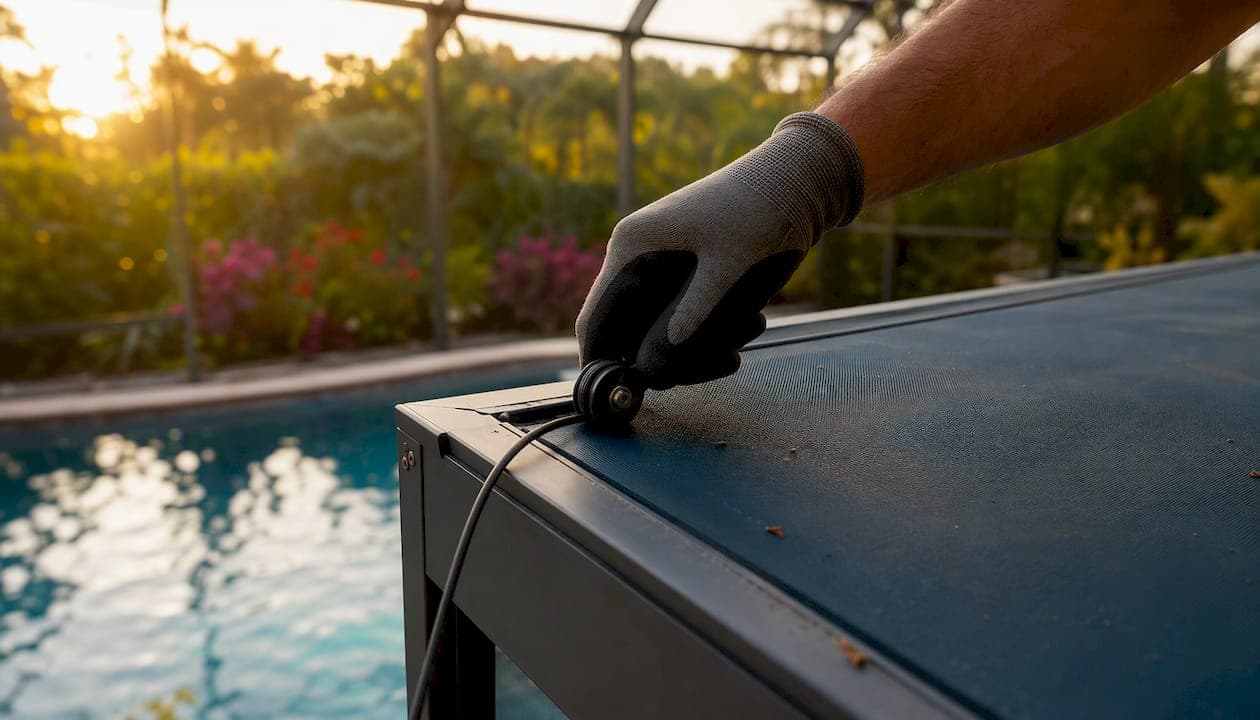
For most Florida pool cages, the right starting point is 18×14 fiberglass for standard visibility and budget, 20×20 No-See-Um for tiny insect control, vinyl-coated polyester (TuffScreen or Super Screen) for coastal durability and pets, and stainless or security mesh for high-wind or privacy needs. If your frame is structurally sound and you're dealing with brittle mesh or surface rust, a restoration — re-screening plus new fasteners and a fresh coating — is almost always the smarter financial move over a full rebuild.
The most common pool screen mesh types to know before you call a contractor:
- 18×14 fiberglass — the standard pool enclosure screen; good clarity, lowest cost
- 20×20 / No-See-Um — finer weave that blocks tiny biting insects; slightly reduced airflow
- 17×20 / Super Screen — vinyl-coated polyester with higher tear resistance; popular in Florida
- TuffScreen — heavy-duty vinyl-coated mesh; Phifer's go-to for high-traffic or pet households
- Pet-resistant screen — thicker yarn or vinyl-coated polyester; built to handle claws and impact
- Solar/privacy screen — denser weave for heat and glare reduction; limits outward view
- Stainless or security mesh — maximum strength; used for high-wind coastal zones or security
Restore or replace? If tears are localized and the frame is solid, re-screening with a better mesh grade is cost-effective. Widespread structural rust or bent frame members point toward frame replacement first.
Key Takeaways
The right pool screen mesh comes down to matching your material and mesh count to your single biggest constraint — insects, pets, UV exposure, or visibility — before anything else.
| Point | Details |
|---|---|
| Match material to your environment | Vinyl-coated polyester (TuffScreen, Super Screen) outlasts standard fiberglass in Florida's UV and salt-air conditions. |
| Mesh count controls insect exclusion | 18×14 blocks mosquitoes; 20×20 No-See-Um blocks biting midges; higher counts reduce airflow and visibility. |
| Hardware matters as much as mesh | Stainless or Nylotech fasteners prevent the corrosion failures that cause screens to sag before the mesh wears out. |
| Restore when the frame is sound | Re-screening with upgraded mesh and new hardware saves up to 60% compared to a full cage rebuild. |
| Mrpoolscreen for Central Florida | Mrpoolscreen handles re-screening, fastener replacement, frame coatings, and deck refinishing for aging pool cages. |
Table of Contents
- What are the main pool screen mesh types and materials?
- How does mesh count affect what your screen actually blocks?
- What specialty screen options are worth considering?
- How do UV, salt air, and pool chemicals change your material choice?
- What to know before ordering screen rolls or scheduling installation
- What does pool screen mesh cost, and how long does it last?
- Should you restore your pool cage or replace it entirely?
- How to choose the right mesh for your property
- What installers see most often — and what homeowners miss
- Mrpoolscreen restores Central Florida pool cages — at a fraction of replacement cost
- Sources
What are the main pool screen mesh types and materials?
The material a screen is made from determines almost everything else: how long it lasts, how clearly you see through it, how well it handles UV and salt air, and what it costs to replace. Pool enclosure screening broadly falls into four material families.
Fiberglass is the most common starting point. It's woven from glass fibers coated in PVC, which gives it flexibility and decent UV resistance at a low price. Standard 18×14 fiberglass is what you'll find on most residential pool cages across the Southeast. The trade-off is brittleness over time — prolonged UV exposure causes the coating to break down, and the mesh becomes stiff and prone to cracking. In a high-sun climate like Central Florida, standard fiberglass typically needs replacement sooner than coated alternatives.
Aluminum offers better tensile strength and tear resistance than fiberglass. It doesn't stretch under impact, which makes it useful in high-wind areas. The downside is glare — aluminum reflects more light, which can be distracting around a pool — and it costs more per roll. In salt-air environments, untreated aluminum can corrode at the frame connection points, so the mesh itself may outlast the hardware holding it in place.
Vinyl-coated polyester is where most Florida installers land when a homeowner wants something that lasts. Products like Phifer's TuffScreen and Super Screen lines use a polyester base yarn laminated in vinyl, which gives them roughly three times the tear strength of standard fiberglass and significantly better UV and chemical resistance. These are the meshes most often recommended for coastal homes, households with pets, and anyone who wants to go more than a few years between re-screens.
Stainless steel and specialty bronze meshes sit at the top of the durability and cost spectrum. Stainless is used primarily for security enclosures or high-wind coastal zones where structural integrity matters more than visibility or cost. Bronze architectural mesh is occasionally specified for high-end custom enclosures where aesthetics drive the decision.
- Fiberglass: best visibility, lowest cost, shortest lifespan in UV-heavy climates
- Aluminum: strong, tear-resistant, prone to glare and corrosion at connection points
- Vinyl-coated polyester: best all-around for Florida; UV-stable, pet-tolerant, mid-range cost
- Stainless/security: maximum strength and longevity; highest cost; limited to specific use cases
Pro Tip: Spending a little more upfront on UV-stabilized or vinyl-coated mesh almost always pays off in Florida. The difference in material cost between standard fiberglass and TuffScreen is modest compared to the labor cost of re-screening two years earlier than you needed to.
How does mesh count affect what your screen actually blocks?
Mesh count is the number of strands per linear inch, measured horizontally and vertically. An 18×14 screen has 18 strands running one direction and 14 running the other. Metro Screenworks explains that mesh count and wire diameter are two separate specs that work together — mesh count controls which insects get through, while wire diameter controls how clearly you see out and how much force the screen can absorb before tearing.
Higher mesh counts mean smaller openings between strands. A 20×20 weave blocks no-see-ums (biting midges) that sail right through a standard 18×14. A 20×30 weave is even finer and is often marketed specifically as a no-see-um or solar screen. The trade-off is airflow and visibility: more strands per inch means less open area, which reduces both the breeze coming through and your sightlines to the yard.
Wire diameter works in the opposite direction. Thinner wire leaves more open space between strands, so you get a clearer view outward — Phifer's BetterVue is built on this principle. Thicker wire increases tensile strength and tear resistance but cuts into visibility.
| Mesh Count | Common Name | Insects Blocked | Visibility | Typical Use |
|---|---|---|---|---|
| 18×14 | Standard pool screen | Mosquitoes, large insects | Good | Most residential pool cages |
| 17×14 | Slightly finer standard | Mosquitoes, large insects | Good | Budget-friendly alternative |
| 17×20 | Super Screen variant | Mosquitoes, most small insects | Moderate | Florida coastal, durability focus |
| 20×20 | No-See-Um | No-see-ums, gnats, small midges | Reduced | High-insect areas, near water |
| 20×30 | Solar/No-See-Um | No-see-ums, fine debris | Low | Privacy, heat reduction, fine insect control |
One thing most homeowners miss: the same mesh count performs differently depending on the material. A 20×20 weave in vinyl-coated polyester is noticeably stiffer and more tear-resistant than the same count in fiberglass, but it also blocks slightly more light. If you're choosing a No-See-Um screen for a shaded enclosure, fiberglass 20×20 keeps things brighter. For a sun-exposed cage near the coast, vinyl-coated 20×20 holds up far longer.
MightyMesh's product documentation confirms that 18×14 is the industry standard for pool enclosures, with UV protection built into the coating and large roll lengths available for full-cage projects.
What specialty screen options are worth considering?
Standard fiberglass handles most situations, but several specialty categories solve specific problems that a basic 18×14 simply can't.
Pet-resistant screens use thicker yarn or a vinyl-coated polyester base to handle the impact and abrasion of dogs and cats pressing against the mesh. They won't stop a determined large dog from breaking through, but they resist the casual scratching and leaning that destroys standard fiberglass within a season. Visibility is lower than standard mesh — the thicker strands are more visible — but for households with active pets, the trade-off is obvious.
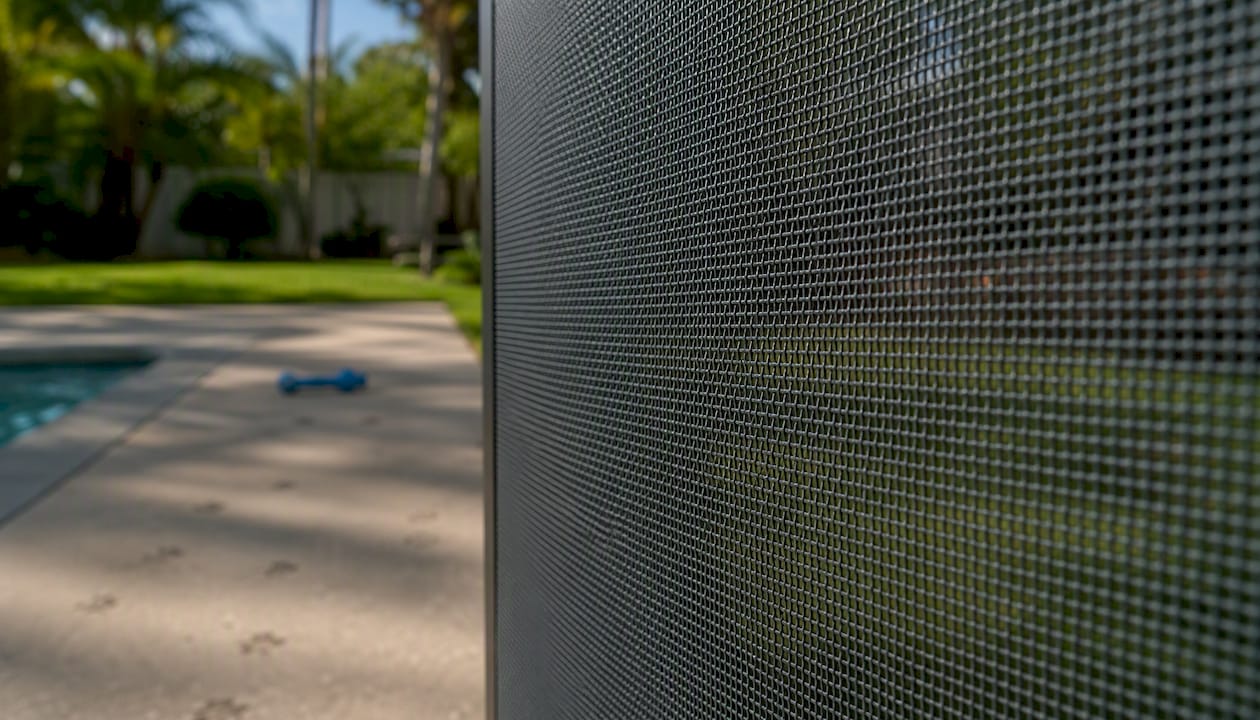
Solar and privacy screens use a denser weave (often 20×30 or similar) to block a meaningful portion of solar radiation and reduce glare around the pool. They also limit sightlines from outside, which appeals to homeowners in tighter neighborhoods. The downside is that they cut outward visibility significantly, and they reduce airflow more than any other common pool screen option.
High-visibility screens like Phifer's BetterVue and UltraVue lines use thinner yarn to maximize the open area between strands. The view through them is noticeably clearer than standard mesh — almost like looking through a fine window screen. The trade-off is durability: thinner yarn tears more easily, and these screens are not a good fit for households with pets or for enclosures in high-debris areas.
Retractable systems are a different category entirely. Rather than a fixed screen panel, retractable screens roll up or fold away when not in use. They appeal to homeowners who want an unobstructed view for parties or seasonal use, but they cost significantly more than fixed screens and require more maintenance over time. Pool enclosure screen guides note that retractable systems are best suited to covered patios or lanais where the screen isn't the primary weather barrier.
- Pet-resistant: thicker yarn or vinyl-coated polyester; handles claws and impact; lower visibility
- Solar/privacy: dense weave; blocks heat and glare; limits outward view and airflow
- BetterVue/UltraVue: thin yarn; maximum clarity; not for pets or high-debris zones
- Retractable: flexible use; highest cost; more maintenance; best for covered areas
How do UV, salt air, and pool chemicals change your material choice?
Florida's environment is genuinely hard on pool screens. UV radiation, salt air, and pool chemical off-gassing all attack different parts of the screen system, and ignoring any one of them shortens the lifespan of an otherwise good installation.
UV is the biggest factor for the mesh itself. Uncoated fiberglass loses its PVC coating over time as UV breaks down the plasticizer in the vinyl. The mesh turns brittle, becomes chalky to the touch, and eventually crumbles at the edges. UV-stabilized coatings — standard on most vinyl-coated polyester products — resist this breakdown significantly longer. Phifer's Florida pool enclosure guidance consistently points homeowners toward vinyl-coated or UV-stabilized options for this reason, particularly for south-facing or unshaded enclosures.
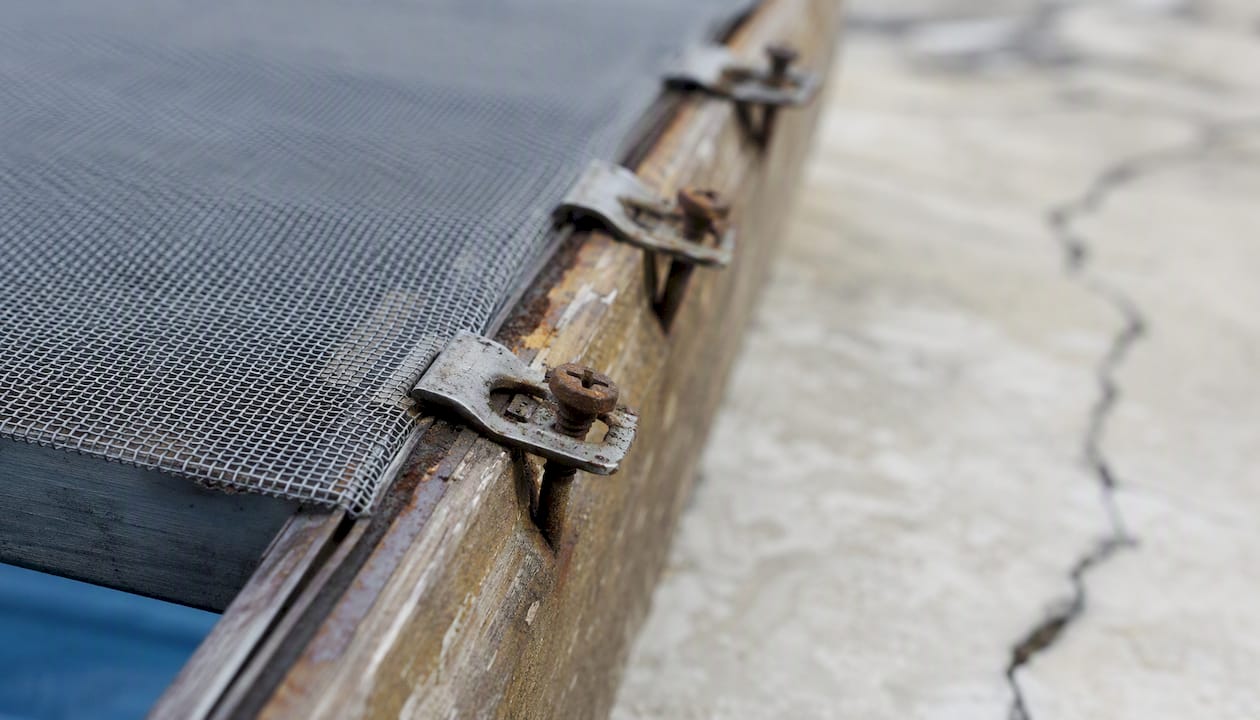
Salt air attacks the hardware more than the mesh. Galvanized or zinc-plated screws and spline clips corrode quickly in coastal environments, and once a fastener fails, the screen panel loses tension and starts to sag or pull away from the frame. The fix is straightforward: replacing corroded fasteners with stainless steel or Nylotech hardware at the time of re-screening eliminates this failure mode for years. Aluminum framing holds up reasonably well in salt air when it carries a proper powder-coat or paint finish, but bare or scratched aluminum corrodes at the joints.
Pool chemicals — primarily chlorine off-gassing from the water surface — affect the lower panels of an enclosure more than the upper sections. Vinyl-coated meshes resist chemical exposure better than uncoated fiberglass. If you're replacing only the lower panels after chemical damage, stepping up to a vinyl-coated product for those sections makes sense even if the upper panels are standard fiberglass.
Understanding what causes pool screen mesh breakdown — UV, salt, and chemical exposure working together — is the clearest argument for choosing UV-stabilized materials from the start rather than replacing cheaper mesh more often.
Pro Tip: For any coastal or high-sun installation, specify UV-stabilized or vinyl-coated polyester mesh and stainless or Nylotech fasteners in writing before the job starts. These two upgrades together address the two most common failure modes in Florida pool cages.
What to know before ordering screen rolls or scheduling installation
Ordering the wrong roll width or underestimating the footage needed is one of the most common mistakes on re-screening jobs. Standard screen rolls come in widths of 36 inches and 48 inches, with some specialty products available in 60-inch or wider cuts. Roll lengths vary by product and supplier — MightyMesh's pool screen rolls are available in lengths suited to full-cage projects, which matters when you're covering a large enclosure without mid-panel seams.
Here's what to have ready before calling a contractor or placing an order:
- Overall cage dimensions — length, width, and height of each screened bay, including any roof panels
- Frame channel size — the spline groove width determines which spline diameter fits; most residential frames use 0.140" or 0.160" spline
- Panel count and shape — note any angled or non-rectangular panels, which require more material and more labor
- Existing mesh type — knowing what's currently installed helps the contractor recommend a compatible or upgraded replacement
- Hardware condition — note any visible rust, loose screws, or sagging panels before the appointment
For fastening, the spline (the rubber cord that locks the screen into the frame channel) must match the channel depth. Thicker mesh like TuffScreen or pet-resistant polyester often requires a slightly larger spline diameter than standard fiberglass. Stainless or Nylotech screws replace the standard galvanized hardware at the frame connection points and are worth specifying for any coastal installation.
DIY re-screening is possible for small, simple panels — a spline roller and a utility knife are the basic tools — but a full pool cage with roof panels, angled bays, and a mix of mesh types is a job where professional installation pays for itself in tension consistency and material efficiency. Poorly tensioned screens sag, collect debris, and fail at the edges faster than properly installed ones.
What does pool screen mesh cost, and how long does it last?
Cost and lifespan vary more than most homeowners expect, and the cheapest option per roll almost never delivers the best value per year of service.
Standard fiberglass is generally the least expensive material but has a shorter lifespan in high-UV Florida environments compared to coated alternatives. Vinyl-coated polyester products tend to last significantly longer with proper installation and hardware. Stainless and security meshes have the highest upfront cost and are typically reserved for situations requiring maximum durability or security.
| Material | Relative Cost | Expected Lifespan (Florida) | Warranty Signal |
|---|---|---|---|
| Standard fiberglass (18×14) | Lowest | 5 years | Basic UV coating; limited warranty |
| Vinyl-coated polyester (TuffScreen/Super Screen) | Mid-range | 10 years | UV-stabilized; manufacturer warranty available |
| Pet-resistant coated polyester | Mid to high | 8 years | UV-stabilized; varies by product |
| No-See-Um fiberglass (20×20) | Low to mid | 5 years | Similar to standard fiberglass |
| Stainless/security mesh | Highest | 20+ years | Corrosion-resistant; long manufacturer warranty |
When evaluating warranties, look for two things: explicit UV-stabilization language and a stated warranty period from the manufacturer, not just the installer. Phifer's pool and patio screening product lines include UV-resistance specifications for their TuffScreen and Super Screen products — that kind of manufacturer-level documentation is worth asking for before committing to a material.
A few practical notes on lifespan:
- Salt-air exposure can cut fiberglass lifespan by 20–30% compared to inland installations
- Lower panels near the pool surface degrade faster due to chemical exposure
- Hardware failure (corroded fasteners) often causes screens to fail before the mesh itself wears out
- Shaded enclosures consistently outlast sun-exposed ones, regardless of material
For a pool screen maintenance schedule that extends the life of any mesh type, annual cleaning and a fastener inspection go a long way.
Should you restore your pool cage or replace it entirely?
The frame condition is the deciding factor. If the aluminum frame members are straight, the joints are solid, and corrosion is surface-level, a restoration — re-screening with a better mesh, replacing fasteners, and applying a fresh coating — delivers most of the benefit of a new cage at a fraction of the cost.
Replace the frame when you see: bent or bowed vertical members, joints that have separated or cracked, widespread deep corrosion that has eaten through the aluminum wall thickness, or any section where the frame has shifted out of plumb. Surface rust on fasteners and minor oxidation on the frame finish are restoration problems, not replacement triggers.
A typical Mrpoolscreen restoration in Central Florida involves removing the old mesh, replacing every corroded fastener with stainless or Nylotech hardware, re-screening with the homeowner's chosen mesh grade, and applying a water-based acrylic coating to the frame. Homeowners who go this route rather than a full rebuild routinely save up to 60% on the total project cost while ending up with a structurally refreshed cage and a higher-grade mesh than was originally installed.
A quick inspection checklist before you call a contractor:
- Press on several screen panels — do they feel brittle or crumble at the edges?
- Check fasteners at the frame corners — any visible rust or loose screws?
- Look along the top beam — is it straight, or does it bow in the middle?
- Inspect the base rail — any separation from the deck or visible corrosion at the anchor points?
- Check the vertical uprights — do they stand plumb, or have any shifted?
If the first two items are the only problems, re-screening and hardware replacement will solve them. If the last three show issues, get a structural assessment before spending money on new mesh. The pool screen safety inspection checklist from Mrpoolscreen walks through this process in more detail.
How to choose the right mesh for your property
Match your single biggest constraint to a material, then verify the details with your installer.
- Visibility is the priority: Standard 18×14 fiberglass or BetterVue/UltraVue thin-yarn mesh. Ask for the wire diameter spec — thinner wire means a clearer view.
- Tiny insects are the problem: 20×20 No-See-Um in fiberglass (budget) or vinyl-coated polyester (durability). Confirm the mesh count in writing.
- Pets are in the household: Pet-resistant vinyl-coated polyester. Ask whether the product uses a thicker base yarn, a heavier vinyl coat, or both.
- Coastal or high-UV location: Vinyl-coated polyester (TuffScreen, Super Screen, or equivalent) with stainless or Nylotech fasteners. Ask for the manufacturer's UV-stabilization spec sheet.
- Privacy or heat reduction: Solar/privacy screen in 20×30 or similar. Understand that outward visibility will be significantly reduced.
Questions to ask any installer before signing:
- What mesh count and material are you recommending, and why for my specific enclosure?
- Is the mesh UV-stabilized? Can you provide the manufacturer's spec sheet?
- What fastener type are you using — galvanized, stainless, or Nylotech?
- What warranty does the manufacturer offer on this mesh, and what does it cover?
- Can I see a sample of the mesh before installation, and can you show me a splice or repair on a test panel?
Pro Tip: Request a physical sample of the mesh before any work starts. Hold it up to the light and look through it — that's the clearest way to judge actual visibility before it's installed across your entire cage.
What installers see most often — and what homeowners miss
The most common failure pattern in Florida pool cages isn't dramatic. It's gradual: fiberglass mesh that was installed 8–10 years ago has gone brittle from UV exposure, the galvanized fasteners at the corners have rusted through, and the frame has a light oxidation layer that the homeowner has been painting over with the wrong product. None of these problems individually forces a replacement. Together, they make the cage look and feel like it's failing.
What most homeowners overlook is that the fasteners often go first. A screen panel that looks intact can be holding on by two or three corroded screws instead of the full set. Pressing on the panel reveals the problem — it moves more than it should. Catching this early, before the panel tears or the frame channel cracks, is the difference between a straightforward hardware swap and a more involved repair.
Small fixes that genuinely defer replacement: replace corroded fasteners before they pull through the frame, clean the mesh annually to prevent mildew from accelerating UV breakdown, and apply a water-based acrylic coating to the frame when the finish starts to oxidize. These aren't glamorous maintenance tasks, but they add years to a cage that would otherwise be quoted for full replacement. The pool enclosure upkeep guide covers the inspection rhythm that catches these issues before they compound.
Mrpoolscreen restores Central Florida pool cages — at a fraction of replacement cost
Replacing a pool cage frame is expensive.
Mrpoolscreen handles the full restoration workflow for Central Florida homeowners: choosing the right mesh grade for your enclosure (from standard 18×14 fiberglass to vinyl-coated TuffScreen or pet-resistant polyester), replacing every failed fastener, and finishing the frame so it holds up to UV and salt air for years. Deck refinishing for concrete, wood, and masonry surfaces is also available as part of a complete enclosure refresh.
If your frame is structurally sound and your mesh is brittle, sagging, or torn, a pool screen restoration estimate is the logical first step. Contact Mrpoolscreen to schedule an on-site inspection and get a written quote.
Sources
Phifer is the most referenced U.S. manufacturer for pool enclosure screening. Their Florida pool enclosure blog post explains material choices for coastal and high-UV conditions, and their pool and patio product page lists current product lines with UV-resistance and performance specs. Use Phifer's documentation when verifying warranty language and UV-stabilization claims for TuffScreen, Super Screen, and BetterVue.
Metro Screenworks publishes a detailed mesh guide that explains mesh count definitions, wire diameter trade-offs, and which counts exclude specific insects. It's the clearest plain-language explanation of how to read a mesh specification, and worth bookmarking before you talk to an installer.
MightyMesh provides product documentation that confirms standard mesh counts, UV protection specs, and roll lengths for pool cage projects — useful for cross-checking what a supplier quotes you against published product data.
For real-world installation outcomes and restoration case examples, Mrpoolscreen's blog covers mesh breakdown causes and screen enclosure restoration options with Florida-specific context.
When evaluating any installer, cross-reference their recommendations against manufacturer spec sheets — not just their verbal assurances. A contractor who can hand you a Phifer product data sheet or point you to Metro Screenworks' mesh count guide is one who knows the material they're installing.
- Shield your Florida pool with durable screen enclosures - Phifer
- A Guide to All Types of Screen Mesh - METRO SCREENWORKS
- A Guide to Pool Enclosure Screens
- Durable Pool Screen Solutions for Outdoor Comfort