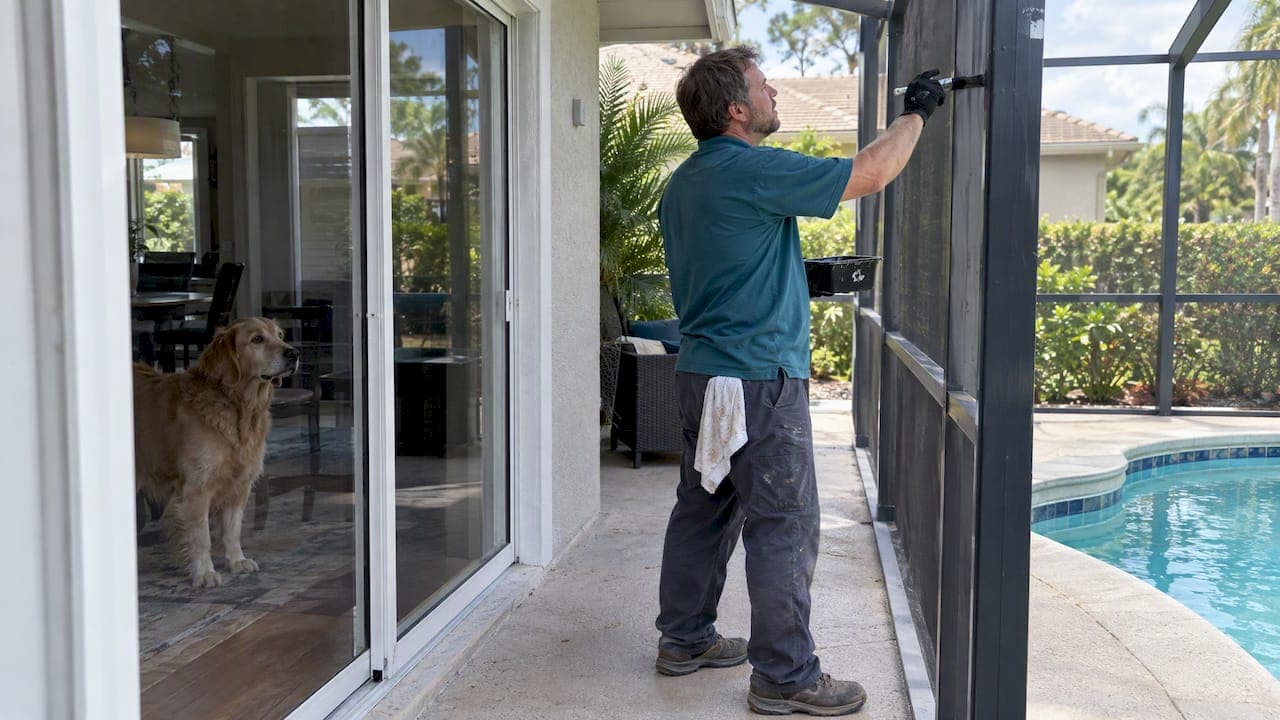
You can paint a pool cage with pets in the household, but no coating makes it safe for an animal to be nearby while it goes on. The safe approach is controlled exposure. Pets stay away from the work area, wet paint, overspray and chips until the coating has cured and the area is cleaned. A compatible water-based acrylic system is a sensible choice for a pet household, as long as you still ventilate and keep animals out.
This guide covers what the pet-safety sources say, how to plan the days of the job, what to ask a contractor, and why the aluminum frame matters as much as the color.
TL;DR
- No paint is "pet safe" in the sense of harmless. Plan on keeping dogs, cats and especially birds away from the work area until the coating is fully dry and cleanup is finished.
- Water-based acrylic coatings generally give off fewer vapors than solvent-based products, but low-VOC is not zero exposure.
- Ask any contractor for the exact product and its safety data sheet, a written masking plan, and cure and re-entry instructions.
- Replace rusted fasteners and check connections while the cage is being refinished. A new color over failing hardware protects nothing.
- If your dog has torn the screen, repaint and re-screen together, with a tougher pet mesh.
Table of Contents
- Why pets change the way you plan a pool cage paint job
- Is the paint itself safe for pets?
- A pet-safe plan for the days of the job
- What to do if your pet gets into paint
- Questions to ask a contractor before you sign
- Paint cannot fix a failing frame
- DIY spray paint with pets in the house
- Do you need a permit to repaint?
- Re-screening for pets while you are at it
- What it costs
- Our perspective: exclusion first, then the right coating
- Have us look at your cage
- FAQ
- Sources
Why pets change the way you plan a pool cage paint job
A pool cage is outdoors, so it is easy to assume fumes disperse and the risk is small. Three things make a pet household different.
First, animals walk through, lick and chew things people never touch. Wet overspray on pavers, a dropped paint chip, a rag or a can of thinner all become exposures.
Second, the cage sits against the house. EPA guidance on volatile organic compounds notes that paints contain organic solvents, and an open slider, lanai door or HVAC intake close to the work can pull fumes and overspray inside.
Third, the cage is where pets spend time. Many dogs patrol the screen line, cats climb it, and birds may be taken out to the lanai. Those habits are exactly why exclusion needs a plan, not a hope.
Is the paint itself safe for pets?
Honest answer: it depends on the label and the safety data sheet, not the brand name or a marketing line.
Take the common question of whether a hardware-store spray is pet safe. Rust-Oleum's technical data sheet for Painter's Touch 2X calls for outdoor or well-ventilated use and lists solvents such as acetone, n-butyl acetate, naphtha and xylene. It also gives application windows of 50 to 90°F and humidity below 65%. Those are application timings, not a veterinary clearance. "Dry to touch" tells you nothing about whether it is fine for an animal to lick or chew.
The ASPCA's guidance on pets during home repairs says water-based paints can cause vomiting and diarrhea if swallowed. It also notes that outdoor coatings may be hydrocarbon-based, which creates an aspiration risk if an animal vomits. Older paint adds a separate concern: many paints made before 1978 contain lead, and pets can swallow flakes or dust that settles on their coats. If your cage or house trim is decades old and you plan to sand or scrape, mention it to your contractor and your veterinarian.
Water-based acrylic versus solvent-based coatings
EPA describes water-based acrylic latex paints as generally lower in VOCs and easier to clean up with water than oil-based alkyd products. That is a real advantage in a pet household, and it is one reason we use water-based acrylic coatings on pool cages.

The same EPA material cautions that low- or no-VOC products can still emit compounds you would rather avoid. So the rule is not "water-based, therefore safe." The rule is: prefer a compatible water-based system where performance allows, follow the manufacturer's instructions, ventilate, and keep animals out during application and curing.
A pet-safe plan for the days of the job
Here is a practical sequence. Adjust it to your animals and your contractor's schedule.
- Decide where the pets will be before the crew arrives. Indoors, in a room away from the lanai, with the door closed and windows on that side shut. For dogs, a day at a boarding facility or a friend's house is the cleanest option. For birds, which the ASPCA warns are extremely sensitive to fumes, arrange complete off-site care during spraying and curing and ask your avian vet how long.
- Walk the masking plan with the crew. The pool, deck, furniture, landscaping, doors and the dog door or pet access route should all be covered or blocked. One gap is enough to leave overspray where a paw will find it. We explain this in why a single masking gap can leave overspray on the deck.
- Lock away cans, thinners and rags. Pets get into open containers and discarded wipes. Ask that all of it leaves the site with the crew.
- Keep a clear exclusion zone until cleanup is done. That means no pets on the deck until the coating has cured per the label, loose chips and dust have been collected, and rinse water has been dealt with.
- Check the deck before letting animals out. Look for flakes, sticky spots and puddles. Walk the screen line, where drips collect at the base of posts.
A word on timing. The manufacturer's data covers application temperature, humidity and recoat times, but it does not give you a pet re-entry time. For an outdoor cage, use the coating label and your contractor's written cure guidance. Do not borrow an indoor number. Humidity matters for the paint too: painting a pool cage only when relative humidity is below 65% helps the coating cure properly.
What to do if your pet gets into paint
Act fast and keep the animal from licking itself.
- For paint on fur or skin, the ASPCA says greasy substances such as paint can generally be addressed by bathing with liquid dishwashing soap. Irritating or corrosive products call for flushing with plenty of tepid water for at least 20 minutes.
- If you suspect your pet swallowed any, or you are not sure what it touched, call your veterinarian or ASPCA Animal Poison Control at (888) 426-4435. Do not induce vomiting unless a professional tells you to.
- Keep the product label or safety data sheet handy. It speeds up the conversation.
These are general steps from the ASPCA. Your own vet knows your animal's size, health and the exact product involved, so call them first for anything beyond a small smear.
Questions to ask a contractor before you sign
If you have pets, the quote should come with answers in writing. Ask for:
- The exact coating product and its safety data sheet, plus VOC and solvent information.
- Cure time and re-entry instructions, written for an outdoor cage.
- A masking plan that names the pool, deck, doors, furniture, landscaping and pet access routes.
- How pool water and filtration equipment will be protected, and how chips and rinse water will be collected.
- Whether rusted screws and anchors are replaced, and whether the inspection found bent members or failed connections.
- What the warranty covers: adhesion, peeling, corrosion returning, screens and hardware, each separately.
A contractor who answers these without hesitation has done the work before. One who says "it's pet safe, don't worry" has given you a slogan instead of a plan.
Paint cannot fix a failing frame
Here is where many homeowners go wrong. A cage that looks tired may only have cosmetic oxidation, or it may have pitted aluminum, loose connections and rusted fasteners underneath.
Florida State University research on aluminum pool enclosures reports that they produce significant insurance losses in hurricanes and windstorms, and identifies screw pullout and other connection failures among the failure mechanisms. The practical takeaway is that corroded fasteners deserve attention during a repaint, not after the next storm.
Before anyone quotes a repaint, they should separate cosmetic oxidation from deeper damage. Our guides on restoring a faded aluminum cage with an adhesion test and on stopping rust bleed show what proper preparation looks like. If the paint is already chalky, this diagnosis guide will help you tell what you are dealing with.
DIY spray paint with pets in the house
Spray cans are the first thing people reach for, and the questions that rank for this topic are mostly from homeowners weighing exactly that. With pets, DIY has extra weak points: you are the one managing overspray, the only person who can keep animals out, and the one handling the cleanup. Aerosol overspray drifts, and a cage has a lot of surface area.
Surface prep, weather limits and substrate compatibility control how a coating performs, as the Rust-Oleum data sheet makes clear. Light chalking on a sound cage is a plausible weekend project. Deep corrosion is not, and we cover where the line sits in DIY in a weekend versus a pro for deep corrosion.
Do you need a permit to repaint?
Often not, but it varies by jurisdiction in Florida. Manatee County lists painting, rescreening and fastener repairs among work that does not require a permit. Columbia County's permit guide sets a $5,000 threshold for projects and lists building and structural work. Rules differ in each city and county, so call yours before work, especially if framing, anchors, electrical or the safety barrier will change.
Re-screening for pets while you are at it
If your dog has run through the screen or your cat has shredded the lower panels, paint is only half the answer. The cleanest moment to replace damaged mesh is alongside the repaint, because the frame is already prepped and masked and you avoid paying for access twice. Ask about heavier pet-resistant mesh for the bottom section, where claws do the most damage. Our Florida rescreening cost guide lays out what drives the price, and the overview of restoring, upgrading and protecting screen enclosures covers the options.

What it costs
We do not publish a fixed price, and you should be wary of anyone who quotes one without seeing the cage. The number depends on cage size and height, access, corrosion and prep, the number of colors and coats, masking, whether screens come off or get replaced, fastener replacement and any deck work. Ask for a written scope that separates restoration from structural replacement. Our pool cage painting cost guide explains how to budget.
Our perspective: exclusion first, then the right coating
We restore pool cages in Central Florida, and pets come up on almost every estimate. Our view is simple. Nobody should promise you a paint that is harmless to animals. What we can promise is a process built around keeping them out of harm's way.
That starts with careful preparation and masking so overspray does not land on the deck or in the pool. It continues with industrial-grade water-based acrylic coatings, which we choose for durability and for their lower-vapor profile compared with solvent-based products. And it includes stainless steel or Nylotech fasteners in place of rusted ones, because we would rather fix the cause of the damage than cover it.
For homeowners with aging cages, restoration can save up to 60% compared with a full rebuild, and our work carries a three-year warranty. For a pet owner, there is a quieter benefit: a restoration generates far less debris and disruption than tearing a cage out.
Tell us about your animals when you call. We will schedule around them and put the masking plan in writing.
— Michel
Have us look at your cage
If your cage is faded, rusting or has been clawed through, our pool screen restoration service covers repainting with water-based acrylic coatings, stainless steel or Nylotech fastener replacement and re-screening. If the deck needs refreshing at the same time, see our pool deck staining. You can also browse finished jobs in the project gallery or start from mrpoolscreen.com.
FAQ
Is Rust-Oleum spray paint pet safe?
Not categorically. The label and safety data sheet control the answer, and the product's technical data lists solvents and calls for outdoor or well-ventilated use. Keep pets away from the work area until the paint is fully dry and the area is clean.
Can you repaint a pool cage?
Yes, when the aluminum frame is structurally sound and the coating system is compatible with what is already on it. A contractor should check for pitting, loose connections and failed anchors first. Confirm with your city or county whether a permit is needed.
Are water-based acrylic coatings safer for pets?
They generally release fewer chemical vapors than oil-based products, according to EPA. That does not make them harmless: the ASPCA says water-based paint can still cause vomiting and diarrhea if swallowed, so exclusion and ventilation still apply.
How long should pets stay away after painting?
There is no universal number. Follow the coating label and your contractor's written cure and re-entry instructions, and keep animals off until chips and dust are cleaned up. For birds, ask your avian veterinarian, since they are especially sensitive to fumes.
How much does it cost to paint a pool cage?
It depends on the cage and the condition of the frame, so a reliable price needs a site visit. Ask for a written scope that lists prep, masking, fasteners, screens and deck work separately.
Sources
- Keeping Pets Safe During Home Repairs, ASPCA
- My Pet Walked Through Paint, Now What?, ASPCA
- Volatile Organic Compounds' Impact on Indoor Air Quality, US EPA
- Controlling Pollutants and Sources, US EPA
- Painter's Touch 2X technical data sheet, Rust-Oleum
- Aluminum pool enclosure research, Florida State University
- What Does and Doesn't Require a Permit, Manatee County
- When Do I Need a Permit, Columbia County