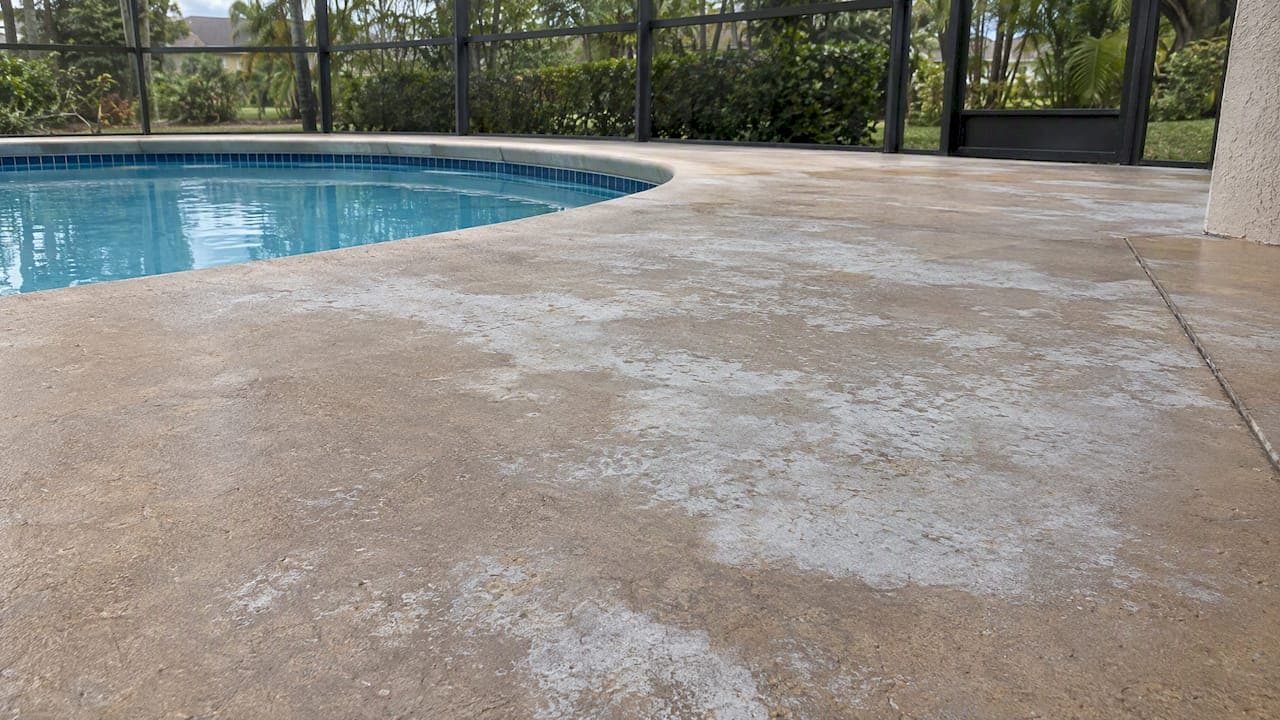
When pool deck sealer turns white, hazy or milky, the cause is almost always moisture trapped in or under the sealer film. Whether you can fix it depends on how fast you catch it and why it happened. A caught-early case can sometimes be reversed with a solvent wash. A thick, puddled or peeling case means stripping the deck and starting over. Sealing on top of white sealer fixes nothing.
This guide shows you how to diagnose what you have, what to try first, when to stop trying and call a professional, and how to reseal a Central Florida deck so it stays clear.
TL;DR
- Whitening (also called blushing) is trapped moisture. It shows up as cloudy or milky patches, often a few days after sealing or after heavy rain.
- White, powdery crust that wipes or brushes off is likely efflorescence (mineral salts), not sealer whitening. The two need different fixes.
- A solvent wash can sometimes clear early whitening. Puddled, over-applied, peeling or efflorescence-related cases usually need full stripping.
- In Central Florida, seal between October and April, in thin coats, over a thoroughly cleaned and dry deck, with a breathable sealer and a slip-resistant additive.
- Never seal over the white. Fix the root cause first or it comes back.
Table of Contents
- What sealer whitening actually is
- Is it whitening or efflorescence?
- The most common causes on Florida pool decks
- What to do first: a decision path
- Can a solvent wash fix it?
- When you need full stripping
- How to reseal so it stays clear
- Does the deck material change anything?
- Our perspective on whitening
- Fixing a white deck with Mr. Pool Screen
- Quick prevention checklist
- FAQ
- Sources
What sealer whitening actually is
A sealer is a thin film or a penetrating treatment that sits in or on the concrete. Film-forming acrylics can trap water vapor. If moisture is inside the film or beneath it when it cures, or moves up from the slab afterward, the film clouds. Technical guidance from a concrete sealer supplier describes two main reasons recently applied sealer turns white, and both involve moisture.
Florida makes this worse. High humidity, daily rain and a shallow water table keep vapor moving through slabs. A Florida sealing guide explains that moisture trapped by non-breathable sealers, or sealer applied too thick, can't evaporate and leaves milky, hazy spots. Solvent-based products behave like a sheet of plastic over the surface. Water-based, microporous products let that vapor escape.
A pool deck is a harder environment than a driveway. It is wet almost every day, it gets splashed with chlorinated or salt-chlorinated water, and it takes direct sun. That is why the same product that looks fine on a garage floor can cloud over beside a pool.

Is it whitening or efflorescence?
Before you buy anything, work out which problem you have. They look similar from across the yard.
| Sign | Sealer whitening (blushing) | Efflorescence |
|---|---|---|
| Look | Cloudy, milky, hazy film; the concrete color looks washed out | White, chalky or crystalline powder or crust |
| Feel | Smooth, sometimes tacky or peeling at edges | Gritty, powdery |
| Wet it | The haze often stays or looks the same | Salts may darken or partly dissolve, then return as it dries |
| Brush it | Does not brush off | Dry stiff brush removes much of it |
| Cause | Moisture trapped in or under the sealer film | Minerals carried to the surface by water |
A Florida sealing guide notes that efflorescence, a white powdery deposit of salts, is often mistaken for sealer whitening, and the two conditions need different remedies. If you suspect salts, read our walkthrough on brushing off pool deck efflorescence before reaching for acid. Acid on a sealed, whitened surface can make things worse.
A quick test: scrub a small patch with a dry stiff brush. If white dust comes off, you are looking at efflorescence, possibly under or through a failing sealer. If nothing comes off and the haze is in the film, it is whitening.
The most common causes on Florida pool decks
Moisture in the slab or in the air at application
If the deck was damp, or the dew point was close to the air temperature, water gets sealed in. Morning dew, a sprinkler cycle or yesterday's storm is enough.
Sealer applied too thick
This is the cause we see most often in DIY jobs. Industry guidance is blunt: sealer must be applied in thin coats, and over-application can cause numerous problems. Puddles in low spots and around drains and texture dips are the usual culprits, because thick film can't cure and can't let moisture out. The Decorative Concrete Council's sealer guide gives typical coverage of roughly 200 to 400 square feet per gallon and advises brushing or rolling out excess right away. More material does not buy more durability. It buys a higher chance of whitening.
Wrong season and wrong time of day
Summer sealing in Florida goes wrong more often than people expect. One Florida contractor's guide says the best window is October through April, and that summer humidity and heat cycles can cause fast sealer failure. The same source notes that surface temperatures above 130°F flash-dry the sealer, trapping air and moisture that show up as bubbles and haze. The ASCC guide gives an application surface temperature range of 50°F to 90°F. A dark deck in July afternoon sun is far outside it.
A non-breathable or high-solids product
For pool decks, a breathable, low-solids sealer is generally the better choice than a high-solids film-former, because high-solids products can be slippery when wet and are prone to trapping moisture in damp poolside conditions.
Sealing over an old, unknown sealer
Re-sealing is riskier than sealing bare concrete. If the new product is not compatible with what's already there, the new coat can turn white or peel. Professionals typically test adhesion first, for example with a cross-hatch tape test, before committing to a full coat.
A dirty surface
Oil, mildew, sunscreen residue and old chemical film stop the sealer from bonding. Restoration pros often say cleaning is most of the job, and one Florida pool deck guide makes the same point: you can't fix a dirty deck by sealing it.
What to do first: a decision path
- Note when it happened. Whitening within a few days of sealing is a different situation from white patches that have been there for a year.
- Brush-test for efflorescence. See the table above.
- Check for peeling and puddling. Run a fingernail across a white area. If the film lifts, flakes or feels thick in low spots, a solvent wash will not save it.
- Check the weather. Do not attempt any repair while the deck is damp or rain is expected.
- Decide: wash or strip. The rules are below.
Can a solvent wash fix it?
Sometimes. Industry guidance says a solvent wash, typically with xylene, can reopen a solvent-based acrylic sealer so trapped moisture escapes, but only if the problem is caught early. The window usually cited is within about 48 hours. It is a fix for a fresh solvent-based acrylic with a moisture problem. It is not a fix for:
- Over-application or puddled sealer
- Peeling or delaminating film
- Efflorescence under the film
- Water-based sealer that has fully dried. The NAHB's guide on water-based sealers notes that the dried film can't be re-dissolved in water and resists other solvents
Xylene is flammable and gives off hazardous vapors. Around a pool, with people, pets, landscaping and a screen enclosure nearby, this is a job for a trained applicator wearing proper respiratory protection, not a weekend experiment. Read the sealer maker's technical sheet and the solvent's safety data sheet before anyone opens a can.
When you need full stripping
Stripping is the answer when:
- The white is old, widespread or has been through several rain cycles
- The film is thick, uneven or peeling
- A solvent wash has been tried and the haze returned
- You do not know what is on the deck and compatibility is uncertain
Stripping removes the failed film with a chemical stripper, followed by rinsing, mechanical cleaning where needed, and drying time. The deck must then be fully dry, and any efflorescence dealt with, before anything new goes on. Homeowners should never seal over existing whiteness without first addressing the root cause. Otherwise it will return.
How to reseal so it stays clear
Choose the right product for a pool deck
- Breathable and low-solids. Water-based, microporous or penetrating products let vapor out. Penetrating sealers do not form a surface film and so don't blush the same way, but they also don't add color enhancement or sheen.
- Chemical resistance. Chlorine is a strong oxidizer and salt systems add to the load. A Central Florida paver and pool-surround cost guide lists chlorine splash and salt-chlorine residue among the added stresses on pool decks.
- Slip resistance. Add a slip-resistance additive to the final coat. Look for products rated to recognized safety standards for wet, barefoot areas. If your deck is already slick, see our guide to fixing a slippery pool deck.
- Finish. Natural-look, satin and gloss all exist. Gloss shows moisture problems most and is the slipperiest when wet.
Prepare the deck
- Remove furniture, planters and mats, and cover plants, screens and the pool surface.
- Degrease and clean thoroughly. Remove mildew, oils and any old film that is failing.
- Treat or brush off efflorescence first.
- Let the slab dry fully, usually days, not hours, in Florida humidity.
- Test a small corner for adhesion and appearance before coating the whole deck.
Apply it right
- Work October through April when possible, in early morning or when the surface is within the manufacturer's temperature range.
- Check the forecast: no rain, and no dew-point squeeze during curing.
- Apply thin, even coats by roller or sprayer with back-rolling. Eliminate puddles immediately.
- Mix the slip-resistance additive into the final coat only.
- Keep people and pets off until the technical sheet says the film has cured.
Does the deck material change anything?
Yes. Concrete, pavers, stone, masonry and wood all behave differently. Natural stone such as travertine often does better with a penetrating sealer than a surface film, and our article on the three moves a contractor makes when sealing natural stone explains why. If your deck is stone, this guide on when to stain, seal or call a pro helps. For masonry, joints matter as much as the surface, as covered in our masonry pool deck coating guide. Wood has its own rules, laid out in our wood pool deck refinishing article.
If you are choosing between stain and paint after stripping, our comparison of deck paint and stain for Central Florida covers the tradeoffs, and this piece on chlorine and deck paint explains why breathable acrylics hold up better beside a pool.
Our perspective on whitening
Most white-deck calls we hear about start the same way: someone sealed in a hurry, in summer, over a deck that was not truly clean or dry, with a product built for something other than a wet pool surround. The sealer was rarely the only problem. The preparation was.

We approach pool decks the way we approach pool cages: restore what is there rather than tear it out, and do the unglamorous prep properly. That means careful cleaning, masking so nothing gets overspray or stains, and breathable, water-based coatings rather than a thick film that cannot exhale. Around a Florida pool, a coating that lets moisture out and keeps feet safe matters more than one that looks glossy on day one.
Our advice is to resist the urge to coat over a white patch to hide it. It will cost you twice. Find out why it whitened, fix that, then redo it once, correctly.
— Michel
Fixing a white deck with Mr. Pool Screen
If your deck has gone cloudy, or you want it cleaned, prepped and refinished without a repeat, our pool deck staining service covers concrete, wood, masonry and stone surfaces around Central Florida pools. If your screen enclosure is aging too, we handle that under pool screen restoration. You can also start from the Mr. Pool Screen homepage to reach us. Our pricing is quoted per job, so we do not publish a figure here. For a general idea of local ranges, see our Central Florida pool deck staining cost breakdown.
Quick prevention checklist
- Season: October to April for Central Florida
- Surface: clean, dry, free of oil, mildew and old failing film
- Product: breathable, low-solids, chemical-resistant, with slip additive
- Coats: thin and even, no puddles, within the coverage rate on the label
- Conditions: within the manufacturer's temperature range, no rain, no heavy dew
- Test: adhesion and appearance on a small patch first
FAQ
Why did my pool deck sealer turn white after rain?
Rain pushes moisture into and through the slab, and a non-breathable or over-applied film can trap it. The film then clouds as the vapor tries to leave. If it appears within a day or two of sealing, it may still be reversible with a solvent wash by a professional. If it has been there for weeks, expect to strip.
Will white sealer go away on its own?
Sometimes mild haze from surface moisture clears as the deck dries out and the film finishes curing. If it stays after several dry days, or you see peeling or thick patches, it will not resolve by itself and needs correction.
Can I just apply another coat over white sealer?
No. A new coat over trapped moisture or an incompatible film usually clouds or peels too. Address the cause first: wash, strip or dry out as the situation calls for.
What is the best sealer for a pool deck to avoid whitening?
A breathable, low-solids product, typically water-based or penetrating, applied thin in the cooler months, with a slip-resistance additive in the last coat. The right pick depends on the deck material and finish you want, so test a small area first.
Sources
- Sealing Brick Pavers in Florida: The Complete 2026 Protection Guide
- ASCC: Sealer Selection and Application Guide
- ASCC: Sealer Guide Trifold
- Concrete Sealing Guide for Florida
- Whitening or Blushing of Solvent-Based Acrylic Sealer
- Decorative concrete FAQ for homeowners
- Pool Deck Cleaning and Sealing in Florida
- NAHB: Water-Based Sealers, Guide to Successful Application
- Paver Sealing Orlando cost guide