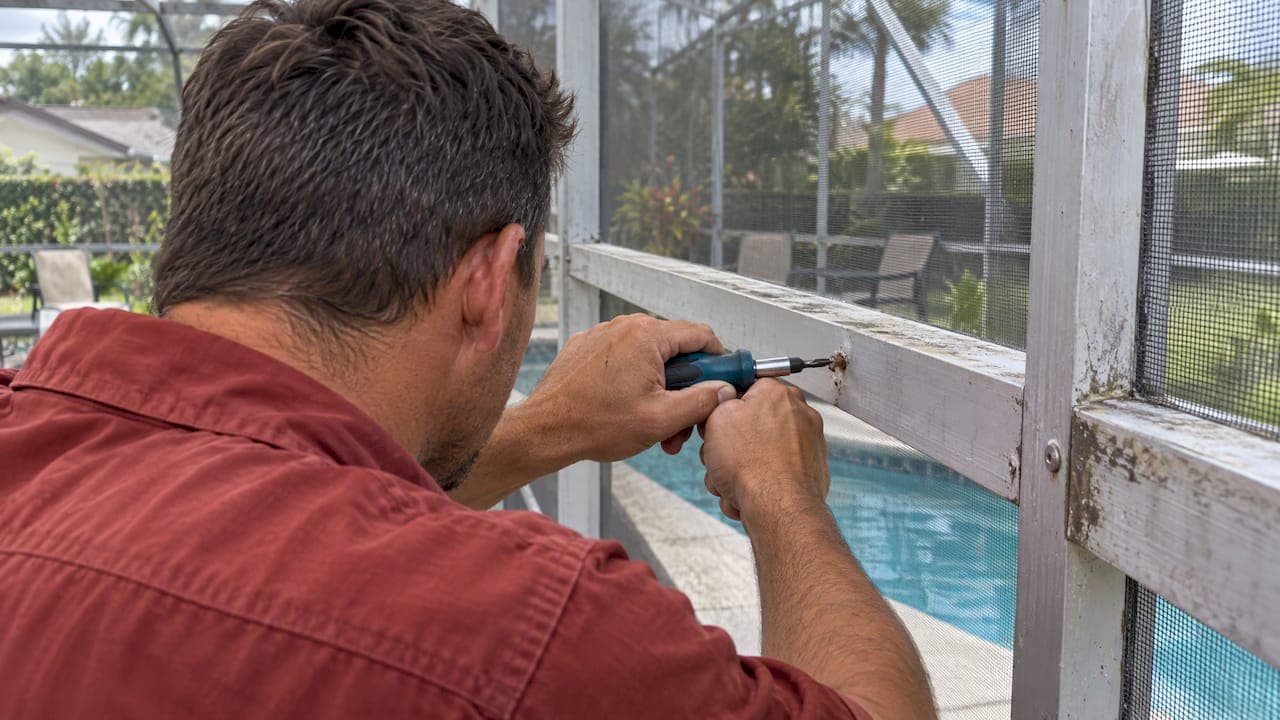
To remove a stripped pool cage screw, start with the gentlest grip: a wide rubber band or a wet-style grip aid on the head, a firm push, and a slow turn. If that fails, move to a screw extractor, then to drilling the head off. Go in that order. Each step is harder on the thin aluminum around the screw. A pool cage frame is not a piece of scrap wood, and the hole you save may be the one holding a roof panel in a 150 mph wind.
This guide covers the methods in the order to try them. It also covers the cases where you should stop, and what to install afterward so you aren't doing this again in three years.
TL;DR
- Try the least destructive method first: a rubber band over the head, a properly sized bit, firm downward pressure, low speed.
- For a head that is rounded off, a left-hand spiral extractor kit is the standard next step. Kits typically cost $15 to $30.
- If the screw is rusted into the aluminum, or it sits in a structural joint or an anchor, stop forcing it. Damage there can turn a $0.20 screw into a frame repair.
- Replace with 316 stainless or a coated fastener, and treat the hole, not just the screw. A stripped hole will not hold a new screw.
- If more than a few screws are stripped or rusted, the problem is the cage's age, not the screws.
Table of Contents
- Why pool cage screws strip in the first place
- Before you touch the screw: a quick safety and scope check
- Method 1: Add grip with a rubber band
- Method 2: Penetrating oil and patience
- Method 3: A screw extractor kit
- Method 4: Drill off the head
- When the screw is broken below the surface
- What to put back in the hole
- Perspective: why one stripped screw is rarely just one stripped screw
- Signs the screws are a symptom
- When to call a pro
- How we handle it
- Preventing the next stripped screw
- FAQ
- Sources
Why pool cage screws strip in the first place
Most stripped heads on a cage come from three causes: corrosion, a worn driver, and a screw that was overtightened when the cage was built or repaired.
Corrosion is the big one in Florida. Heat, humidity, salt air and pool chemicals attack the fastener, and once the head is pitted, the driver no longer seats. You then spin the bit and chew the recess. If the screw is a plain steel or low-grade stainless one, rust can also swell and bind it in the aluminum.
The second trap is the metal pairing. When stainless steel touches aluminum in a damp environment, galvanic corrosion can occur, and aluminum is the metal that loses. That article points to 316 stainless, which contains molybdenum, as the better choice in marine conditions. So a screw can seize not only from its own rust but from white aluminum oxide building up around it.
If you want the long version of how this develops, our guide to pool screen fastener failure signs shows what to look for before a head strips.
Before you touch the screw: a quick safety and scope check
Two minutes of looking saves hours.
- Find out what the screw does. A screw holding a screen spline cover or a kickplate is low stakes. A screw in a beam-to-post connection, a base plate or an anchor is structural. Do not experiment on those.
- Look at the neighbors. If the screws around it show rust streaks, white powder or lifted paint, you are dealing with a pattern. Florida pool cages are built for design wind zones of 150 to 170 mph, and that source notes a small rust spot can precede frame-wide oxidation or anchor failure. It recommends cataloging damage by type rather than replacing hardware one piece at a time.
- Plan your footing. Cage work often means a ladder on a wet, slick pool deck, next to water. Use a stable ladder on level ground, work with a second person nearby, and do not climb to the roof panels. If the screw is above comfortable reach from a ladder, that is a job for a contractor.
Method 1: Add grip with a rubber band
This works when the recess is only partly chewed. Lay a wide rubber band flat over the screw head, press your screwdriver or bit through it into the recess, and turn slowly with firm pressure. The rubber fills the gaps in the stripped recess and gives the bit something to bite. Lowe's lists this as the first step for ordinary stripped heads.
Tips that matter on a cage:
- Use the correct driver size. Many cage screws are hex-head or Phillips self-tappers, and a bit one size too small is the usual reason for stripping.
- Keep the drill off, or on the lowest clutch setting. Aluminum strips fast under a drill.
- Push harder than you turn. Most stripping happens because the bit climbs out of the recess.
If the screw moves even a quarter turn, back it out slowly. Often it frees up after that first break.
Method 2: Penetrating oil and patience
If the screw is seized rather than just stripped, a penetrating oil can help. Spray a small amount at the head, let it sit, then tap the head lightly with a hammer to help the oil creep into the threads and try again. The People Also Ask question about WD-40 is fair: it may help with light corrosion, but it will not fix a stripped recess. Treat it as a helper for the rubber band method, not a replacement. Wipe off any overspray so it doesn't stain the screen or deck.
Do not use heat on a cage. Aluminum conducts it quickly, and you can damage paint, screen mesh and spline near the fastener.
Method 3: A screw extractor kit
When the recess is gone, a screw extractor is the right tool. The kit pairs a drill bit with a left-hand spiral extractor. You drill a small pilot hole into the center of the head, then switch to the extractor, which turns counterclockwise and bites into the screw as you do. IRWIN describes its spiral design as built to remove broken studs and bolts, and a smaller single-size option such as the Century Drill & Tool spiral flute extractor is sized for small screws and comes with a matching bit.
How to use it on a small cage screw
- Center-punch the head lightly so the drill bit does not wander. Wander is how you end up drilling into the frame.
- Drill straight in at low speed, only as deep as the extractor needs.
- Tap the extractor into the pilot hole, then turn it counterclockwise with a tap handle or wrench, slowly and steadily.
- Stop if resistance spikes. A snapped extractor is harder to remove than the original screw because it is hardened steel.
For the small screws on a pool cage, choose the smallest bit and extractor that fit. A large extractor can expand a small screw and lock it tighter in the aluminum.
Method 4: Drill off the head
If the extractor fails, you can drill the head off. Use a bit slightly larger than the shank but smaller than the head diameter, and drill just enough to separate the head from the shaft. The piece you are fixing, such as a bracket or trim, then lifts away, and the leftover shank can be gripped with locking pliers and turned out. Lowe's describes this approach: when a screw is broken flush, expose the shank and grip it with locking pliers.
The catch: Lowe's guidance is written for wood. In aluminum, you cannot simply cut surrounding material away to expose the shank, because that material is your frame. Use this method only on non-structural parts, and stop if the shank is flush with a thin wall.

When the screw is broken below the surface
A screw snapped below the surface of aluminum, or rusted into a hollow extrusion, has no head to grip. Your options narrow:
- If you can still see a bit of shank, grip it with locking pliers and turn gently.
- If you cannot, use the extractor method on the shank itself, with a very small pilot hole.
- If the shank is tight and the metal around it is flaking, stop. Drilling blindly can open the hole, crack a thin wall, or hit the inner structure.
This is where DIY ends for many homeowners, and it should. A professional has the tools to re-tap, sleeve or through-bolt a damaged joint. A through-bolt is a common fix that a Reddit thread on stripped screws in a pool screen door suggests: drill clean through and use stainless machine screws with washers and locknuts, though that is for a door frame, not a structural joint.
What to put back in the hole
Removing the screw is half the job. If you drive an identical screw into an enlarged, corroded hole, it will strip again.
Your options, from simplest to most robust:
| Situation | Fix |
|---|---|
| Hole is slightly worn, still has thread | Next size up self-tapping screw in 316 stainless |
| Hole is stripped but wall is solid | Larger diameter screw, or a threaded insert sized for the metal |
| Hole goes through a double wall | Through-bolt with washer and locknut |
| Hole is cracked or oversized | Do not patch. Have a contractor evaluate the joint |
A few details that matter:
- Choose 316 stainless or a coated fastener rather than plain steel. Our walkthrough on using 316 for rusted pool cage screws goes into the grade choice.
- Clean the hole of aluminum oxide before installing. A wire brush or a small pick helps.
- Do not overtighten. Snug is enough. Overtightening is a common reason holes strip again.
- Use a barrier. A thin film of anti-seize or a nylon washer between dissimilar metals slows the galvanic reaction described above.
If you are dealing with loose bolts rather than stripped screws, see our code-aware guide to loose pool enclosure bolts for what you can safely tighten yourself.
Perspective: why one stripped screw is rarely just one stripped screw
We restore aging pool enclosures in Central Florida, and the pattern we see is consistent. A homeowner calls about one screw that will not come out. We walk the cage and find forty more in the same condition.
Fasteners are the cheapest part of a cage and the most overlooked. They age at the same rate as the paint and the screen, in the same sun and the same pool-chemical air. By the time one head is rusted solid, its neighbors are usually on the same path. That is why we replace fasteners as part of a restoration with stainless steel or Nylotech hardware, rather than one at a time as they fail.

Our advice is practical. If it is one screw on a trim piece, use the methods above and be patient. If it is a screw in a beam connection, a base plate, or anything you would not want to see fail in a storm, do not experiment. If you find rust streaks across multiple posts, the cage is telling you something about its age, and restoring the structure typically costs far less than a full rebuild. In our work, restoration can save clients up to 60% compared to a rebuild.
We would rather you spend an afternoon with a rubber band than a weekend with a drill and a cracked extrusion. But we would also rather you call us before a storm than after.
— Michel
Signs the screws are a symptom
Check this list. If you tick more than two, the screws are not your real problem.
- Rust streaks running down from fasteners onto the frame or the deck
- White, chalky powder on the aluminum around screw heads
- Paint bubbling or lifting around fasteners
- Screws backing out of the frame or sitting proud
- Base plates or anchors with visible rust or flaking concrete
- Screen panels sagging at the spline or loose in the frame
Our guides on pool screen frame corrosion, frame rust removal and anchor rust explain each in more detail. The aging pool enclosure repair checklist helps you document what you find, which is also useful when you talk to a contractor or your insurer. If you are thinking about storm resilience, read about pool enclosure wind mitigation.
When to call a pro
Call a contractor if any of these are true:
- The screw is in a structural joint, base plate or anchor
- It is high enough that you would need to stand on the cage or an unstable ladder
- The extractor has snapped or the hole has widened
- You find cracked aluminum or heavy flaking
- More than a handful of screws are stripped or rusted
Hiring early is cheaper. A stripped screw you hand off today is a fastener swap. The same screw after a failed drilling attempt can become a frame section replacement.
How we handle it
If your cage has multiple rusted or stripped fasteners, our pool screen restoration service covers the whole structure in Central Florida: rusted fasteners replaced with stainless steel or Nylotech hardware, frame repainted with water-based acrylic coatings, and re-screening with the mesh type you choose. We mask carefully to avoid overspray and stains, and the work carries a three-year warranty. If the deck around the cage is also weathered, we also do pool deck staining. You can reach us through Mr. Pool Screen for an assessment.
Preventing the next stripped screw
- Use the right driver, matched to the head, and replace worn bits.
- Install fasteners in a stainless grade suited to the coastal and pool environment.
- Avoid overtightening. Lowe's also suggests lubricating long screws with beeswax to reduce binding, though that tip is for wood screws of 2-1/2 inches or longer and is not designed for cage hardware.
- Rinse the frame with fresh water periodically to remove salts and chemical residue.
- Inspect fasteners every year, especially after storm season. Our weather damage prevention tips cover a simple routine.
For a bigger picture of your options, see screen enclosures: restore, upgrade and protect.
FAQ
How do you unscrew a badly stripped screw on a pool cage?
Start with a rubber band over the head and a correctly sized bit, pressing hard and turning slowly. If that fails, drill a small pilot hole in the head and use a left-hand spiral extractor. Stop if the screw is in a structural joint or if the aluminum around it is cracking.
How do you replace pool cage screws?
Remove the old screw, clean the hole of oxide, and install a 316 stainless or coated screw sized to bite fresh metal. Snug it without overtightening. If the hole is worn out, use a larger screw, an insert or a through-bolt, depending on the wall.
What if a screw won't unscrew at all?
First check whether it is seized by corrosion or just stripped. Penetrating oil and a light tap can help a seized screw. If it still does not move, stop forcing it, because the next step in aluminum is drilling, and that is where frames get damaged.
Will WD-40 loosen a stripped screw?
It can help free a screw that is stuck from light corrosion, but it does nothing for a damaged recess. Pair it with a rubber band or an extractor, and wipe off overspray so it doesn't mark the screen or deck.
Sources
- How to Remove a Stripped Screw | Lowe's
- IRWIN 10-Piece Spiral Screw Extractor and Drill Bit Combo Pack | Lowe's
- Century Drill & Tool 73501 Spiral Flute Screw Extractor | Lowe's
- Pool Screen Enclosure Repair in Florida
- Can Stainless Steel Fasteners Be Used with Aluminum?