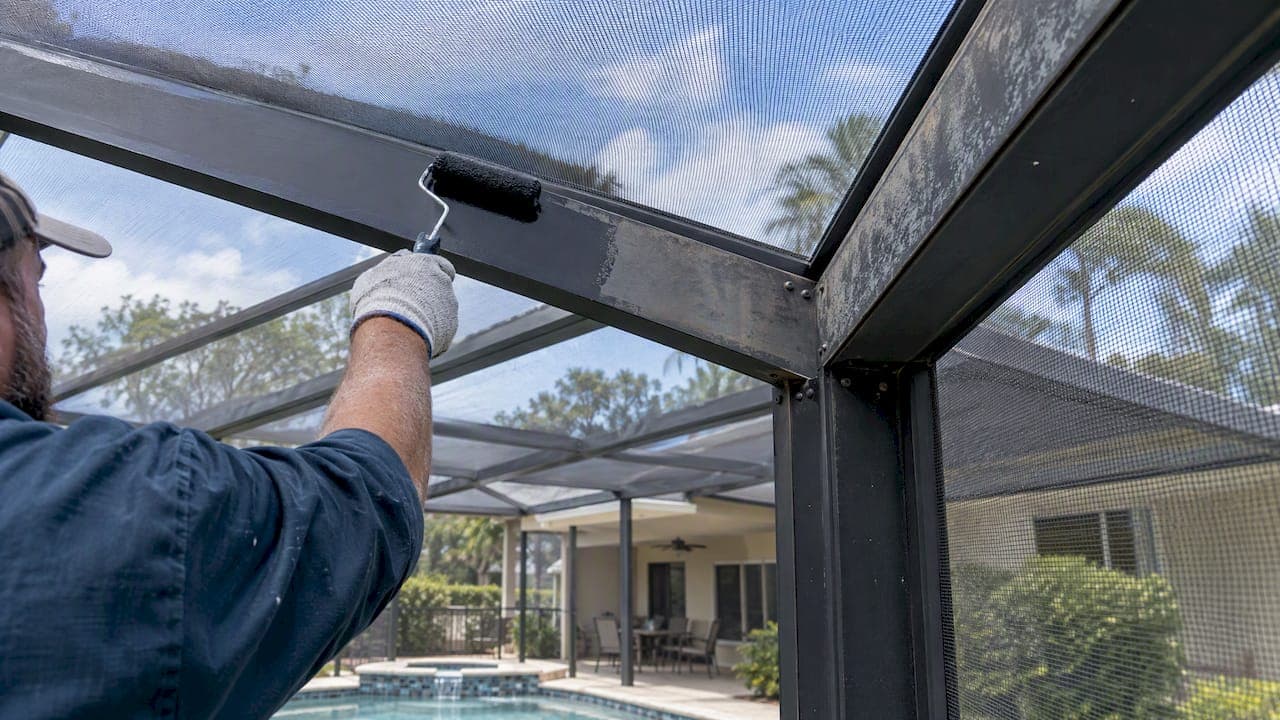
Yes, a pool cage can be painted with the screens still on. A crew masks the mesh and sprays the frame. The catch is that the paint has to reach the spots the mesh covers, which are the channels, the spline lines and the joints where rust usually starts. Painting around intact screens is a compromise. It can work on a cage whose screens are new and whose aluminum is in good shape. On an older cage it often leaves the weakest areas untreated.
Below, we explain how screen-in-place painting works, where it falls short, what it costs, and how to decide between it and a full restoration.
TL;DR
- Painting with the screens in place is possible, but the mesh and spline hide the frame surfaces that most need prep and coating.
- It makes the most sense when the screens are new or in good condition and the frame has chalk or fading, but no real rust.
- If the screens are more than about 10 years old, are sagging, or the frame shows rust at fasteners and joints, removing the screens costs less over time.
- Repainting typically runs $1.50 to $2.50 per square foot, while full replacement starts above $6,000.
- Ask any contractor how they handle rust, fasteners and masking, and what the warranty covers.
Table of Contents
- How painting with the screens in place works
- When painting around the screens is reasonable
- When you should take the screens off
- Why prep decides whether the paint lasts
- What paint to use
- What it costs
- A quick way to decide
- Our perspective
- Questions to ask any contractor
- Restoration with Mr. Pool Screen
- FAQ
- Sources
How painting with the screens in place works
A pool cage is an aluminum frame with mesh held in each opening by a rubber spline pressed into a channel. To paint the frame the usual way, the crew pulls the spline, takes out the mesh, preps and coats every surface, then installs new screening.
The screens-in-place method skips that. The crew cleans the visible frame, then masks the mesh with tape, plastic or paper, and sprays the exposed surfaces. Some also use shields held against the mesh as they work.
Three things follow from this:
- The spline channel stays unpainted. The mesh sits in that groove, so the aluminum underneath stays as it was.
- Prep is limited to what the crew can reach. Chalky oxidation, mildew and rust in the hidden edges stay put.
- Overspray risk is high. Fine paint mist passes through a screen. If the masking has gaps, it lands on the pool deck, the patio furniture, the windows and the neighbor's car.
Our article on masking gaps and overspray explains how one missed spot can leave marks on the deck.
When painting around the screens is reasonable
We would not tell every homeowner to remove the screens. This approach can be a sensible call in a narrow set of cases:
- You re-screened recently. If the mesh is only a few years old, tearing it out to paint the frame wastes good material.
- The frame is faded or chalky, not corroded. A cage that looks dull but has solid metal, no pitting and no rust streaks is a candidate for a refresh.
- You want a short-term cosmetic improvement. For example, you plan to sell soon, and the main goal is curb appeal.
The lifespan of the mesh matters here. According to this pool screen guide, fiberglass screens last about 10 to 15 years and polyester 20 to 30. If your screens are within a few years of the end of that range, you will be paying to re-screen soon anyway, and painting first with the mesh in place means you lose the chance to coat everything properly. If you are weighing materials, see our comparison of fiberglass and polyester screen.
When you should take the screens off
Removing the mesh is the better route when any of these apply:
- Rust at the fasteners or joints. Aging cages often have steel screws that have rusted and stained the aluminum. Painting over them hides the problem for a season or two. Rust bleed returns through new paint. We cover this in stopping rust bleed on a pool cage.
- Chalking paint. When you rub the frame and a white powder comes off on your hand, the old finish has broken down. Paint over loose chalk and it can fail to bond. Our guide to chalky pool cage paint shows how to check it in about 10 minutes.
- Old, sagging or torn screens. If the mesh is going to be replaced within a few years, do both jobs together.
- Heavy mildew or pollen buildup in the channels. The groove under the spline holds moisture in Florida's humidity.
- You want a warranty on the whole system. A warranty means more when the crew was able to prep and coat the entire frame.
A second reason to remove the screens is safety. A cage with corroded hardware is under load from wind. We recommend treating the structure as a system: the frame, the fasteners, the anchors and the mesh age together.
Why prep decides whether the paint lasts
Contractors in the field agree on one point: poor prep is the leading reason pool cage paint fails early. Chalk that was not removed, or rusted joints that were painted over, will cost you the finish. A Tampa pool cage painting contractor describes prep as the most labor-intensive part of the job, and the factor that most affects how long the coating lasts.
A proper prep sequence for an aluminum cage looks like this:
- Wash the frame to remove dirt, mildew and pollen.
- Remove chalk and loose coating, by cleaning agent or by abrasion.
- Treat rust and replace rusted fasteners.
- Rinse, let it dry fully, and mask everything you do not want painted.
- Coat with a product made for bare or weathered metal.
- Inspect for missed spots before the crew leaves.
With the mesh on, steps 2, 3 and 5 can only be done in part. That is the central trade-off.
Check the paint manufacturer's directions too. For example, Sherwin-Williams' product data sheet for one of its acrylic coatings lists surface preparation steps, including a warning that scraping or sanding old paint can release lead dust. If your home was built before lead paint was banned, tell your contractor.
What paint to use
For aluminum, specify a direct-to-metal (DTM) acrylic. These water-based industrial coatings bond to metal, resist UV and handle moisture. Examples from the Florida market include Sherwin-Williams Latitude and Pro Industrial DTM Acrylic, which are cited as formulated for metals and flexible enough for Florida's climate. Some can be recoated in as little as 4 hours under the right conditions.
Water-based acrylic also has an advantage for homeowners who want a greener option. It has less solvent odor than oil-based products and cleans up with water. Our post on spray painting a pool cage compares what a weekend DIY job can do against what a pro does when there is deep corrosion.

What it costs
Prices vary by size, access and the condition of the frame. These are national averages, not quotes:
| Item | Typical range | Source |
|---|---|---|
| Painting an aluminum cage | $1.50 to $2.50 per sq ft | Angi |
| Paint, as an added cost | About $46 per gallon | HomeAdvisor |
| Rescreening | $7 to $9 per sq ft | Angi |
| Full replacement | $6,200 to $15,475 | Angi |
The same Angi page says aluminum cages should be repainted every 5 to 10 years.
A worked example: a cage of 1,500 square feet would run roughly $2,250 to $3,750 to paint at those per-square-foot rates. Re-screening it at $7 to $9 would add $10,500 to $13,500. Sizes and conditions differ, so treat this as arithmetic on published averages, not a bid. The point: painting is a small share of the cost of a new cage. Re-screening is the larger line item, which is why many people want to skip it.
If the screens are still good, skipping it is fair. If they are near the end of their life, you are only postponing the larger bill, and you lose the ability to repair hidden corrosion in the meantime.
A quick way to decide
| Your situation | Likely best route |
|---|---|
| New screens, faded frame, no rust | Paint with screens in place, with careful masking |
| Screens 8 or more years old, frame chalky | Remove screens, prep, paint, re-screen |
| Rust streaks, stained fasteners | Replace fasteners, treat rust, paint, re-screen |
| Torn, sagging or brittle mesh | Re-screen as part of the project |
| Cage in poor structural shape | Get a structural assessment before any paint |
If you are not sure where yours falls, our guide on pool cage maintenance versus repair will help you sort cosmetic wear from real damage. You can also read how long a pool cage lasts in Florida.
Our perspective
We restore pool cages across Central Florida, and the question we hear most is whether the screens really have to come off. Our honest answer is that it depends on what is wrong with the cage.
What we see on older enclosures is rarely just faded paint. It is rusted screws, bleed stains running down the aluminum, chalked coating and mesh that has done its job. When a homeowner asks us to paint over all of that, we explain that the paint will look good for a little while and then the rust will come back through it. That is why we prepare carefully, replace rusted fasteners with stainless steel or Nylotech hardware, and coat with water-based acrylic made for metal.

We also understand the cost worry. Re-screening is a real expense. But a restoration still costs far less than rebuilding: we have seen it save homeowners up to 60% compared with a full rebuild. When we do it, we mask carefully so the deck and landscaping stay clean, and we back the work with a three-year warranty.
Our advice: do not decide on the method first. Decide on the condition of the frame, then pick the method that fits it. Ask for an adhesion test, a straight answer on fasteners, and a written scope. Our post on insisting on an adhesion test for a faded aluminum cage explains why.
— Michel
Questions to ask any contractor
Whether you choose screens in place or a full restoration, put these to every bidder:
- How will you handle rust, and will you replace the fasteners?
- What coating do you use, and is it made for metal?
- How do you mask the screens and the deck, and who pays for overspray damage?
- What does the warranty cover and for how long?
- Does the quote include the screens, or only the frame?
Vague answers to the first two are a red flag. Our guide on what pool cage upkeep involves can also help you set a maintenance rhythm afterward, and how long paint lasts in Florida sets realistic expectations.
Restoration with Mr. Pool Screen
If your cage is weathered or rusted, our pool screen restoration covers repainting with water-based acrylic coatings, replacing rusted fasteners with stainless steel or Nylotech hardware, and re-screening with a range of mesh types. If your deck also looks tired, we offer pool deck staining for concrete, wood, masonry and stone. To talk through your cage, start at mrpoolscreen.com.
FAQ
What is the best paint for a pool cage?
A direct-to-metal acrylic is the standard choice for aluminum. It bonds to metal, resists UV and tolerates moisture. Check that the manufacturer lists it for exterior metal and follow its prep directions.
How long does a pool cage last?
The aluminum frame can last 20 years or more with good maintenance. The screen mesh wears out sooner, about 10 to 15 years for fiberglass and 20 to 30 for polyester, depending on the material and sun exposure.
How much does it cost to paint and rescreen a pool cage?
Using national averages, painting runs $1.50 to $2.50 per square foot and rescreening $7 to $9, per Angi's 2026 cost data. Your total depends on cage size, frame condition and screen type, so get a written quote.
Can you paint an aluminum screen enclosure?
Yes. Aluminum takes paint well if it is cleaned, de-chalked and primed or coated with a product made for metal. Rust at fasteners has to be treated first, or it will bleed through the new finish.
Sources
- Pool Screen Enclosure Repair Cost, Angi
- How Much Does It Cost to Rescreen or Repair a Pool Enclosure, HomeAdvisor
- Pool Screen Enclosures: Cost and What to Know, Pool-Wise
- Sherwin-Williams product data sheet
- Pool Cage Painting in Tampa, FL, Westchase Painting